






About this worksheet
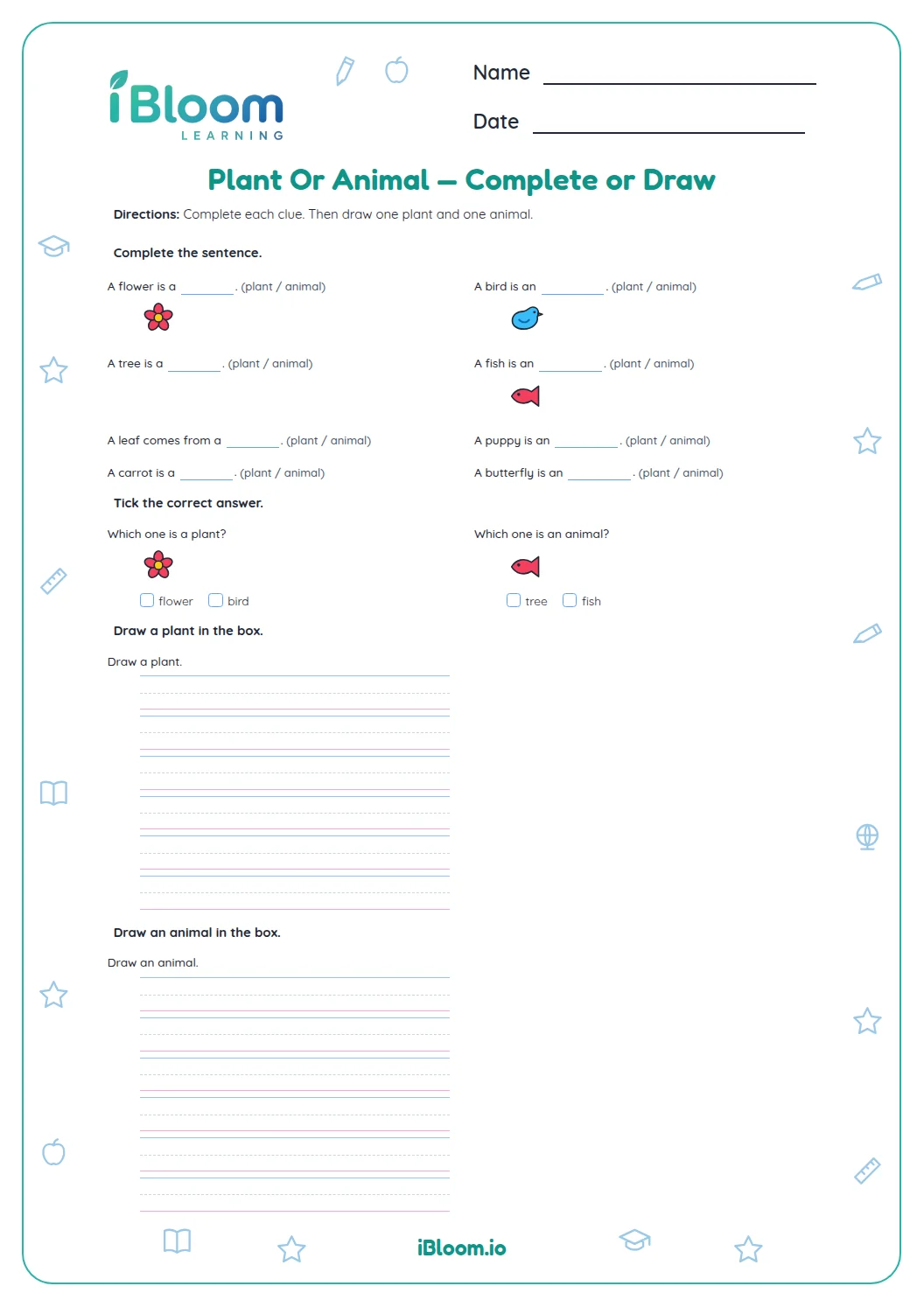
This printable plant-or-animal activity is designed for preschool and kindergarten learners. It has 10 picture-supported identification questions, four short word rows for circling plants and plant parts, and two draw-and-label prompts. Students sort familiar flowers, trees, pets, and other animals, then draw one plant and one animal. A separate key checks the choices and describes acceptable drawings.
How do children sort plants and animals?
Part A (1–8) identifies plants and animals from pictures. Part B (9–12) asks children to circle plant names and plant parts in short word rows. Part C (13–14) uses picture pairs, and Part D (15–16) asks for a labeled plant and animal drawing.
- Part A: picture identification
- Part B: circle plant words
- Part C: choose between picture pairs
- Part D: draw and label one of each
How can a child answer a picture question?
For question 1, look at the flower picture and choose “Plant.” A flower grows as part of a plant. For a bird picture, choose “Animal.” Encourage children to say the group name as they point.
- 1[pic:flower] Is this a plant or an animal?
- 2Answer: Plant
- 3A flower is part of a plant.
What should the drawings show?
For question 15, accept a recognizable plant labeled plant; for question 16, accept a recognizable animal labeled animal. The drawings can be simple.
How to use this plant and animal page
- 1Name the pictured object together before choosing its group.
- 2Ask whether it is a plant or an animal, then point to the matching word.
- 3For the pair questions, look at both pictures before choosing.
- 4On question 15, draw a plant and add the label plant.
- 5On question 16, draw an animal and add the label animal.
- 6Use the key to check choices and drawing labels.
Common plant and animal sorting mistakes
The mistake
Choosing animal for a flower because it is a living thing.
The fix
Living things include both groups; a flower is part of a plant.
The mistake
Calling a tree an animal because it is tall or old.
The fix
A tree grows leaves and stays rooted; it belongs to the plant group.
The mistake
Drawing a living thing but forgetting its label.
The fix
Point to the two group words and help the child copy the matching label.
What to practice next
Make more practice
Questions parents and teachers ask
What groups do children identify on this page?
Children sort familiar pictures into plants and animals, circle plant names and plant parts in four short word rows, and draw and label one example from each group. The questions include flowers, trees, leaves, a seedling, pets, and other animals.
Are pictures included for the identification questions?
Yes. Ten questions use picture clues, including flower, dog, tree, bird, seedling, cat, rose, fish, and picture pairs. Four more rows ask children to circle plant words, and the final two prompts ask for drawings. The picture choices do not depend on reading object names.
What should my child draw at the end?
Question 15 asks for a plant labeled “plant,” and question 16 asks for an animal labeled “animal.” The drawings do not need to be detailed. A simple recognizable example with the correct group label meets the prompt. The adult can accept different examples as long as each is recognizable and labeled.
How can I help a child who is unsure?
Ask what the pictured thing is called, then talk about what kind of thing it is. A tree grows leaves and is a plant; a dog is an animal. Offer the two printed group names and let the child point to a choice before saying it.
Is an answer key included?
Yes. The separate key marks the picture choices and explains what to accept for the drawing prompts. For the drawings, look for a recognizable plant or animal and its matching label; children may choose many different examples. The key also lets adults check the two drawing prompts without requiring one specific plant or animal.
How long does the activity take?
Plan for about 15 minutes, including the two drawings. Younger children may complete the picture choices with an adult reading each prompt, then draw and label one example from each group at their own pace. Pause between the choice questions and drawings if the child needs more time.