


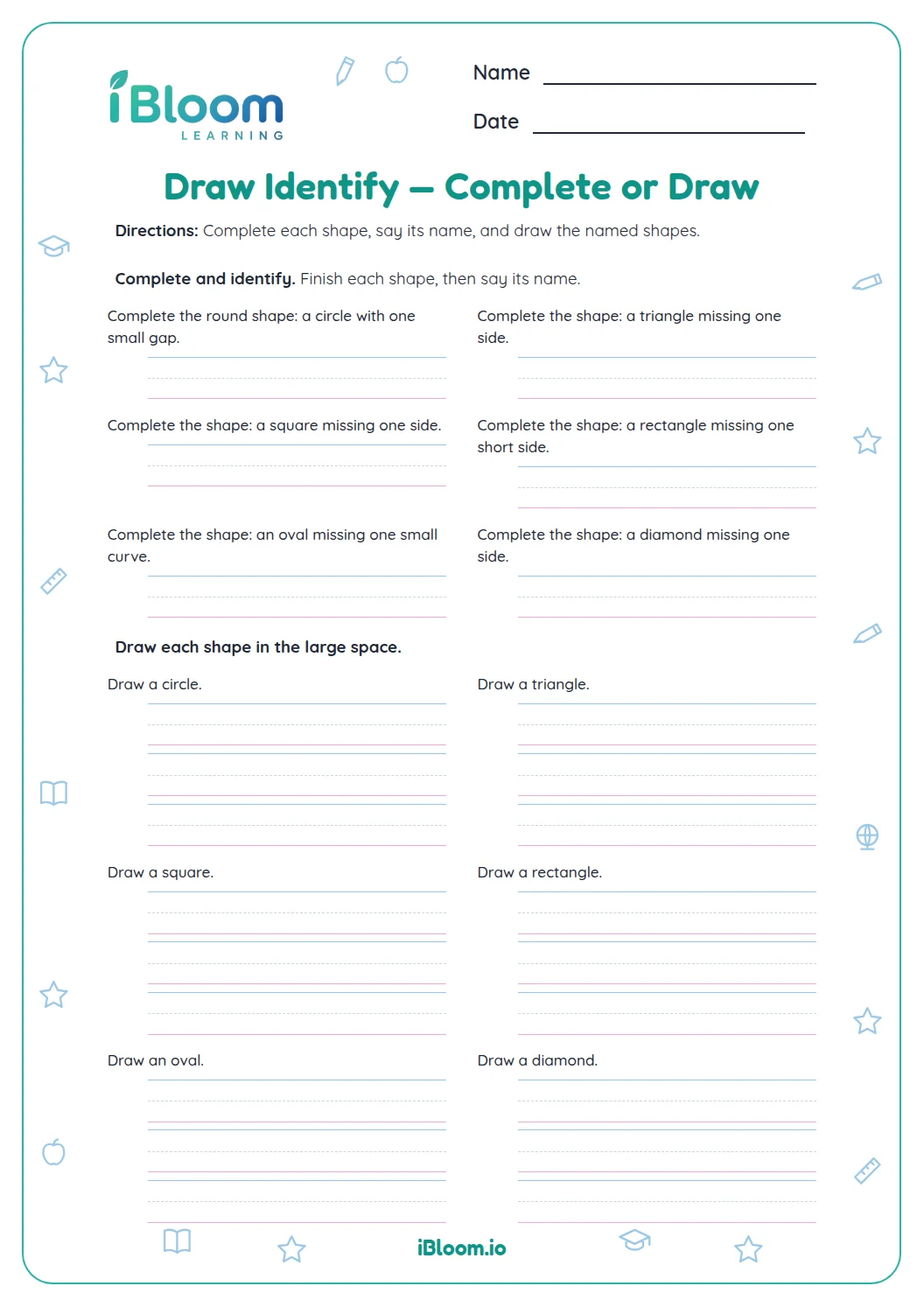


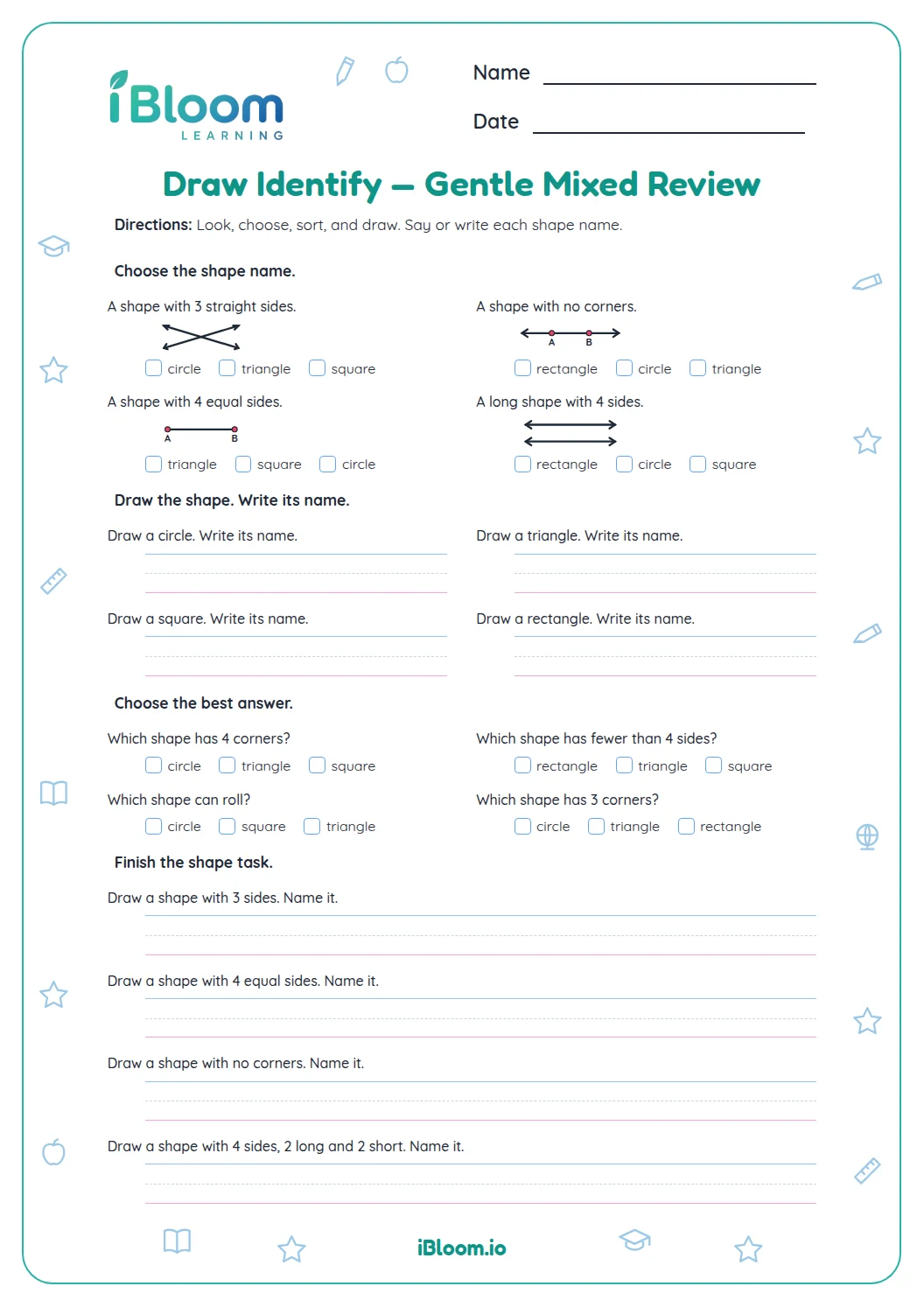
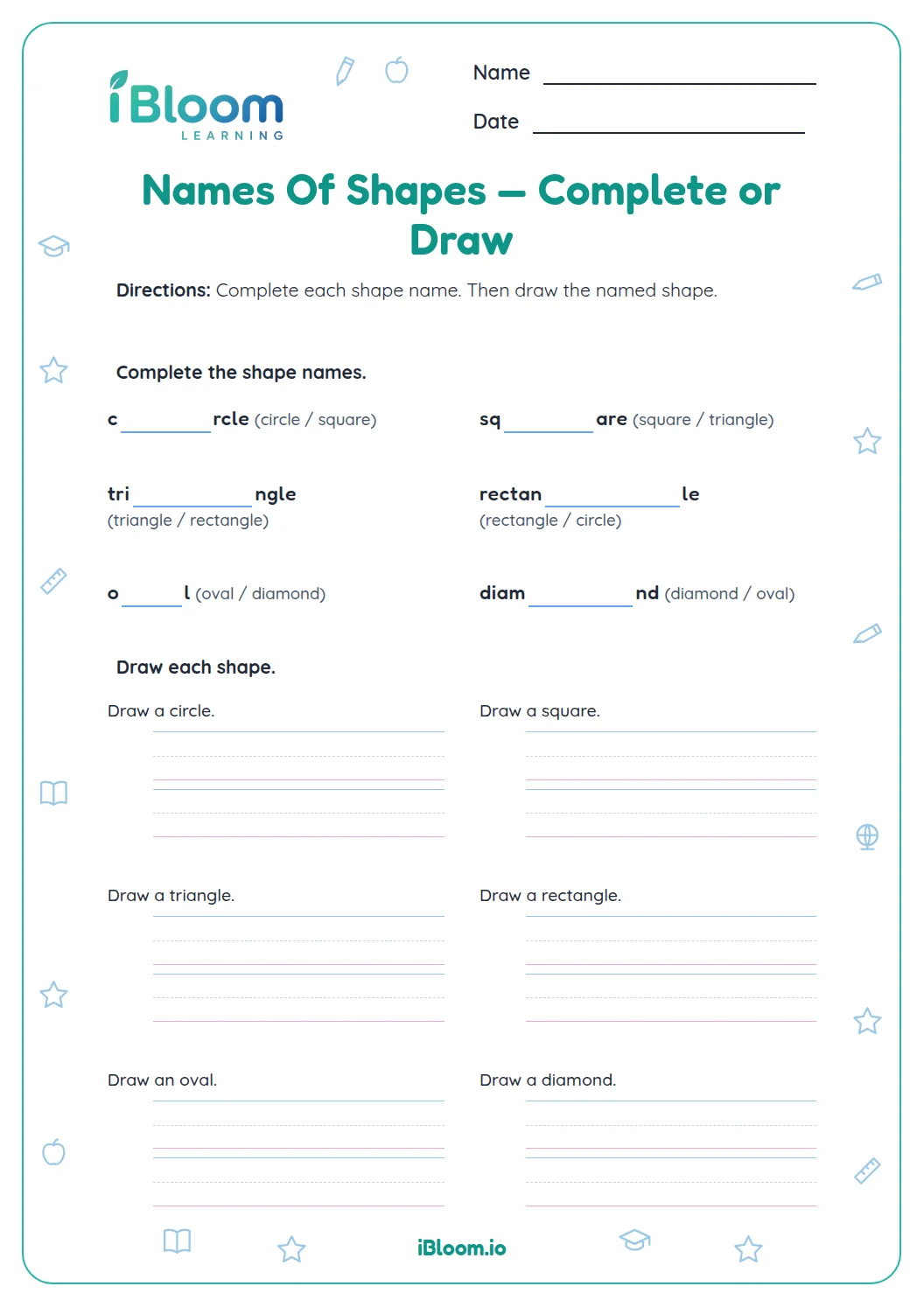
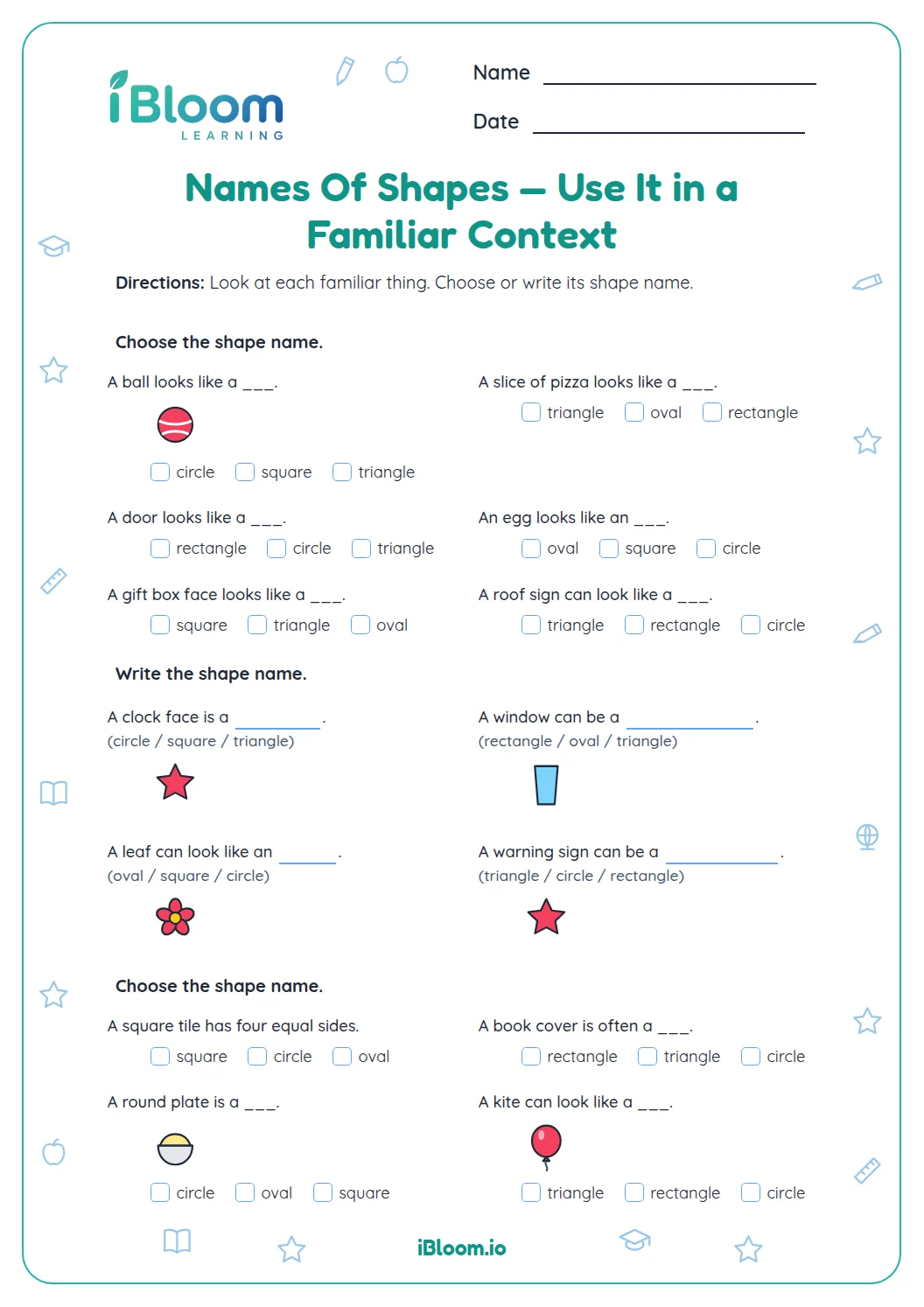

About this worksheet
This printable replaces the original color-the-shape prompt with practice that fits the Mirror Image title. Children draw familiar shapes and objects around a vertical line, making the main parts match on both sides. The drawing boxes leave room for large preschool and kindergarten marks. The answer key describes the intended matching result, since children can make many valid drawings.
How do children complete a shape across a line?
Part A asks children to draw familiar shapes centered on a vertical line, with matching sides. They create both halves and compare how each side relates to the line.
- 1A circle has matching curved sides on both sides of its center.
- 2A square has matching straight sides across its middle.
What pictures can children draw as mirror images?
Part B uses familiar pictures such as a butterfly, house, flower, and kite. Children place matching main parts on either side of a vertical line.
How can a child check whether the sides match?
Compare each side to the middle line. Ask whether the main parts sit at similar heights and distances from the line; exact artistic detail is not the goal.
How to use this worksheet
- 1Draw a vertical line in the box to use as the mirror line.
- 2Choose the shape or object named in the prompt.
- 3Place it around the line so its main parts match on both sides.
- 4Check that important parts appear on both sides.
- 5Praise careful looking and matching, not tiny drawing details.
Common mistakes and quick fixes
The mistake
Making the second side much larger than the first.
The fix
Compare how far each side sits from the center line.
The mistake
Putting a feature on only one side.
The fix
Check for matching parts on both sides, such as two wings or two eyes.
The mistake
Drawing across the middle line instead of beside it.
The fix
Treat the line like a mirror edge and keep each half on its own side.
What to practice next
Make more practice
Further reading
Questions parents and teachers ask
Why are the answers described instead of drawn?
Children can make many correct mirror images, so the answer key describes the matching feature to look for. A butterfly may have different colors or wing details and still be correct when its two sides match on both sides of a vertical line.
What should count as a matching side?
The main parts should appear on both sides at similar heights and distances from the center line. The drawing does not need perfect curves or identical tiny details; the aim is noticing and completing a balanced pair of sides.
Why does this version ask children to draw?
The old prompt asked children to circle a red shape, which did not practice mirror images. This version uses drawing boxes for children to create centered shapes and familiar pictures with matching sides around a line they draw.
Can a child choose what the final picture looks like?
Yes. The directions name a familiar subject or shape, but children can choose colors and small details. The left and right sides should still match in their main outline and placement, as though one side were reflected in a mirror.
How can an adult support a young child?
Point to the center line and ask the child to compare one side with the other. Simple prompts such as “Where is the other wing?” or “Does the roof reach the same height?” guide observation without drawing for them.