







About this worksheet
This free preschool and kindergarten worksheet uses familiar designs to practice naming shapes and continuing patterns. Part A has four shape drawings connected to a plate, cracker, flag and mat. Part B has six rows of shapes imagined as beads, tiles, flags, stickers, a quilt border and a party banner. Children say each row aloud and choose what comes next. All 10 questions include pictures, and the pattern questions use picture answer choices. Shape naming supports Common Core K.G.A.2. An adult can read the short directions and check responses with the separate answer key.
Aligned to K.G.A.2
How do familiar objects help with shape patterns?
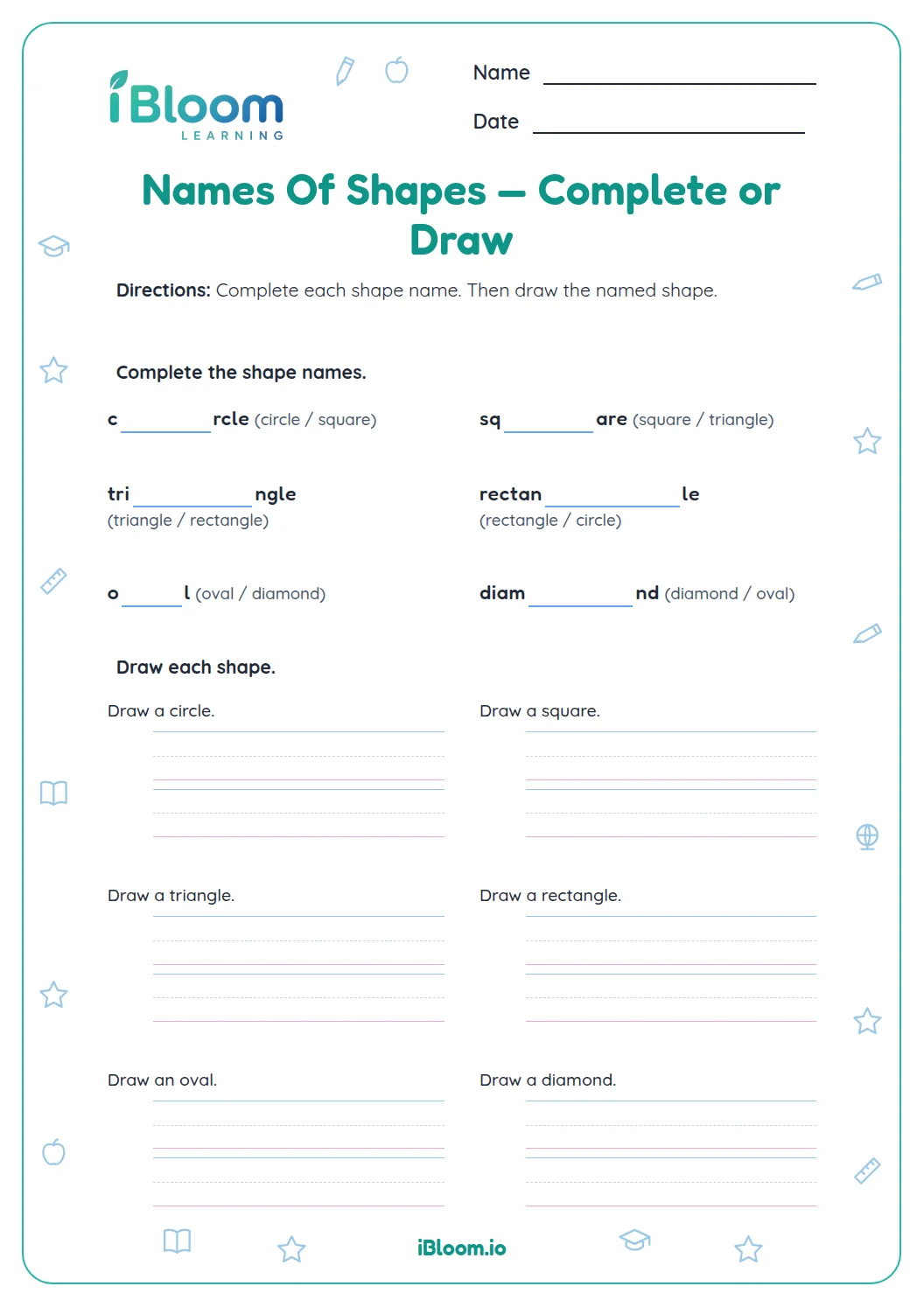
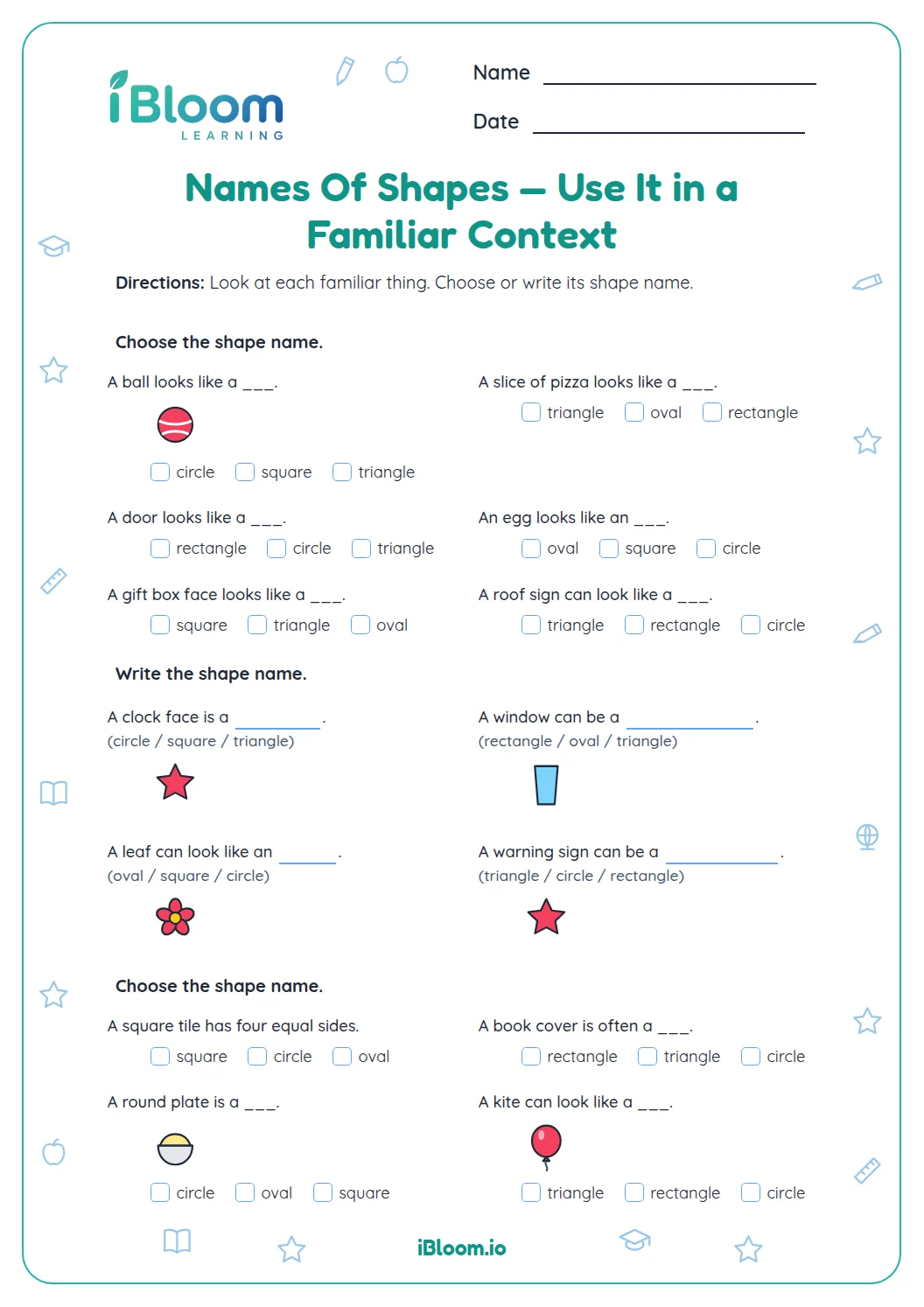
A plate can suggest a circle, a cracker a square, a flag a triangle and a mat a rectangle. Part A supplies a simple outline for each example so children can name the shape they actually see. Read the choices aloud if needed.
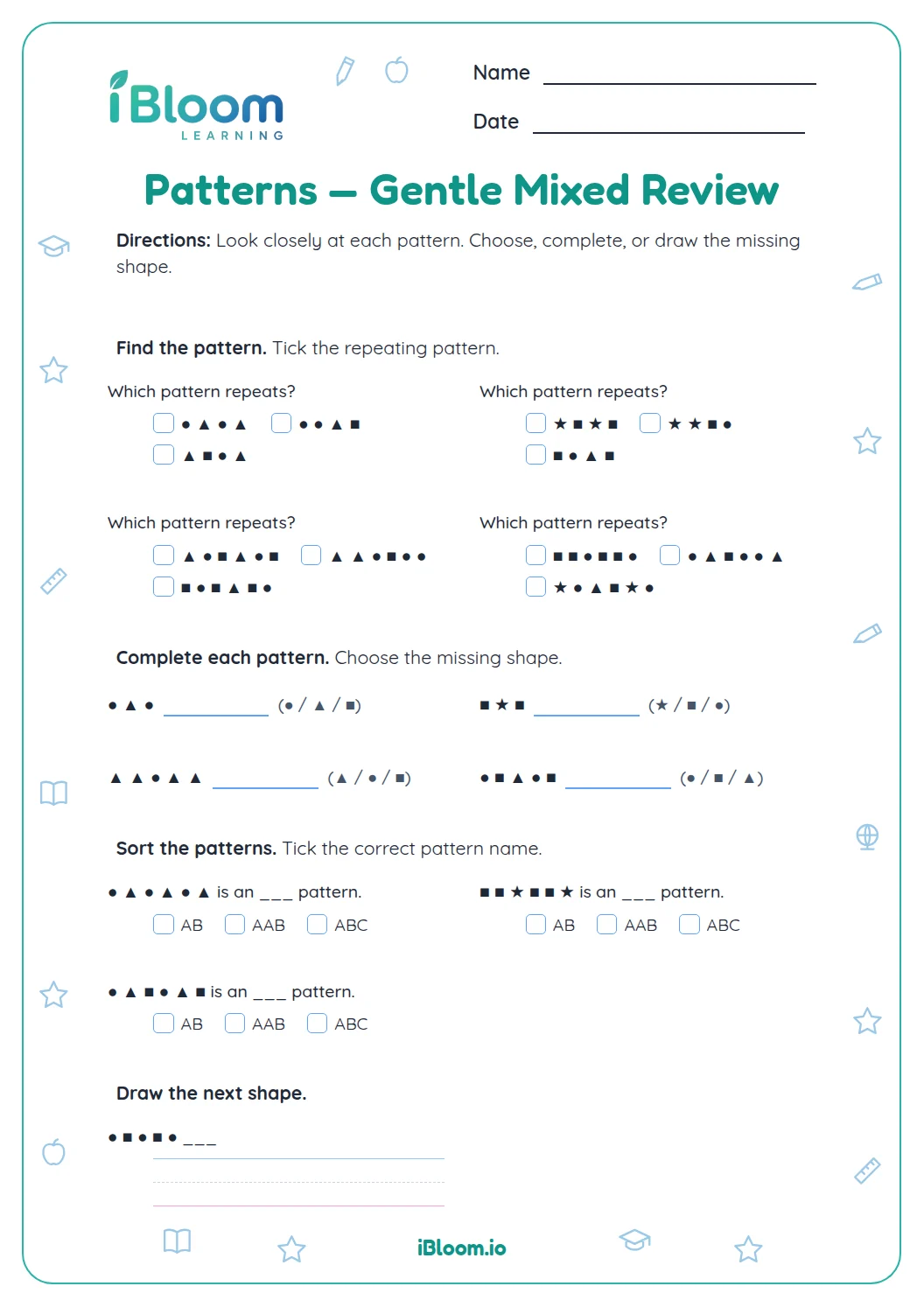
Part B uses the same shapes as parts of everyday designs. The rows are shape models for those designs; children focus on the order of the shapes.
How do you find the repeating group?
Point to each shape while saying its name. In question 5, the row is circle, square, circle, square, circle. Circle and square form the repeating group. After each circle comes a square.
- 1Beads: circle, square, circle, square, circle
- 2Repeating group: circle, square
- 3Say it again: circle, square | circle, square | circle…
- 4Choose the square picture.
What changes in the last two patterns?
The first four patterns in Part B alternate two shapes. Question 9 uses circle, triangle, square, then starts that group again. Question 10 repeats square, square, circle, so children must keep both squares together.
Allow children to touch each shape or use household objects to copy a row. A child who can name the repeating group has a way to explain the answer instead of guessing from the last shape alone.
How to use this worksheet
- 1Read the four object clues and have your child point to each shape before choosing its name.
- 2Say each pattern aloud from left to right.
- 3Find and repeat the smallest group of shapes that follows the same order.
- 4Ask your child to point to the next shape among the picture choices.
- 5Check with the key, then recreate one row with paper shapes or blocks.
Mistakes to notice and ways to help
The mistake
Choosing the last shape again in an alternating row.
The fix
Say the whole row aloud and pause where the next shape belongs.
The mistake
Treating square, square, circle as square, circle.
The fix
Tap twice for the two squares before saying circle; keep the repeated pair.
The mistake
Naming a triangle by how its point faces.
The fix
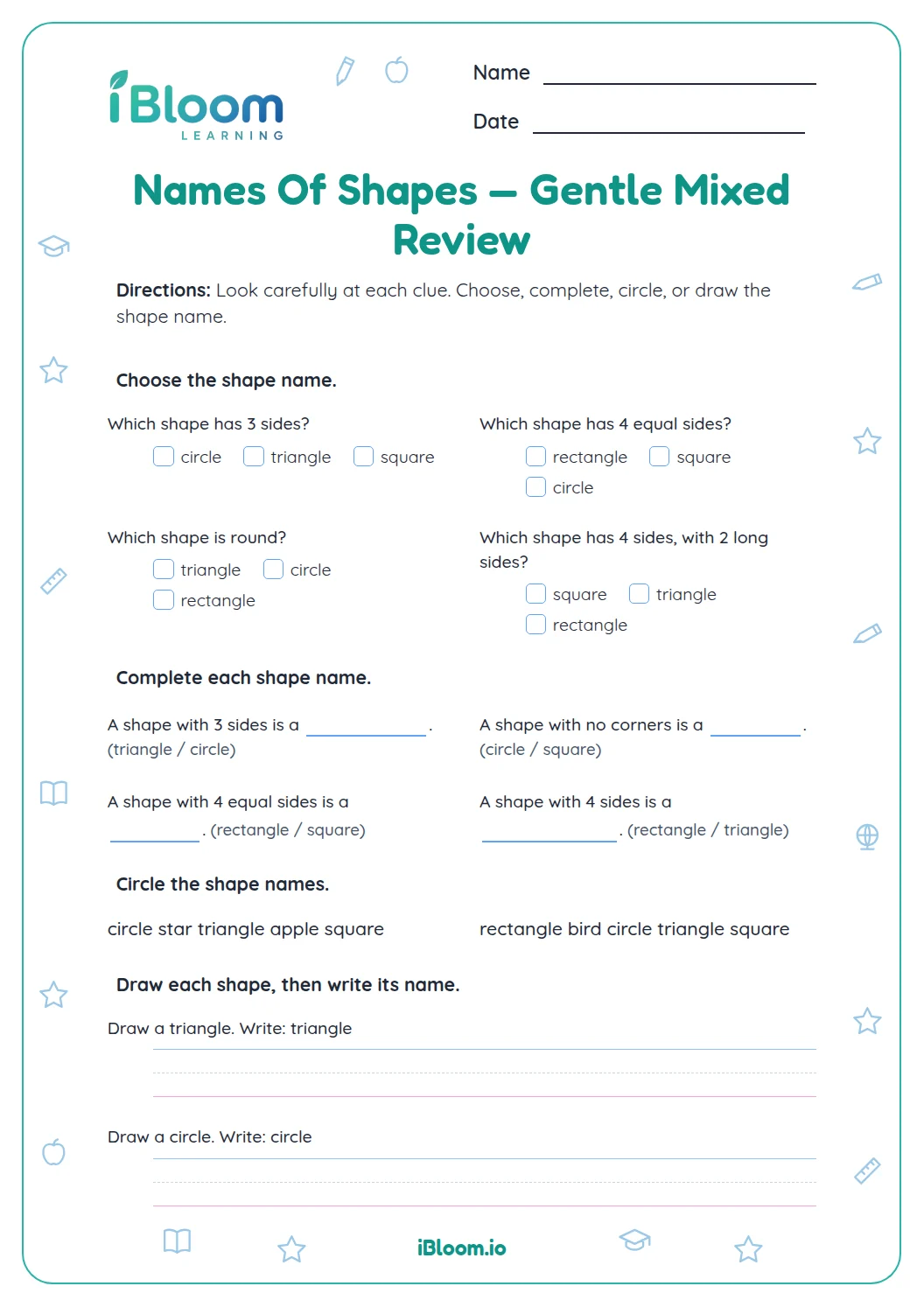
Count its three straight sides, then say triangle; turning it does not change the name.
Common Core alignment
Name circles, squares, triangles and rectangles in everyday shape activities.
On this sheet: Part A asks children to name four drawn shapes; naming the shapes also supports reading each pattern aloud.
Show the official wordingHide the official wording
Correctly name shapes regardless of their orientations or overall size.
What to practice next
Make more practice
Further reading
Questions parents and teachers ask
Does my child need to read the shape names?
No. An adult can read the names and directions aloud while the child looks at the drawings. Part A has word choices for naming shapes, and Part B has picture choices for continuing patterns. Ask your child to point first, then mark the selected answer bubble.
Which patterns are on the sheet?
There are six picture patterns. Four alternate two shapes. The quilt border repeats circle, triangle, square, and the party banner repeats square, square, circle. Each row stops partway through a repeating group, so children use the order to choose the single shape that should come next.
Can children use blocks while working?
Yes. Blocks or paper shapes can help children copy and continue each printed row. Use shapes that match the drawings and keep their order. After building the row, ask your child to add one piece and find the same shape among the worksheet’s picture choices.
Why does the party banner need another circle?
Its repeating group is square, square, circle. The printed row ends after the next pair of squares, so circle completes that group. Say “square, square, circle” together twice, pointing as you go. Keeping both squares in each group is the useful reasoning step in this question.
Can this worksheet be printed in black and white?
Yes. The answers depend on shape and order, so the outlines remain useful in black and white. Children distinguish circles, squares, triangles and rectangles by their forms. The answer key marks the correct choices; an adult can also name each selected shape aloud during checking.