







About this worksheet
This printable shape review is for preschool and kindergarten learners practicing how familiar two-dimensional shapes look. Fourteen activities include tracing dotted outlines, naming labeled shapes, and drawing a circle, triangle, and square. The worksheet replaces the old color-based activity with direct tracing and identification tasks. A separate answer key is included.
Aligned to K.G.A.2
How does tracing support shape recognition?
Following a dotted outline draws attention to straight sides, corners, and curved edges. In the first activity, children trace a circle, square, and triangle and notice how their outlines differ.
- 1Circle: curved edge
- 2Square: four straight sides
- 3Triangle: three straight sides
How can children name a shape in a row?
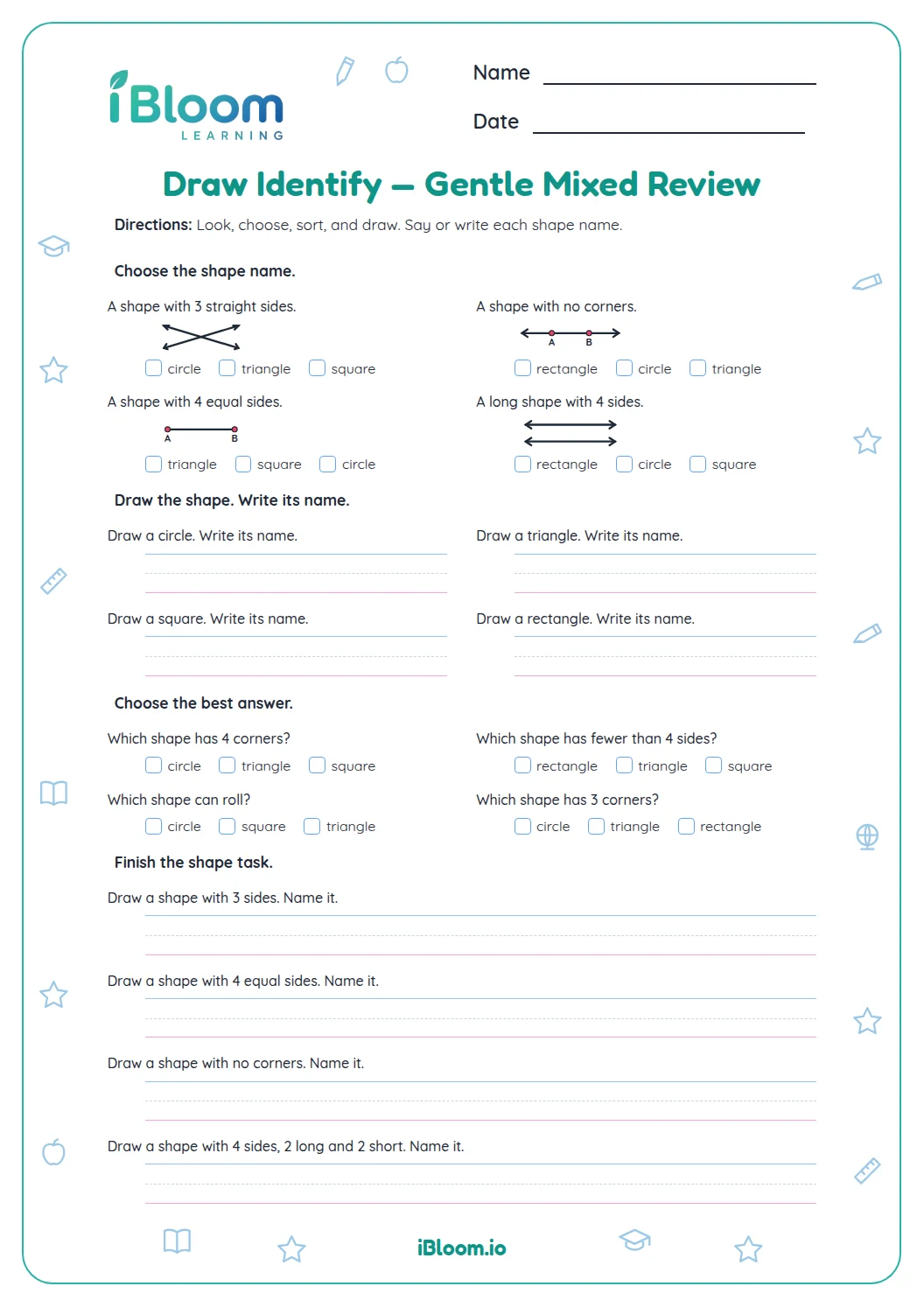
Look at the shape labeled A and say its name. Count straight sides and corners for polygons; a circle has a curved edge and no corners.
How can a child find a named shape?
Scan each shape in the row and match its outline to the requested name. Notice the overall shape rather than its size or position.
How to use this worksheet
- 1Trace each dotted outline slowly.
- 2Say the shape name as you follow its edge.
- 3For a labeled row, look at shape A first.
- 4For a find task, compare each outline with the named shape.
- 5Review the rows and name the shapes aloud.
Common mistakes and quick fixes
The mistake
Calling every four-sided shape a square.
The fix
Check whether its outline matches the named shape, including side lengths and corners.
The mistake
Confusing a circle and an oval.
The fix
Notice that both have curved edges, but their outlines have different proportions.
The mistake
Naming a shape by its direction.
The fix
Turn your attention to its sides and corners; its name stays the same when rotated.
This worksheet gives learners practice with the stated skill.
naming shapes regardless of orientation or size
On this sheet:
Show the official wordingHide the official wording
Correctly name shapes regardless of their orientations or overall size.
What to practice next
Make more practice
Further reading
Questions parents and teachers ask
What does this preschool and kindergarten shape worksheet include?
It has 14 activities: four tracing tasks, seven shape-naming questions, and three drawing prompts. Children trace circles, squares, triangles, rectangles, and ovals, then name labeled shapes and draw three familiar shapes. The worked examples use the same kind of quantities and relationships that appear in these questions, so learners can follow the reasoning and check a result.
Which shapes do children trace?
The dotted outlines include circles, squares, triangles, rectangles, and ovals. In question 1, children trace a circle, square, and triangle; later tracing questions combine other familiar outlines. The worked examples use the same kind of quantities and relationships that appear in these questions, so learners can follow the reasoning and check a result.
How do the labeled shape questions work?
Each question shows a row of labeled shapes and asks for the shape marked A. For example, in question 5 the first labeled shape is a circle, so the child names or selects circle. The worked examples use the same kind of quantities and relationships that appear in these questions, so learners can follow the reasoning and check a result.
What do the drawing prompts ask a child to draw?
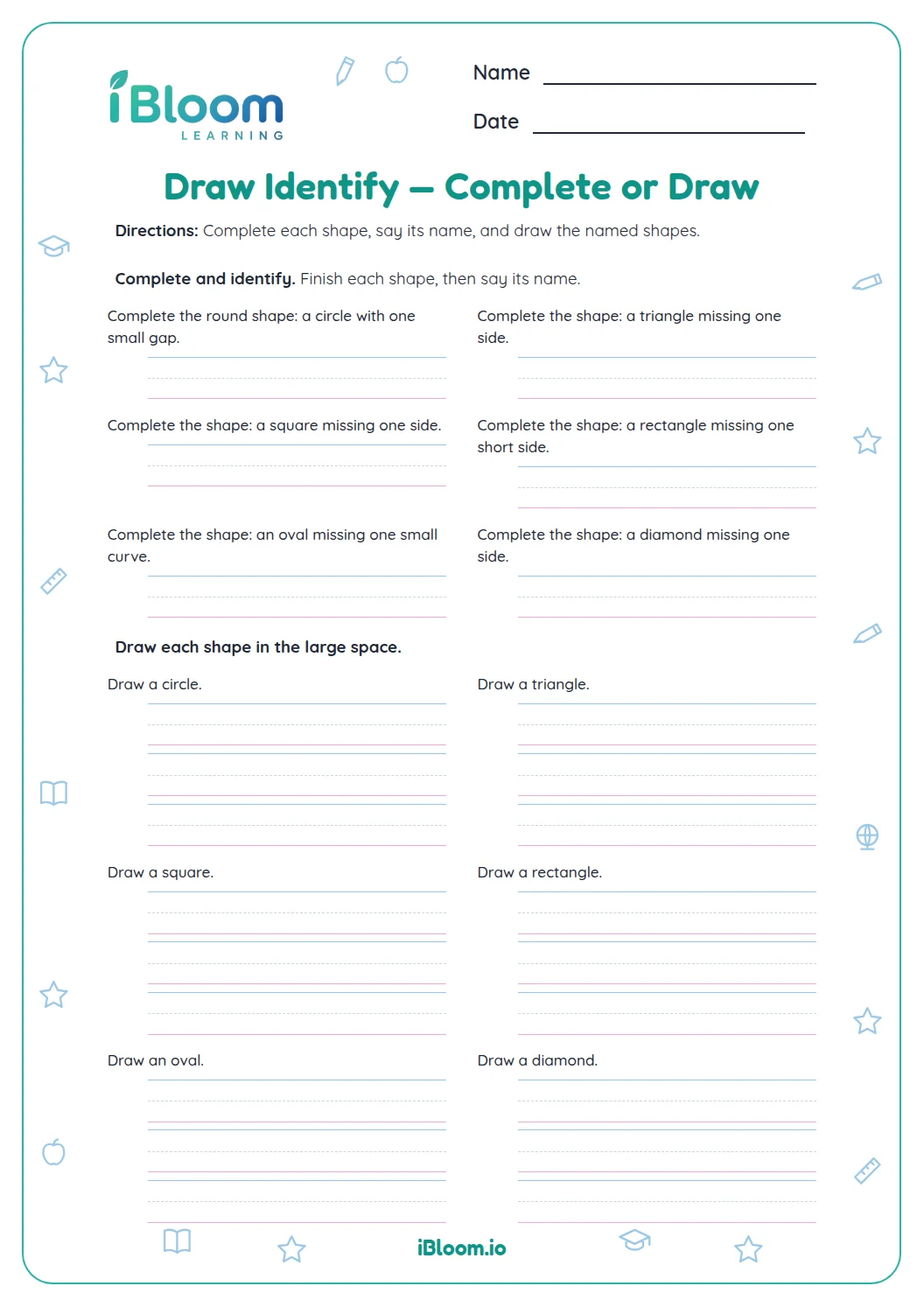
The last three questions ask children to draw a circle, a triangle with three straight sides, and a square with four equal sides. The answer key describes the features to look for in each drawing. Use the page to check each step.
Is an answer key included?
Yes. The separate key lists the names for the labeled shapes and describes the tracing and drawing activities. A parent or teacher can use it to talk about curved edges, straight sides, and corners. The worked examples use the same kind of quantities and relationships that appear in these questions, so learners can follow the reasoning and check a result.