








About this worksheet
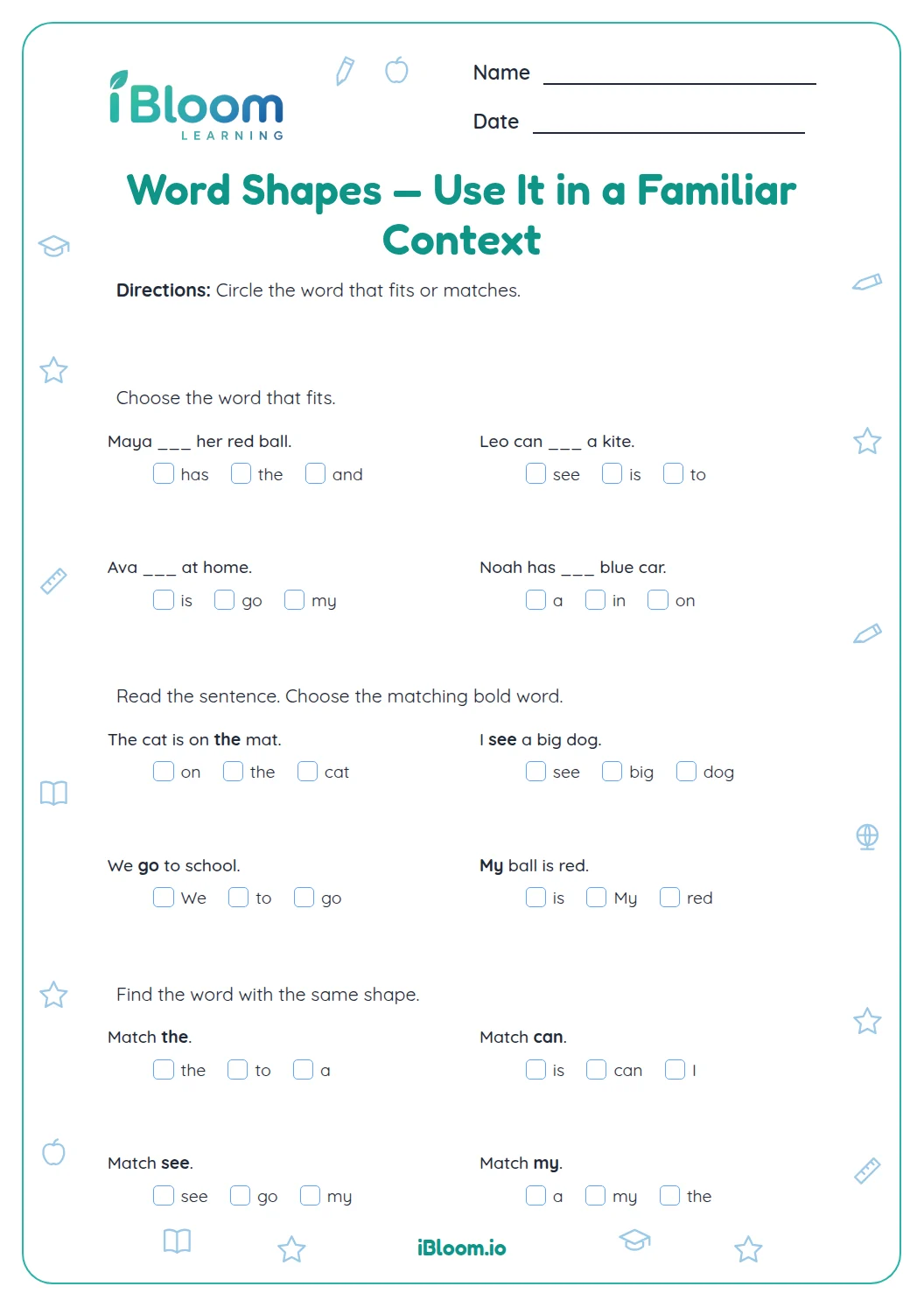
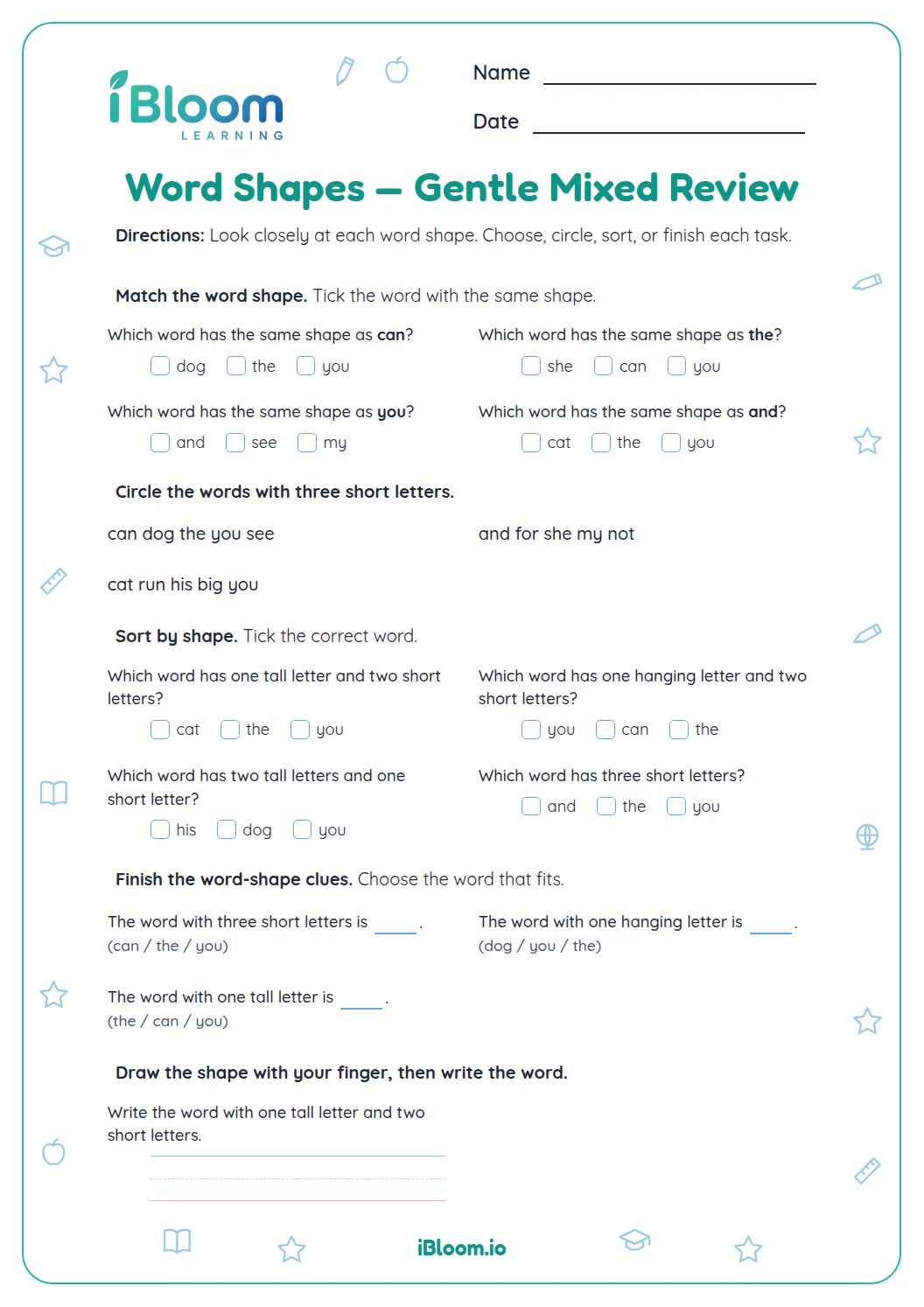
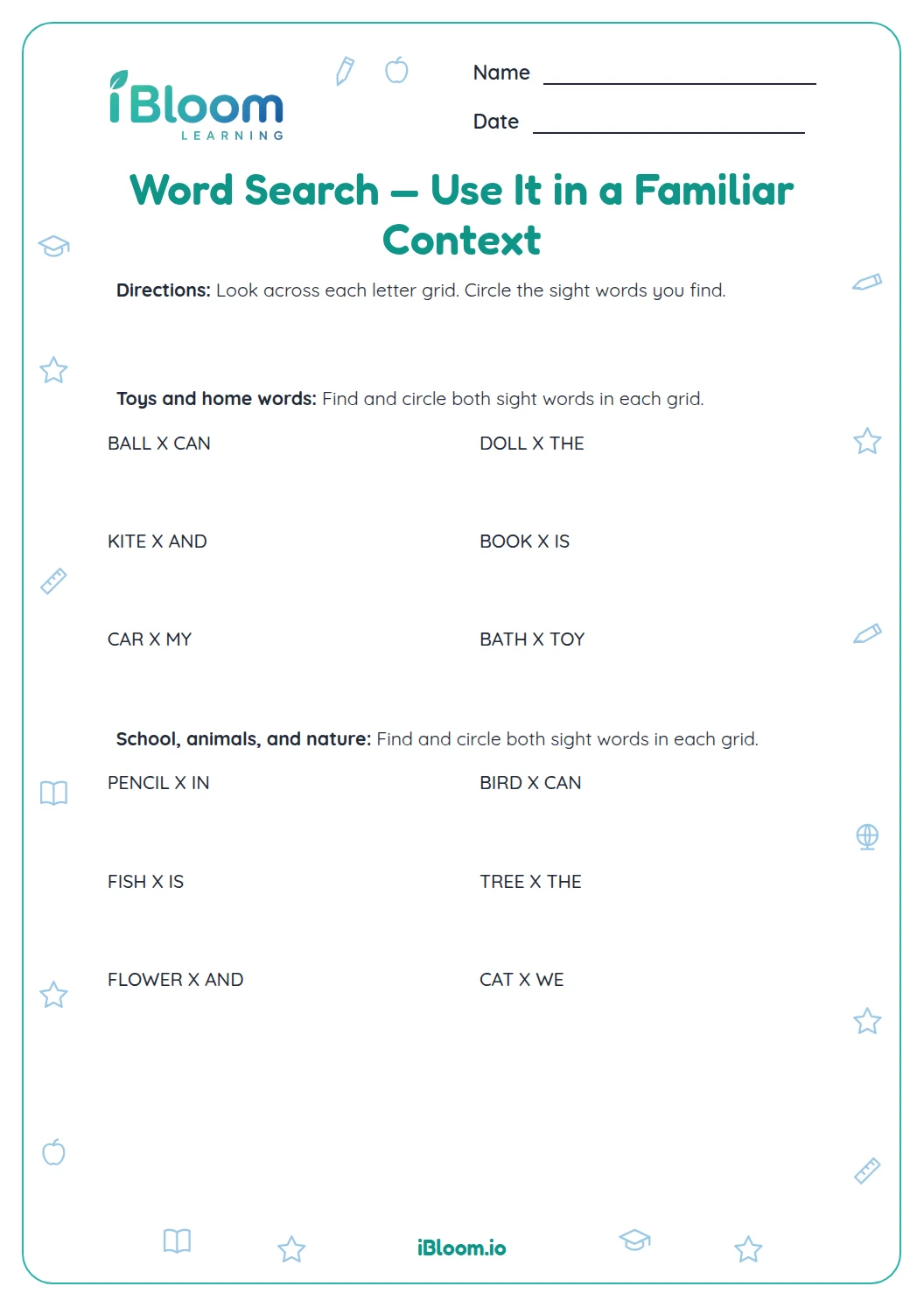
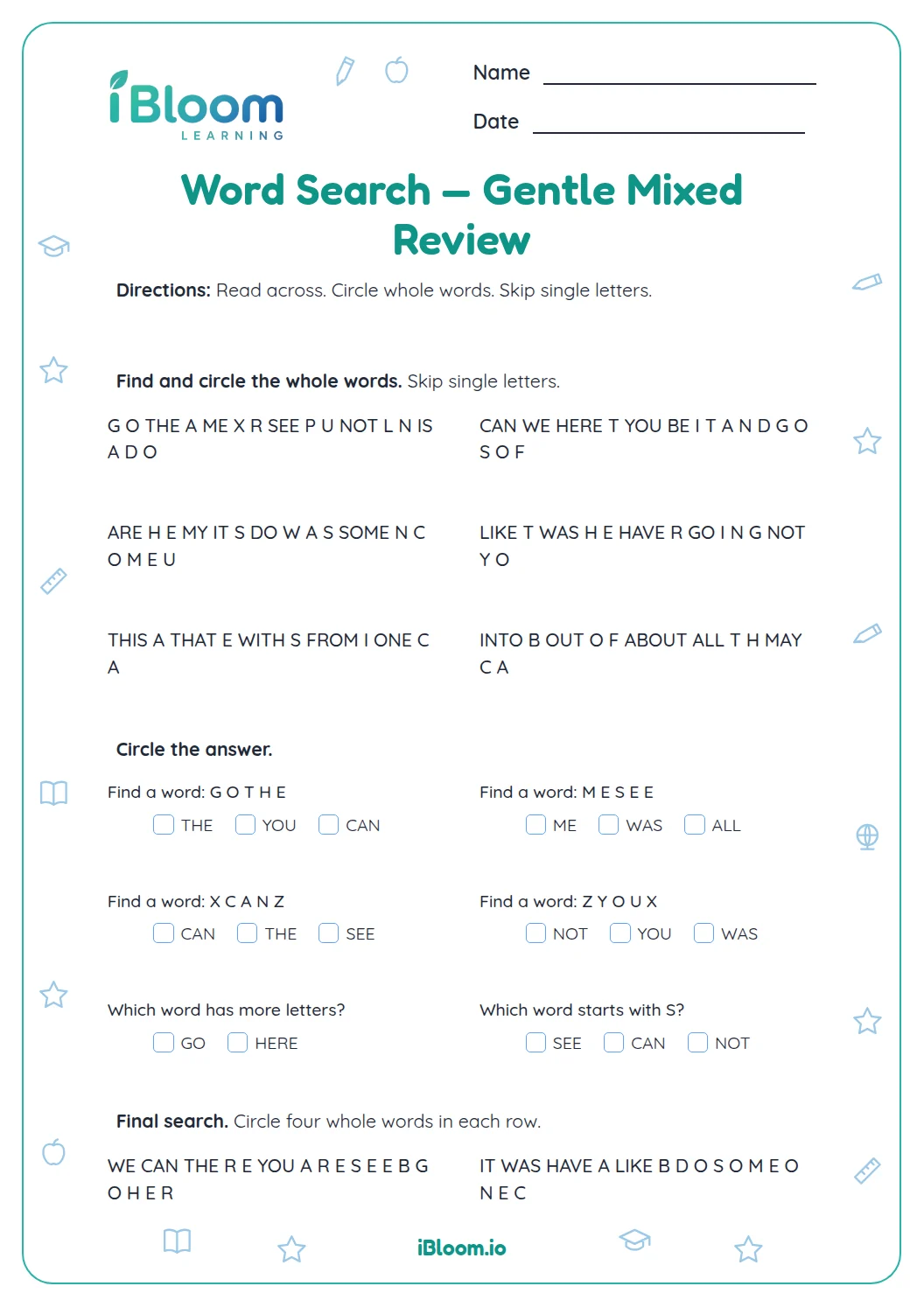
This free printable sight word worksheet is a gentle mixed review for preschool and kindergarten children who are learning the, see, my, can, is and and. Children circle the word the in rows of four, match three words by choosing from three, finish picture sentences with a dog, a cat and a frog, and trace and print the, see and can on handwriting lines. It practices reading common words by sight (CCSS RF.K.3.c) and printing letters (L.K.1.a). There are 12 questions on two pages, with a separate answer key.
Aligned to RF.K.3.c and L.K.1.a
What are sight words, and why practice them in different ways?
Sight words are common words, like the and my, that children are expected to know at a glance because they appear in almost every sentence. Seeing the same word in several jobs helps it stick: finding it in a row, matching it, using it in a sentence and printing it.
This worksheet mixes those jobs on purpose. A child who has circled the three times has seen the word, and a child who has traced it has felt its shape. Neither job takes long, which keeps the review gentle.
- 1I ___ a dog.
- 2Read the sentence and say each word: I, ___, a, dog.
- 3Try each word: I see a dog.
- 4Choose see.
What is on this worksheet?
Twelve questions on two pages, in four short parts.
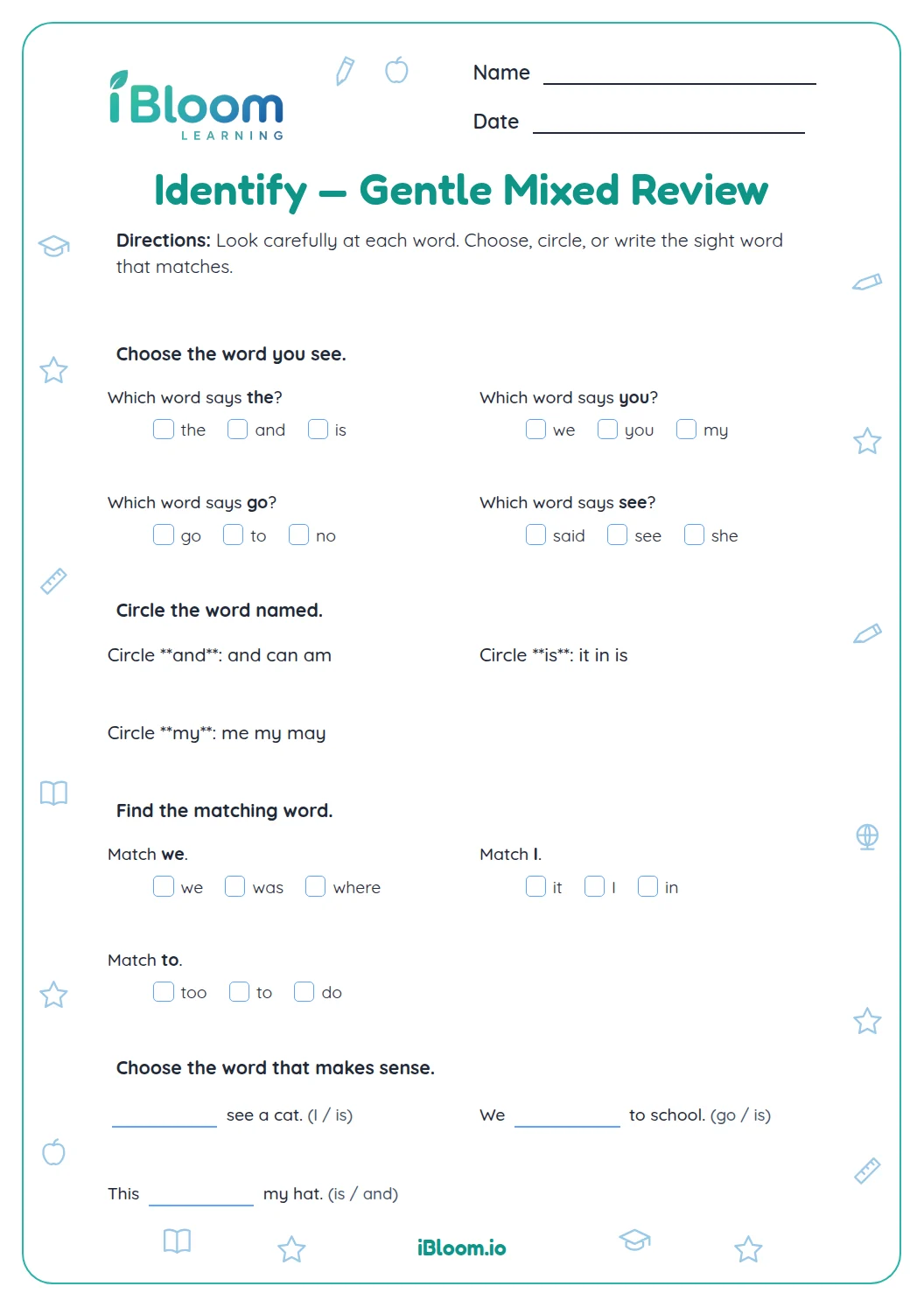
- Part A, Find the word: three rows of four words, and children circle the in each row
- Part B, Match the word: three questions asking which word says my, is and and, with three choices each
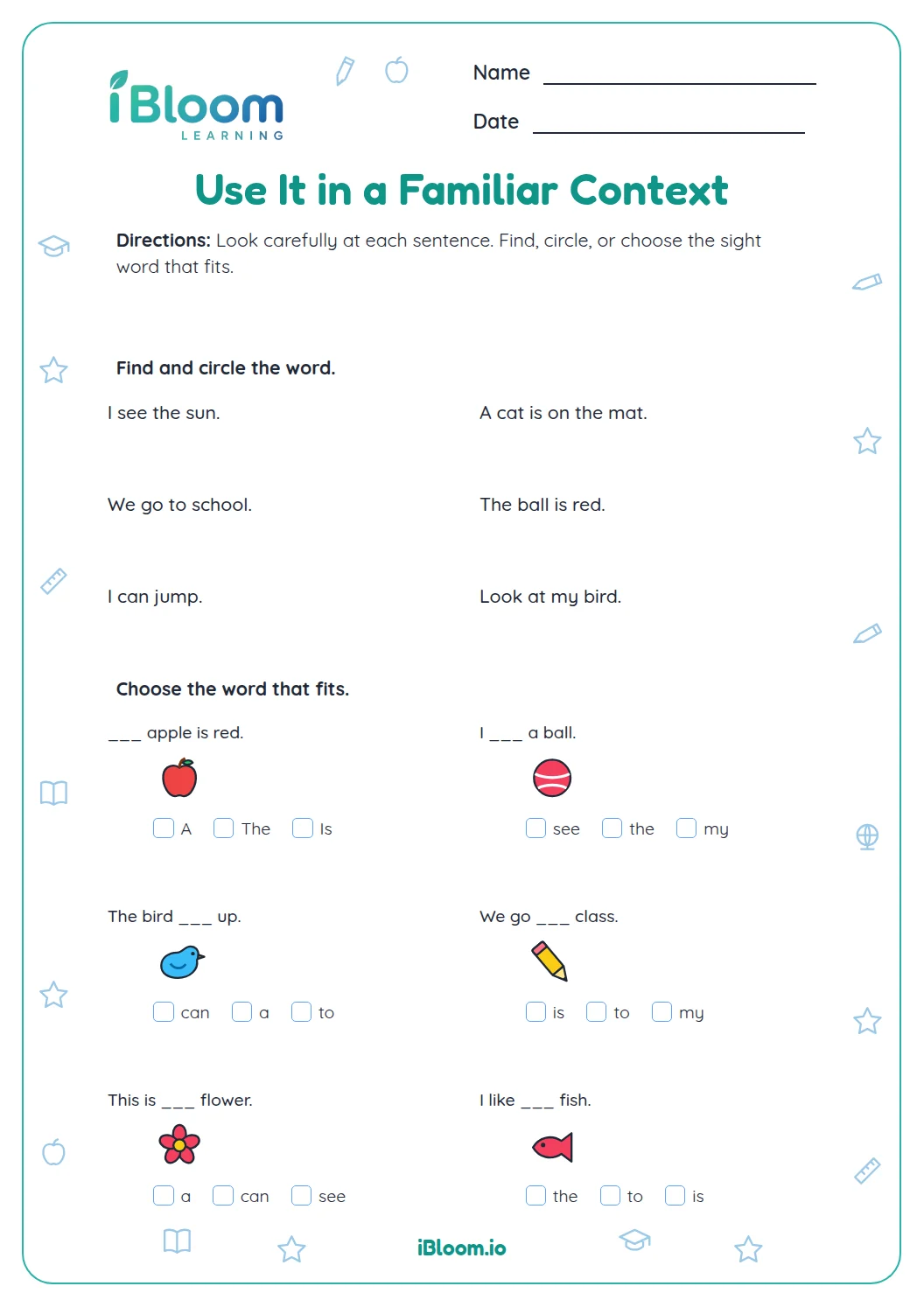
- Part C, Finish the sentence: a picture and a sentence for each of I see a dog, This is my cat and The frog can hop
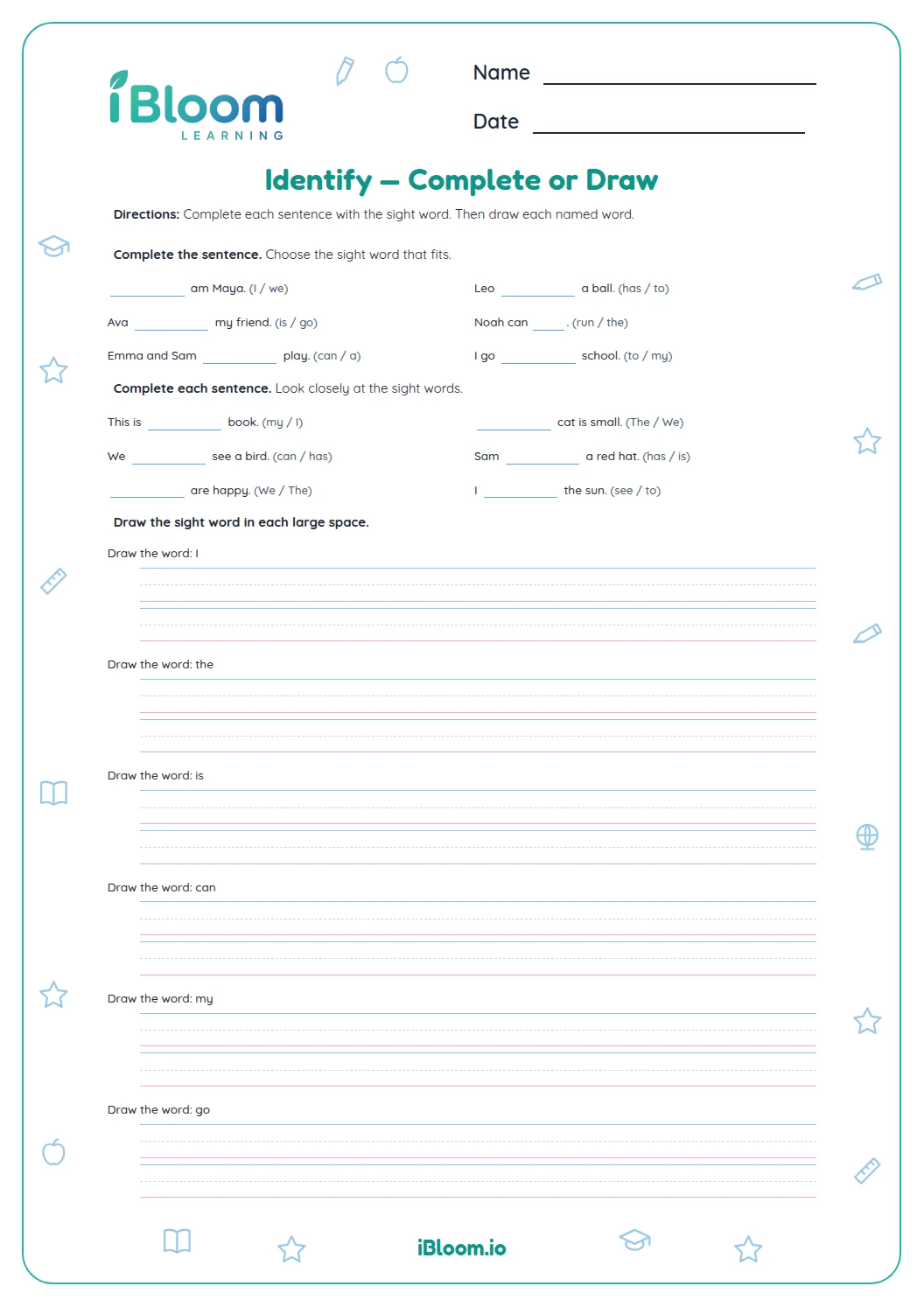
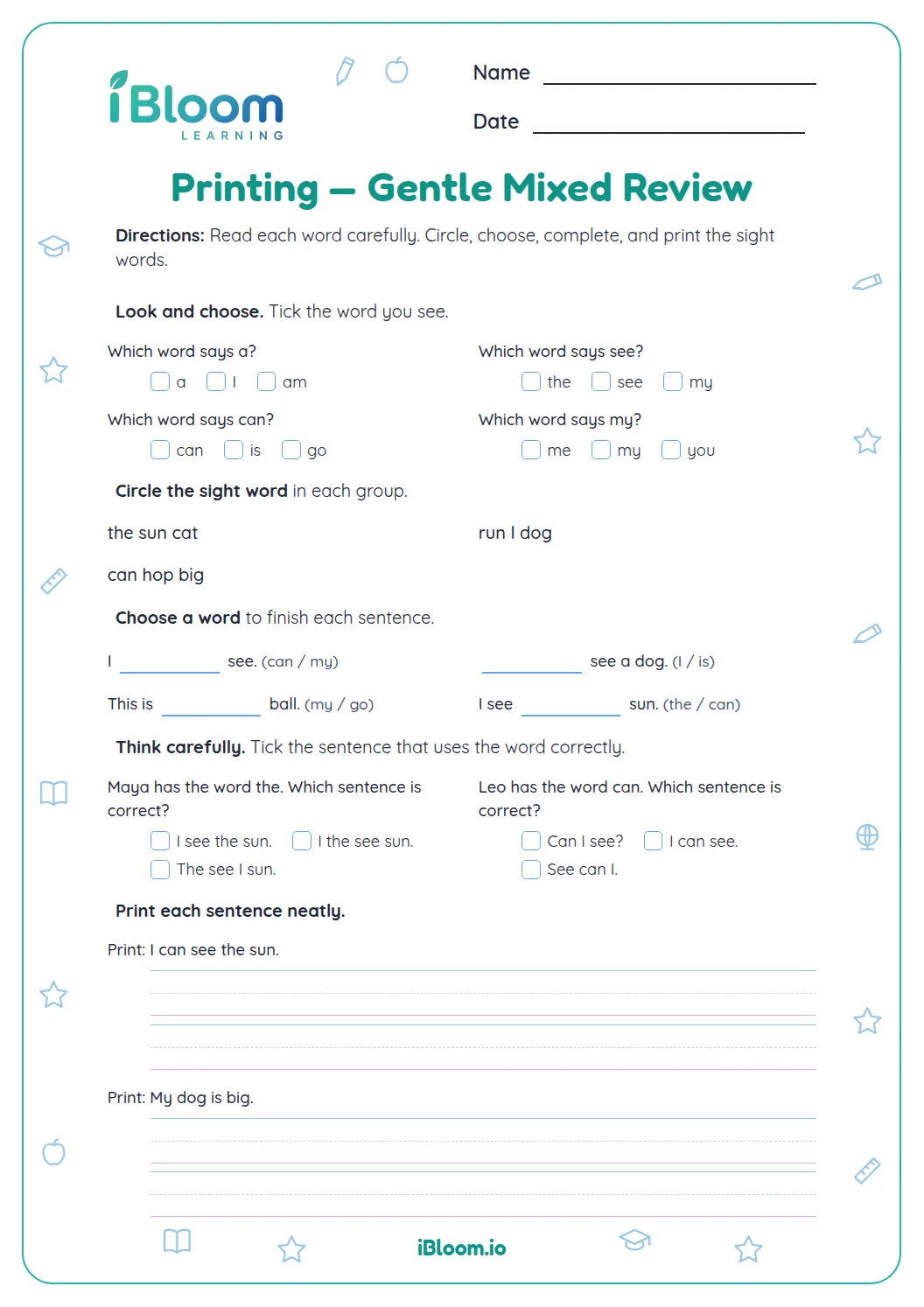
- Part D, Print the word: trace the, see and can, then print each one on the lines
- A 2-page answer key
Why do the sentences have pictures?
The picture of a dog, a cat or a frog gives a child a reason to read the sentence. The child still has to read the choices to pick the word that fits, since a picture cannot show which of see, is or the belongs in the blank. Read the sentence aloud with each choice, and the one that sounds right is usually the one that fits.
How should a child print the words?
Start at the top of each letter and trace the gray word first. Then print the word again on the lines without help. Say the letters aloud as the pencil moves: t, h, e for the, and s, e, e for see. Keep the pencil grip relaxed, and stop when your child tires.
How to use this worksheet at home or in class
- 1Say the six words aloud together: the, see, my, can, is, and. Point to each as you say it.
- 2Do the first row in Part A together. Ask your child to find the word the and point before circling it.
- 3In Part B, say the word aloud and let your child look at all three choices before filling in a bubble.
- 4In Part C, read each sentence with your child and try each word in the blank until one sounds right.
- 5For printing, trace each word with a finger first, then with a pencil, then print it on the lines.
- 6Check with the answer key and celebrate each word your child knows.
Watch for these slips
The mistake
Matching by length instead of letters, such as choosing see for AND in question 6 because both have three letters.
The fix
Point to each letter of the word in the question, then to each letter of the choice. Every letter has to match, in the same order.
The mistake
Choosing a word that fits the sound but not the sentence, such as I is a dog.
The fix
Read the whole sentence aloud with the chosen word. If it sounds wrong, try another choice.
The mistake
Printing letters backwards or out of order, as in ees for see.
The fix
Trace the gray word again with a finger, saying each letter in order, then print it a second time.
Common Core alignment
Most US states use the Common Core standards or a close state version. This sheet practices the sight word and printing standards below.
Read common high-frequency words by sight.
On this sheet: Every part asks children to recognize the, see, my, can, is or and and to read them in a sentence.
Show the official wordingHide the official wording
Read common high-frequency words by sight (e.g., the, of, to, you, she, my, is, are, do, does).
Print many upper- and lowercase letters.
On this sheet: Part D has children trace and then print the, see and can on handwriting lines.
Show the official wordingHide the official wording
Print many upper- and lowercase letters.
What to practice next
Make more practice
Further reading
Questions parents and teachers ask
Which sight words are on this worksheet?
The worksheet uses six words: the, see, my, can, is and and. Part A asks for the, Part B asks for my, is and and, Part C uses see, my and can in sentences, and Part D prints the, see and can. The words repeat across parts, so each one is seen in more than one way.
Can a preschooler do this worksheet?
Many can with a grown-up's help. Circling and matching only need a child to look closely at words, and the picture sentences can be read aloud together. Printing is the hardest part, so trace with a finger first, and let your child stop after Part C if they are tired.
How do I help with the picture sentences?
Read the sentence aloud with a pause in the blank, then try each choice. For I ___ a dog, the choices see, is and the make I see a dog, I is a dog and I the a dog. Only one sounds like a real sentence. Let your child hear the difference before marking.
Should my child circle the word or say it first?
Say it first. Ask your child to say the word the, then look along the row from left to right and point to each word before circling. Pointing slows the eyes down so every word gets a look. If your child circles too fast, cover all but one word at a time.
How many times should we practice each word?
Short, regular practice works better than long sessions. A few minutes a day, with two or three words, is enough. Use this worksheet as a review once the words have been introduced, and repeat the parts your child found tricky on another day with the answer key beside you.
Is there an answer key for this worksheet?
Yes. The 2-page answer key shows the circled the in each row, the correct word for each match question, the word that finishes each picture sentence and the printed words. Print the worksheet alone for your child, keep the key for checking, or download the worksheet and key together as a free PDF.