



About this worksheet
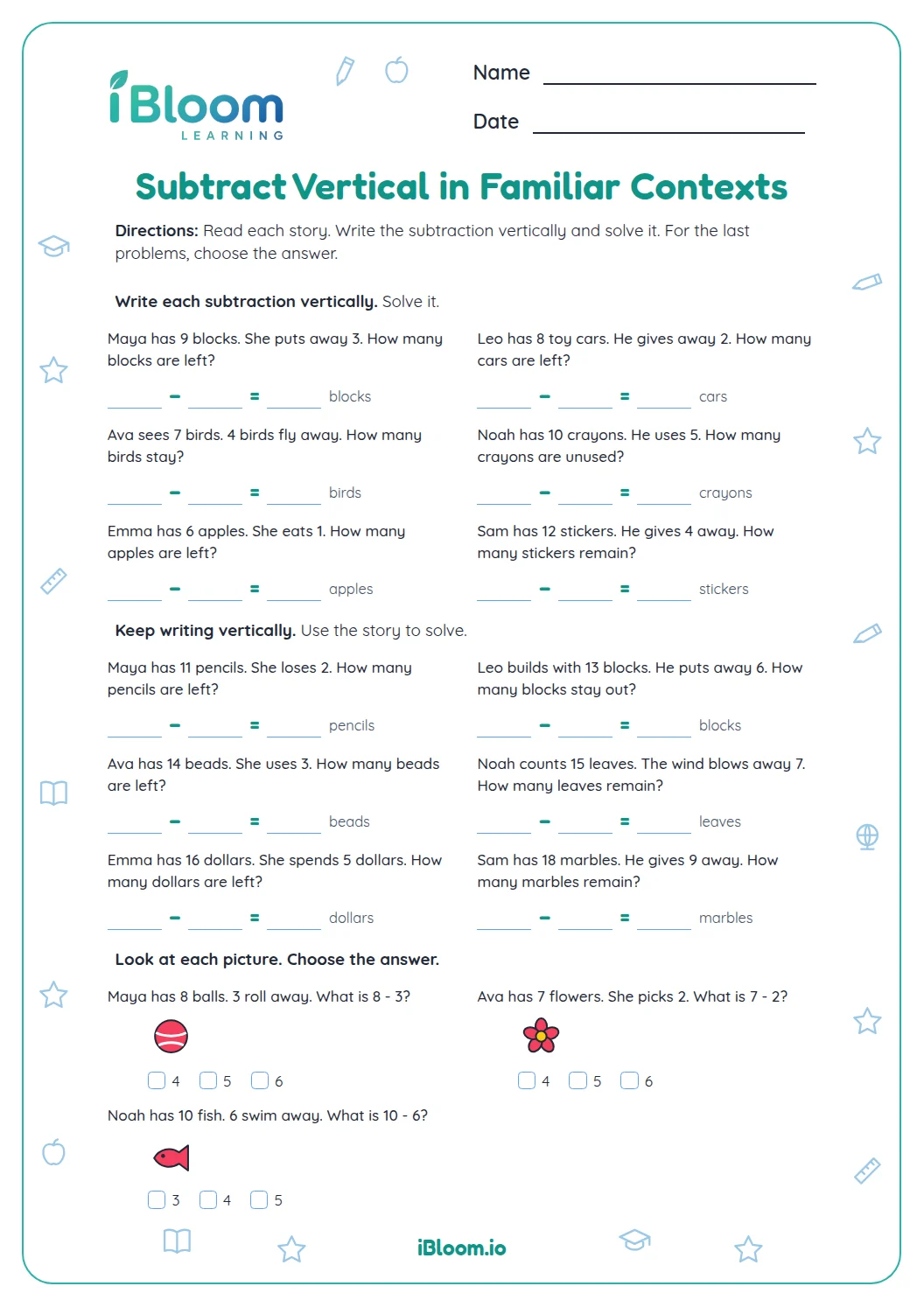
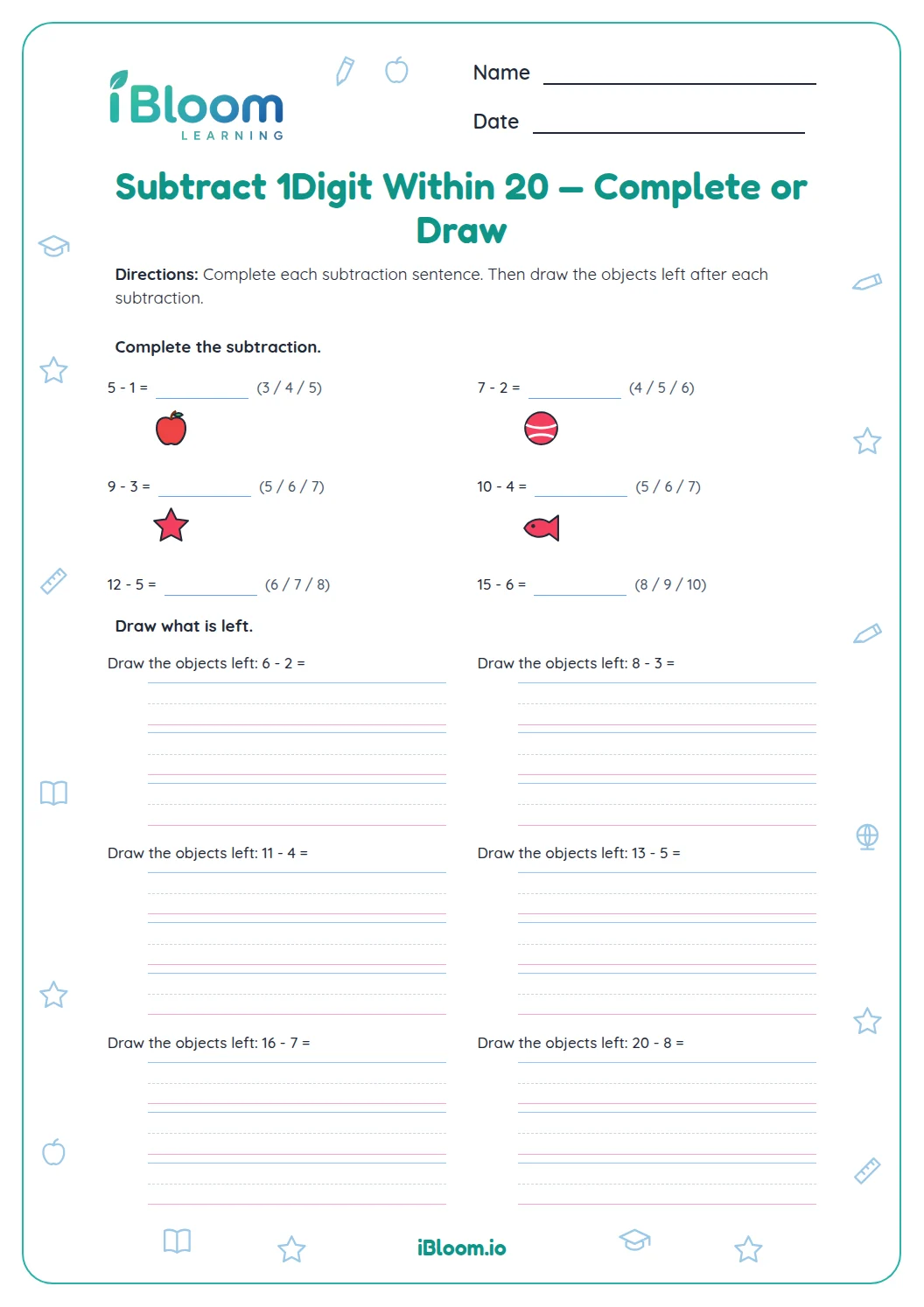
This kindergarten worksheet practices subtraction within 10, the same take-away skill as the original vertical-work page. Children solve 14 number sentences and four short stories about objects being eaten, popped, flown away, or taken from a group. The template presents the equations horizontally, so students can focus on finding the difference and explaining the take-away situation. The work supports CCSS K.OA.A.2.
Aligned to K.OA.A.2
How do students find each difference?
In Part A, read the subtraction sentence from left to right. The first number is the starting amount; take away the second number and write what remains.
- Questions 1–6 practice the first set of facts.
How can students check a subtraction fact?
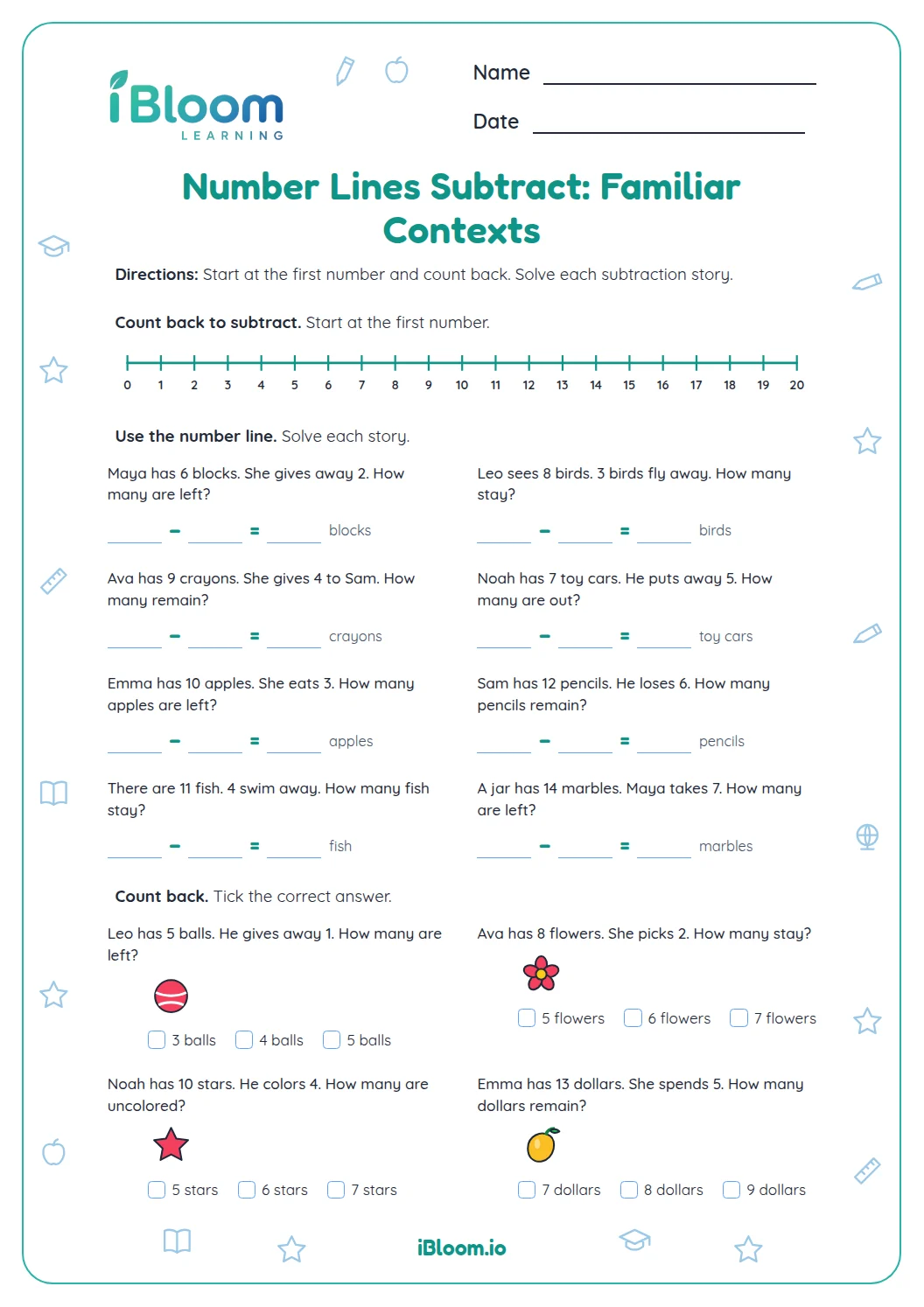
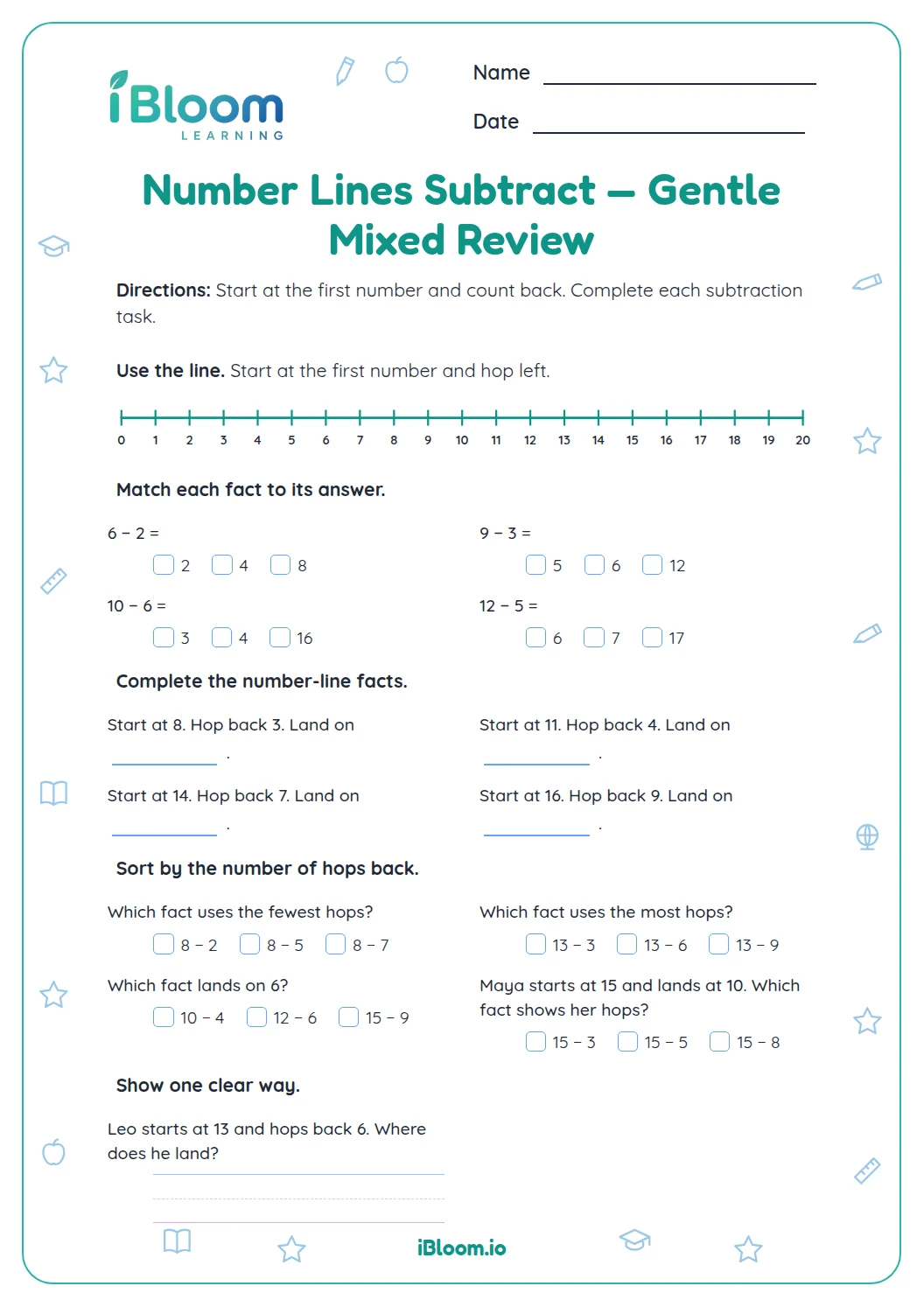
Use a count-back or think of the number that makes the subtraction equation true. For 8 − 2, count back two steps from eight to reach six.
- 1Question 9: 8 − 2 = ___
- 2Count back two: 7, 6.
- 3The difference is 6.
What does “remain” mean in a story?
A take-away story starts with a group and removes some objects. Subtract the number taken away from the starting number to find how many remain.
- Questions 15–18 describe objects leaving or being taken from a group.
How to use this worksheet
- 1Read the part direction before starting.
- 2Complete the first item together and name the strategy.
- 3Work through the remaining items one at a time.
- 4Reread each response and check its units or punctuation.
- 5Use the answer key to correct any missed step.
Common mistakes and quick fixes
The mistake
Subtracting the first number from the second.
The fix
Start with the amount before the minus sign and take away the amount after it.
The mistake
Counting the starting number as the first step back.
The fix
For 8 − 2, say 7 for the first step and 6 for the second.
The mistake
Answering with how many were taken away instead of how many remain.
The fix
Use the starting group minus the removed group, then reread the story question.
This worksheet practices subtraction facts and take-away word problems within 10.
Solve take-away stories and subtract within 10.
On this sheet: Students subtract within 10 in number sentences and solve four take-away stories.
Show the official wordingHide the official wording
Solve addition and subtraction word problems, and add and subtract within 10, e.g., by using objects or drawings to represent the problem.
What to practice next
Make more practice
Further reading
Questions parents and teachers ask
How many problems are on the subtraction sheet?
There are 18 questions: 14 subtraction number sentences and four take-away stories. Every problem stays within 10. The key gives the difference for each item, so an adult can check the equation and story answers in order. A child can work with an adult at home or in class.
Does the new sheet use vertical subtraction?
The original asks children to set up subtraction vertically. The printable template lays out number sentences horizontally, while keeping the same within-10 take-away skill. Children can still use a count-back or sketch beside an equation before recording the difference.
What is a helpful way to solve 8 minus 2?
Start at 8 and count back two steps: 7, then 6. That makes 6 the difference. Another check is to ask which number added to 2 makes 8. Question 9 uses this fact as a model for the remaining subtraction practice.
How should a child solve the take-away stories?
Find the starting number and the number that leaves or is removed. Subtract the second amount from the first, then answer the story question using “remain,” “left,” or “stay.” The four stories use apples, balloons, birds, and blocks.
What does the answer key include?
The separate key lists all 18 differences, including the four story answers. Have the child finish a few equations first, then compare each result with the key and explain one count-back or take-away step aloud. Review one answer at a time and praise careful counting.