






About this worksheet
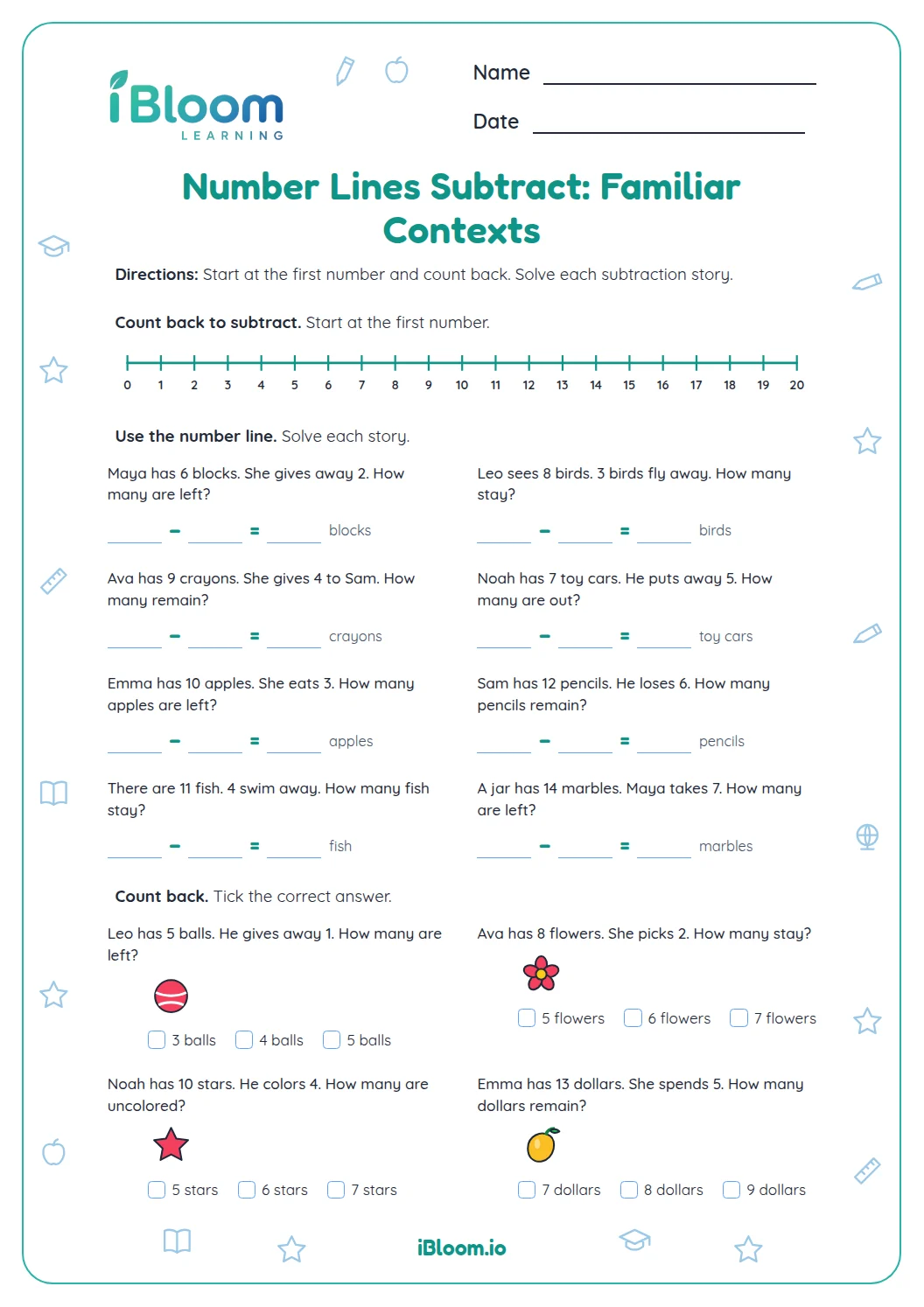
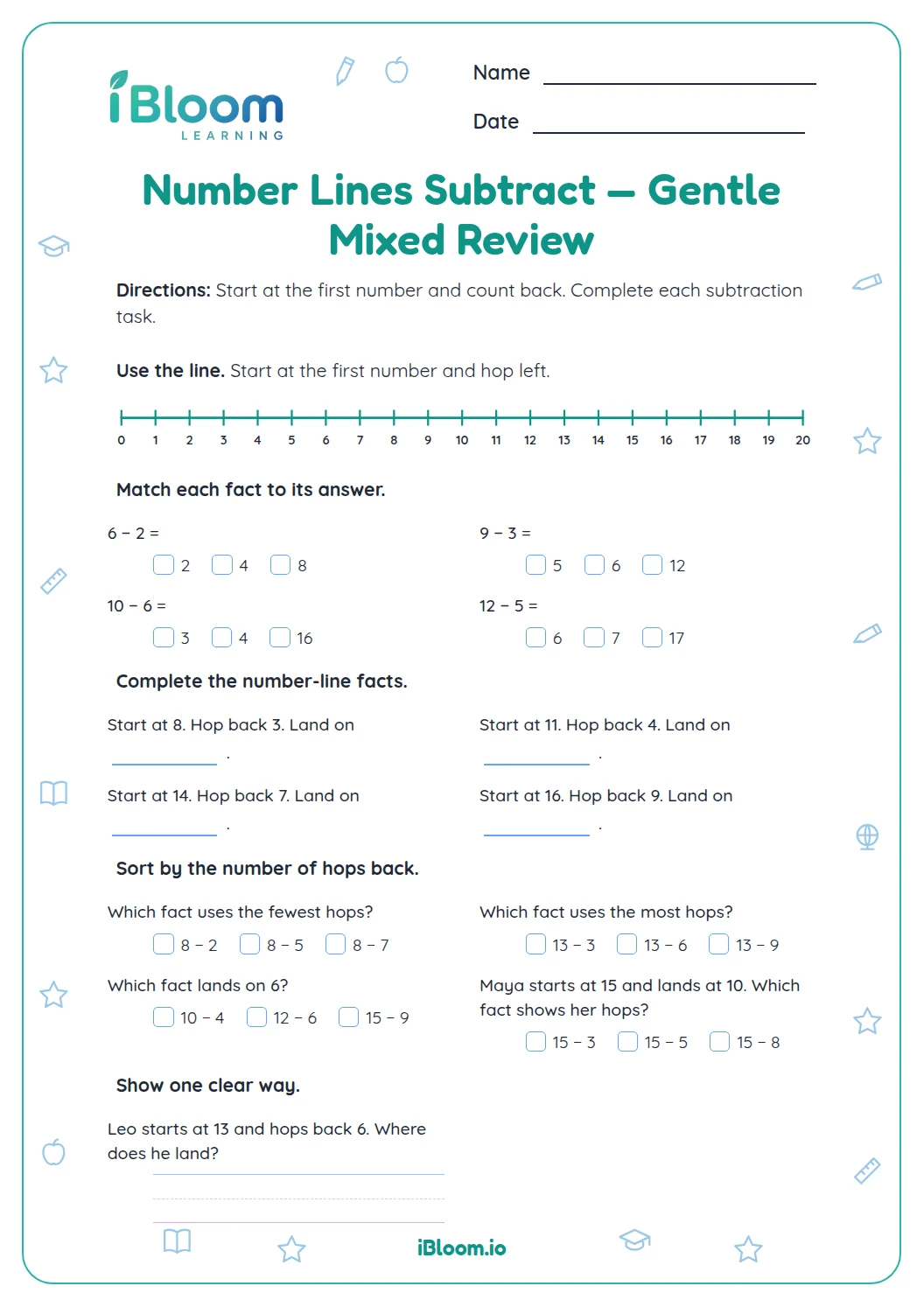
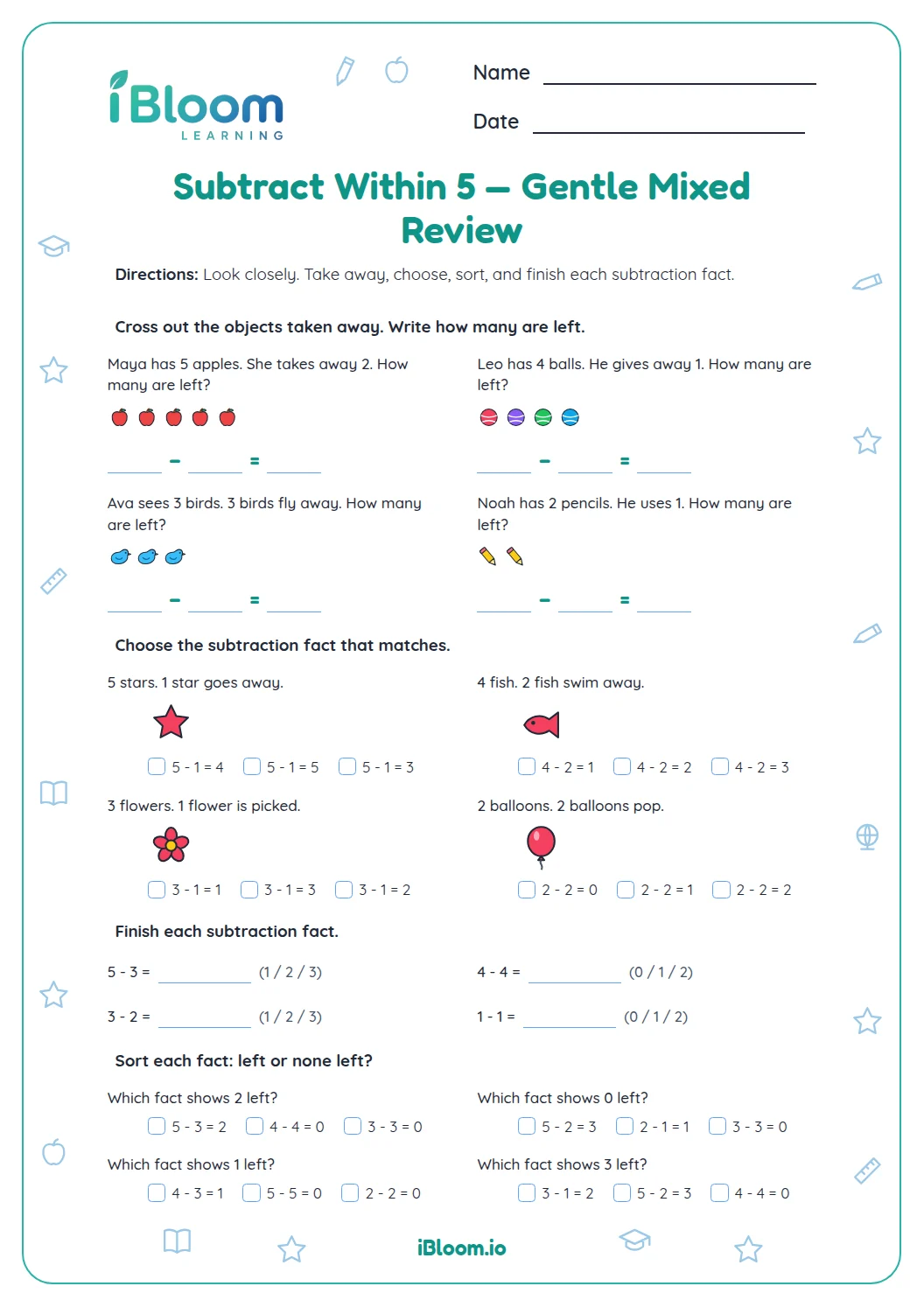
This free printable worksheet shows young children how subtraction looks on a number line. They start on the first number, jump back once for each thing taken away, and see where they land. Some questions give both dots and ask how many jumps were taken. Others give one dot and ask the child to draw the jumps with a pencil. The last questions use pictures to cross out, and one open box lets children draw their own. It uses numbers 0 to 10, practices Common Core K.OA.A.1 and K.OA.A.2, and comes with a separate answer key.
Aligned to K.OA.A.1 and K.OA.A.2
How does a number line show subtraction?
A number line lays numbers out in order, so taking away becomes moving back. In 9 − 4, the 9 is where you start and the 4 is how many jumps you take. Each jump lands one number lower, and the number where you stop is the answer.
The number line also shows the difference between the two numbers. When two dots are on the line, the number of jumps between them is the number taken away.
- 19 − 4 = ___
- 2Start on the dot at 9
- 3Jump back 1 → 8
- 4Jump back 2 → 7
- 5Jump back 3 → 6
- 6Jump back 4 → 5
- 7Write 5: 9 − 4 = 5
What is on this worksheet?
Every number line runs from 0 to 10 with each number labeled, so children can read the numbers as they jump. The questions move from reading a line that is already marked to drawing their own.
- Part A, Finish the sentence: three questions with a dot at the start and a dot where the jumps end, such as 6 − ___ = 4
- Part B, Draw the jumps: two questions with a dot at the start, where children draw each jump back and write the answer
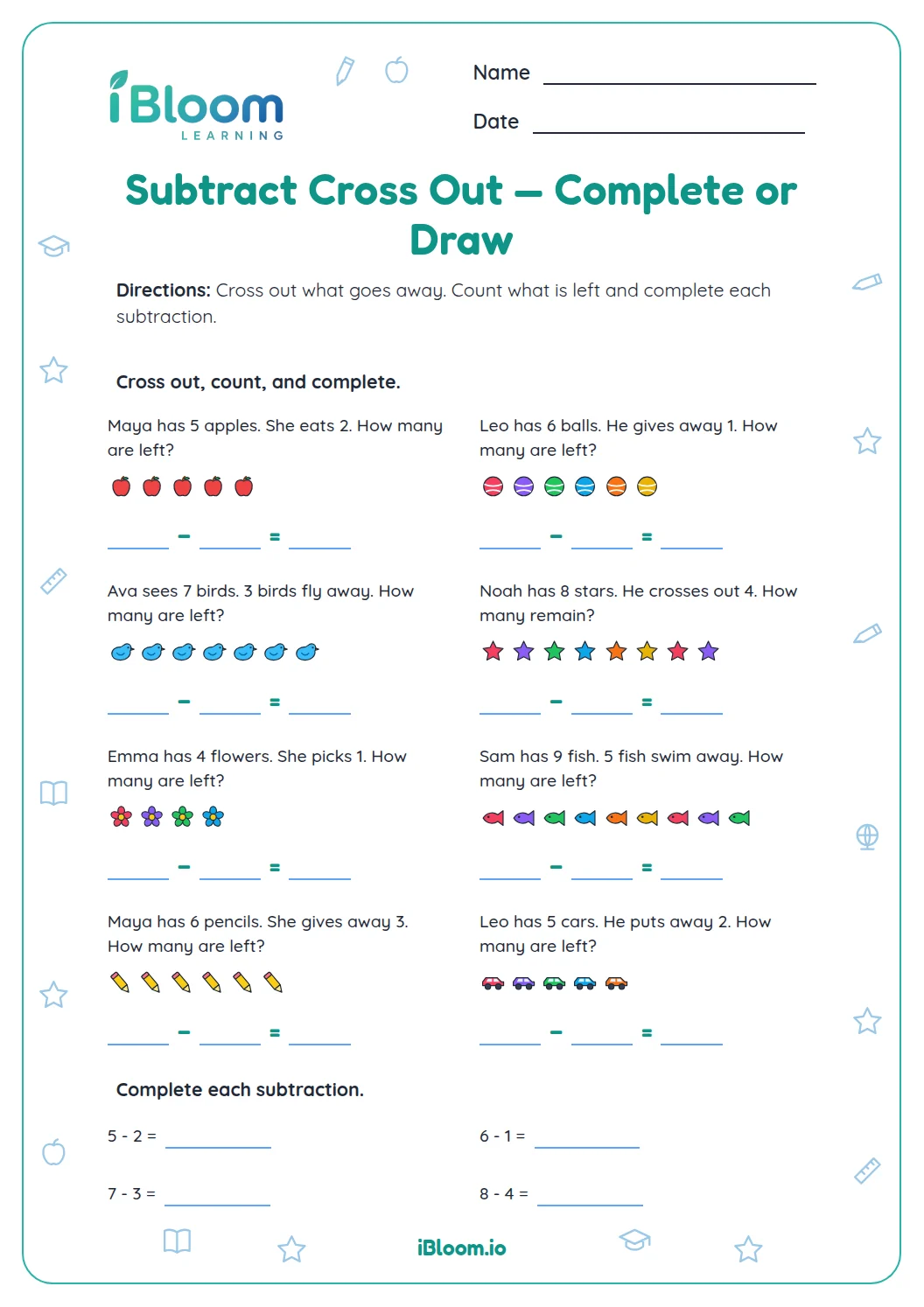
- Part C, Cross out: two picture questions, 6 − 2 with apples and 8 − 5 with balloons, where children cross out and write what is left
- Part D, Draw and cross out: one open box to draw 5 stars and cross out 3
- Answer key on a separate page
Why does the starting dot cause mix-ups?
A common slip is counting the number you are standing on as the first jump. Starting on 9 and counting 9, 8, 7, 6 lands on 6, but 9 − 4 is 5. The first jump goes to the next number back, so the starting number is not counted.
Question 5 is a good place to practice. Have your child say “start” on the dot and then count out loud only while the pencil moves.
How to use this worksheet at home or in class
- 1Warm up with a floor number line made of tape, numbered 0 to 10. Stand on 6 and take two steps back. Ask where you are now.
- 2Do question 1 together. Put a finger on the first dot, hop to the second, and count the hops out loud.
- 3In Part B, show your child how to draw one small curved jump for each number taken away. Use a pencil so they can fix a jump.
- 4Ask your child to say the whole sentence at the end, for example: “Nine take away four is five.”
- 5For the apples and balloons, cross out the things that are taken away, then count what is left. Check it matches the number line answer.
- 6Check with the answer key, and replay any missed question on the floor number line.
Common mistakes and quick fixes
The mistake
Counting the start dot as jump one, so 8 − 3 lands on 6.
The fix
Say "start" on the first dot, and count only while moving. The first jump lands on 7.
The mistake
Jumping forward instead of back, so 7 − 2 becomes 9.
The fix
Remind your child that subtract means fewer, so the answer is smaller than the start number. Draw the jumps toward the zero.
The mistake
Counting both dots in Part A, so the jumps from 6 to 4 count as 3 instead of 2.
The fix
Count the jumps, not the dots. Trace the little arcs between the numbers with a finger and count each arc.
Common Core alignment
Most US states use the Common Core standards or a close state version. These two Kindergarten math standards match what this sheet practices.
Show subtraction with drawings, pictures, or number sentences.
On this sheet: Children draw jumps on a number line and cross out pictures to show taking away.
Show the official wordingHide the official wording
Represent addition and subtraction with objects, fingers, mental images, drawings, sounds (e.g., claps), acting out situations, verbal explanations, expressions, or equations.
Subtract within 10 using objects or drawings.
On this sheet: Every difference on the sheet is within 10 and is found with a number line or pictures.
Show the official wordingHide the official wording
Solve addition and subtraction word problems, and add and subtract within 10, e.g., by using objects or drawings to represent the problem.
What to practice next
Make more practice
Further reading
Questions parents and teachers ask
What should my child know before this worksheet?
Your child should be able to count aloud to 10 and match each number to its written numeral. It also helps to know that taking away makes a group smaller. If counting back is new, practice with a few toys first, taking one away at a time and saying the number left.
What is the answer to question 5?
The answer is 5. The number line has a dot at 9, and the sentence is 9 − 4. Jump back four times, landing on 8, then 7, then 6, then 5. The number where the fourth jump stops is the answer, so your child writes 5 in the blank.
How do children solve a sentence like 6 − ___ = 4?
They count the jumps between the two dots. Start at 6 and jump back until you reach 4. That takes two jumps, so the missing number is 2. The answer key shows each missing number in green, and a quick check is to count back from 6 again.
Do children have to draw perfect jumps?
No. A quick curve or a small arrow from one number to the next is fine. What matters is that there is one jump for each number taken away, and that the child counts them out loud. Pencil lets children erase and try again, which helps if the jumps land in the wrong place.
Why does the sheet include pictures to cross out?
Pictures show the same subtraction in another way. Crossing out 2 of 6 apples leaves 4, and the number line for 6 − 2 also lands on 4. Seeing both side by side helps children link objects, numbers and the number line, and gives a way to check an answer.
Is there an answer key for this worksheet?
Yes. A separate answer key shows the missing number in each Part A sentence, the answers to the Part B and Part C sentences, and a note on what the drawing in Part D should show. Print the worksheet pages on their own and keep the key for checking together.