





About this worksheet
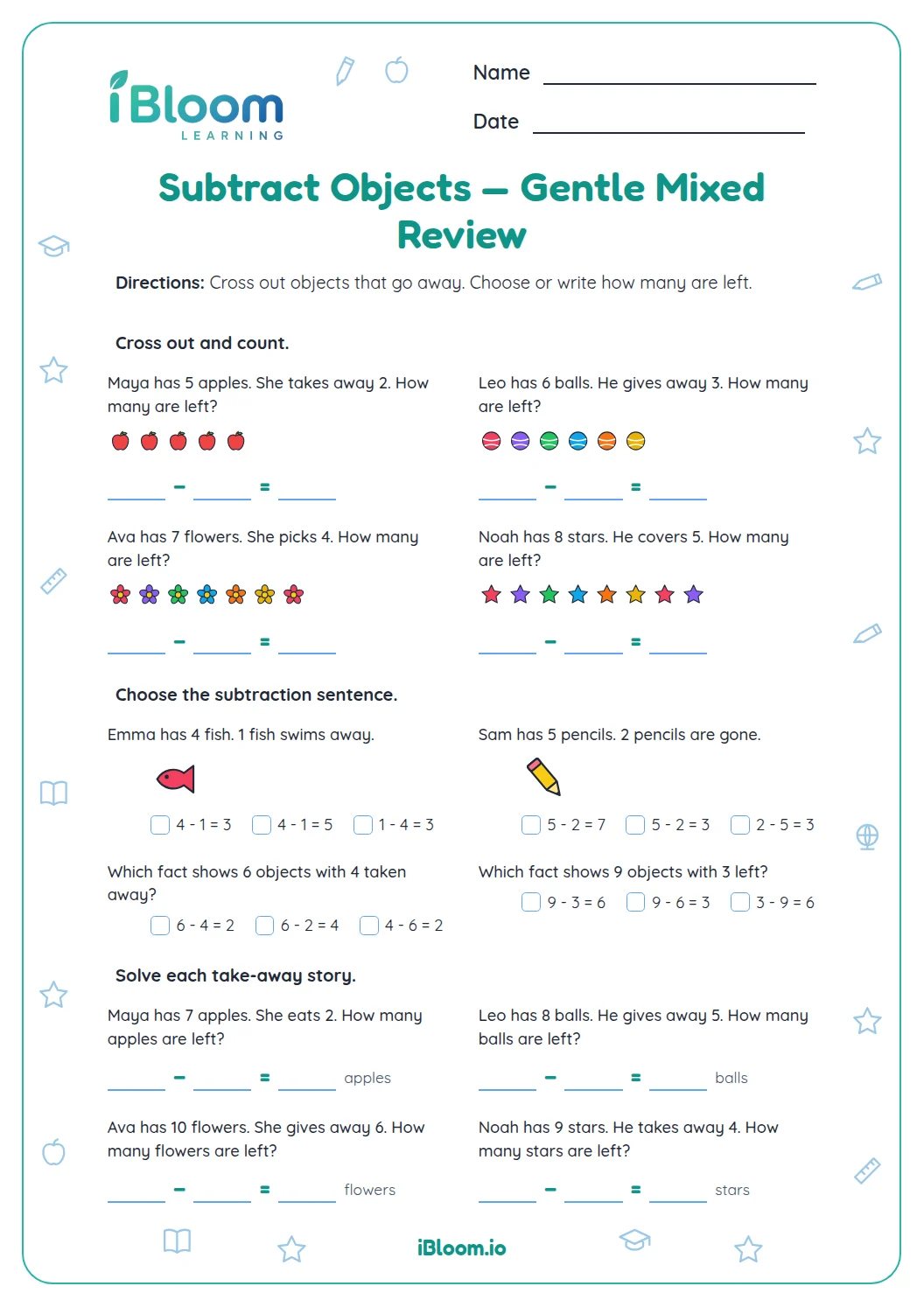
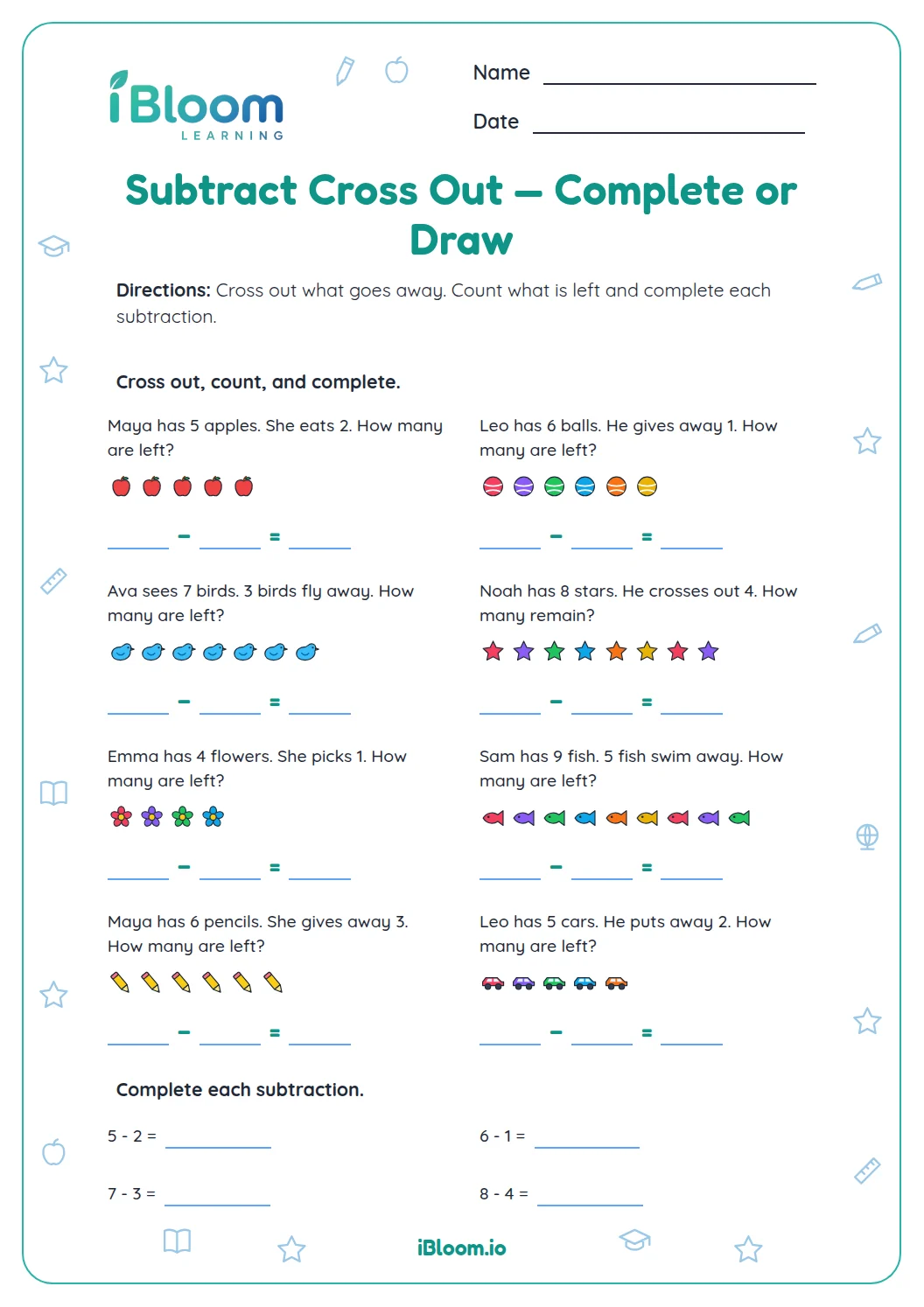
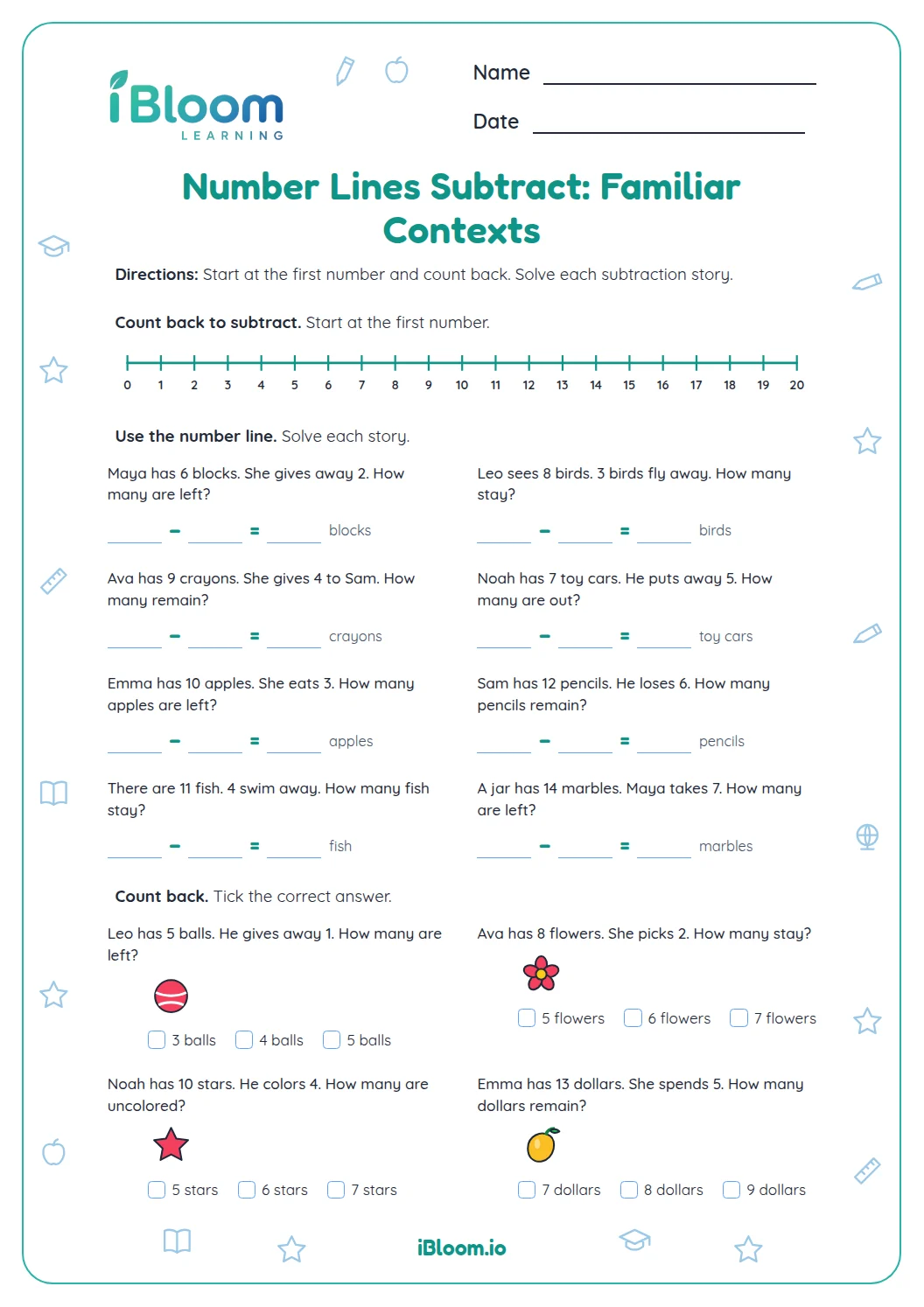
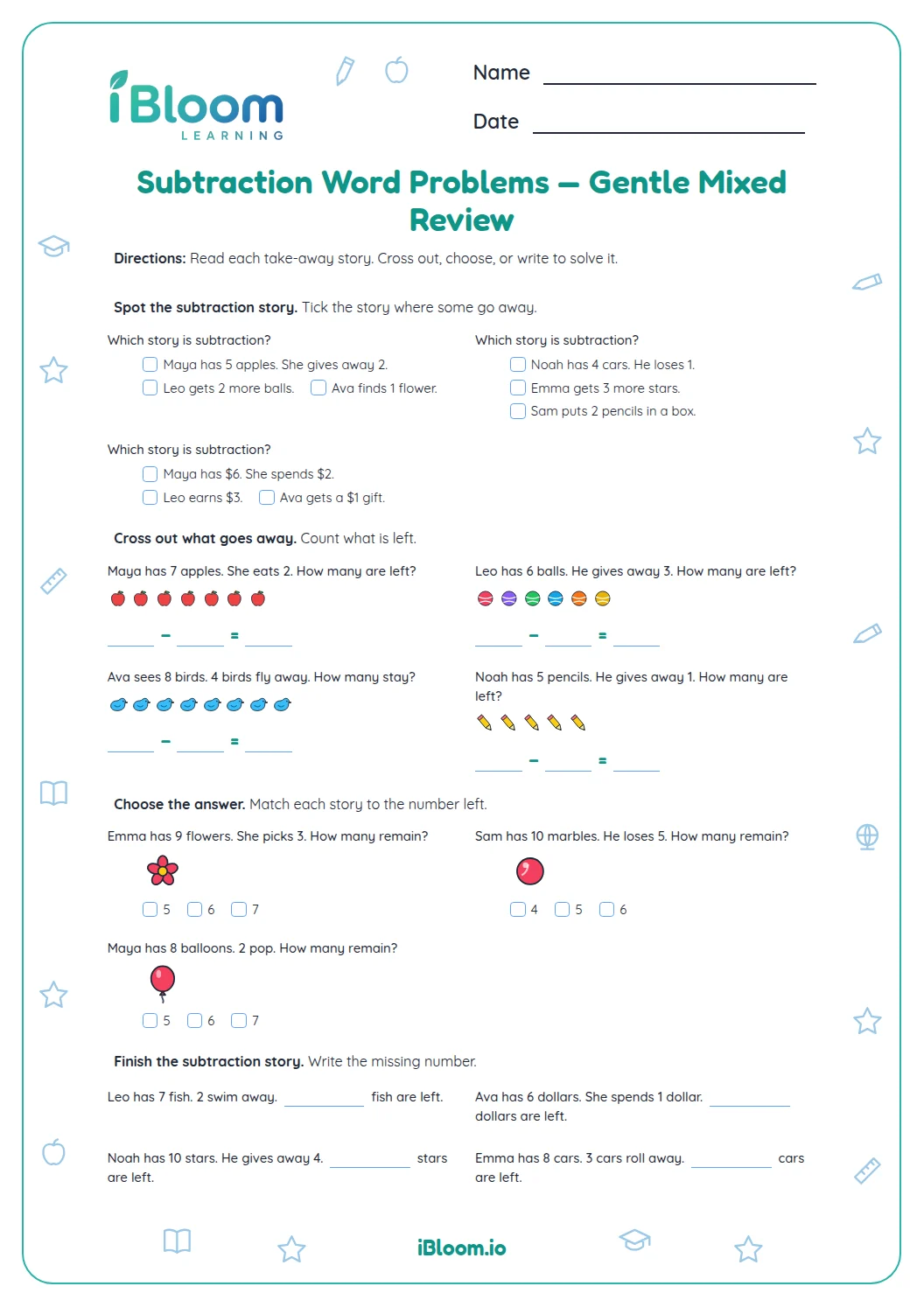
This printable is for preschool and kindergarten learners beginning subtraction through familiar situations. Each of the sixteen prompts pairs a short story with a picture group, then asks how many objects remain after some are taken away. Children can count the group, act out the change with counters or fingers, and say the subtraction aloud. It practices representing subtraction with drawings and explanations in Common Core K.OA.A.1. The answer key gives the remaining count for every story.
Aligned to K.OA.A.1
How can pictures help show subtraction?
Start by counting all the objects. Then imagine removing the number named in the story and count what is still there. The picture gives a concrete group to count before saying the answer.
Question 1 has five apples and two are eaten. Count 1, 2, 3, 4, 5; take away two; three apples remain.
- 15 apples to start
- 2Take away 2 apples
- 3Count the apples left: 1, 2, 3
- 45 − 2 = 3
How can a child act out the story?
Use counters, fingers or small toys to match the picture group. Move away the number in the story, then count the remaining objects. Saying “five take away two leaves three” connects the action to the subtraction sentence.
What should the answer describe?
The answer is the number of objects still there, still shining or still awake. It should be smaller than the starting group when something is taken away. The familiar situations give children a reason to name what remains, not only say a number.
How to use this worksheet
- 1Read one story aloud and identify how many objects there are at first.
- 2Count the picture group together.
- 3Use fingers or counters to act out taking away the stated amount.
- 4Count the objects that remain and say the answer in a full sentence.
- 5Repeat with a new story and invite the child to act it out independently.
- 6Use the key to check the remaining count.
Common mistakes and quick fixes
The mistake
Counting the objects that were taken away as if they remain.
The fix
Move those counters aside before counting what is left.
The mistake
Starting with the number taken away instead of the full group.
The fix
Count the whole picture group first, then remove the story amount.
The mistake
Giving the starting count as the answer.
The fix
Ask “How many are still here?” and count only the remaining objects.
Common Core alignment
This worksheet practices the math skills named below through its sequence problems and explanations.
Represent take-away stories with pictures, spoken explanations and equations.
On this sheet: Each story pairs a familiar take-away situation with a picture group and a subtraction answer.
Show the official wordingHide the official wording
Represent addition and subtraction with objects, fingers, mental images, drawings, sounds (e.g., claps), acting out situations, verbal explanations, expressions, or equations.
What to practice next
Make more practice
Further reading
Questions parents and teachers ask
Should my preschooler write an equation for every story?
Writing is optional at this stage. The child can count the objects, move counters away, and say how many remain. An adult can model a sentence such as 5 − 2 = 3, connecting the spoken story and action to written symbols when the child is ready.
How do the pictures support the subtraction stories?
Each prompt has a group of matching objects to count before anything is taken away. The child can point to or cover the number in the story, then count the remaining group. This gives a visual starting amount for all sixteen familiar situations.
What does “how many remain” mean?
It asks for the objects still there after some leave, are eaten or are put away. For example, if five apples start on the page and two are eaten, the three apples not eaten are the ones that remain.
Can we use counters instead of the printed pictures?
Yes. Gather the same number of counters as the starting group, then move aside the number named in the story. Count what is still on the table. This hands-on action can make the take-away idea clearer before the child answers from the picture alone.
Is there an answer key?
Yes. A separate key lists the remaining number for each of the sixteen stories. Ask the child to explain one answer by recounting the objects that stay. The wording of the explanation can vary as long as it tells how many are left.