




About this worksheet
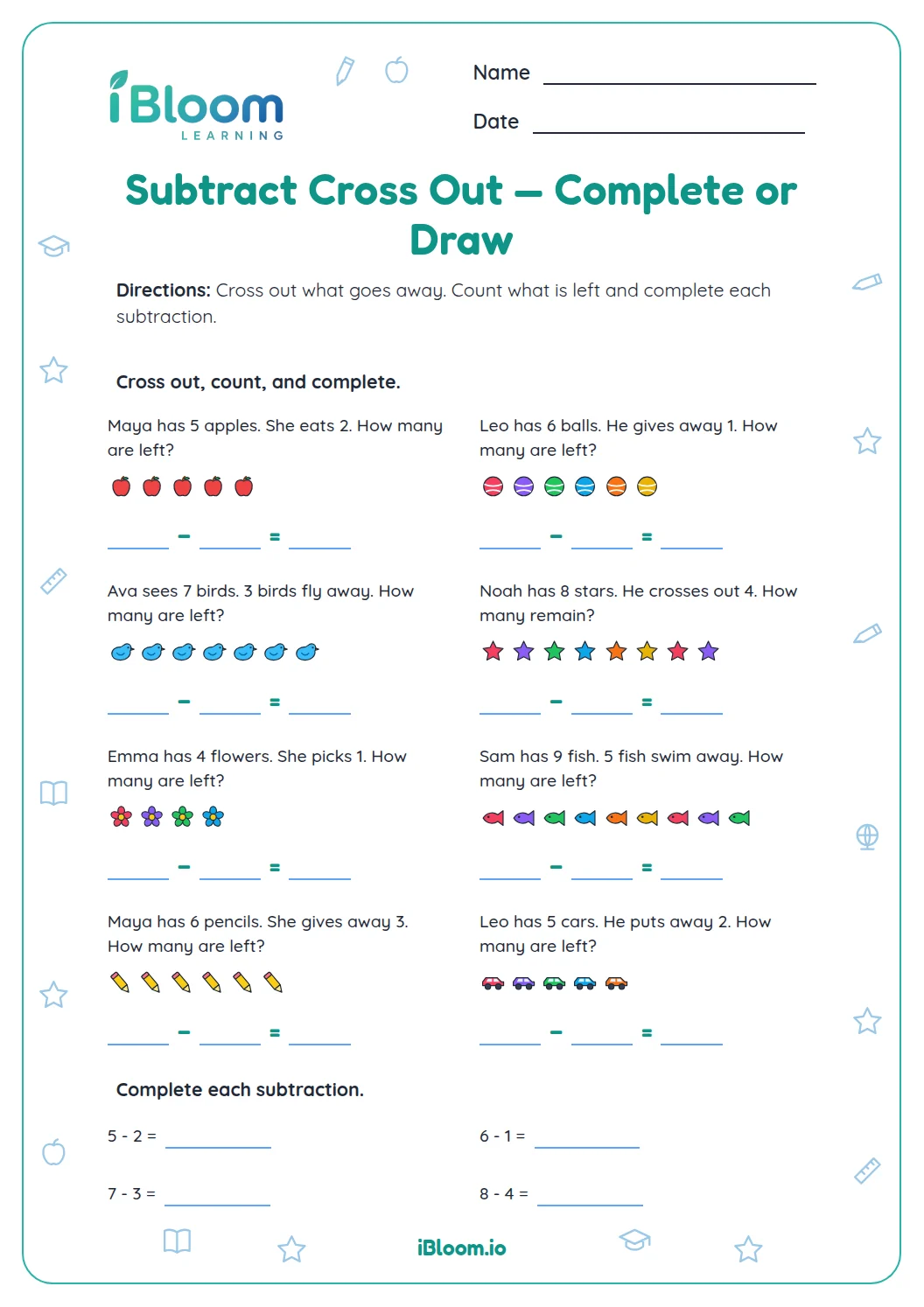
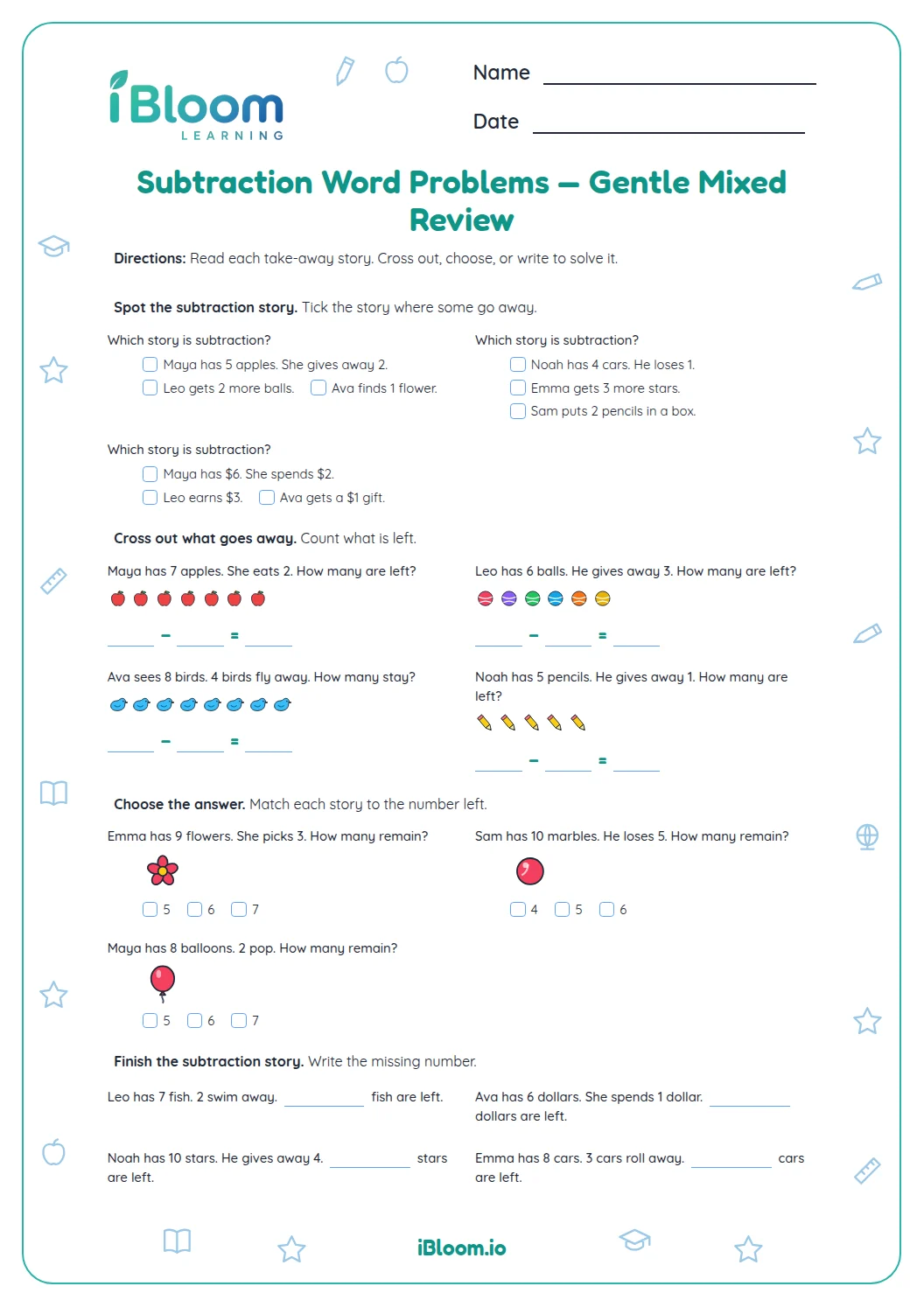
This free printable subtraction worksheet is for preschool and kindergarten learners. Children count apple and duck pictures, solve subtraction sentences within 10, and draw objects to show what remains after taking some away. The picture stories keep the starting set visible so learners can cross out the objects that leave. There are 14 questions and a separate answer key with sample drawings.
Aligned to K.OA.A.1
How do pictures show taking away?
Part A shows the full set of apples. Cross out the number named in the prompt, then count the uncrossed apples. In Part C, use the same action with ducks in a pond.
- 1Start with 5 apples. Cross out 2.
- 23 apples remain.
How can a subtraction sentence match the action?
Part B uses number sentences without pictures. Say the starting number, take away the second number, and name how many remain. Children can use fingers or draw a quick set to check.
What should a child draw for the last part?
Part D asks children to draw the starting set, cross out the given amount, and tell how many are left. The answer key gives sample results; a child’s drawing can look different while showing the same quantities.
How to use this worksheet
- 1Read the first number as the starting group.
- 2Count or draw that many objects.
- 3Cross out the number taken away.
- 4Count only the objects that are not crossed out.
- 5Say the answer as the number remaining, then check with the key.
Common mistakes and quick fixes
The mistake
Counting the crossed-out objects in the answer.
The fix
Touch only the objects that remain when counting the answer.
The mistake
Starting with the amount taken away.
The fix
Make the first number in the problem before crossing anything out.
The mistake
Drawing fewer objects than the starting number.
The fix
Count the full group first, then cross out the amount named.
Early math alignment
This worksheet practices taking away objects to find how many remain at the stated grade level.
taking away objects to find how many remain.
On this sheet: taking away objects to find how many remain.
Show the official wordingHide the official wording
Represent addition and subtraction with objects, fingers, mental images, drawings, sounds (e.g., claps), acting out situations, verbal explanations, expressions, or equations.
What to practice next
Make more practice
Further reading
Questions parents and teachers ask
What subtraction skills does the worksheet practice?
Children find how many objects remain after some are taken away. They work with picture sets, number sentences, two short duck stories, and draw-and-cross-out tasks. The problems stay within 10, and the answer key includes results and sample drawing descriptions.
Can children mark the pictures?
Yes. The apple and duck pictures show the full starting set. Children can cross out the number of objects named in the prompt, then count the pictures that remain. This makes the subtraction action visible. The answer key gives the number left in every picture and drawing example.
What do children draw in the final questions?
They draw the starting number of circles or stars, cross out the amount named, and count what is left. The answer key describes one correct result, but the child’s own drawing may use different shapes or spacing. The answer key gives the number left in every picture and drawing example.
How many questions and pages are included?
The worksheet has 14 questions over two pages, followed by a two-page answer key. It includes four picture counts, four number sentences, four picture stories, and two draw-and-subtract tasks. The answer key gives the number left in every picture and drawing example.
What is a good way to check the answer?
After crossing out the objects taken away, count only those still visible. You can also check by adding the answer to the number crossed out; that total should match the starting group. The key gives the expected number left. The answer key gives the number left in every picture and drawing example.