





About this worksheet
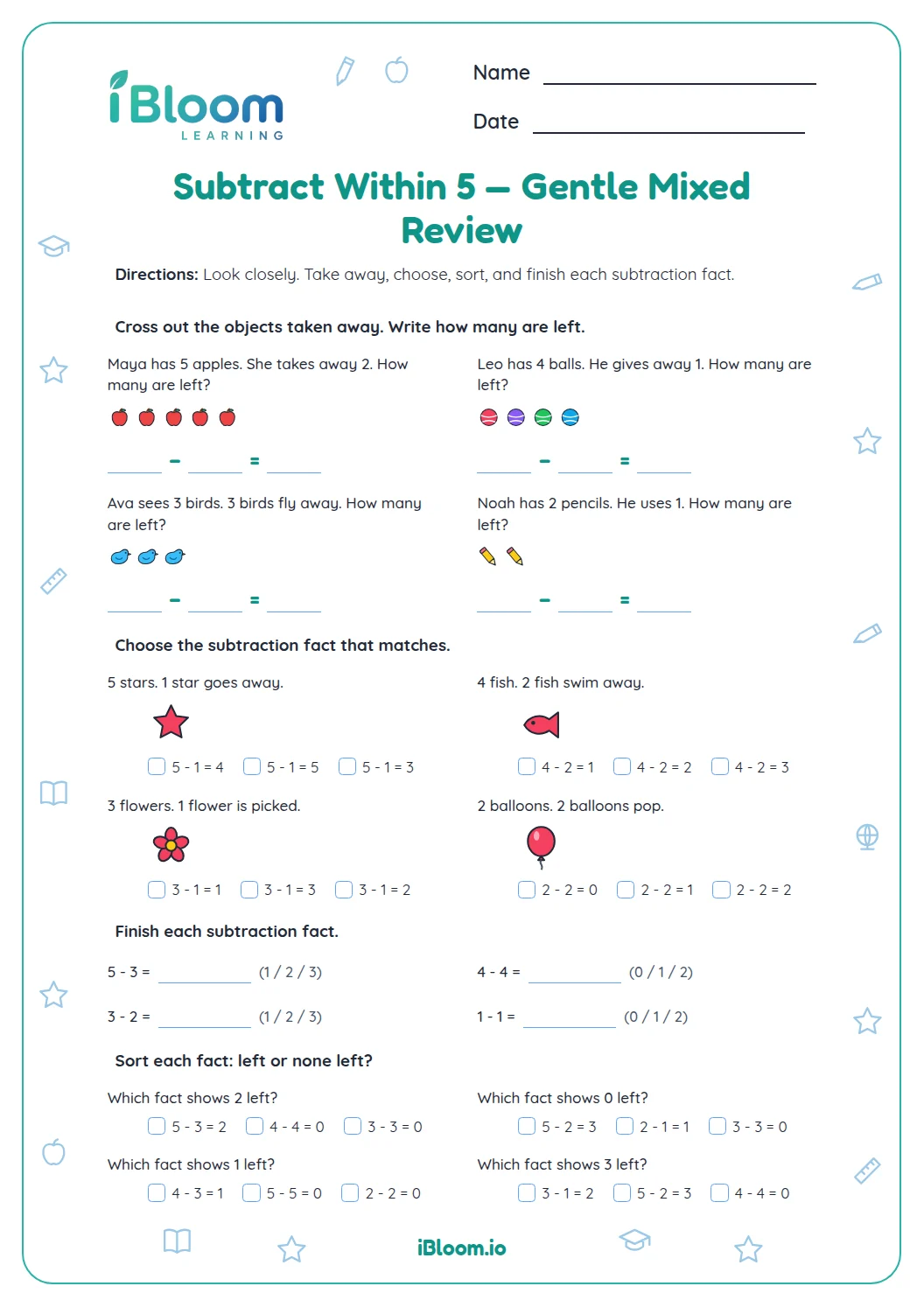
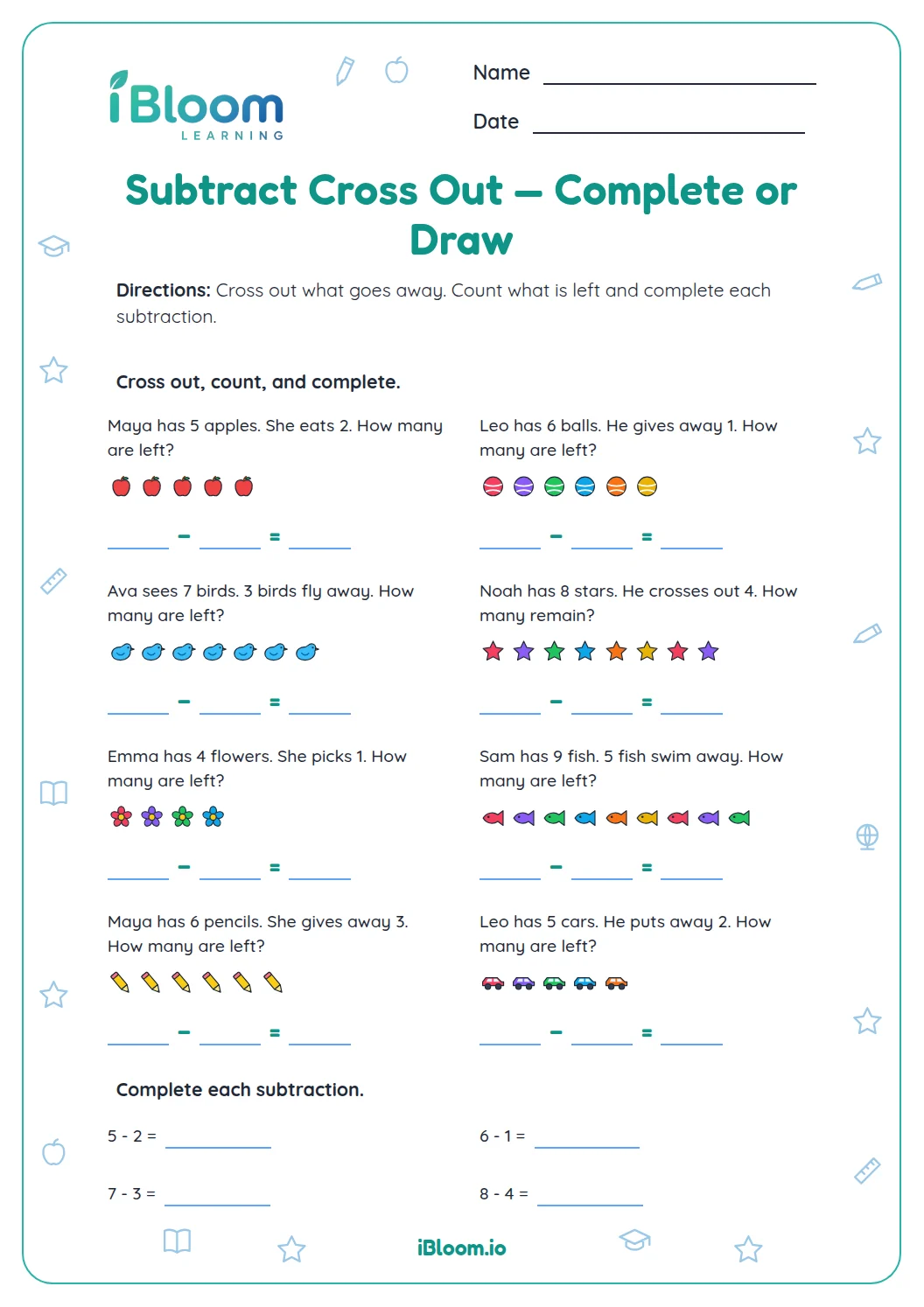
This printable gives preschool and kindergarten learners 14 ways to practice subtraction within 5. Children solve familiar take-away stories, cross out objects in four pictured groups, and find missing numbers in subtraction sentences. Each problem uses small numbers and a concrete action, with a separate answer key for checking.
Aligned to K.OA.A.2
How does a take-away story work?
A subtraction story starts with a group. Some leave, and the answer tells how many remain. For example, four apples minus one apple leaves three apples.
- 14 apples start
- 21 apple goes away
- 34 − 1 = 3 apples remain
How can pictures help?
On the four picture questions, cross out the number that leaves and count the uncrossed objects. Keep your finger on each object as you count once.
Each pictured group shows the whole group before anything is removed.
How do I finish a number sentence?
A sentence such as 5 − ___ = 3 asks how many were taken away. Count back from 5 until you reach 3.
How to use this worksheet
- 1Read the whole story before counting.
- 2Name the starting group.
- 3Move or cross out the number that leaves.
- 4Count only the objects remaining.
- 5Check that the number sentence matches the story.
Common mistakes and quick fixes
The mistake
Counting the objects that leave in the answer.
The fix
Move those objects away, then count only the group that remains.
The mistake
Starting at zero and counting the starting group plus one.
The fix
Touch each object once, saying one through the last number.
The mistake
Writing the number that left instead of the number left.
The fix
Ask, “How many are still here?” and count the uncrossed objects.
Common Core connection
These questions practice early subtraction through object and story models.
Solve subtraction word problems with objects or drawings.
On this sheet: Children model take-away stories with small groups of objects.
Show the official wordingHide the official wording
Solve addition and subtraction word problems, and add and subtract within 10, e.g., by using objects or drawings to represent the problem.
What to practice next
Make more practice
Further reading
Questions parents and teachers ask
What does subtraction mean on this page?
Subtraction means taking some objects away from a starting group. The answer tells how many are still there after the change. The four pictured groups also let a child point to each object while naming what remains. Try saying the action aloud before writing the answer.
How many questions are included?
There are 14 questions in three parts: six short stories, four picture-supported take-away stories, and four missing-number sentences. Each part changes the task type while keeping every number at five or below. The formats keep practice concrete and varied.
Can my child use counters?
Yes. Put out the starting number of counters, move away the amount named in the story, and count what remains. Finger counting, counters, or a quick sketch are all useful ways to check the same small subtraction. Repeating the same steps helps connect the story to subtraction.
What if my child counts the crossed-out objects too?
Ask them to touch only the objects that stay. Moving crossed-out counters aside can make the remaining group easier to count. The four picture items show the starting group, so children can track what is removed before counting the rest.
Is an answer key included?
Yes. A separate key lists the answer to every story and number sentence so an adult can check the work. The key is designed for quick checking after the child has tried each item independently. It also helps spot a reversed or skipped count.