




About this worksheet
Children complete short contexts by writing a synonym for a familiar word, then finish picture-supported sentences with familiar opposites.
Aligned to L.K.5
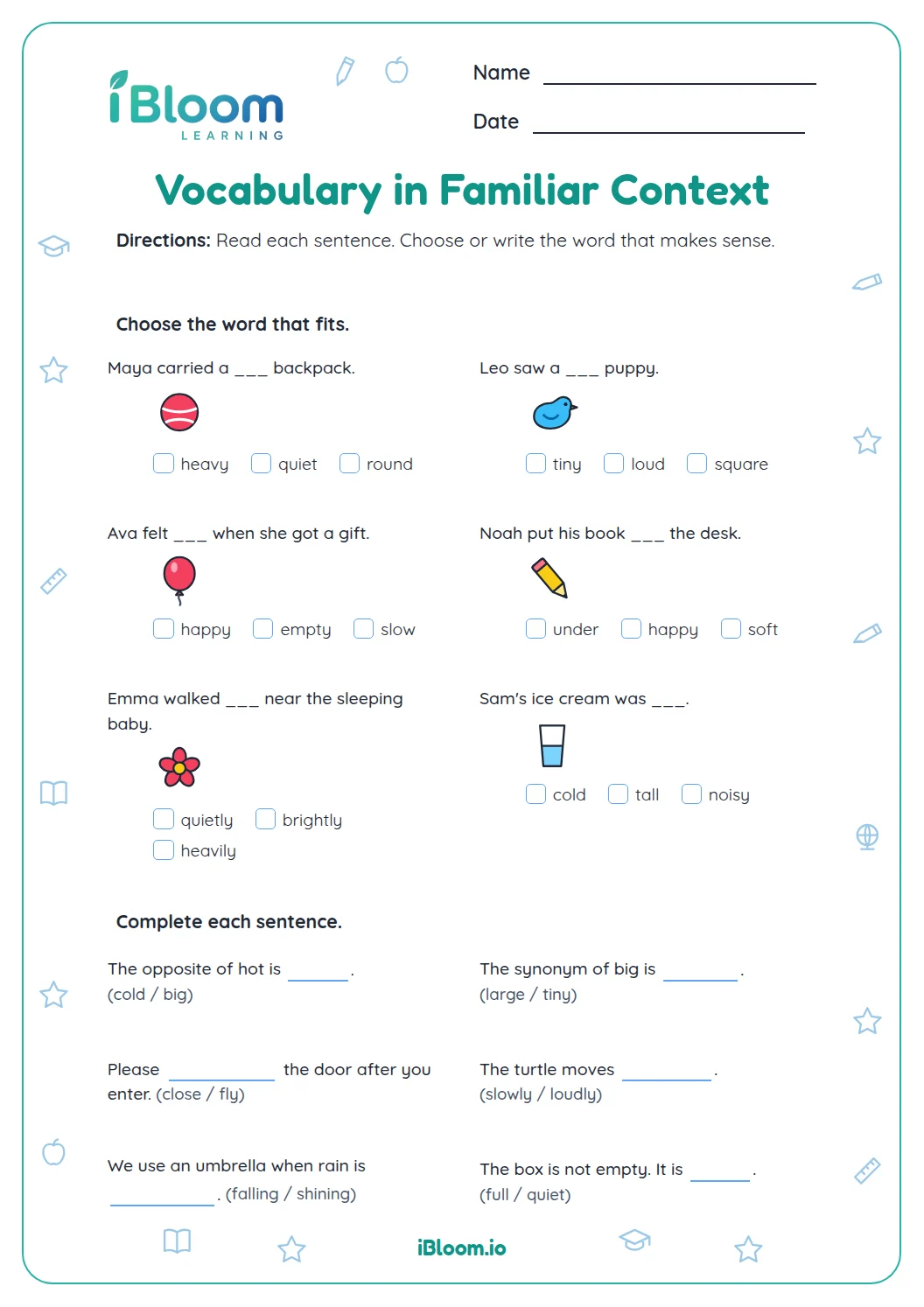
Choose a word that fits
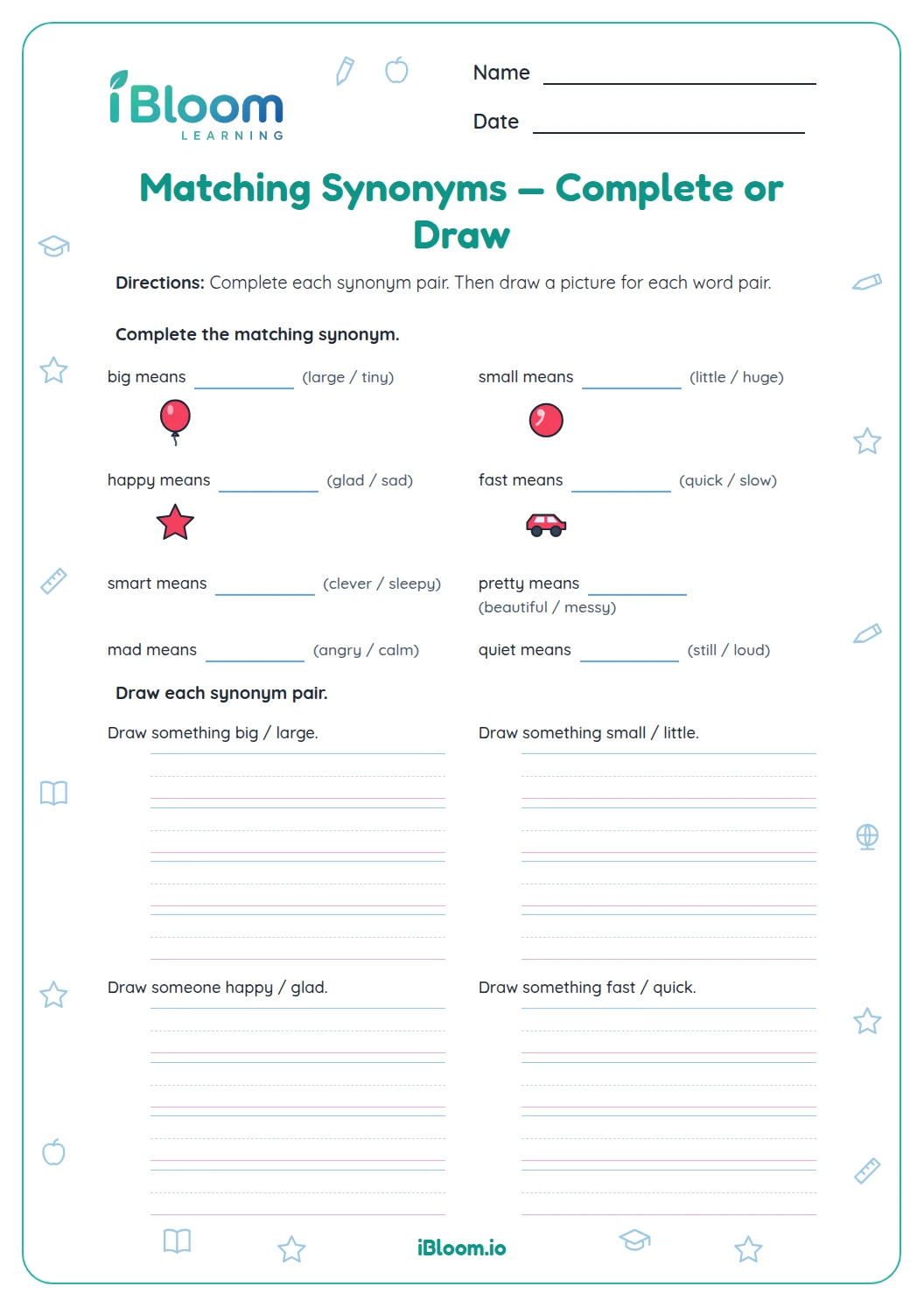
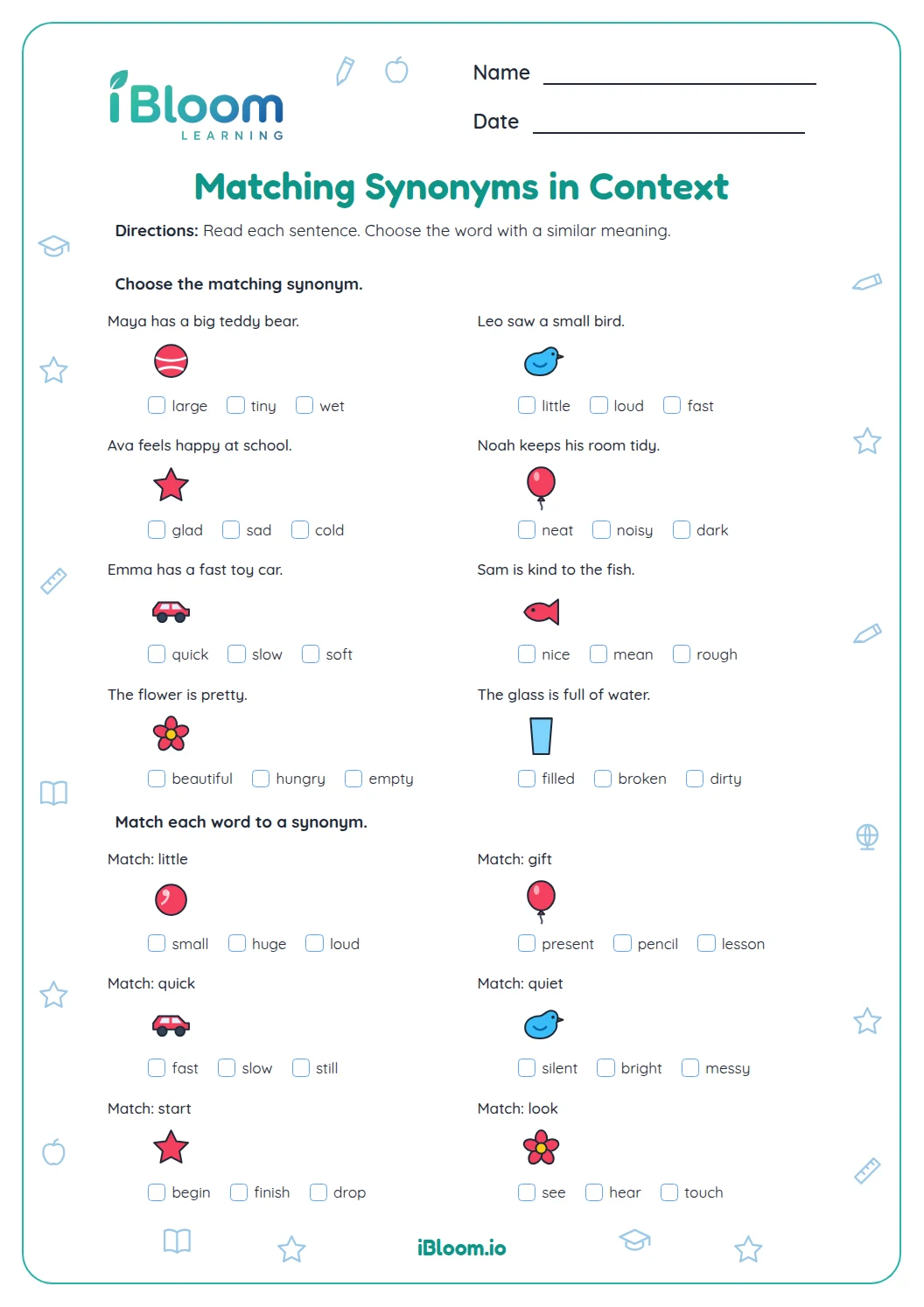
Synonyms have close meanings, but a replacement still has to make sense in its sentence. “Large” can replace “big” in “Maya has a large ball.” “Glad” can replace “happy” when Leo sees a new puppy.
The small pictures give a familiar setting or object. Read the whole sentence, say the supplied word, then try a synonym in the blank.
Think of the opposite
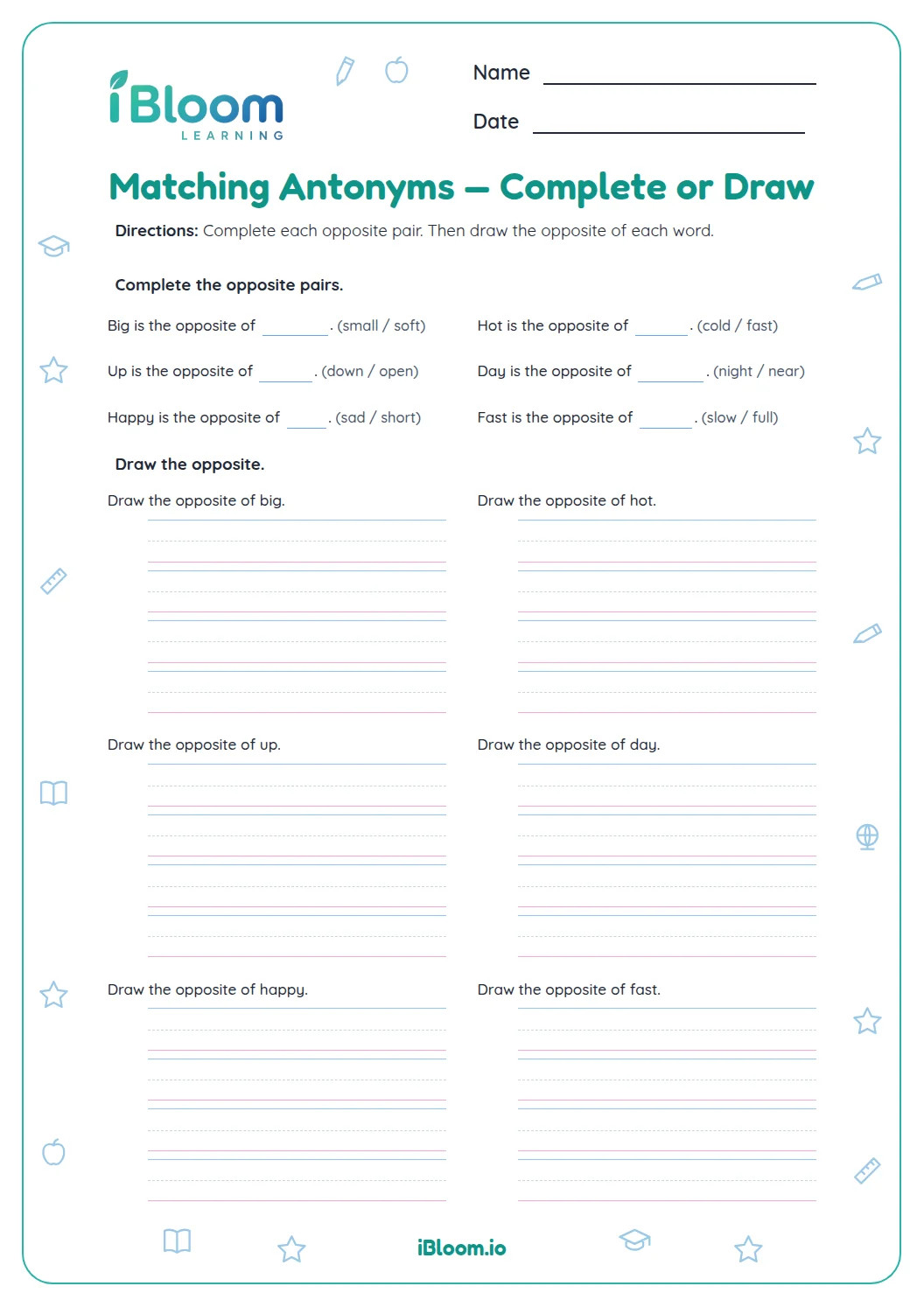
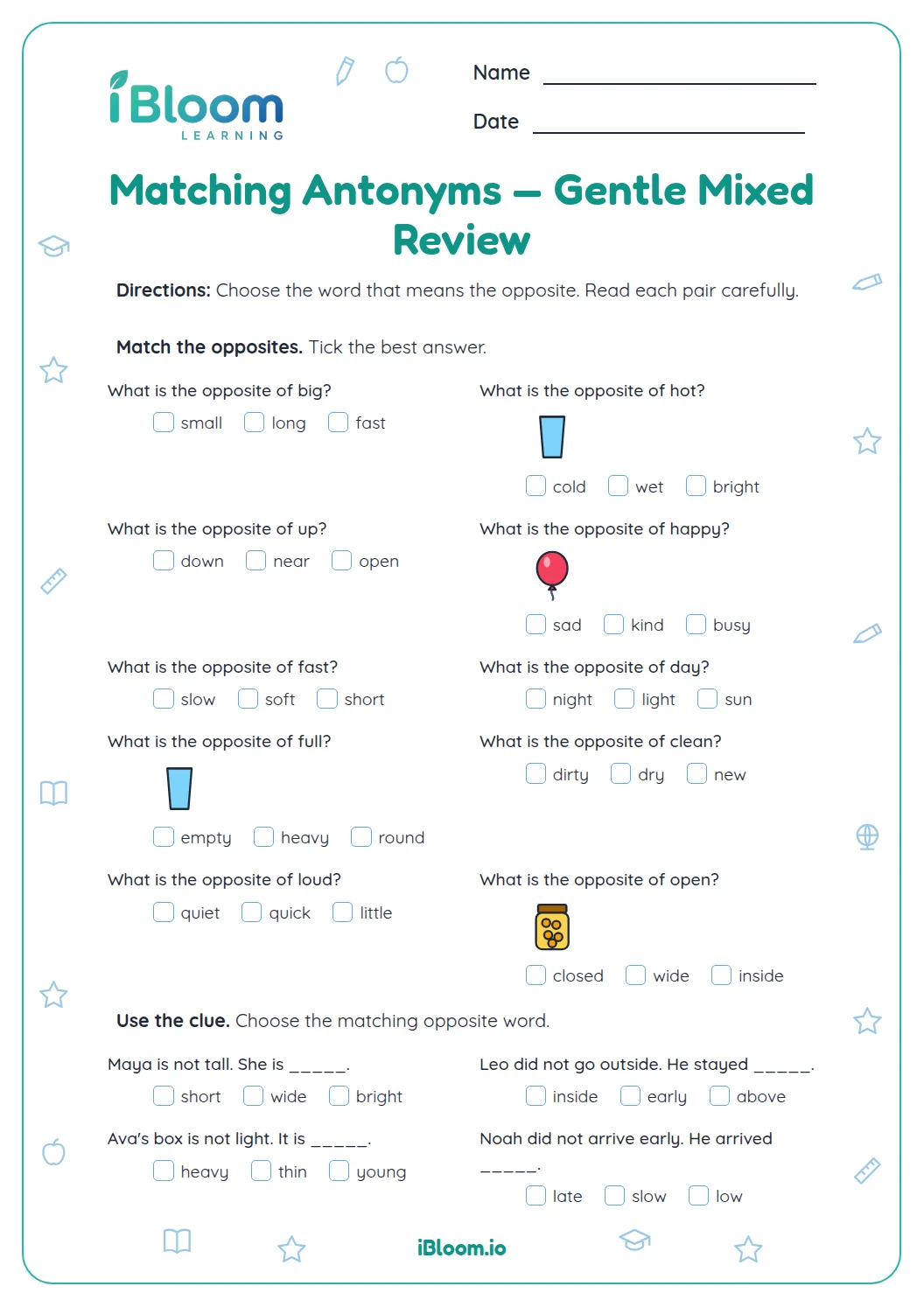
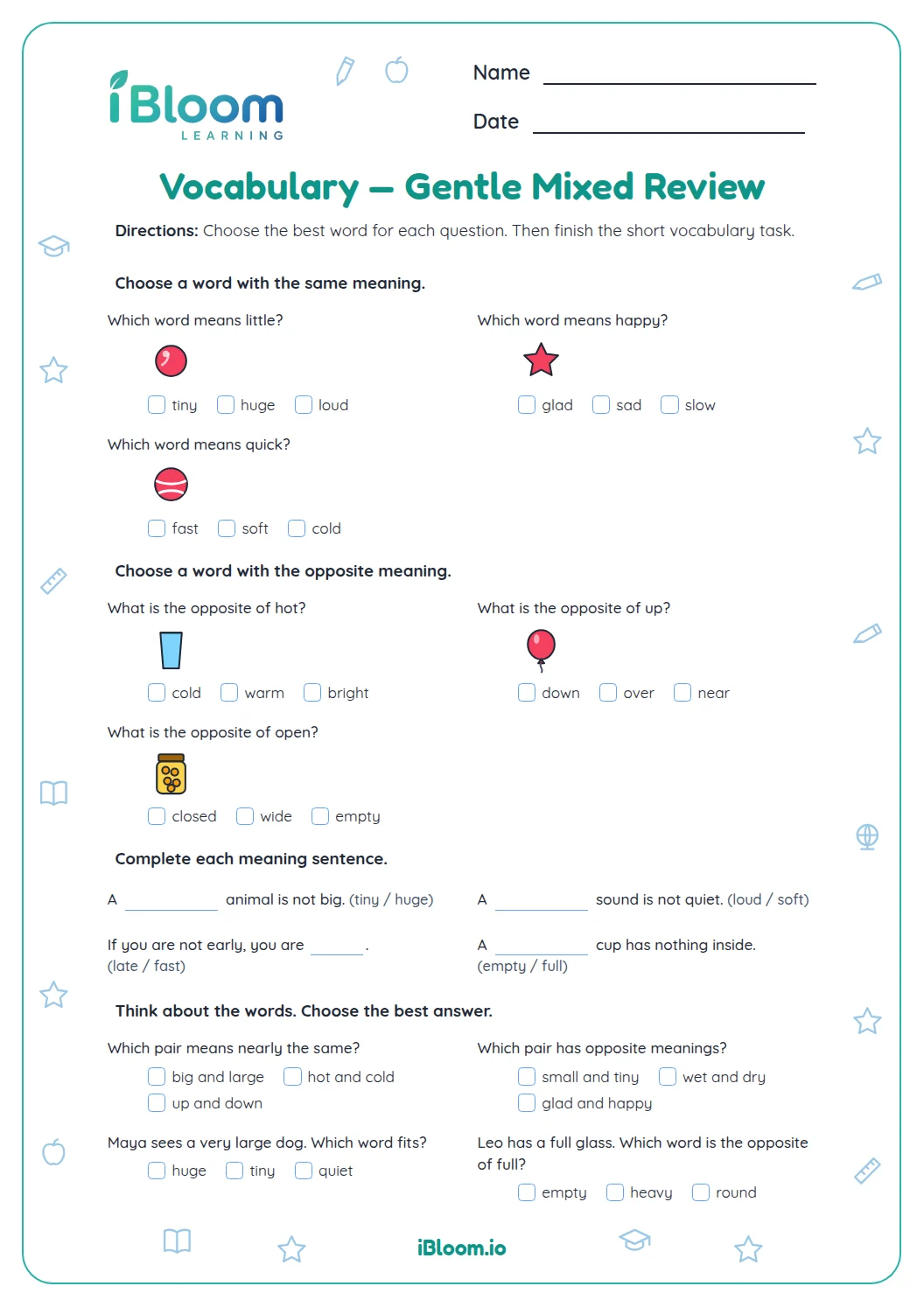
An antonym means the opposite: small is the opposite of big, and slow is the opposite of fast. The second part asks children to supply opposites for familiar words.
Answers may vary when a word has more than one reasonable opposite. The key gives one simple answer for each blank; accept another familiar word that clearly fits the sentence and has the requested relationship.
Talk through each word
- 1Read the sentence and name the word in parentheses.
- 2Ask whether the blank needs a word with a similar or opposite meaning.
- 3Look at the small picture and use the whole sentence as a clue.
- 4Let the child say a possible answer aloud before writing it.
- 5Check the key together; accept another sensible synonym or antonym.
Common word-meaning mix-ups
The mistake
Writing an opposite when the prompt asks for a synonym.
The fix
Repeat the direction: “almost the same” means a synonym; “opposite” means an antonym.
The mistake
Choosing a word that does not fit the sentence.
The fix
Read the completed sentence aloud. “Damp” fits a towel after a bath; “slow” would not.
The mistake
Thinking there is only one possible synonym.
The fix
Use the key as one example. Accept a different familiar word if it has the right meaning and fits the context.
Curriculum alignment
This early vocabulary practice explores word relationships with adult guidance, matching Common Core Language standard L.K.5.
With guidance and support from adults, explore word relationships and nuances in word meanings.
On this sheet: With adult support, children explore familiar words with similar and opposite meanings in short contexts.
Show the official wordingHide the official wording
With guidance and support from adults, explore word relationships and nuances in word meanings.
What to practice next
Make more practice
Further reading
Questions parents and teachers ask
What is a synonym for a young child?
A synonym is a word with a similar meaning. “Large” is a synonym for “big,” and “glad” is a synonym for “happy.” Children use the word in parentheses and the short sentence to write a word that fits. The answer key lists large as one possible synonym.
What is an antonym?
An antonym is a word with the opposite meaning. “Small” is the opposite of “big,” and “slow” is the opposite of “fast.” The second part asks children to write simple opposites for familiar words. For example, sad is the opposite of happy.
Why are there pictures beside the sentences?
The pictures show concrete words in the activity, such as a ball, rabbit, book, rain, elephant, ant, turtle, drum, sun, and snowflake. Each picture matches the object or context in its sentence. Read the words as well as looking at the icon so the meaning relationship stays clear.
Does every blank have only one right answer?
The answer key gives one suitable answer for each blank, but some familiar words have more than one synonym or antonym. Read the completed sentence aloud. Accept another answer when it fits the context and clearly has the requested similar or opposite meaning.
How can an adult help with a hard word?
Read the whole sentence aloud, say the word in parentheses in this activity, and ask for another word that makes sense and means almost the same or the opposite. Accept a clear match even if it differs from the key’s sample answer.