





About this worksheet
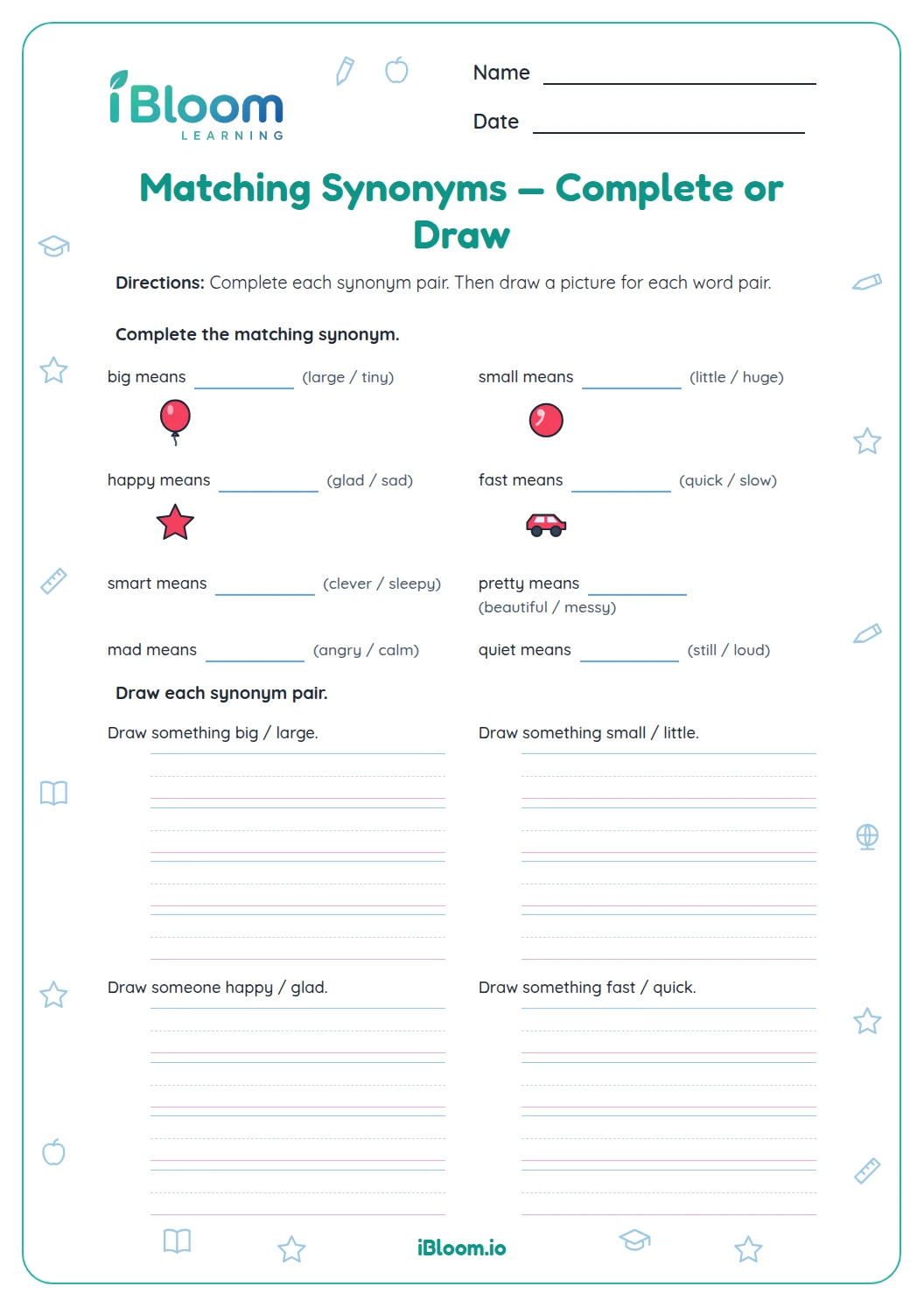
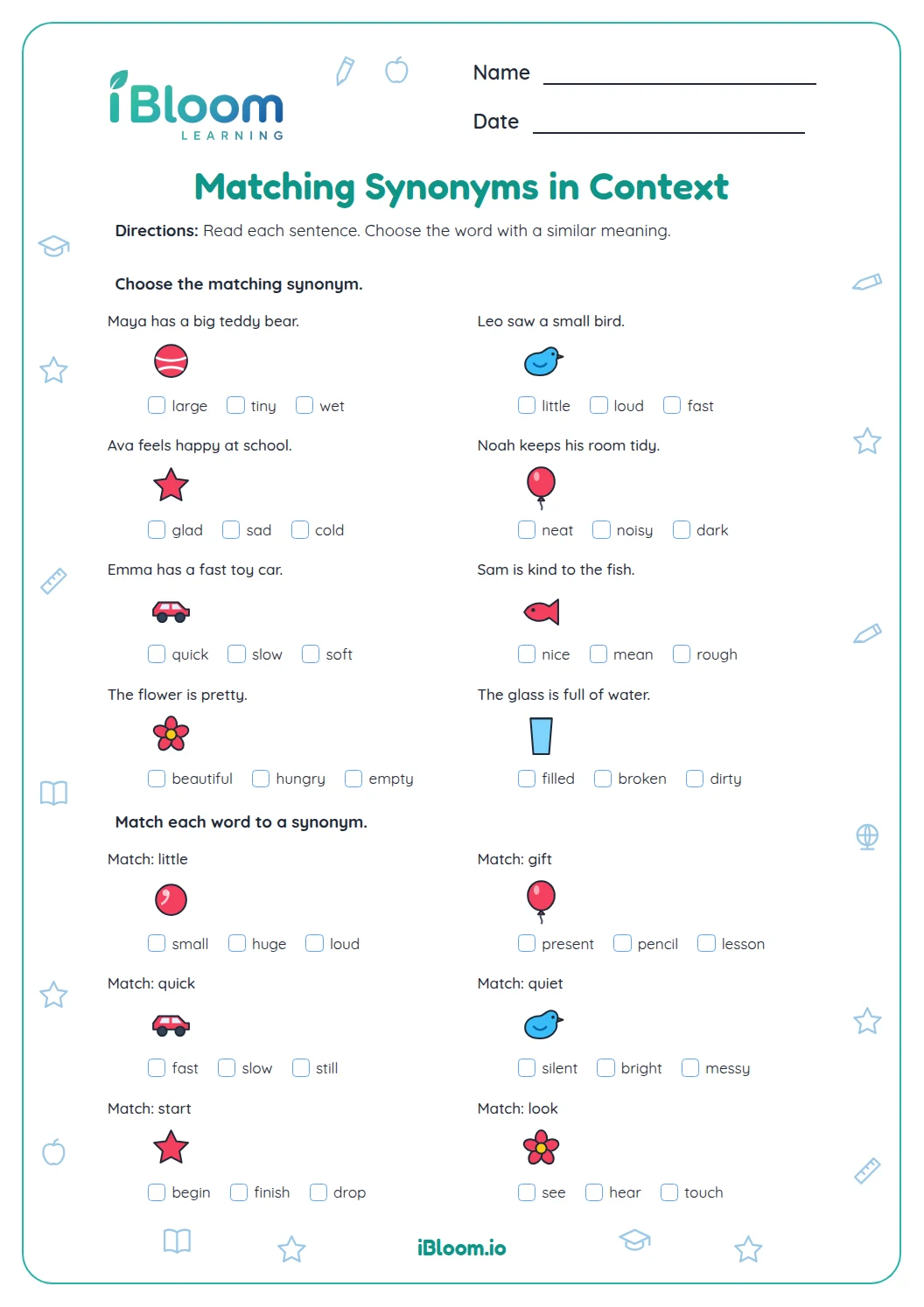
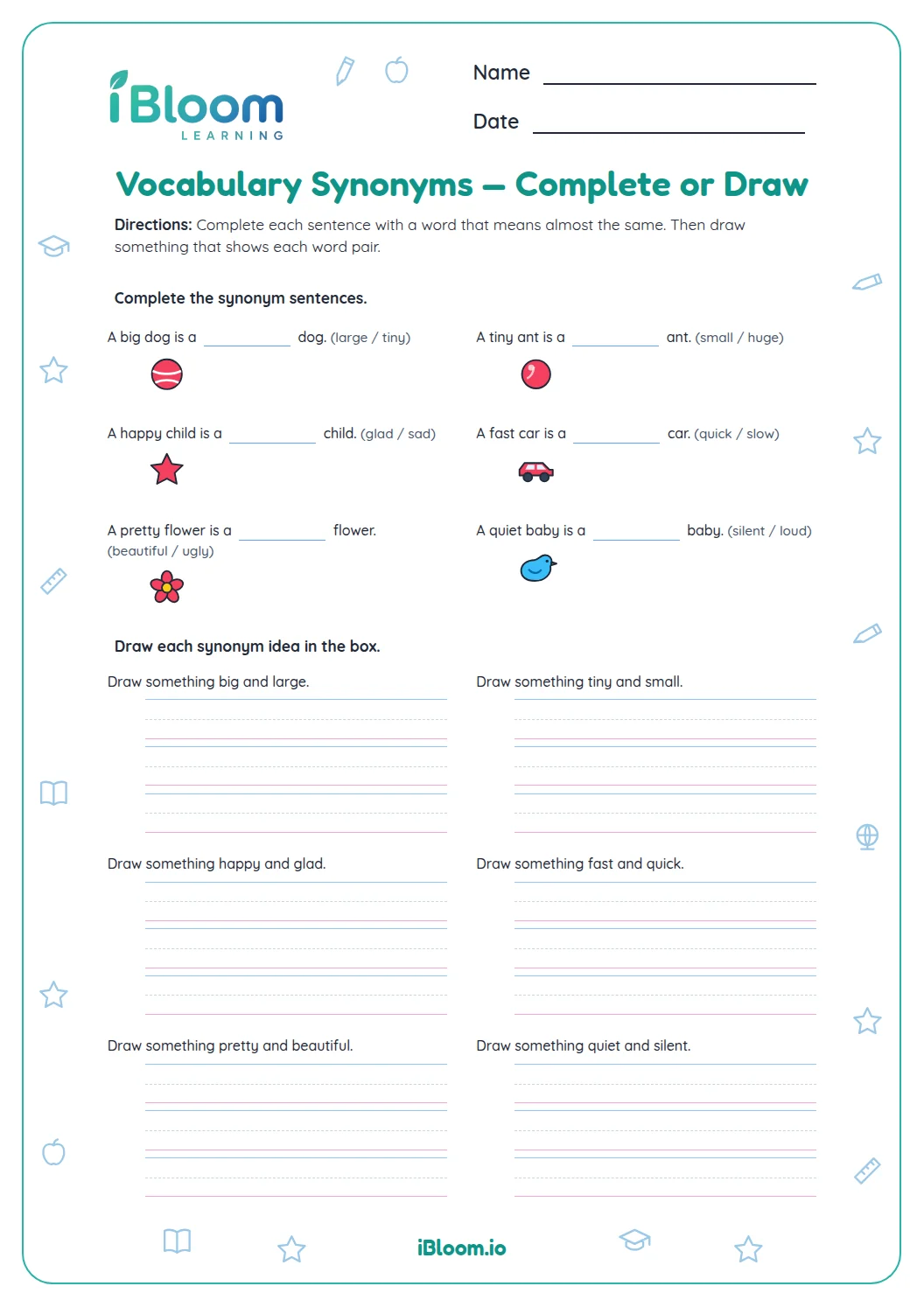
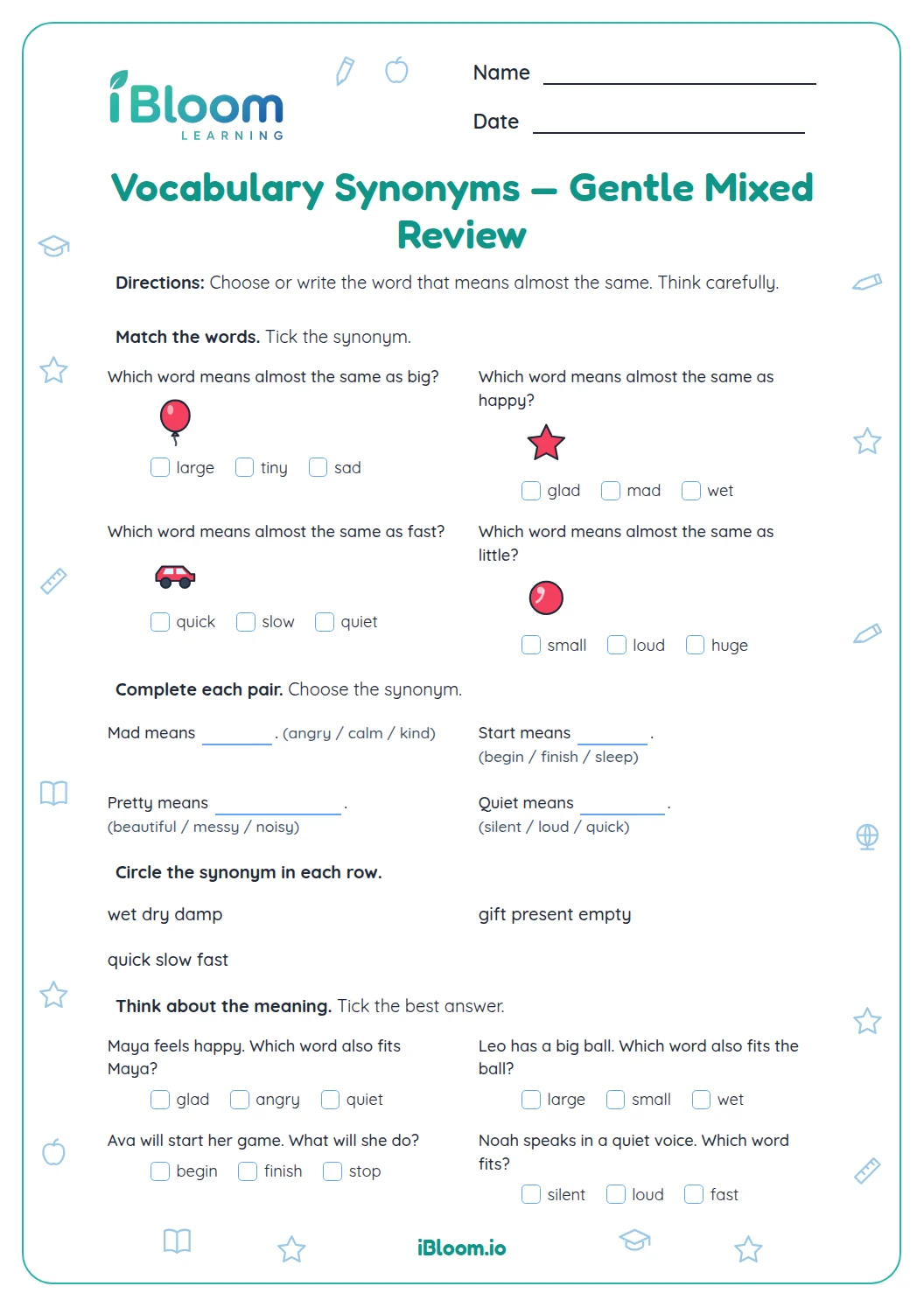
This free printable Pre-K and Kindergarten worksheet introduces synonyms, words that mean almost the same thing. A grown-up reads each word aloud while the child picks the word that means the same as big, cold, fast and pretty, chooses the picture that shows large, quick, chilly or little, traces the synonyms large and quick, and draws something large. It practices exploring word relationships and word meanings with adult support (CCSS L.K.5). A separate answer key is included.
Aligned to L.K.5
What is a synonym for a young child?
A synonym is a different word that means the same thing. Big and large both tell about size, and cold and chilly both tell about temperature. At this age the goal is not to learn the term but to notice that there is more than one way to say the same thing.
Each question in Part A shows a picture of something the word describes. An elephant is big, so the grown-up reads the choices and the child marks the word that means the same, large, instead of the opposite, tiny.
- 1The picture shows an elephant.
- 2Big means the same as ...
- 3tiny? No, tiny is the opposite.
- 4large? Yes. An elephant is big and large.
Why are there picture questions?
Part B turns the words around. Instead of reading a word, the child looks at two pictures and marks the one that is large, quick, chilly or little. Seeing the meaning in a picture helps the new word stick to something real, such as a rabbit for quick and a snowflake for chilly.
Each pair has one picture that fits and one that does not, so a child who knows the meaning can choose without having to read.
What do the tracing and drawing add?
In Part C children trace large and quick, the synonyms of big and fast from Part A. Tracing gives their hands a first feel for the letter shapes of the new words. In Part D they draw something large in a box big enough to fill.
The answer key notes what a good drawing shows, such as a whale or a bus. Any picture of something large is right, and asking your child to name it with both words, big and large, repeats the synonym pair once more.
What is on this worksheet?
Eleven items in four parts on two pages, meant to be done with a grown-up reading aloud.
- Part A, Same meaning: four questions, each with a picture clue and words to choose from (big, cold, fast and pretty)
- Part B, Pick the picture: four questions with two pictures each (large, quick, chilly and little)
- Part C, Trace the synonym: two words to trace, large and quick
- Part D, Draw it: one drawing box for something large
- A separate answer key
How to use this worksheet at home or in class
- 1Say the instructions together and read each word aloud. Your child does not need to read the words alone.
- 2In Part A, point to the picture, say the first word, then read each choice and let your child decide.
- 3If your child picks the opposite, ask about the picture again: is the elephant small or big?
- 4In Part B, read the word first, then ask your child to point to the picture that matches.
- 5In Part C, say each word before your child traces it and ask which word from Part A it matches: large goes with big, quick goes with fast.
- 6In Part D, let your child draw anything large, then ask them to tell you about it using both big and large.
Common mistakes and quick fixes
The mistake
Choosing the opposite word, such as tiny for big, because both words are about size.
The fix
Look at the picture again and ask whether the word fits it. Tiny and big could not describe the same elephant.
The mistake
Picking a word because it starts with the same sound, such as plain for pretty.
The fix
Say that a synonym is chosen by what the word means, not by how it starts. Ask what pretty things look like.
The mistake
Drawing something small for large, such as a bug or a button.
The fix
Ask your child to compare: would this fit in your hand? A large thing is much bigger than that, like a bus, a whale or a house.
Common Core alignment
Most US states use the Common Core standards or a close state version. This sheet practices the standard below.
With a grown-up, explore how words relate and how their meanings differ.
On this sheet: Parts A and B match words that mean the same, and Parts C and D practice the synonym pairs.
Show the official wordingHide the official wording
With guidance and support from adults, explore word relationships and nuances in word meanings.
What to practice next
Make more practice
Further reading
Questions parents and teachers ask
What should my child know before this worksheet?
Your child should know the words big, small, hot, cold and fast from daily life, and be able to point to a picture when asked. They do not need to read, because a grown-up reads the words aloud. Tracing is easier if your child can already hold a pencil and make simple lines.
What does synonym mean for a preschooler?
A synonym is a different word that means the same thing, like big and large. You can say it simply as another word for. Ask, "What is another word for big?" and let your child hear large. The word synonym itself can wait until your child is older.
Is this worksheet too hard for Pre-K?
It is made for Pre-K and Kindergarten with a grown-up. Parts A and B are choices with pictures, so no writing is needed. Part C is two words to trace, and Part D is free drawing. Do as much as your child enjoys and return to the rest another day.
What should my child draw for large?
Anything that is big. A large thing is bigger than most things around it, like a whale, a bus, a house or a mountain. The answer key notes this and accepts any picture that fits the word. Ask your child to say a sentence about the drawing using large, such as "The whale is large."
What if my child cannot trace the words yet?
That is fine. Tracing is practice, not a test. Your child can trace over only the first letter or trace with a finger first. You can also write the word together on a separate paper and let them copy the shape of it. The synonym matching in Parts A and B is the main skill.
Is there an answer key for this worksheet?
Yes. A separate answer key shows the correct word for each question in Part A, the correct picture in Part B, the traced words in Part C and a note on what a good drawing shows in Part D. Print the worksheet on its own and keep the key nearby to check together as you go.