







About this worksheet
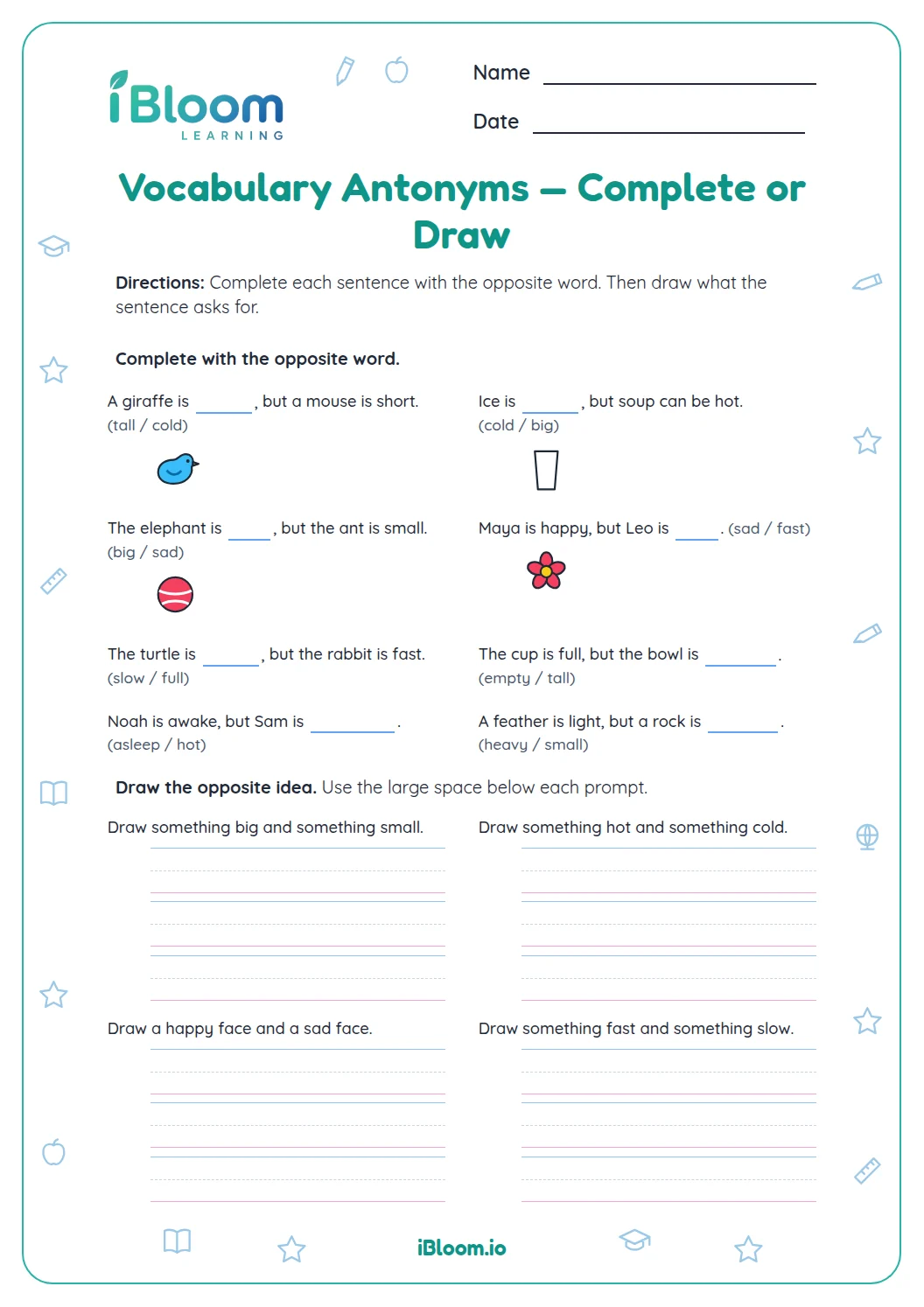
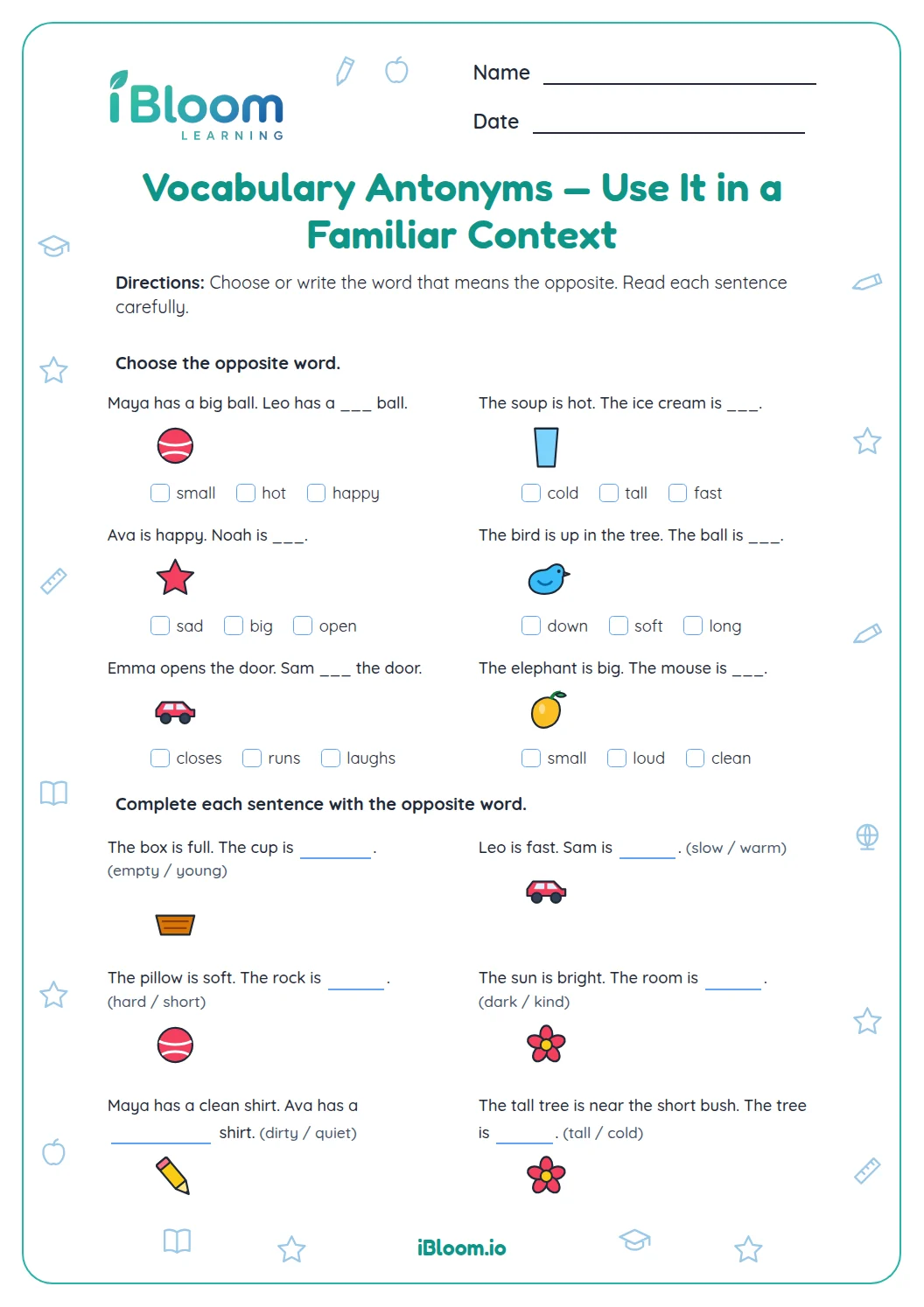
This printable helps preschool and kindergarten learners recognize antonyms, or words with opposite meanings. Children choose opposites for familiar describing words and actions, use picture clues, and write two words of their own. The 14 questions practice CCSS L.K.5.b with a gentle move from choices to independent responses.
Aligned to L.K.5.b
What does an opposite word tell us?
An antonym tells a contrasting meaning. Hot and cold describe opposite temperatures; up and down describe opposite directions. Children can use the whole sentence to decide which word fits.
For question 1, ice is cold, the opposite clue for hot.
- 1The sun is hot. Ice is ___.
- 2Think of a contrasting temperature word.
- 3Answer: cold
How do picture clues help?
A picture can make familiar words easier to connect. In question 13, the sun is bright and the moon is dim; the child selects the word that matches the clue.
When should children write their own answer?
The final questions invite a child to supply an opposite without choices. Accept another sensible opposite that fits the word and the child’s vocabulary.
How to practice together
- 1Read each short clue aloud.
- 2Ask what the first describing word means.
- 3Use the sentence or pictures to find a contrasting idea.
- 4Let the child point to a choice before reading it aloud.
- 5For the last questions, accept a sensible opposite and ask for a spoken sentence.
Common mix-ups and a helpful prompt
The mistake
Choosing a word from the sentence that is related but not opposite.
The fix
Ask whether the two words mean contrasting things.
The mistake
Mixing up near and far.
The fix
Use a toy: place it close, then move it far away.
The mistake
Thinking every word has only one opposite.
The fix
Accept a fitting word, such as sad or unhappy for happy, when it suits the clue.
Common Core alignment
This worksheet gives children practice with the standard below.
Show understanding of common adjectives and verbs by relating them to opposites.
On this sheet: Children identify opposites for familiar describing and action words.
Show the official wordingHide the official wording
Demonstrate understanding of frequently occurring verbs and adjectives by relating them to their opposites (antonyms).
What to practice next
Make more practice
Further reading
Questions parents and teachers ask
What does antonym mean?
An antonym is a word that means the opposite of another word. Hot and cold are antonyms, as are up and down. This worksheet uses familiar words that young learners can discuss. Children choose opposites first, then name their own for happy and clean.
Is this worksheet suitable for preschool?
Yes. An adult can read the short prompts and choices aloud. Children can answer by pointing or saying a word, then try writing the final responses with support. The page starts with two-choice clues and keeps the written answers until the end.
How are pictures used?
Two questions use familiar picture clues alongside words, such as the sun and moon or an elephant and mouse. Children use the paired clues to select the opposite word. The images support the vocabulary, while the printed words make the meaning clear.
Can more than one answer be correct?
Some open responses can have more than one sensible antonym. The key gives a sample answer, and an adult can accept another word that expresses a clear opposite. For example, sad works for happy, while unhappy is another reasonable response.
How many questions are included?
There are 14 questions: 12 choose-an-answer clues and two short written responses. The final prompts ask children to supply an opposite for happy and clean. The answer key gives sample responses, and another clear opposite may also be accepted.