








About this worksheet
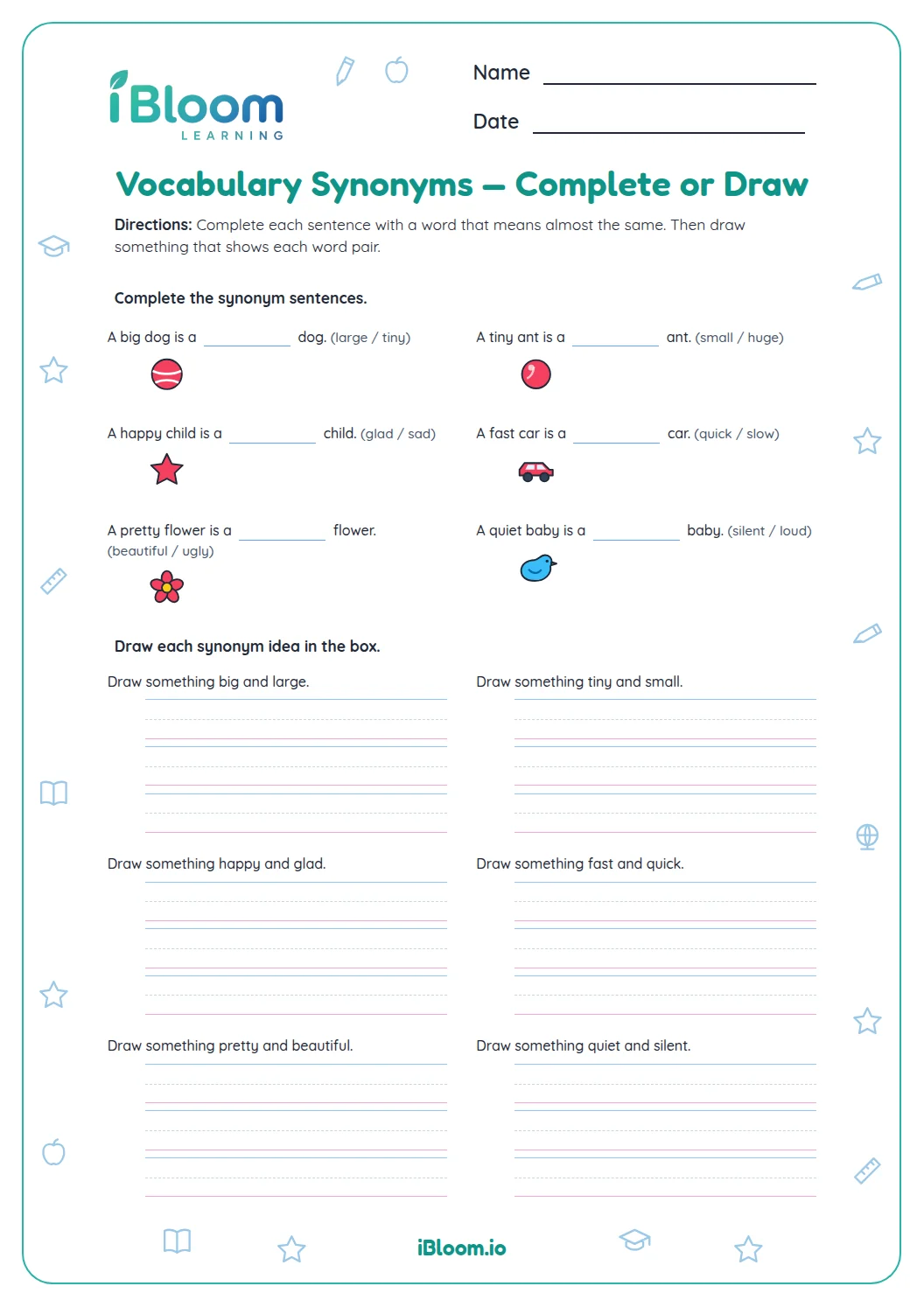
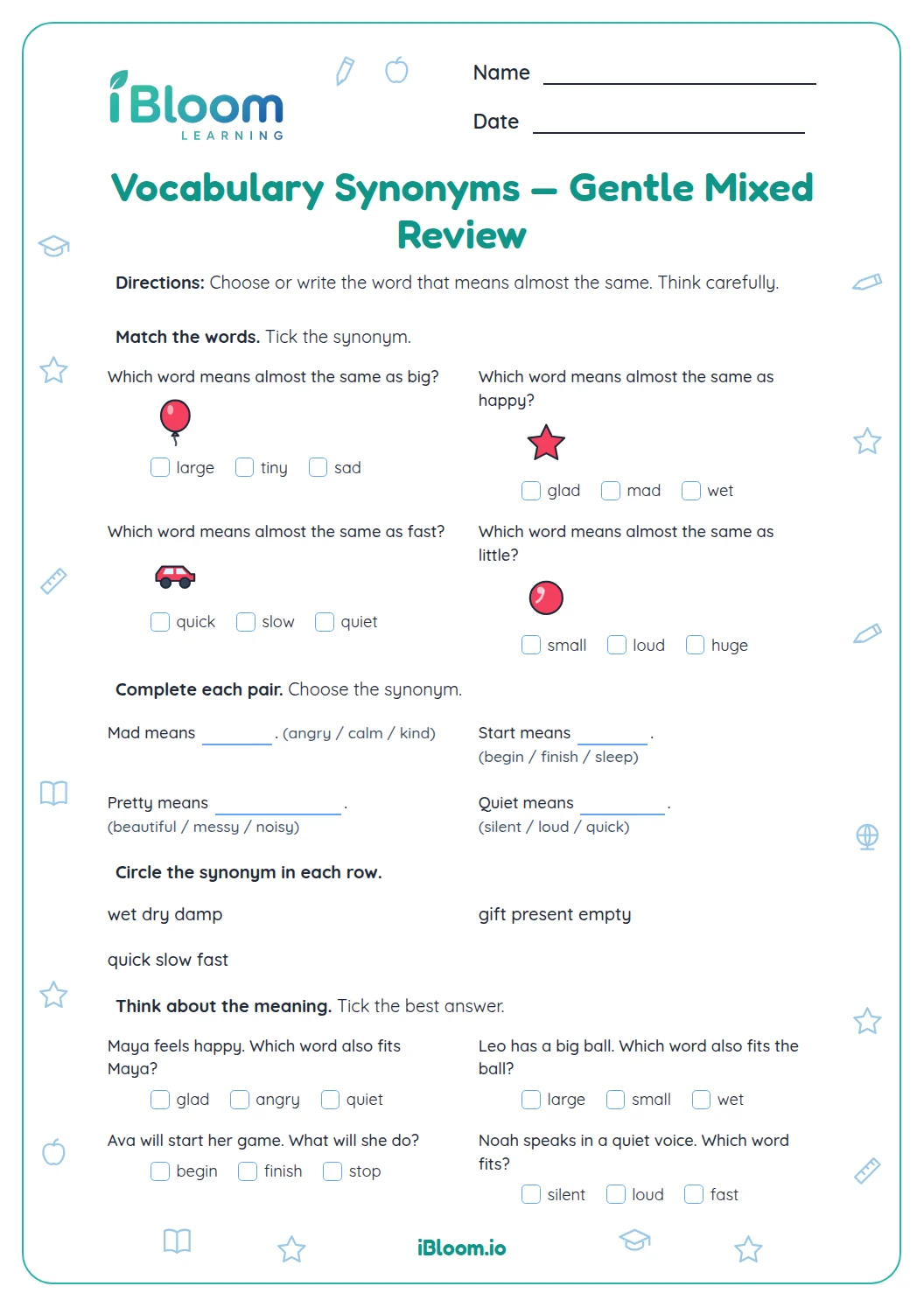
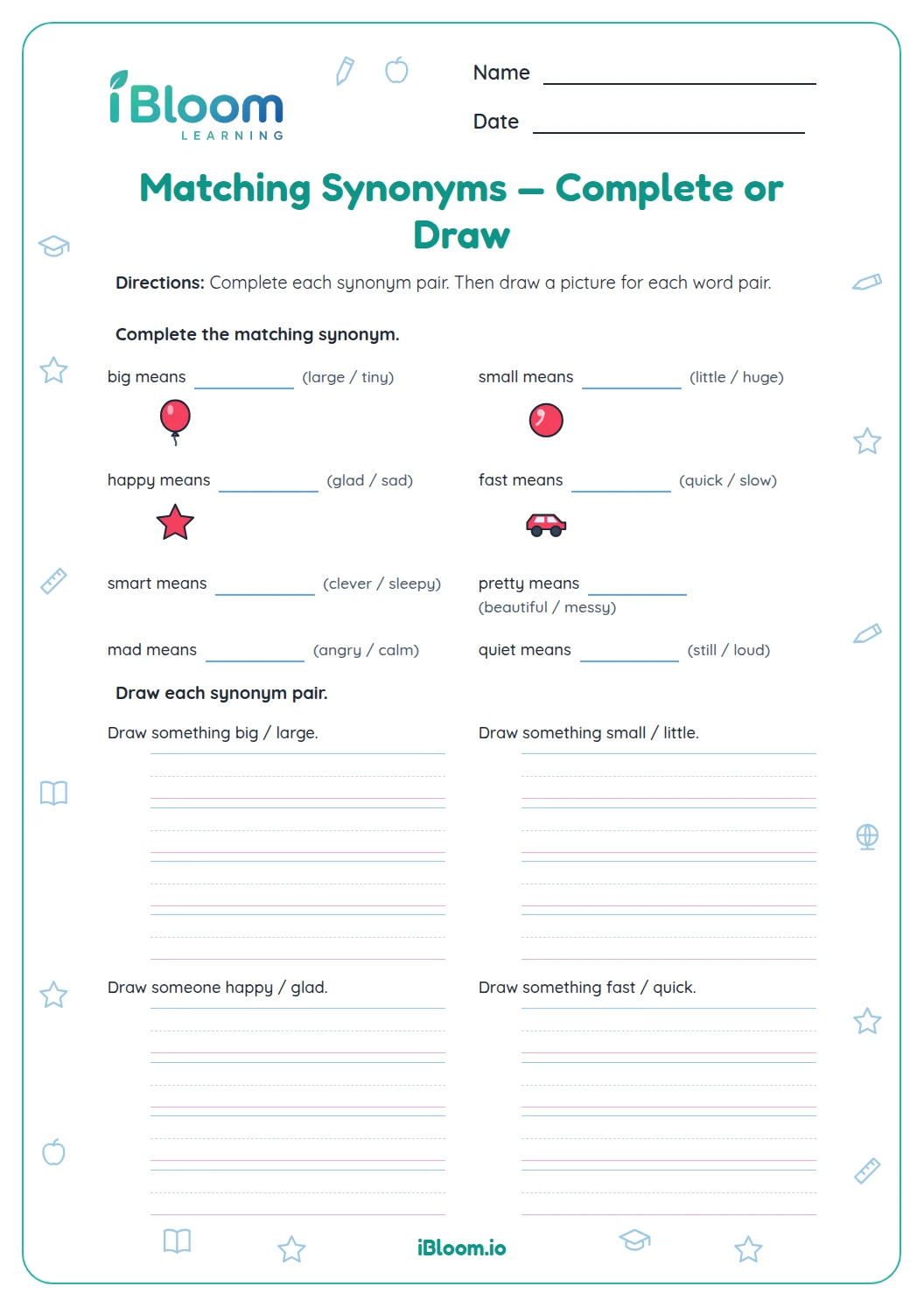
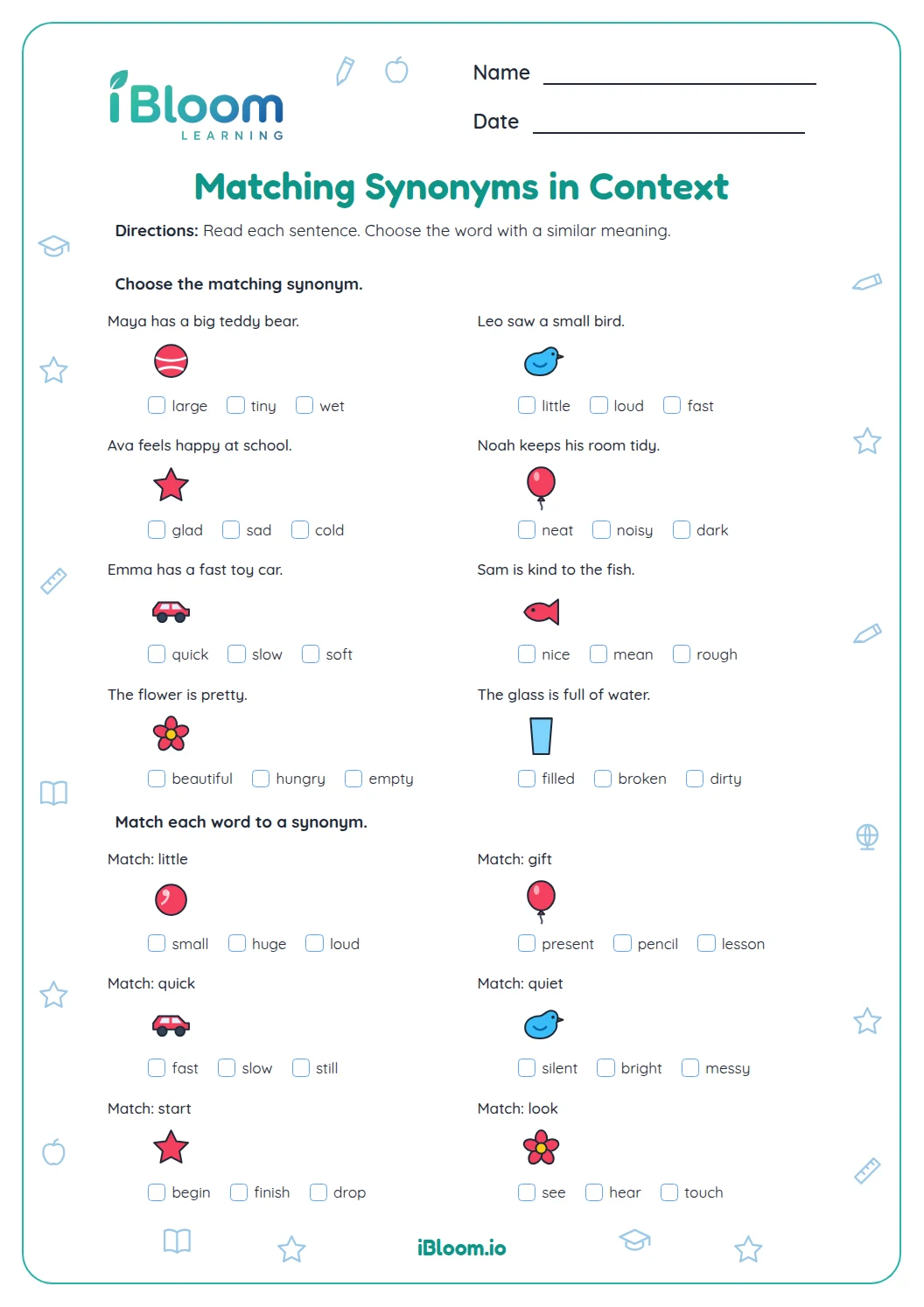
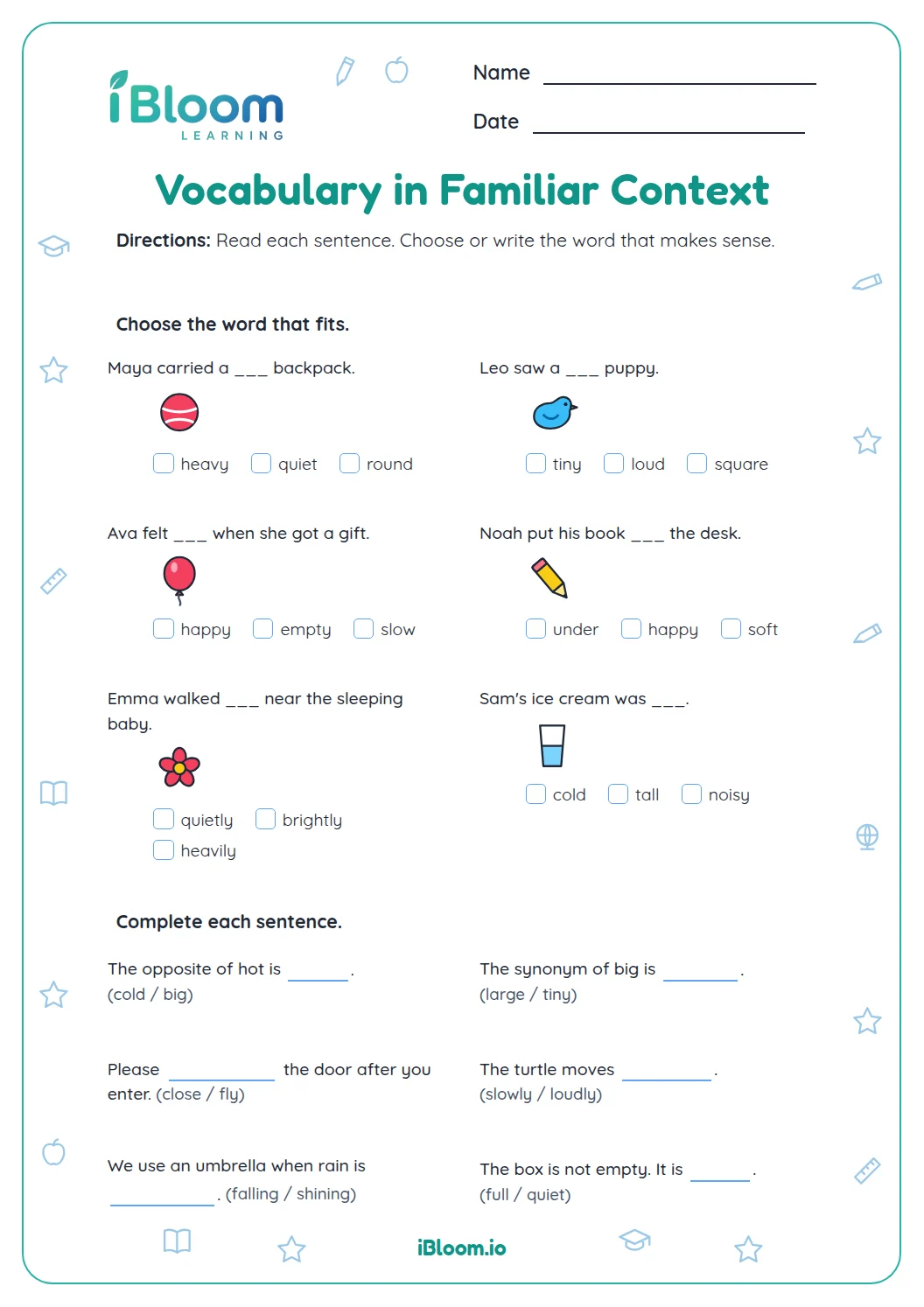
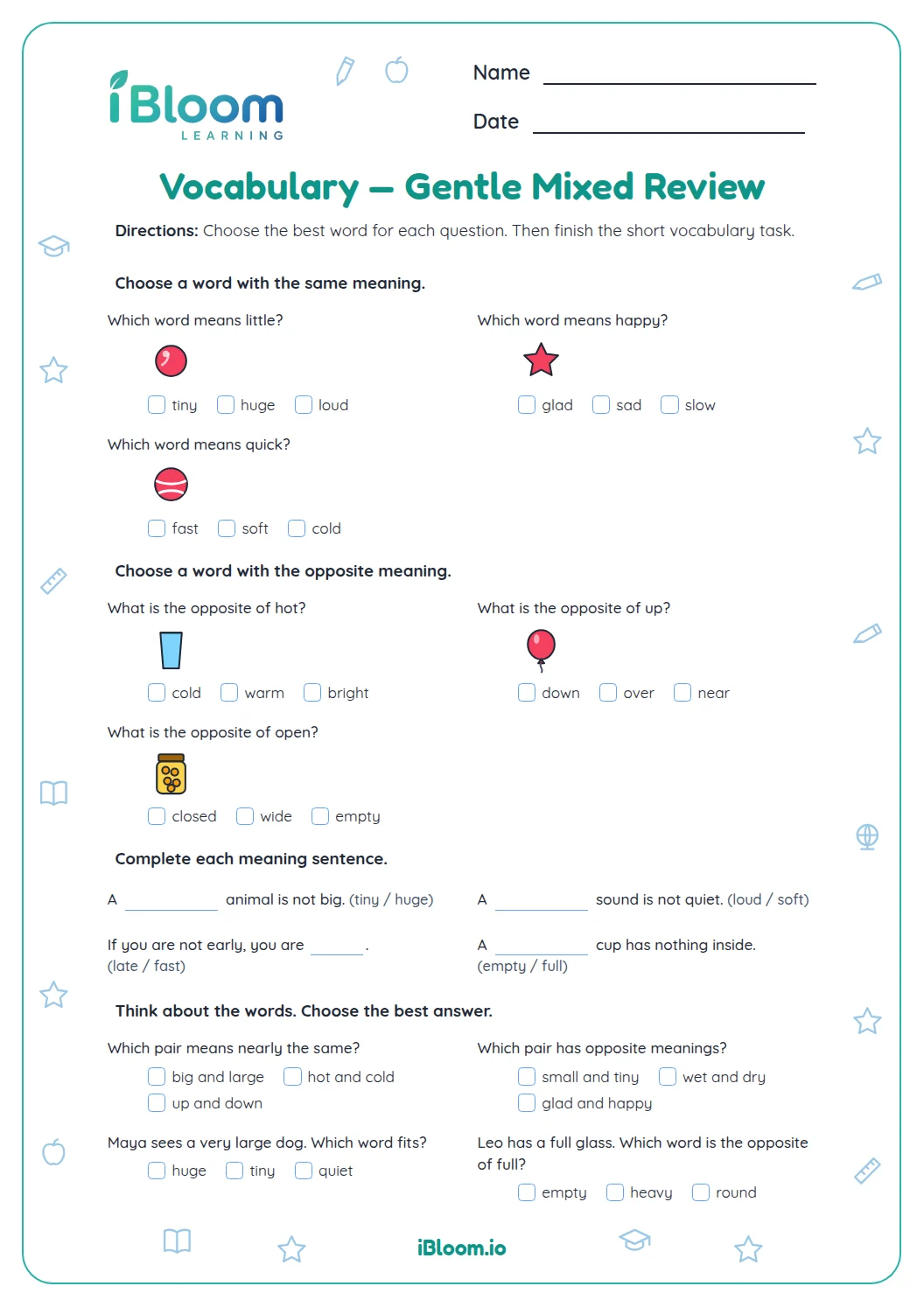
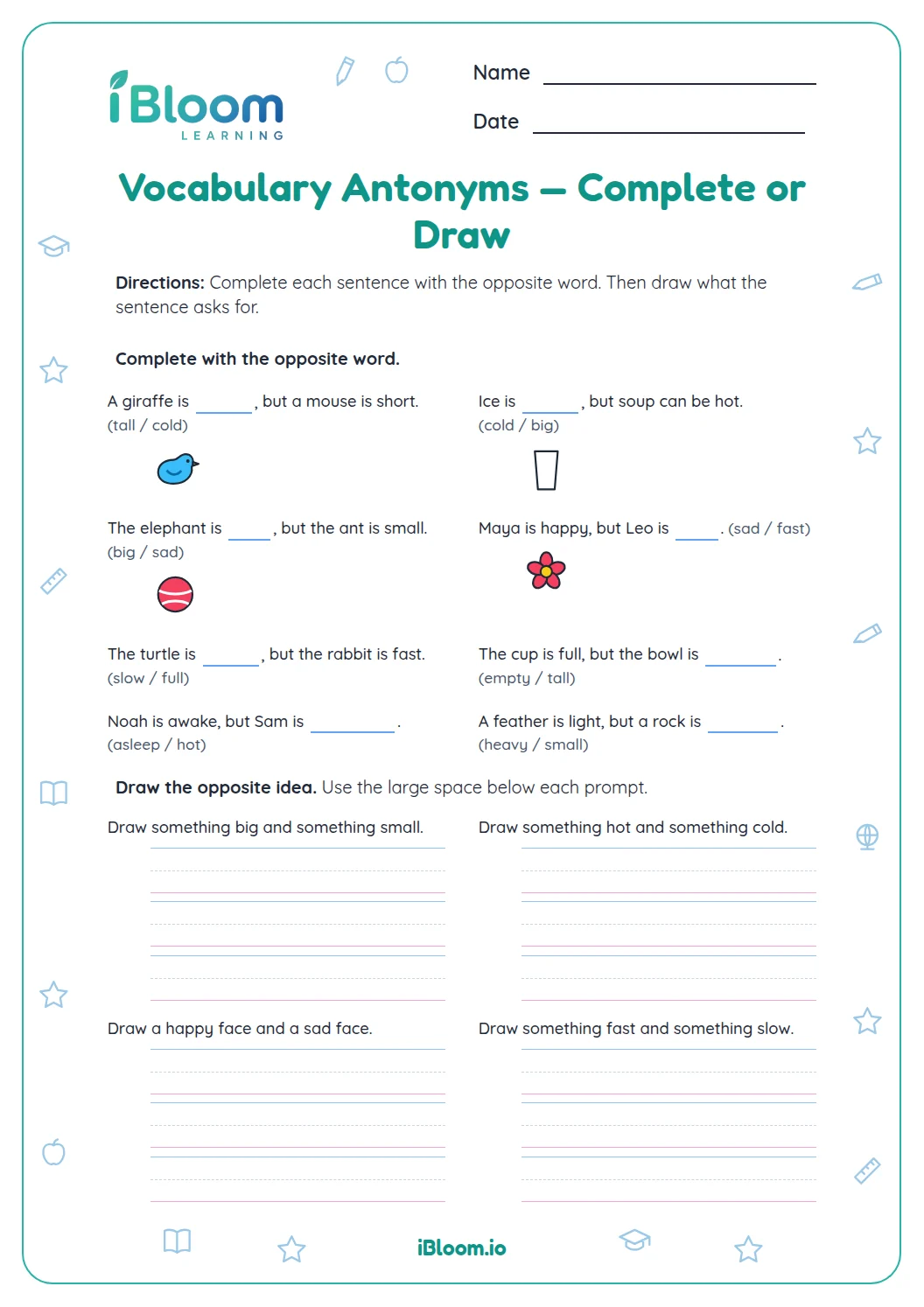
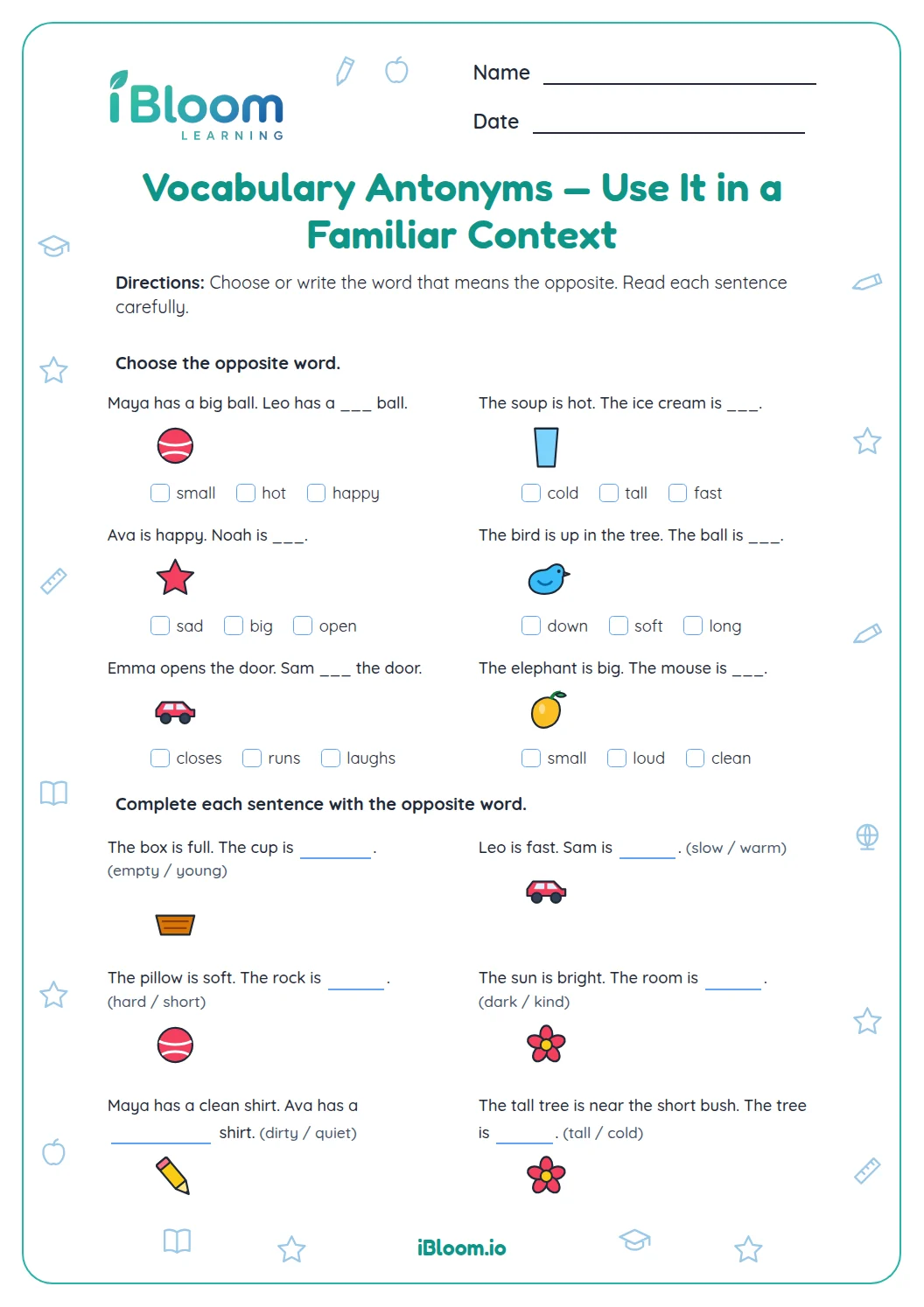
This printable synonym worksheet gives preschool and kindergarten learners a concrete way to explore words that mean almost the same. Picture cues show familiar animals, food and everyday objects while short sentences set a context for words such as big/large, happy/glad and pretty/beautiful. Students choose one matching word from three choices in each of 14 questions. The work connects to CCSS L.K.5.c, identifying real-life connections between words and their use.
Aligned to L.K.5.c
What does it mean when two words are synonyms?
Synonyms are words with similar meanings. They do not always mean exactly the same thing in every sentence, so a child should try each choice in the sentence and see which one makes sense.
Big and large can describe the same elephant. Small and tiny are also close in meaning, but neither is a synonym for big.
How do pictures help children use a word in context?
A picture gives a familiar anchor: an elephant can be big, and a sun can look bright. The sentence adds a clue about the kind of word that belongs.
In q11, the sun is bright. “Shiny” is a similar description; “dark” means nearly the opposite.
- 1The sun is bright. It looks ___.
- 2Choose shiny: bright and shiny are similar descriptions.
How can an adult help without giving the word away?
Read the sentence aloud and ask the child to try each answer in the blank. Then ask whether the two words describe the same kind of thing in a similar way.
For young learners, it is fine to explain a word briefly or point to the picture. Keep the focus on meaning rather than memorizing a list.
How to use this worksheet
- 1Read the picture and sentence together.
- 2Say the target word aloud and talk briefly about what it means.
- 3Try each answer in the blank; choose the one closest in meaning.
- 4Ask whether the chosen word fits the familiar picture or scene.
- 5Check the answer key and revisit any pair that felt confusing.
Common mistakes and quick fixes
The mistake
Choosing a word that fits the object but not the target meaning.
The fix
Compare the word meanings: an elephant may be small in a picture, but the synonym for big is large.
The mistake
Mixing up synonyms and opposites.
The fix
Ask whether the two words are alike or opposite. Happy and glad are alike; happy and sad are opposites.
The mistake
Thinking synonyms must be identical in every way.
The fix
Use the sentence as a clue. Two words can have similar meanings even when one feels stronger, such as pretty and beautiful.
Common Core alignment
Connect familiar words with how they describe people, objects and scenes.
On this sheet: Children use familiar picture and sentence contexts to select words with similar meanings.
Show the official wordingHide the official wording
Identify real-life connections between words and their use (e.g., note places at school that are colorful).
What to practice next
Make more practice
Further reading
Questions parents and teachers ask
What is a synonym?
A synonym is a word that has a similar meaning to another word. Big and large can both describe a large elephant. The words do not need to be identical; they should fit the same kind of meaning in the sentence.
How are synonyms different from antonyms?
Synonyms have similar meanings, such as happy and glad. Antonyms have opposite meanings, such as happy and sad. Some questions include an opposite as a distractor so children can compare the meaning instead of choosing a word just because it sounds familiar.
Why are picture clues included?
Pictures connect a word to something a young learner can recognize, such as a sun, apple, car or flower. The sentence supplies an additional context clue. Together they make the task concrete while the child decides which word has a similar meaning.
Should the child read the sentences alone?
An adult can read a sentence aloud, especially for preschoolers or early readers. The goal is to listen to the target word, understand the simple scene and choose a similar word. Children can point to a choice before they are ready to read every option independently.
What if more than one answer seems close?
Try each choice in the sentence and compare it with the target word. The answer key names the intended match for each item. If a child has another reasonable word in mind, discuss whether it means something similar in that particular context.
What should children practice next?
Children can match synonym pairs, name a synonym without answer choices, or explore antonyms to contrast similar and opposite meanings. The linked activities add a next step after these picture-supported examples feel comfortable. An adult can invite the child to use each new word in another sentence.