




About this worksheet
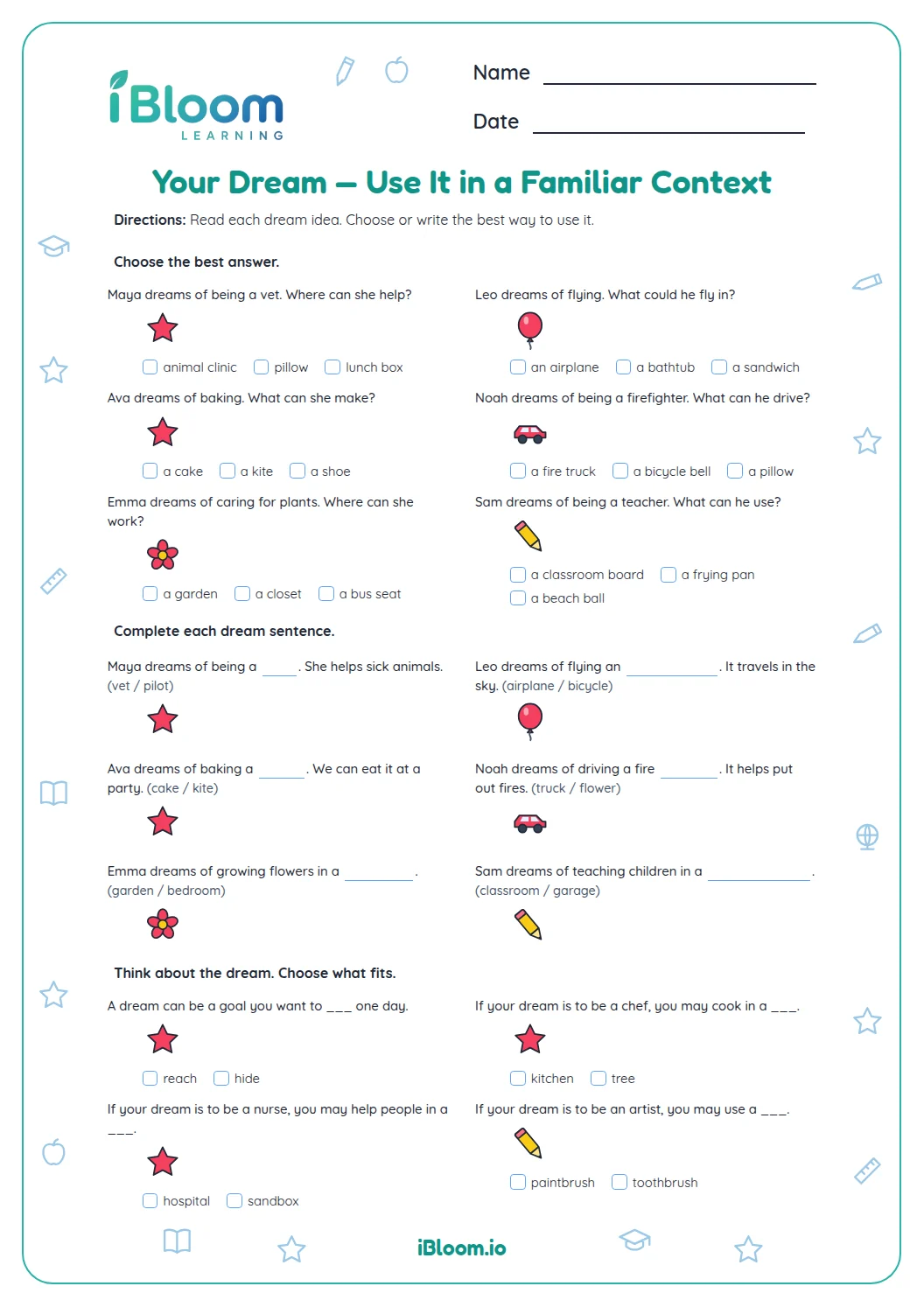
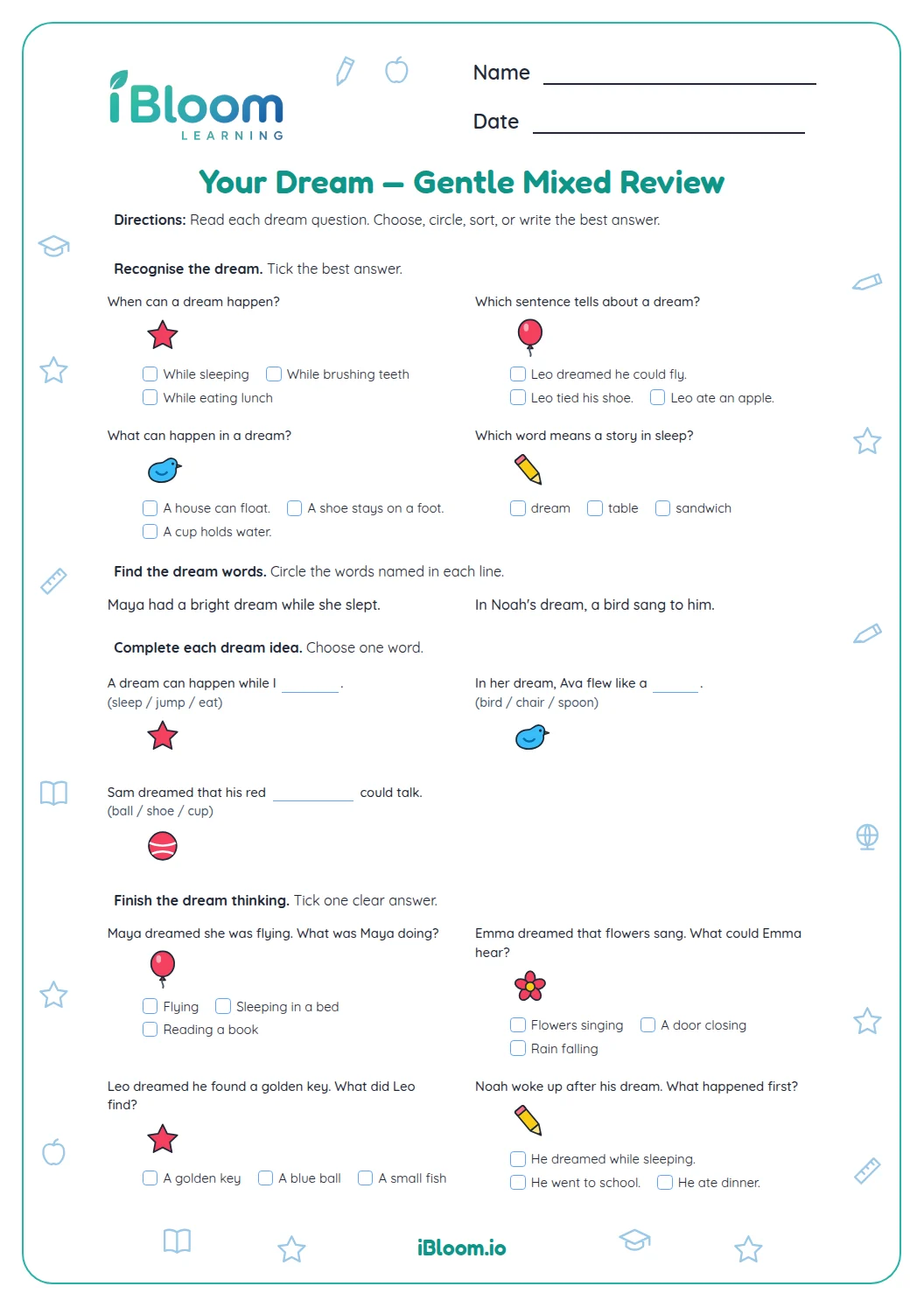
This Kindergarten narrative practice aligns with CCSS W.K.3. It invites children to imagine a dream and shape it into a simple sequence. Fourteen sentence starters ask about the place, a companion, events, feelings, and an ending. Two drawing prompts let children show the setting and a favorite moment. The answer key offers sample ideas rather than one required story.
Aligned to W.K.3
How does this prompt build a dream story?
The sentence starters invite a child to name where the dream begins, who is there, what happens, and how it ends. Two drawing prompts revisit the setting and a favorite moment.
How could a child finish “Then we ___”?
Think of an action that could happen next in the dream. A child might say “Then we danced” or choose another action that fits the story.
- 1Then we ___.
- 2Say an action that could happen.
- 3Sample: danced
Can children draw instead of writing?
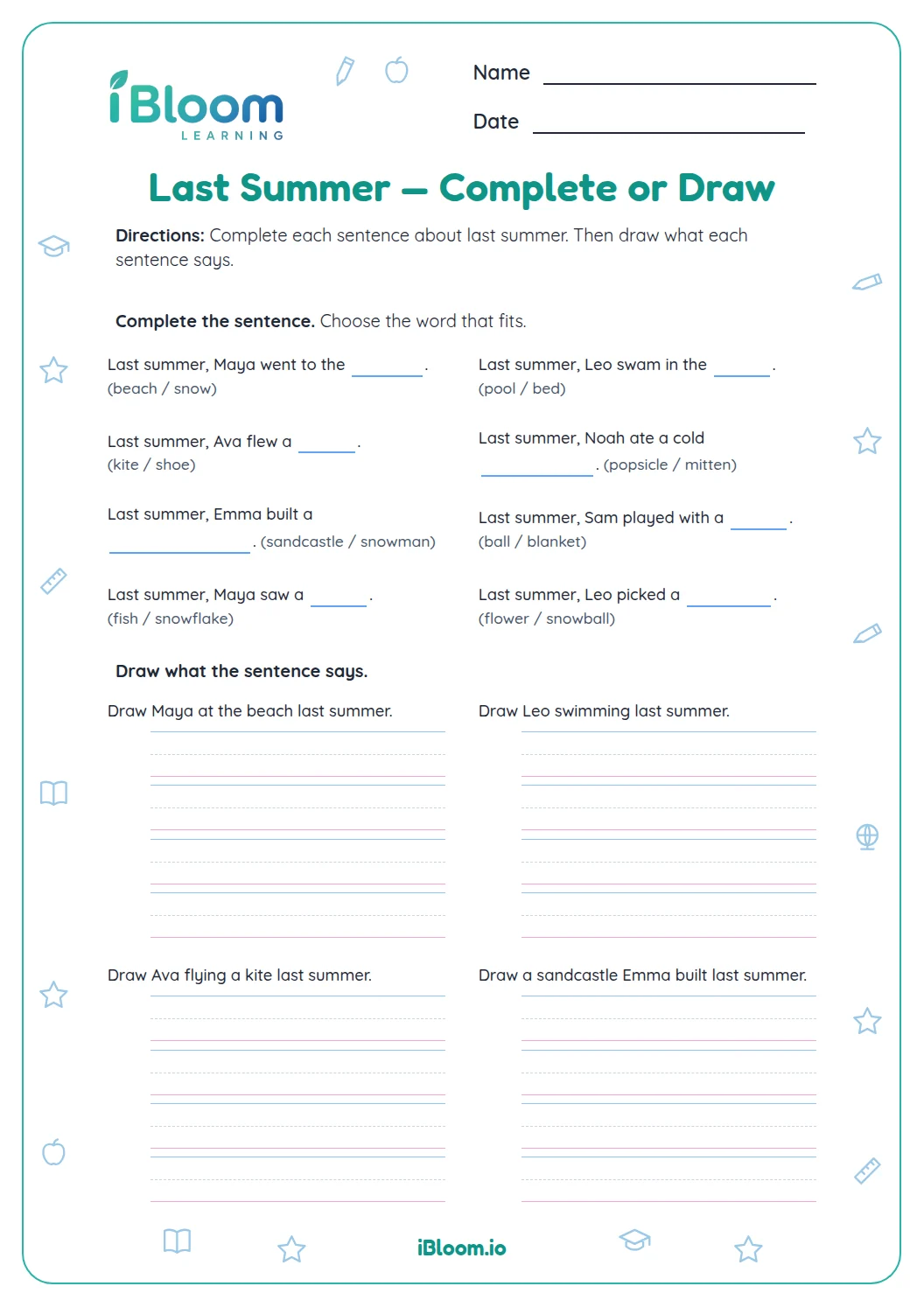
The worksheet includes two drawing prompts as well as fourteen sentence completions. Children can tell an idea aloud before writing it, then use the drawings to add details to the same dream story. The key accepts different ideas that answer each prompt.
How to use this worksheet
- 1Invite the child to tell a dream idea aloud.
- 2Finish each sentence with a word or short phrase that fits.
- 3Keep the events in an order that makes sense to the child.
- 4Draw the place, character, surprising event, and favorite moment.
- 5Ask the child to explain how the pictures connect to the sentences.
- 6Use the sample key as a guide, accepting other fitting ideas.
Common mistakes and quick fixes
The mistake
Treating the sample completion as the only right answer.
The fix
The key gives one example; accept another idea that completes the sentence and fits the child’s story. The two drawings can also show the child’s own version of the dream.
The mistake
Adding an event that does not connect to the dream.
The fix
Ask the child to tell what happened before and after the new event.
The mistake
Expecting a detailed written sentence from every child.
The fix
A child may give a word or phrase, dictate an idea, or show details in the two drawing prompts.
Common Core alignment
Use words and drawings to share dream events in a simple sequence.
On this sheet: Sentence completions and drawings invite children to tell dream events in sequence and share a reaction.
Show the official wordingHide the official wording
Use a combination of drawing, dictating, and writing to narrate a single event or several loosely linked events, tell about the events in the order in which they occurred, and provide a reaction to what happened.
What to practice next
Further reading
Questions parents and teachers ask
Are there right answers for the dream prompts?
There is no single required dream story. The answer key gives sample completions and describes what a fitting drawing might show. Accept a different word, phrase, or picture when it responds to the prompt and makes sense in the child’s story.
Can a child tell an answer instead of writing it?
Yes. An adult can read the sentence starter and invite the child to say an idea aloud before writing it down. The drawing prompts also give children another way to share story details, especially when writing takes more effort.
How many drawing activities are included?
There are two drawing prompts: one for the dream setting and one for a favorite moment. They follow fourteen sentence completions and help children add visual details to the story. Children can explain each drawing aloud and use their own dream ideas.
What kinds of sentence completions are included?
The fourteen starters ask about the dream’s place, companion, sights, actions, sounds, feelings, and ending. A child might write one word or a short phrase in each blank. The key lists sample responses to show the open-ended format and accepts other fitting ideas.
How long does the worksheet take?
The printable has 16 prompts across three worksheet pages, with a matching three-page answer key. About 20 minutes is a reasonable starting estimate, though children may want more time to talk through their dream or add details to the two drawings. The time can vary by child.