






About this worksheet
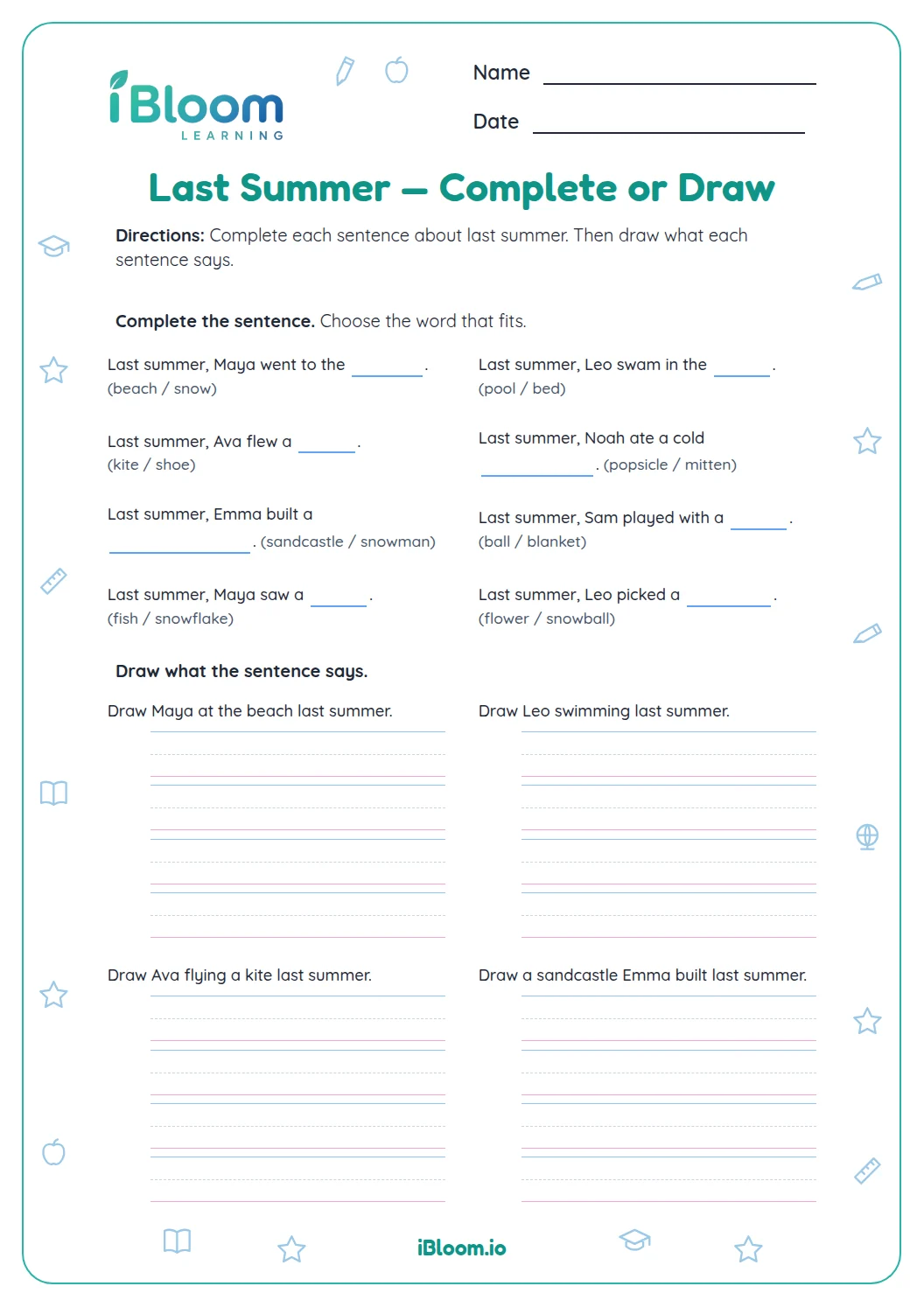
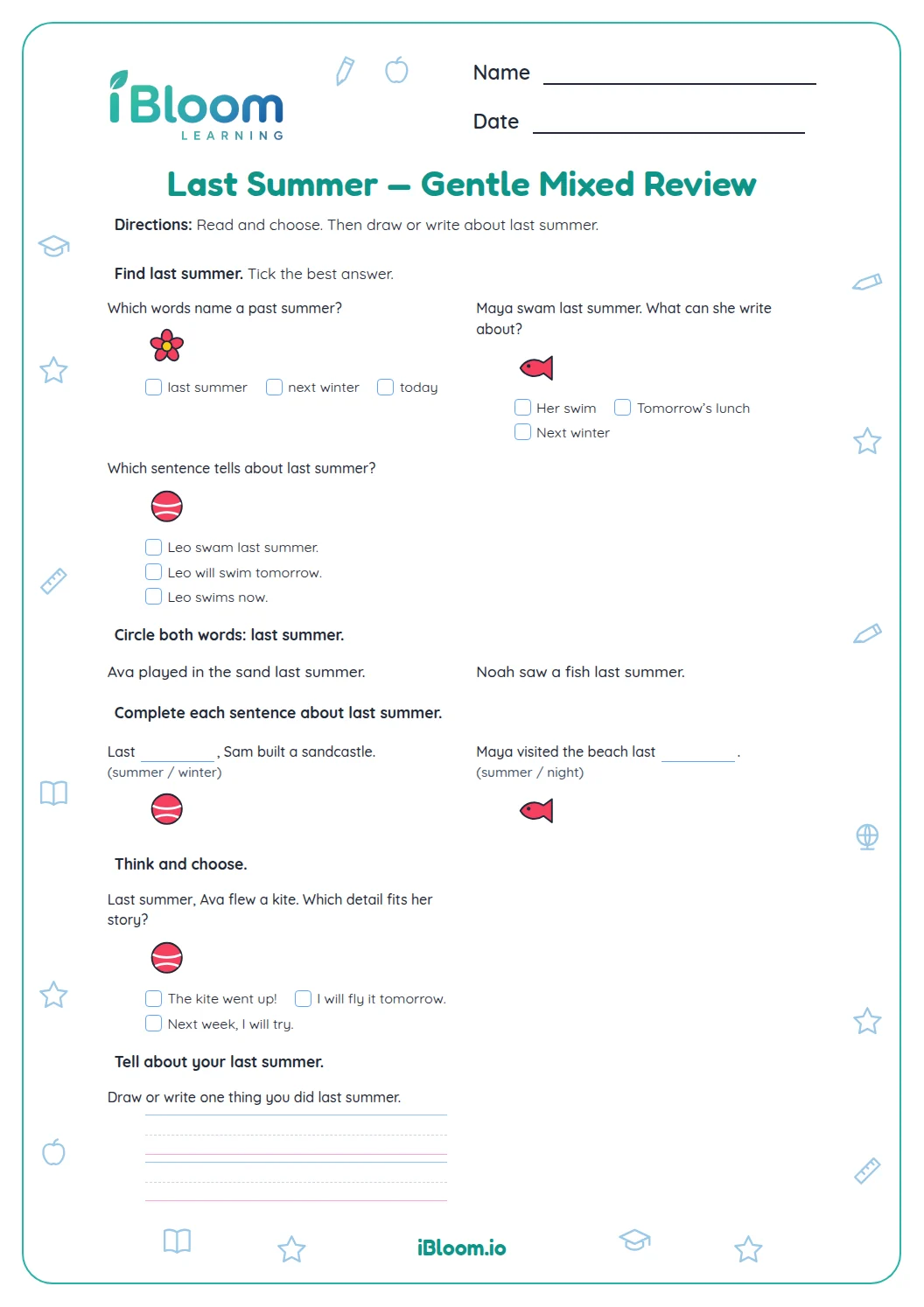
This free printable worksheet helps Pre-K and Kindergarten children tell a short story about last summer. They choose pictures that belong to summer and pick the sentence that tells what already happened. Then they draw one thing they did and finish the sentence “Last summer, I ___,” with a grown-up writing the child's words if needed. It practices Common Core W.K.3, narrating an event with drawing, dictating and writing. A matching answer key is included.
Aligned to W.K.3
Why start with last summer?
Young writers find it easier to write about something they actually lived. Last summer is a memory almost every child has, such as ice cream, a trip to the water or a day with a kite, so there is always something to say.
The sheet also introduces the idea that stories tell what already happened. Words like “ate,” “saw,” “flew” and “rode” are the past words children hear in every story at home.
- 1Which one happened last summer?
- 2I ate ice cream. or I will eat ice cream.
- 3“Ate” means it already happened.
- 4“Will eat” means it has not happened yet.
- 5The answer is I ate ice cream.
What is on this worksheet?
Ten questions on two pages, in four short parts, with a picture or a drawing in most of them.
- Part A, Summer pictures: four questions with two big pictures each, such as a sun and a snowflake
- Part B, What happened?: four questions with a picture and two sentences, one that already happened
- Part C, Draw it: a box to draw one thing from last summer
- Part D, Tell it: finish the sentence “Last summer, I ___,” in the child's own words
- Answer key, two pages, in the same layout
What should a grown-up do during the drawing box?
Ask one open question, such as “Who was with you?” or “What did you see first?” Then let the child draw without correcting the picture. When the drawing is done, ask the child to tell you about it.
Then turn to Part D. Ask the child to say the whole sentence, “Last summer, I…,” and write it on the line in the child's own words. Older children can write a word or two themselves, such as the name of the thing they drew.
How to use this worksheet at home or in class
- 1Talk for a minute about summer. Ask what the weather was like and what the child liked to do.
- 2Read each Part A question aloud and let the child point to the picture that goes with summer.
- 3In Part B, read both sentences aloud and ask which one already happened. Stress the past word, such as “ate” or “rode.”
- 4Give the child time to draw a real memory in Part C. Resist adding details yourself.
- 5Ask the child to tell about the drawing, then help finish “Last summer, I ___” in Part D, writing down the child's own words.
- 6Read the finished sentence back together, pointing to each word as you say it.
Common mistakes and quick fixes
The mistake
Choosing a picture because it is a favorite thing, such as the snowman, rather than a summer thing.
The fix
Ask what the weather is like when you see this picture. A snowman needs snow and cold, and ice cream and a watermelon are summer treats.
The mistake
Picking the sentence with “will” because it sounds like the start of a story.
The fix
Ask: “Did it already happen, or is it going to happen?” “Last summer” means it is over, so use the sentence that tells what happened.
The mistake
Leaving the drawing box empty because the child is not sure what to draw.
The fix
Offer two memories to choose from, such as the park or a trip. Choose one together and let the child draw it.
Common Core alignment
Most US states teach early writing with the Common Core standards or a close state version. This sheet practices the standard below.
Tell about an event by drawing, dictating and writing.
On this sheet: Children draw one event from last summer, then tell it in a sentence that they dictate or write.
Show the official wordingHide the official wording
Use a combination of drawing, dictating, and writing to narrate a single event or several loosely linked events, tell about the events in the order in which they occurred, and provide a reaction to what happened.
What to practice next
Make more practice
Further reading
Questions parents and teachers ask
What age is this worksheet for?
It suits Pre-K and Kindergarten children, roughly ages four to six. Pre-K children can do the picture choices and the drawing box with help, while kindergartners can read the sentences with support and write a word or two. A grown-up can write down the child's own sentence in Part D.
Why are there sentences about the past?
Stories tell what already happened, so children need to hear past words such as ate, saw and flew. In Part B, each question has one sentence about the past and one about the future. Reading both aloud helps children notice the difference, even if they cannot yet read every word.
What if my child does not remember last summer?
That is fine. Use any recent memory, such as a day at the park, a trip or a visit, and talk about it first. You can also look at a photo together. The goal is telling one event in order, not exactly which season it happened in.
Should I correct my child's drawing?
No. The drawing is the child's way of telling the story, so let it look the way the child wants. Ask questions instead, such as “Who is in your picture?” or “What happened next?” Then write the child's answer beside the drawing, using the child's own words.
How do I check Part A and Part B?
Part A has one summer picture in each pair: the sun, the ice cream, the watermelon and the ocean wave. In Part B, the sentence that tells what happened is the one with a past word: ate, saw, flew or rode. The answer key shows each correct choice in green.
Is there an answer key for this worksheet?
Yes. The answer key marks the correct choice in every question, describes a good drawing and gives a sample sentence for Part D. Download the free PDF from this page, print the worksheet by itself and use the key to check the choices before you talk about the drawing together.