






About this worksheet
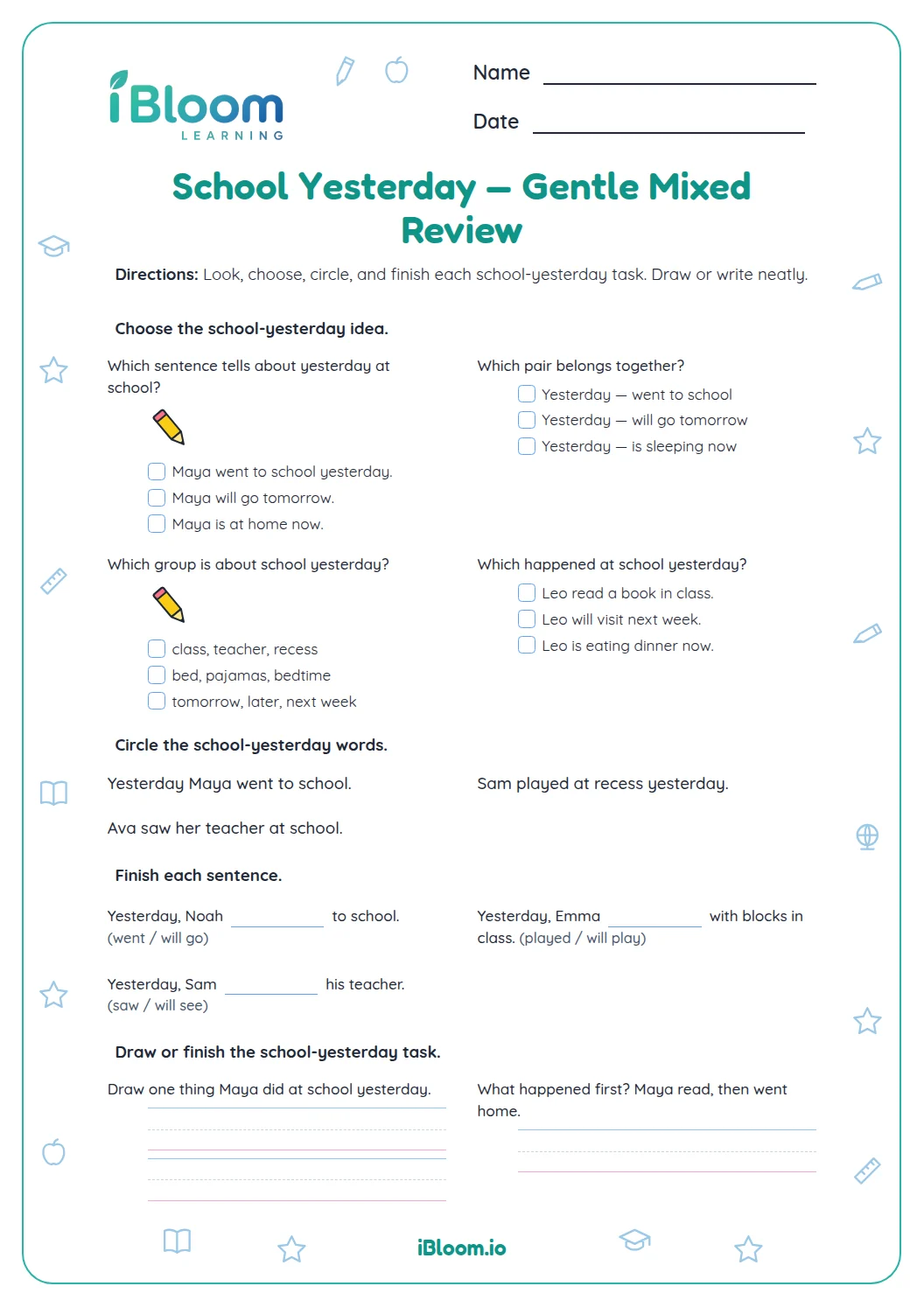
This printable worksheet invites Preschool and Kindergarten learners to recall what happened at school yesterday. Children choose past-tense sentences, complete seven short sentences with action words, and write or dictate two details from their own day. The last part builds a brief narrative by putting an event first and adding what happened next or how the child felt. Sample answers are included for adults checking the page.
Aligned to W.K.3
How does this page help children tell about yesterday?
Part A contrasts past events with things happening now or planned for later. Part B gives a time clue and three verb choices for each sentence. In Part C, children tell two events from their own school day in order and add a feeling.
- 1Question 6 reads “Yesterday, Maya ___ a picture at school.” Choose painted because it tells what Maya did in the past.
- Part A: recognize sentences about past events
- Part B: choose a past-tense verb to complete each sentence
- Part C: recount two events in order and add a feeling
What words signal that an event already happened?
Yesterday gives a time clue, and verbs such as painted, played, saw, and sang tell the action in the past. Compare those forms with will paint or is painting to hear how the time changes.
How can a child tell a short school-day story?
Begin with one event that happened first, then add what happened next or a feeling. A child may write the words or dictate them to an adult. Keep the memory specific to the child rather than matching the sample answer.
How to use this worksheet
- 1Read the sentence choices in Part A and listen for the event that already happened.
- 2In Part B, use yesterday or the sequence word to choose a past-tense verb.
- 3Talk about one real event from school yesterday before writing.
- 4In Part C, tell what happened first, what came next, and how it felt.
- 5Check fixed answers with the key and accept a true personal response in the final item.
Common mistakes and quick fixes
The mistake
Choosing a future sentence because it names a school activity.
The fix
Check the time word and verb: will happen is future, while happened yesterday is past.
The mistake
Using a present-tense verb after “Yesterday.”
The fix
Say the sentence aloud with a past action, such as played or sang.
The mistake
Listing events without a sequence clue.
The fix
Start with first, then add a second event using then or next.
Common Core alignment
Children use writing or dictation to recount a school event in order.
Recount a school event in order and add a detail or reaction.
On this sheet: The final prompts ask children to recount school events in order and tell a feeling.
Show the official wordingHide the official wording
Use a combination of drawing, dictating, and writing to narrate a single event or several loosely linked events, tell about the events in the order in which they occurred, and provide a reaction to what happened.
What to practice next
Make more practice
Further reading
Questions parents and teachers ask
What does this School Yesterday worksheet practice?
Children choose sentences about past events, complete sentences by choosing past-tense verbs, and write or dictate two details from their own school day. The questions move from recognizing what happened to telling a brief personal story in order. The key identifies the fixed answers.
How can my child tell whether a sentence is about yesterday?
Look for the time clue yesterday and a verb that tells what already happened, such as painted, played, saw, or sang. The choices also include actions happening now or planned for later. Read the full sentence aloud before choosing.
Can my child dictate the last answer?
Yes. A young learner can say two details while an adult writes them down. Keep the child’s own event and wording. The prompt asks what happened first, what happened next, and a feeling about the school day. A short response is enough if the sequence and personal detail are clear.
What if my child does not remember a school event?
Think together about familiar parts of a school day, such as arriving, reading, art, play, or packing up. Ask what your child remembers doing yesterday. A small true moment is enough for a short response about events in order.
Is the sample story answer required?
No. The answer key gives one example, but a child’s actual day will differ. Accept a sensible personal response that names two school events in order and includes a feeling. Use the sample to discuss what makes the sequence clear.