
About this worksheet
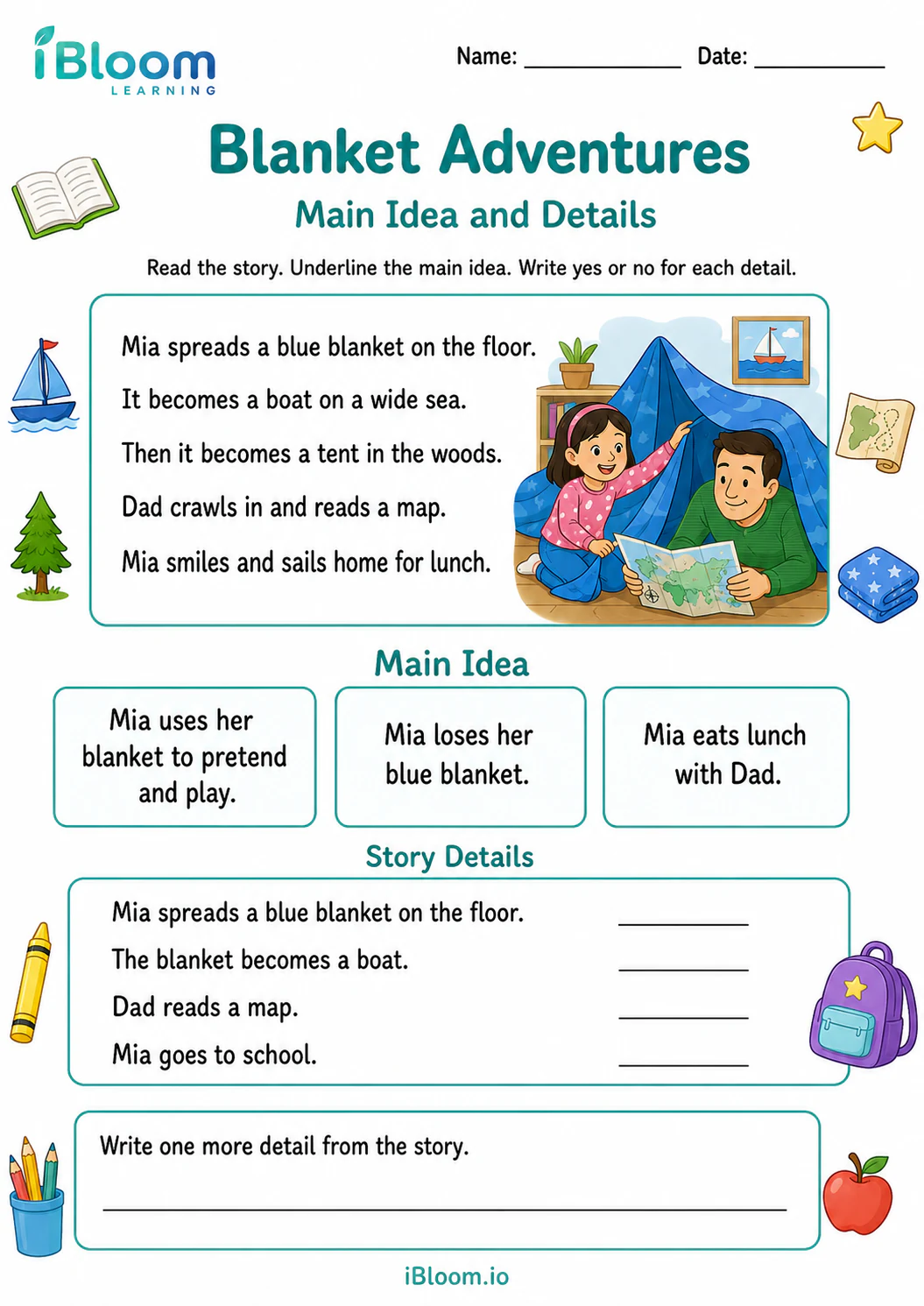
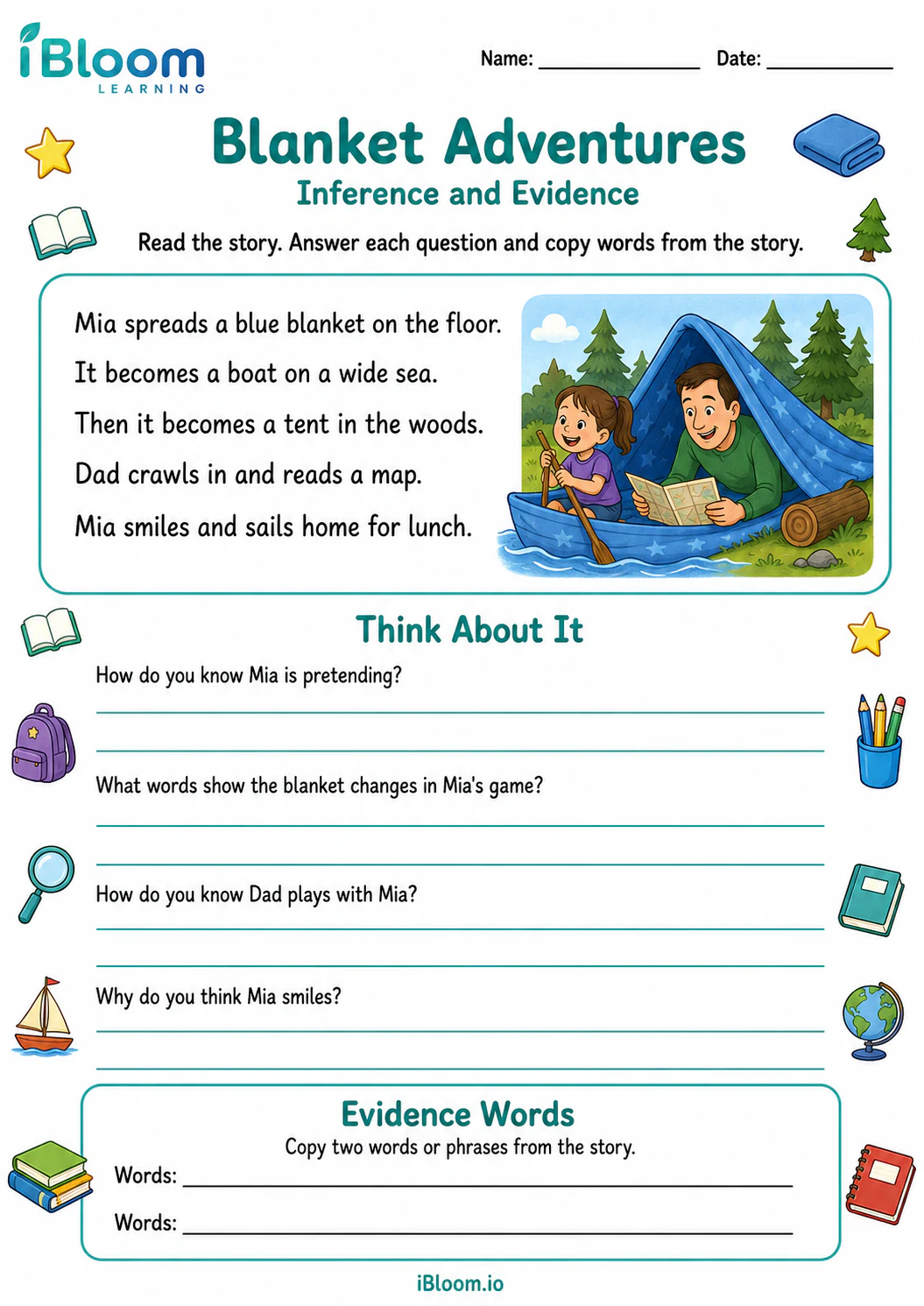
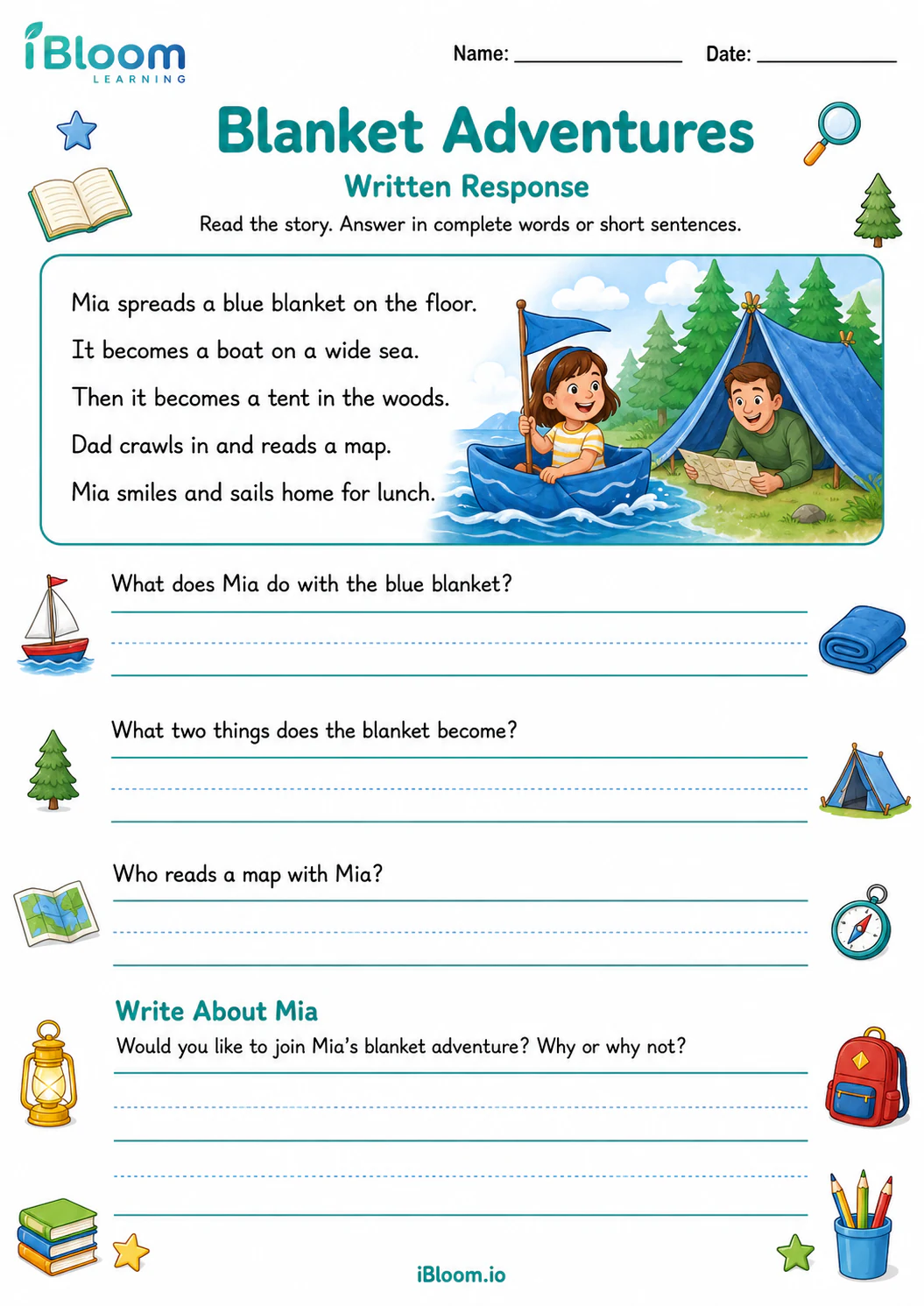
This Grade 1 printable introduces an original short story about Mia turning a blanket into a boat and a tent. Children read the passage, locate stated details, fill in words from the text, and use the story’s boat and sailing clues to understand sea. The 16 questions are grouped into detail recall, passage vocabulary, and story thinking. They practice CCSS RL.1.1 by asking and answering about story details, plus L.1.4a through a context clue question. The answer key is included on a separate page.
Aligned to RL.1.1 and L.1.4a
What is the story about?
Mia spreads a blue blanket on the floor and imagines it as a boat on a wide sea. Later she turns it into a tent in the woods. Dad reads a map, finds a path home, and they fold the blanket before lunch. The story gives children details to find and a context clue for sea.
How can a reader find a story detail?
Read the question, then look for the part of the story that tells the answer. For question 6, the sentence “Dad crawls inside and reads a map” gives the answer. Rereading is a good way to check a detail.
- 1Question: What does Dad read?
- 2Find the sentence: “Dad crawls inside and reads a map.”
- 3Answer: a map
How does context help with a new word?
Use nearby words and what is happening in the story. Mia imagines the blanket as a boat that sails across a wide sea. Boat and sails help readers understand that a sea is a large area of salt water.
How to use this worksheet
- 1Read The Blanket Fort once all the way through.
- 2Read each question and return to the matching story sentence.
- 3For multiple choice, check each option against the story.
- 4For a blank, find the exact word in the passage.
- 5Use nearby actions and descriptions to reason about cozy.
Common mistakes and quick fixes
The mistake
Answering from what might happen instead of what the story says.
The fix
Point to a sentence in the passage that supports the response.
The mistake
Mixing up what Mia imagines the blanket becomes.
The fix
Reread the sentences that name the boat and the tent.
The mistake
Guessing a word meaning without nearby clues.
The fix
Read the whole sentence and connect the word to what happens.
Curriculum alignment
This worksheet gives children direct practice with the skill named in the standard.
Ask and answer questions about key details in a story.
On this sheet: The questions ask children to recall and use details stated in the original story.
Show the official wordingHide the official wording
Ask and answer questions about key details in a text.
Use sentence clues to understand a word in the story.
On this sheet: One question asks what sea means in the sentence and story context.
Show the official wordingHide the official wording
Use sentence-level context as a clue to the meaning of a word or phrase.
What to practice next
Make more practice
Further reading
Questions parents and teachers ask
Should a child read the story before answering?
Yes. The questions refer to details in Mia’s blanket adventure, so reading the whole passage first helps the events make sense. A child who needs support can listen to an adult read it, then look back at the story to find evidence for each answer.
What does sea mean in this story?
A sea is a large area of salt water. Mia imagines the blanket as a boat sailing across a wide sea. The words boat and sails help readers work out what kind of place the sea is, and the answer choices let them match that clue to its meaning.
Why do some questions have choices and others have blanks?
The choice questions let children practice locating a detail or a word meaning. The fill-in questions ask them to retrieve a word directly from the passage. Both formats encourage children to use the story rather than guess from memory. A quick reread of the completed item can confirm the answer and make the word relationship clear.
What reading skills does the worksheet practice?
Children answer questions about Mia, Dad, and the events in their blanket adventure. They also use the words boat, sails, and wide to reason about what sea means. The answer key gives the intended choice or story word for each question.
Is an answer key included?
Yes. The answer key is a separate page and gives the expected choice or word for all 16 questions. For a child’s spoken explanation, accept an answer that points to the same story detail even if the wording differs slightly.