
About this worksheet
This free Grade 1 reading worksheet keeps the Milo story from the earlier sheet and rebuilds its mixed challenge in the worksheet template. Children answer five detail choices, complete four sentences using story words, and respond to five questions about rules, events, and the lesson. The short passage follows Milo as he practices walking safely, using a quiet voice, and sharing with friends. The answer key includes the exact choices and sample sentences.
Aligned to RL.1.1 and RL.1.2
Which story details should a reader notice?
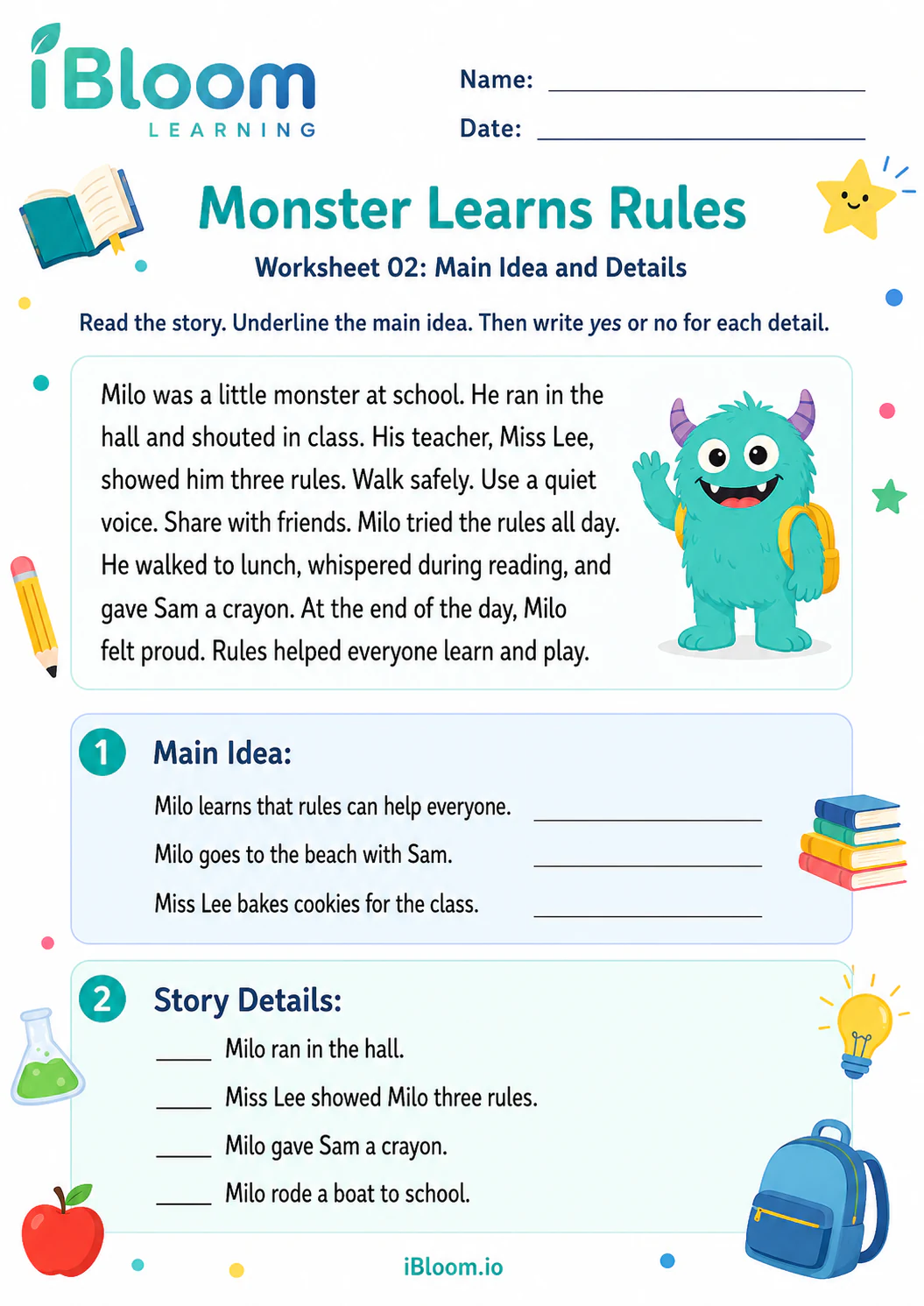
Readers can keep track of who acts, where an event happens, and what changes. Milo runs in the hall and shouts in class before Miss Lee shows him three rules. Later, he walks to lunch, whispers during reading, and shares a crayon.
How do sentence blanks help with retelling?
A missing word can help a child recall a key event without retelling the whole story. Reread around the blank and find the word that completes the event accurately.
- 1Milo walked to ___ after trying the rules.
- 2Find the matching event in the story: “He walked to lunch.”
- 3Answer: lunch.
How can a child explain the story’s lesson?
A lesson is an idea the story shows through what a character does. Milo tries the rules and feels proud; the final line explains that rules helped everyone learn and play. A response should connect the lesson to one of those events.
What does the answer key show?
The key marks the detail choices, supplies missing words, and gives sample responses. A child’s wording may differ while still being correct if it matches the story.
How to use this worksheet
- 1Read the story once to follow what Milo does.
- 2Answer detail choices by finding the matching story sentence.
- 3Use the exact story word that fits each blank.
- 4For a response, write one complete sentence and include a story detail.
- 5Compare the idea with the sample answer in the key.
Common mistakes and quick fixes
The mistake
Mixing up what Milo did before and after the rules.
The fix
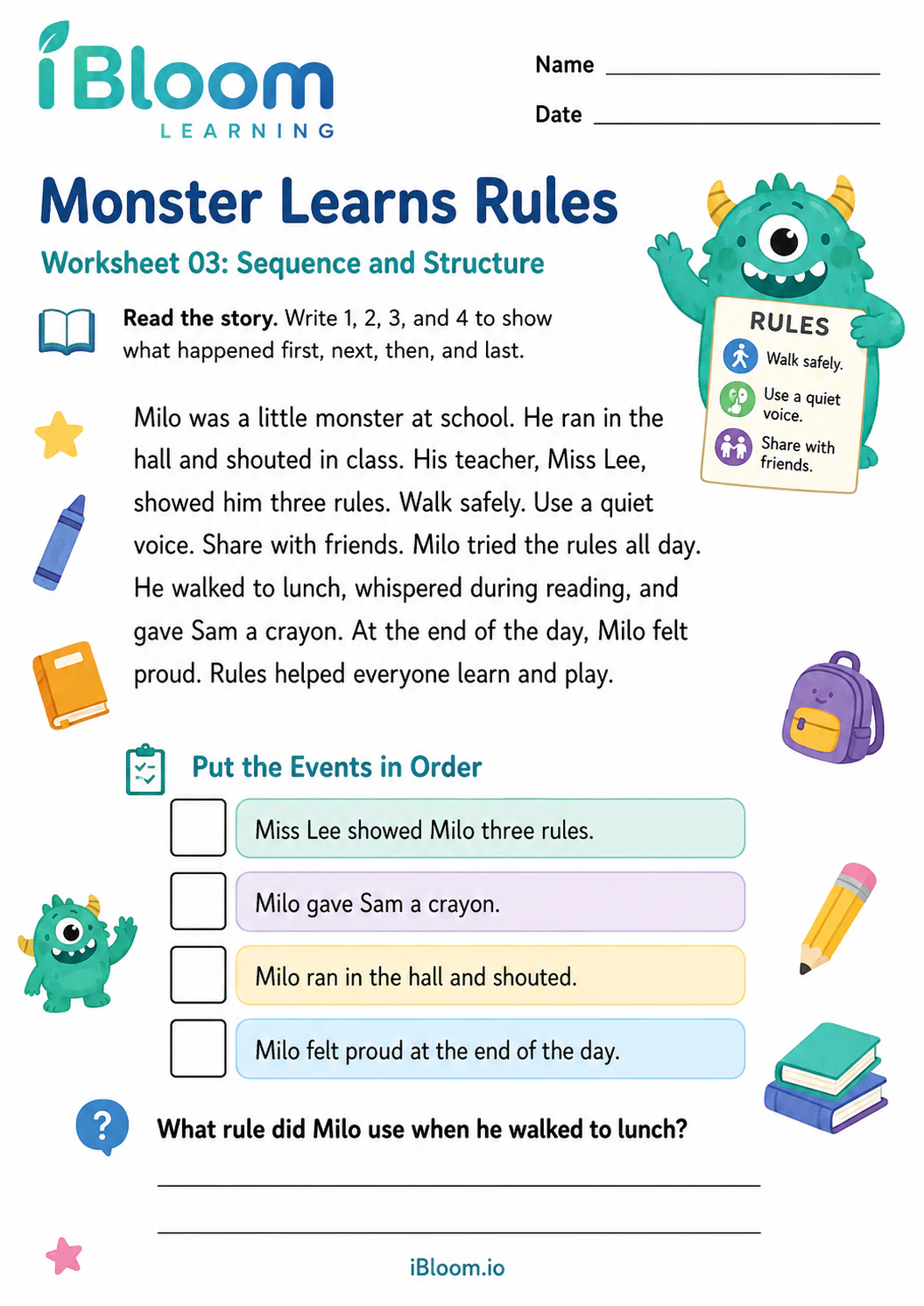
Retell the events in order: Miss Lee shares rules, then Milo tries them.
The mistake
Giving a rule without connecting it to the story.
The fix
Name the event that shows the rule, such as walking to lunch.
The mistake
Writing a lesson that the story does not support.
The fix
Use the ending sentence and Milo’s actions to check the lesson.
Common Core alignment
This worksheet checks story details and a simple story lesson.
Answer questions about details in a story.
On this sheet: The detail choices and sentence responses refer to Milo’s actions and classroom rules.
Show the official wordingHide the official wording
Ask and answer questions about key details in a text.
Retell key events and explain the story’s lesson.
On this sheet: Children put Milo’s actions into words and state what he learns about rules.
Show the official wordingHide the official wording
Retell stories, including key details, and demonstrate understanding of their central message or lesson.
What to practice next
Make more practice
Further reading
Questions parents and teachers ask
What happens in Milo’s story?
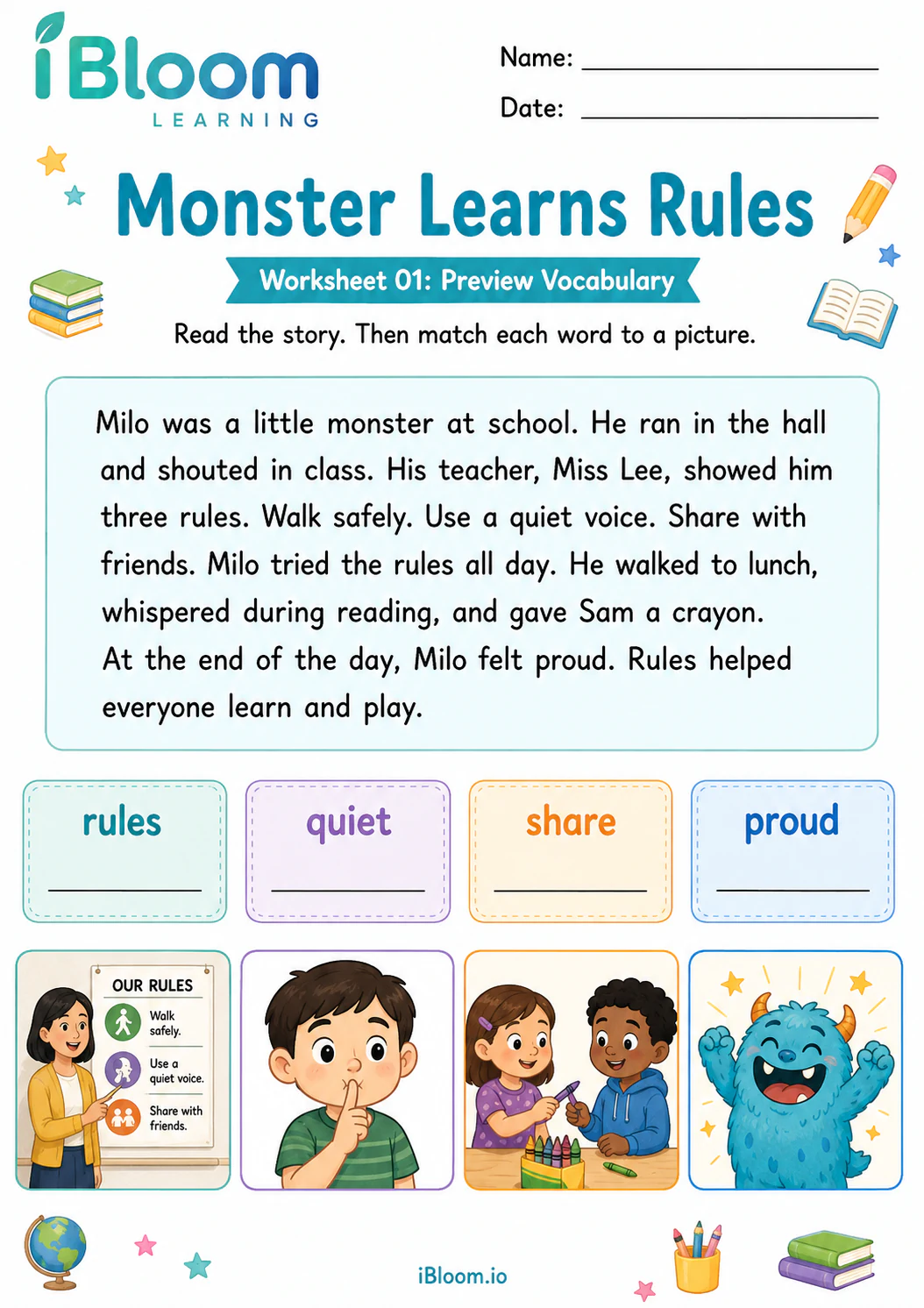
Milo begins the day running in the hall and shouting in class. Miss Lee teaches three rules, and Milo tries them by walking to lunch, whispering during reading, and sharing a crayon. At the end, he feels proud because the rules help everyone learn and play.
What are the three rules Miss Lee teaches?
Miss Lee tells Milo to walk safely, use a quiet voice, and share with friends. Children can find the rules together in the first paragraph. The worksheet focuses on showing how Milo tries them during his school day.
How many questions are on this worksheet?
There are 14 questions: five multiple-choice detail questions, four sentence blanks, and five written responses. The story appears at the start, and a separate answer key gives the correct choices and sample wording. Children may reread the passage while working through each part.
Can my child answer in different words from the key?
Yes. The key gives a sample, not the only possible sentence. Accept a response that answers the question and matches a story detail. For example, “He stopped running and walked to lunch” is a clear way to describe how Milo changed.
What reading skills does the story practice?
Children locate key details, retell events, and explain a lesson. They can reread the short story as often as needed. Asking “Which sentence helped you?” encourages them to connect an answer with the words on the page. The answer key gives one sample for each open response.