


About this worksheet
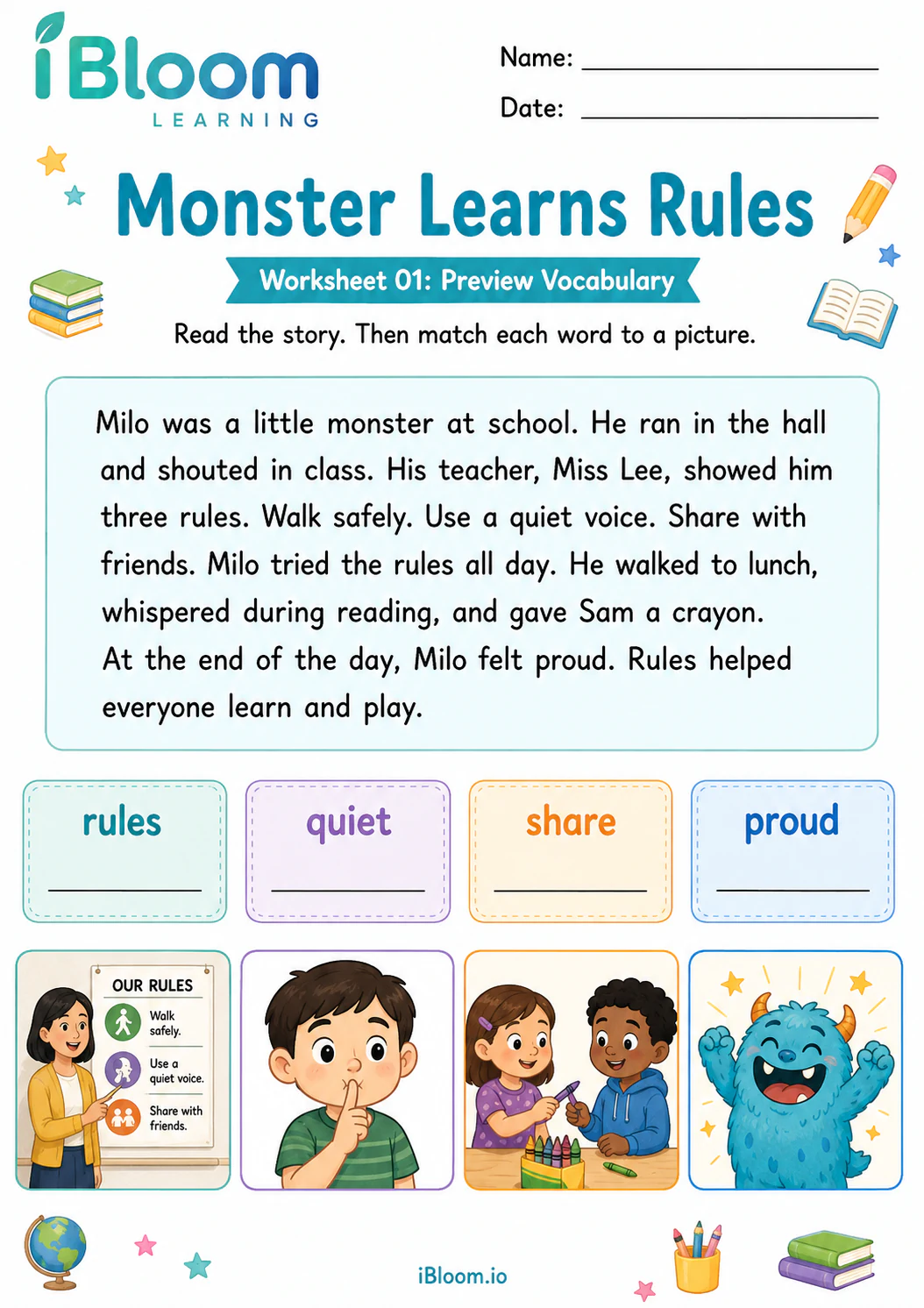
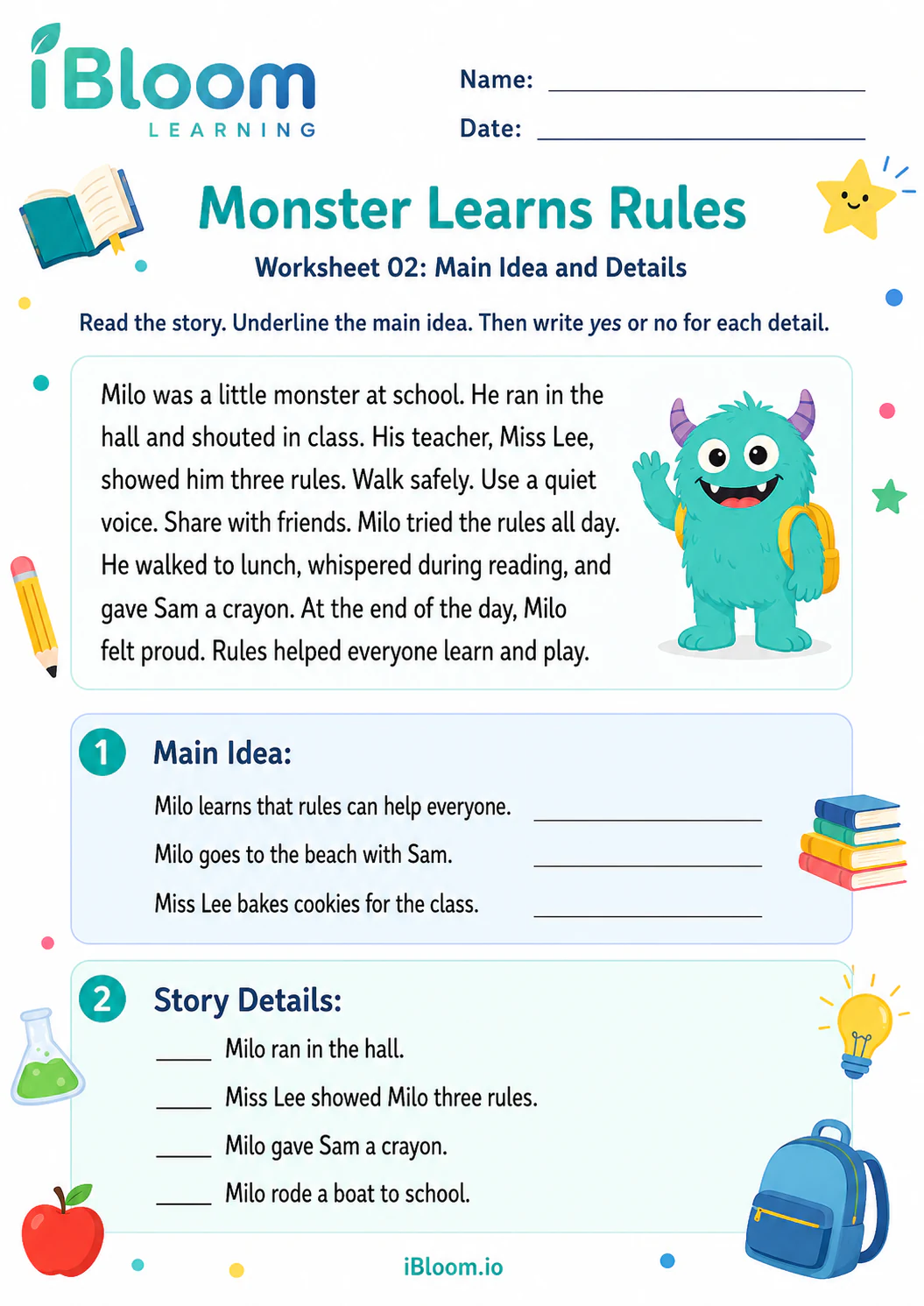
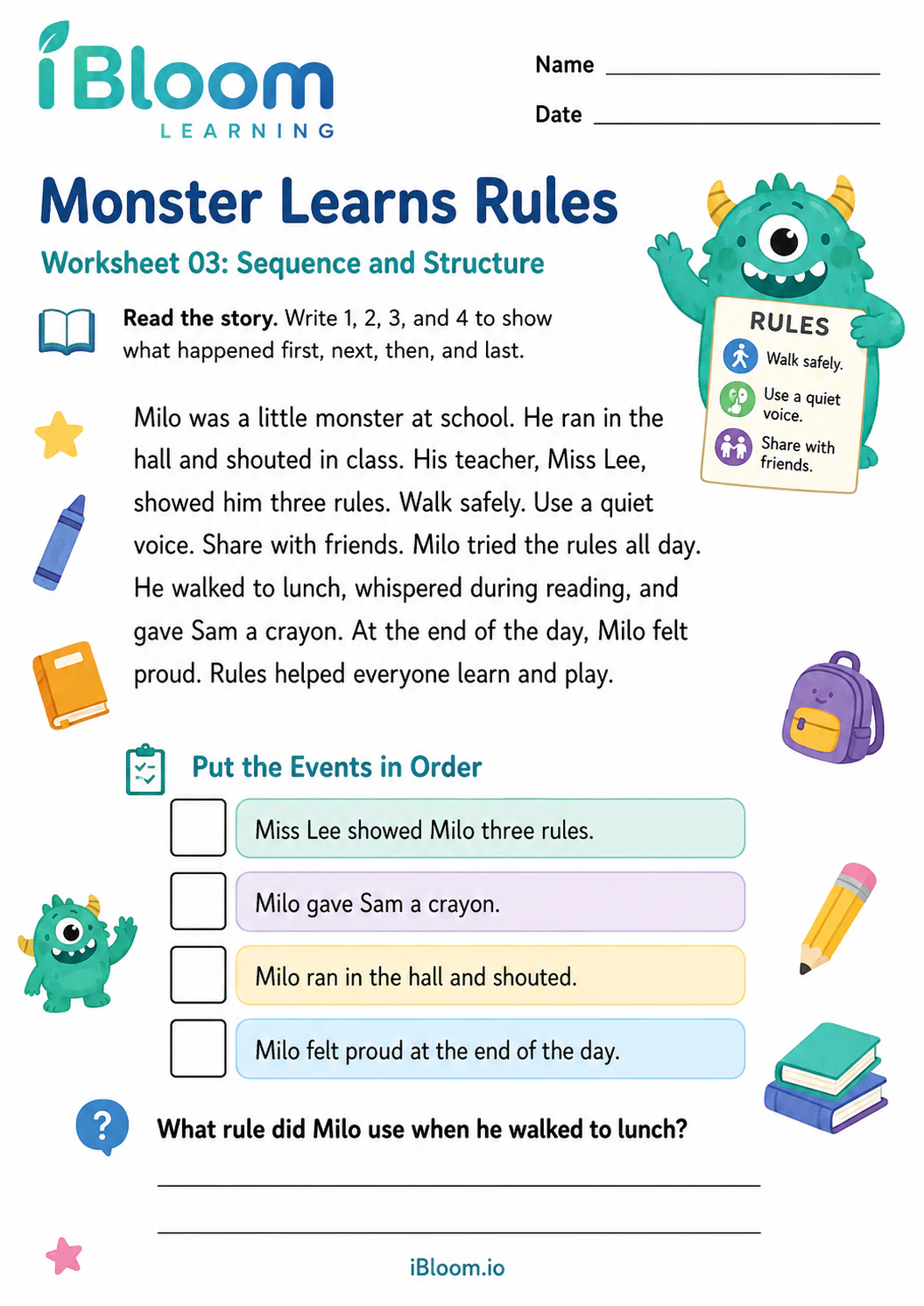
This free Grade 1 reading worksheet pairs the original “Monster Learns Rules” story with questions about Milo’s actions, feelings, and clues. Children read how Milo learns to walk safely, use a quiet voice, and share with friends. They answer ten multiple-choice questions and write four short responses that connect an inference to a story detail. A separate answer key includes sample wording for responses. The page aligns with CCSS RL.1.1 and RL.1.3.
Aligned to RL.1.1 and RL.1.3
What is an inference in a story?
An inference is an idea a reader works out from clues. The story may not say “Milo learned to share,” but his words and actions help readers reach that idea. He whispers during reading and gives Sam a crayon.
How can a detail support an inference?
A detail is a word, action, or event in the story. To support an inference, choose a detail that points toward it. If the idea is that Milo is learning to follow rules, his whispering during reading is stronger evidence than the fact that he goes to school.
- 1Inference: Milo follows the quiet-voice rule.
- 2Clue: He whispers during reading.
- 3The story links the action to a rule.
- 4Answer: He whispers during reading.
What does this worksheet ask children to do?
Part A is “Monster Learns Rules.” Part B has ten questions about events, feelings, and clues. Part C asks for four short responses that connect an inference to story evidence.
- Part B: 10 multiple-choice questions
- Part C: 4 written responses
- Story clues include words, actions, and events
How can an adult help without giving the answer?
Ask the child to point to the sentence that gave the idea. If the clue is hard to find, reread a short part and think aloud about what the character did. Children can answer orally before writing their own sentence.
How to use this worksheet
- 1Read “Monster Learns Rules” together or let the child read it.
- 2Ask what Milo does when he needs to share a crayon with Sam.
- 3Complete Part B by returning to the sentence that gives each clue.
- 4For Part C, say an inference aloud and point to the detail that supports it.
- 5Check the answer key and accept a clear answer in the child’s own words.
Common reading mistakes and quick fixes
The mistake
Guessing how Milo feels without using a story clue.
The fix
Ask which words or actions make that feeling seem likely.
The mistake
Repeating a detail without explaining what it suggests.
The fix
Add “This shows…” and connect the detail to an idea about Milo.
The mistake
Using a detail from the beginning when the question asks about the ending.
The fix
Reread the part named in the question and check when the event happens.
Common Core alignment
The questions connect story details to a character and the events in the story.
Answer story questions with details about what Moss says and does.
On this sheet: Questions ask children to answer who, what, and why questions using story details.
Show the official wordingHide the official wording
Ask and answer questions about key details in a text.
Describe Moss’s actions and the lesson he learns using story details.
On this sheet: Students use Moss’s words and actions to describe how his behavior changes.
Show the official wordingHide the official wording
Describe characters, settings, and major events in a story, using key details.
What to practice next
Make more practice
Further reading
Questions parents and teachers ask
What is an inference?
An inference is an idea a reader works out from clues in a story. The story may not state that Milo learned to wait, but his words and actions give evidence: he asks to use the can, waits until Sam is done, and returns it.
How many questions are included?
There are 14 questions: ten multiple-choice items in Part B and four written responses in Part C. The story is Part A. Children can return to the story whenever a question asks them to explain a clue. The story is Part A and gives the details needed for the questions.
What does the answer key show for written responses?
It gives sample answers that connect an idea to a story detail. Children may use different words, as long as they name a reasonable inference and a clue from the passage. An adult can accept a clear spoken response before the child writes.
Can a first grader work with an adult?
Yes. An adult may read the passage aloud, reread a sentence, or help the child find a clue. Ask the child to explain the idea in their own words so the answer still shows what they understand about Milo.
Which clues show that Milo learned to follow a rule?
Milo whispers during reading and gives Sam a crayon. These details show that his behavior is changing as he tries to follow Miss Lee’s rules. The story also states that he feels proud at day’s end. Ask the child which action helped them decide how Milo changed.