


About this worksheet
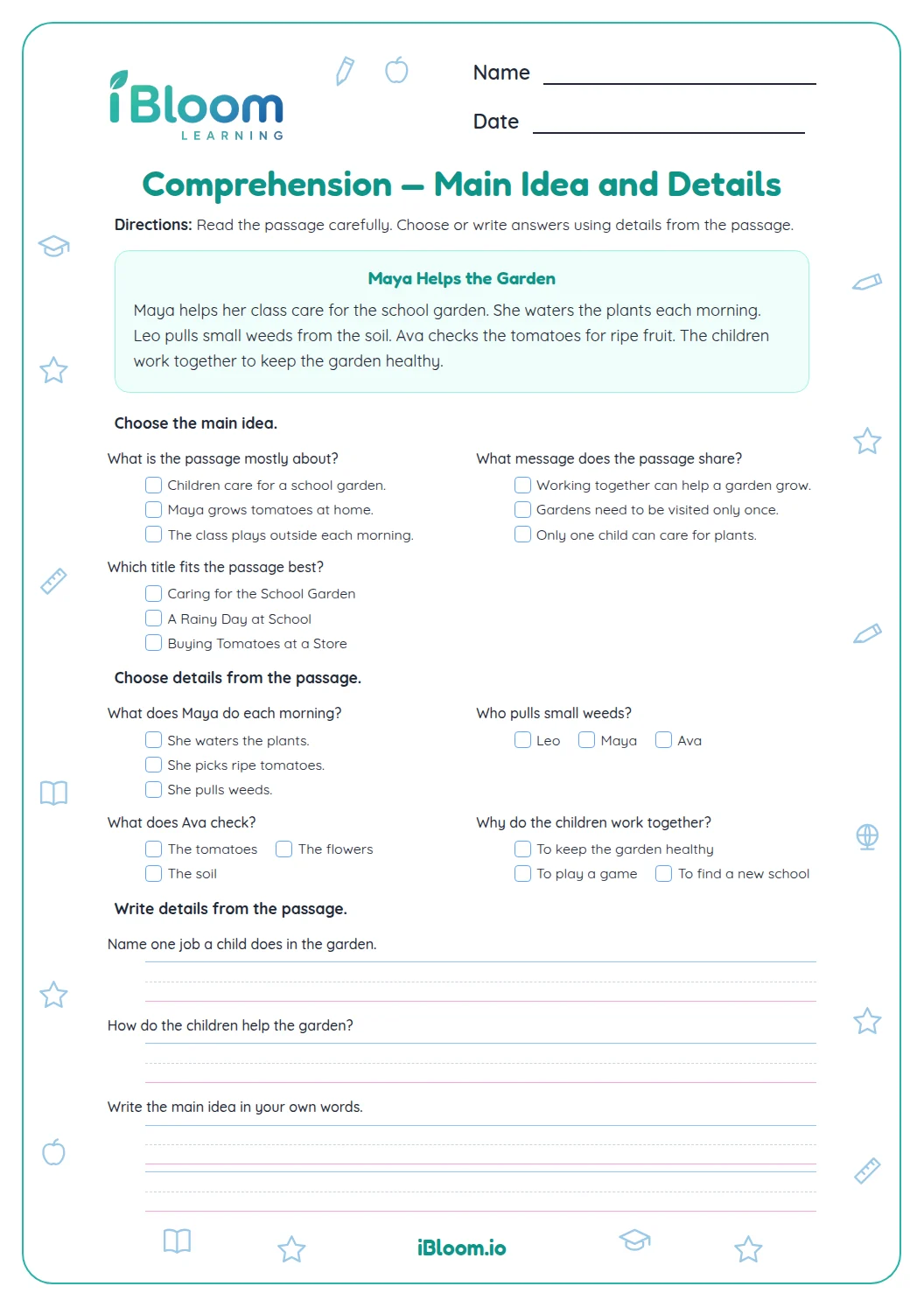
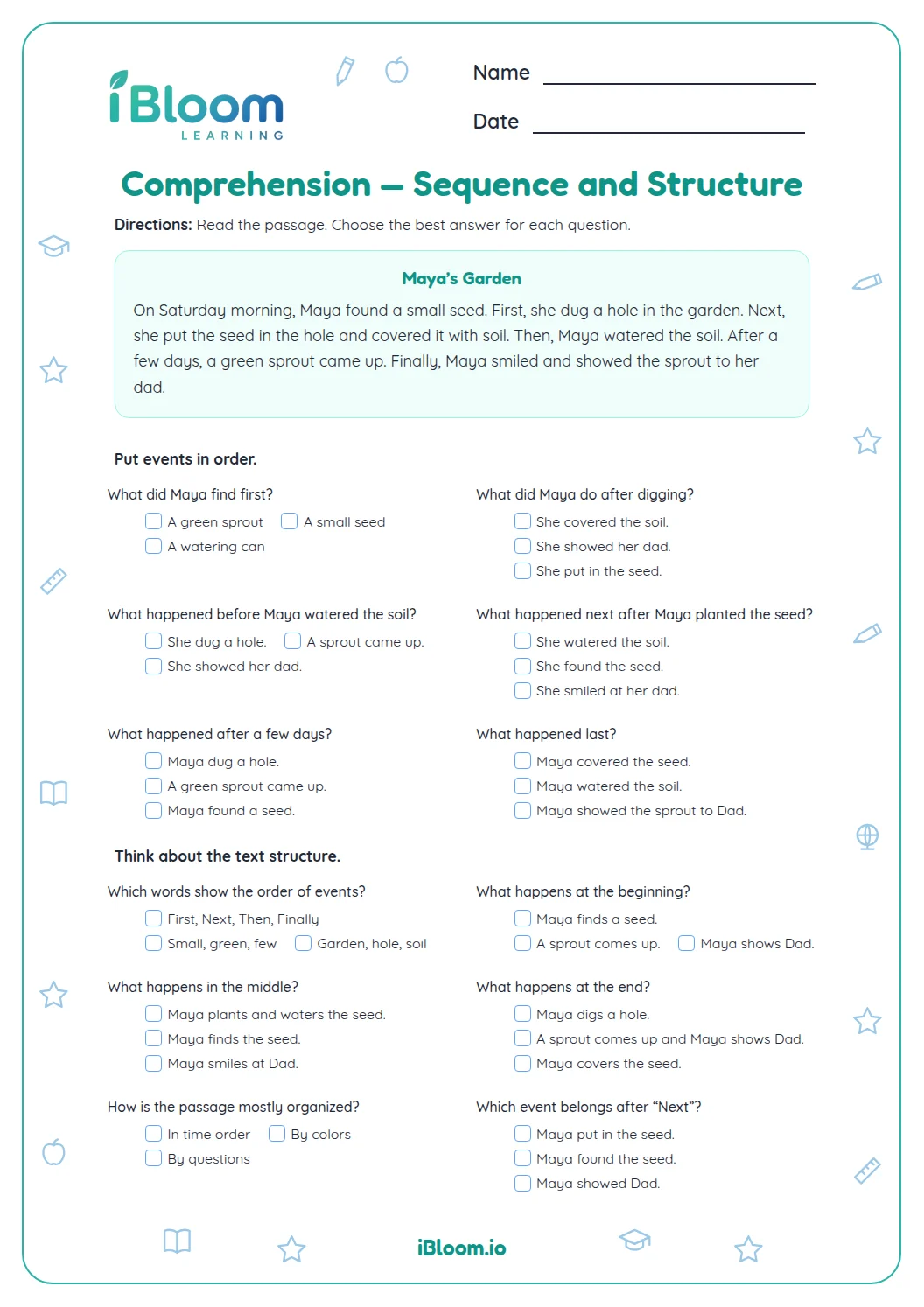
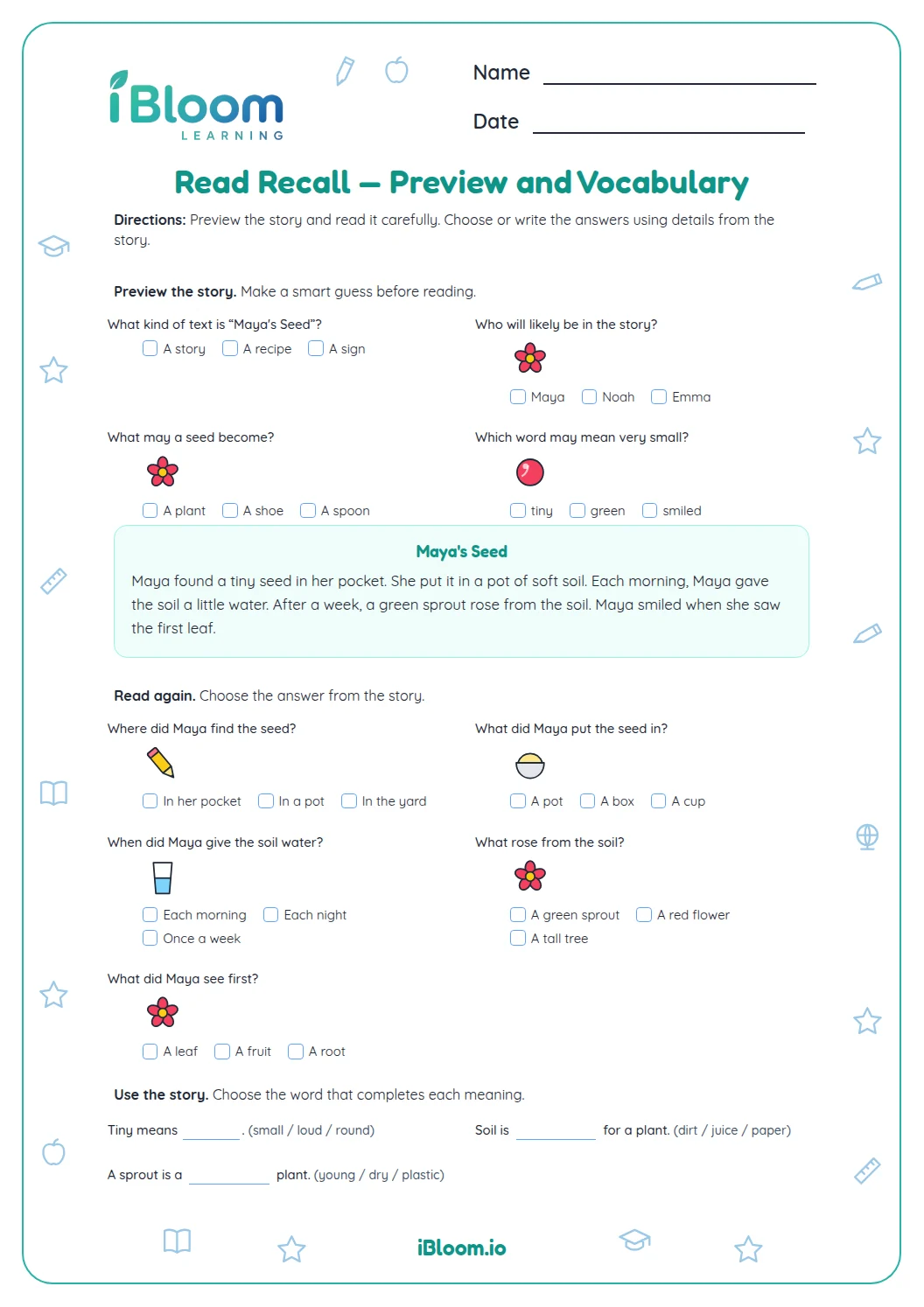
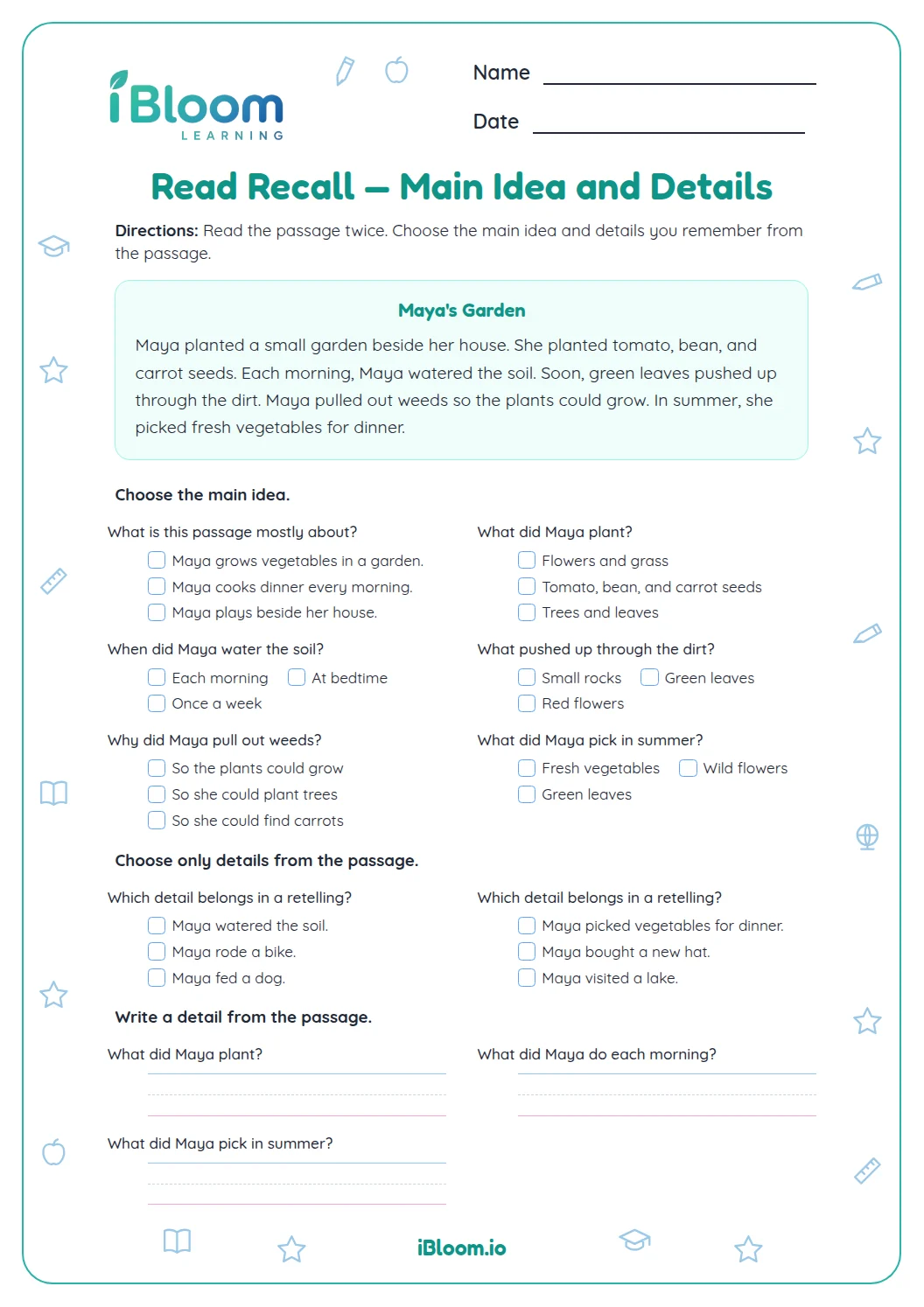
This Grade 1 printable pairs an original 64-word story about Mia growing a seed with 16 reading tasks. Students recall details, use context to understand words such as “sprout,” explain what happened and predict what Mia might do next. A final draw prompt asks them to picture the pot and sprout from the passage. The answer key gives answers and a sample drawing description. The questions practice Common Core RL.1.1 and L.1.4.a.
Aligned to RL.1.1 and L.1.4.a
What happens in Mia’s story?
Part A follows Mia’s seed from planting to sprouting. Parts B and C ask students to recall details, explain the passage and use nearby words to understand “sprout” and “peeked out.” The last prompt asks them to draw a scene the passage describes.
Which details answer the questions?
Some questions ask for a fact stated directly. Others ask students to connect two details, such as Mia watering the seed and feeling proud when it grows.
- 1“On Friday, a tiny green sprout peeked out.”
- 2The nearby details show that “sprout” means a new plant beginning to grow.
How can the story help with a new word?
Nearby actions provide clues to “sprout.” Mia planted a seed, and a tiny green sprout appeared. Those details show that a sprout is a new plant beginning to grow.
How to use this worksheet
- 1Read the story once to find out what happens to Mia’s seed.
- 2Read it again and look for names, actions and time clues.
- 3Use nearby words to work out what “sprout” and “peeked out” mean.
- 4Answer the recall and explanation questions with details from the passage.
- 5Draw the pot and sprout using details the story gives.
Common mistakes and quick fixes
The mistake
Answering from memory without checking the passage.
The fix
Return to the sentence that gives the detail and use its words.
The mistake
Choosing a word meaning that does not fit the event.
The fix
Read the words before and after the unfamiliar word for clues.
The mistake
Drawing a plant without a detail from the story.
The fix
Include a pot, a sprout and the sunny window described in the passage.
Common Core alignment
The questions ask readers to return to story details and use context to understand words.
Ask and answer questions about important story details.
On this sheet: Students answer questions about what Mia did, saw and felt in the passage.
Show the official wordingHide the official wording
Ask and answer questions about key details in a text.
Use sentence and story clues to figure out an unfamiliar word.
On this sheet: Students use nearby details to interpret “sprout” and “peeked out.”
Show the official wordingHide the official wording
Use sentence-level context as a clue to the meaning of a word or phrase.
What to practice next
Make more practice
Further reading
Questions parents and teachers ask
How long is the passage?
“Mia’s Seed” is 64 words, within the brief’s Grade 1 passage range. It describes Mia planting a seed, caring for it and noticing a tiny green sprout. The questions ask students to return to those details and use context clues.
What reading skills does the page practice?
Students recall details, explain what happened, identify the passage’s main idea, and use context to understand “sprout” and “peeked out.” The final item asks them to draw the pot and sprout described in the story. They also draw a scene using details from the passage.
What does “sprout” mean in the story?
A sprout is a new plant that begins growing from a seed. In the passage, the clue is that a tiny green sprout appears above the dark soil and reaches toward the light. Students choose this meaning in Part B.
Is there a drawing task?
Yes. The final question asks students to draw Mia’s pot with the tiny green sprout by the sunny window. The story gives those details directly, and the answer key includes a short sample description of an accurate drawing.
What is included in the answer key?
The key gives the expected answers for the 15 reading questions and a sample description for the drawing task. Some responses, such as a prediction about what Mia might do next, can vary; the sample helps an adult check whether the idea fits the story.