



About this worksheet
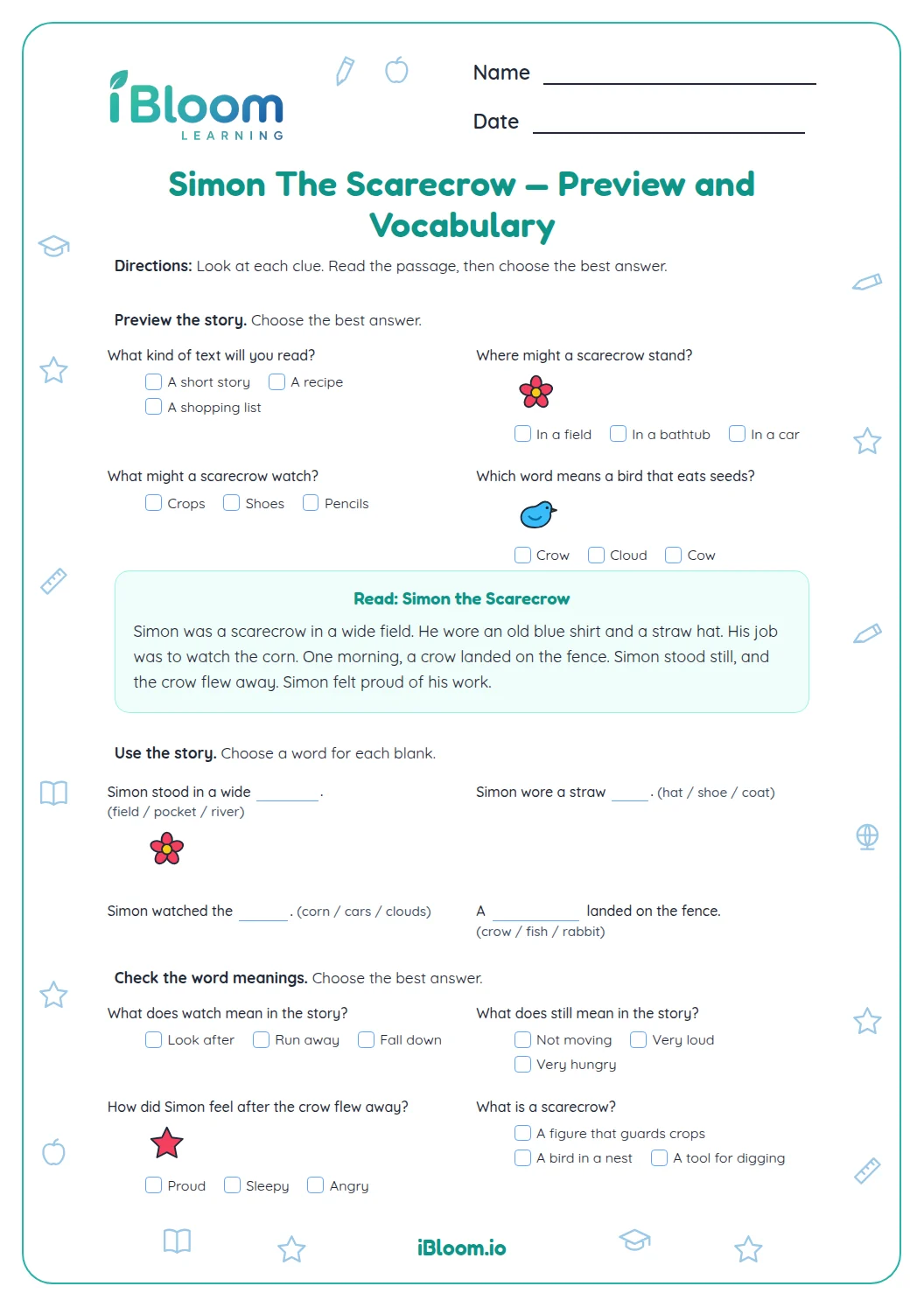
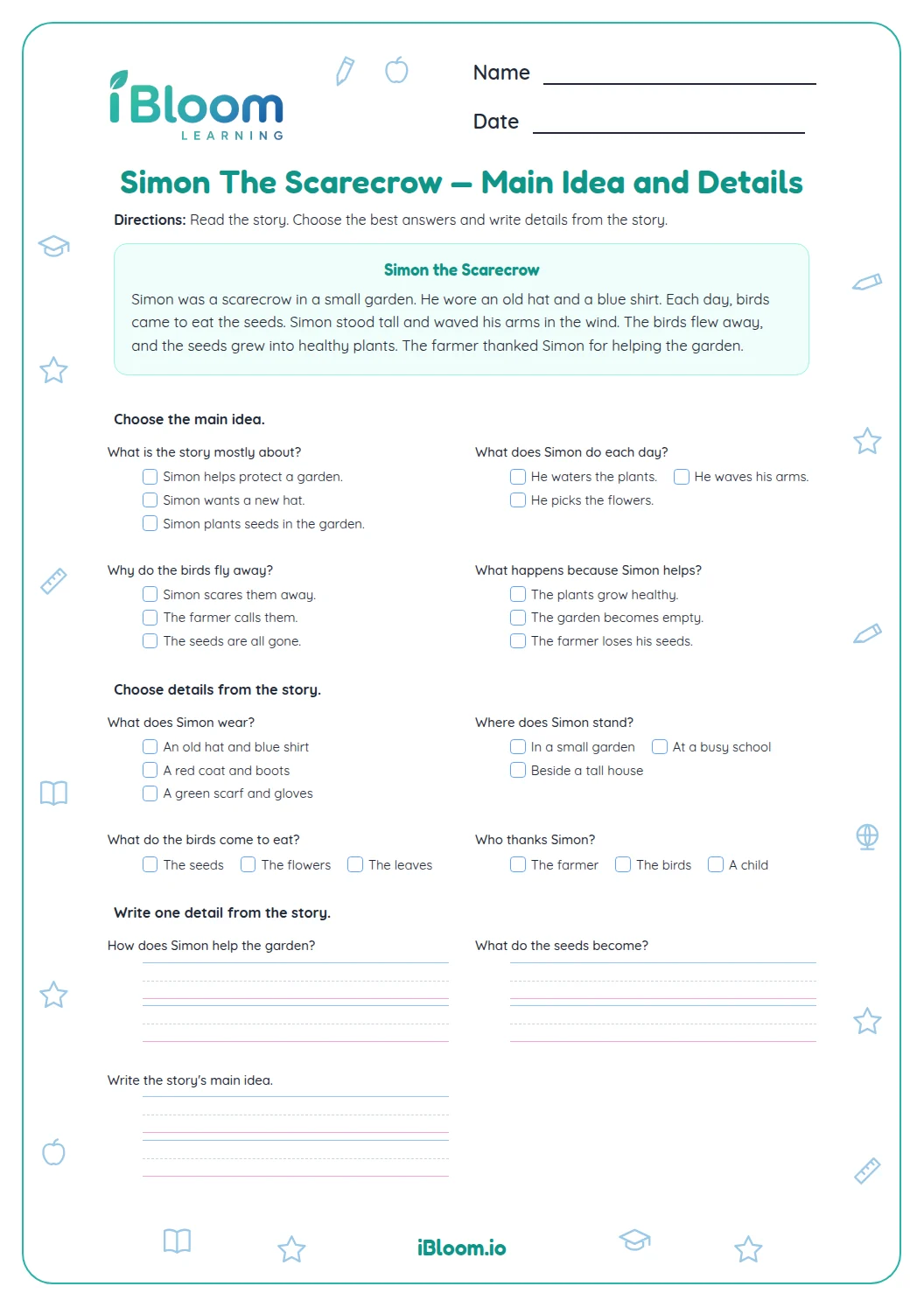
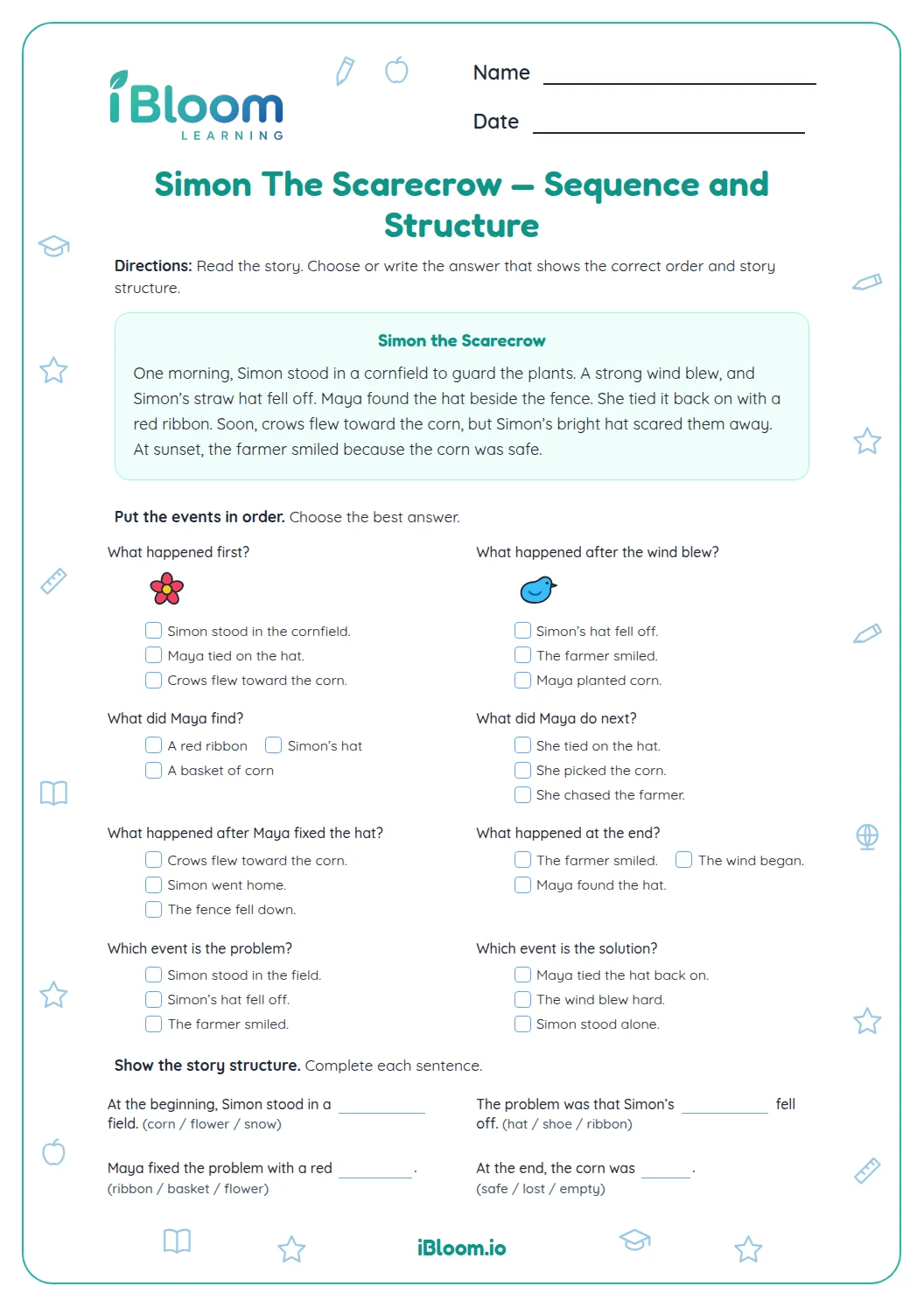
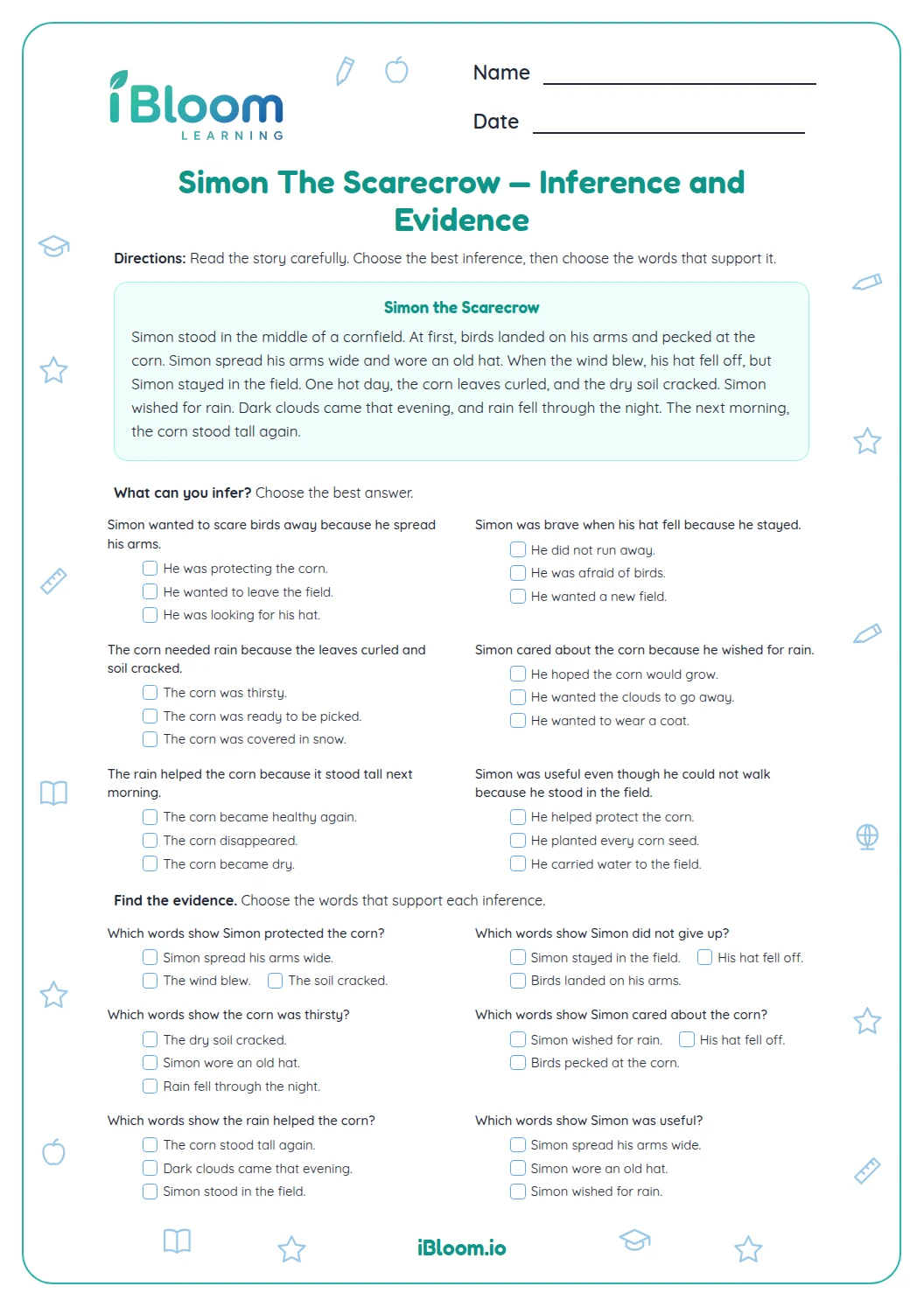
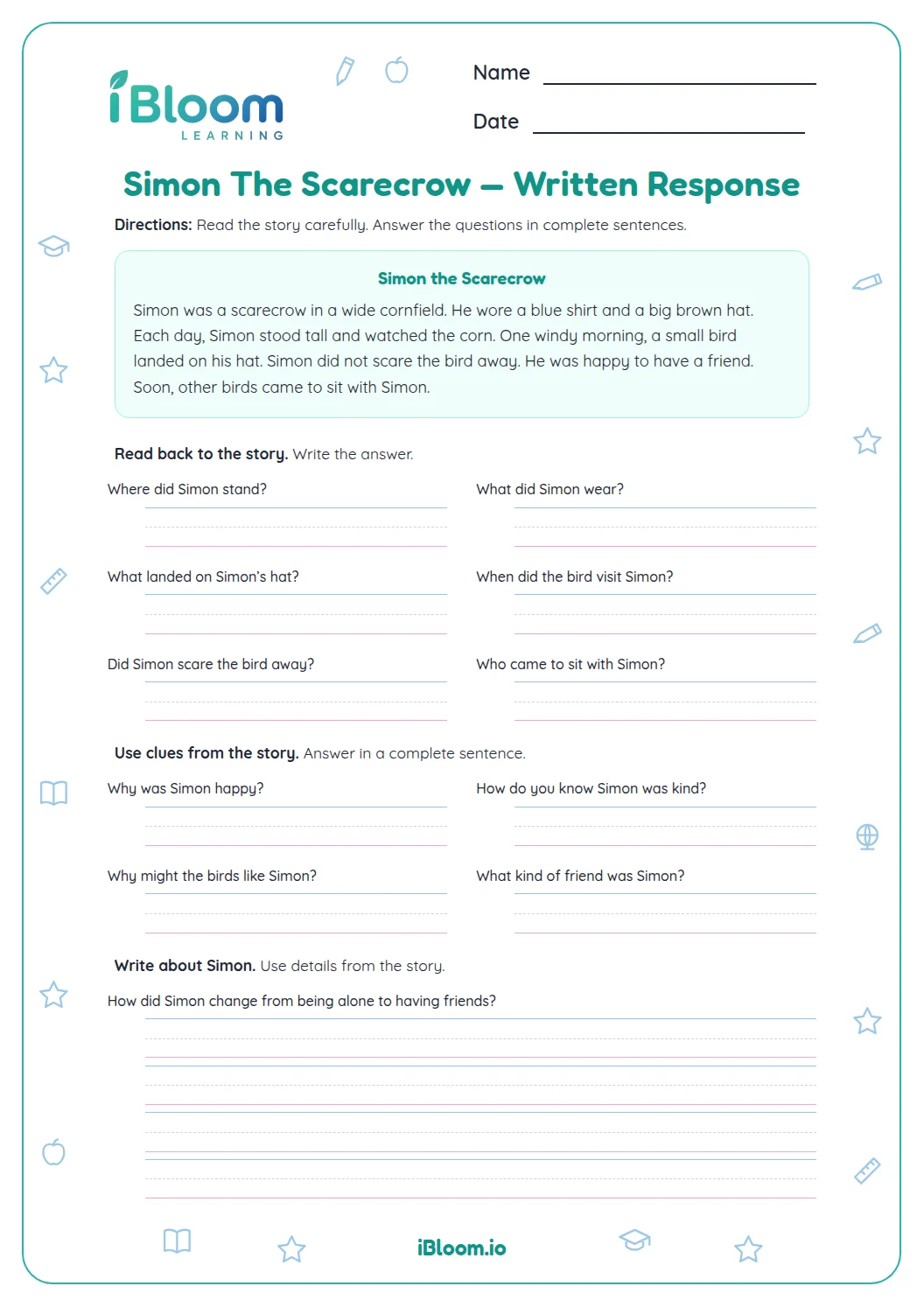
This free Grade 1 worksheet brings several reading skills together around Simon the Scarecrow. Children read a short retelling of Simon standing in a wheat field, choose six answers about details and meaning in Part B, complete six story-detail questions in Part C, and explain two ideas in Part D. The questions support Common Core RL.1.1 and RL.1.2 through close reading, sequence, and a lesson supported by events. Families can read the passage together before children return to it for evidence. The separate answer key includes sample responses for the two open questions.
Aligned to RL.1.1 and RL.1.2
What will children do in each part?
Part A gives the passage. Part B asks about the setting, the crows’ first action, Simon’s behavior, the birds’ response, and the main idea. Part C asks children to recall six story details. Part D asks how Simon helps and what lesson the story suggests.
Keep the passage available during every part. Finding a useful sentence is part of the work; children do not need to memorize the story.
How can a child support an answer?
Ask the child to point to the words that helped before marking a choice. For an inference, connect a detail to a reasonable idea: a smile after solving a problem suggests pleasure or pride.
- 1Question 4 asks what Simon does even when the wind blows.
- 2Find the sentence about Simon standing in the field.
- 3Choose “He stands tall.”
How do you discuss the lesson?
Use the ending to look back at the whole problem. Ask why the crows leave and how that helps the farmer, then help the child state a lesson someone else could use.
Accept different wording that fits the events. “Keep doing your job” and “Stay steady when something is difficult” can both connect to Simon standing tall until the crows leave. A response should explain the lesson rather than name only a character.
How to use this worksheet
- 1Read the title and discuss what a scarecrow is.
- 2Read Part A together, pausing to check the meaning of scarecrow and safely.
- 3Have the child find evidence before choosing each Part B answer.
- 4Complete Part C, then retell the events aloud in order.
- 5Discuss Part D, write short responses, and compare them with the sample key.
Mistakes to discuss and fix
The mistake
Choosing a fact about farms that the passage never gives.
The fix
Ask for a sentence in this passage that supports the choice.
The mistake
Putting the successful idea before the first attempt.
The fix
Retell the beginning, middle, and ending before filling the event sentences.
The mistake
Writing “a scarecrow” as the lesson.
The fix
Ask what a person could learn from the way Simon handles his problem.
Common Core alignment
Answer questions using details about Simon and the crows.
On this sheet: Children locate actions, setting details, and evidence for Simon’s feelings.
Show the official wordingHide the official wording
Ask and answer questions about key details in a text.
Follow the order of events and explain a lesson from Simon’s actions.
On this sheet: Event completions and the final written response connect the plot to its lesson.
Show the official wordingHide the official wording
Retell stories, including key details, and demonstrate understanding of their central message or lesson.
What to practice next
Make more practice
Further reading
Questions parents and teachers ask
Can I read the passage aloud?
Yes, an adult can read the passage while the child follows the words. Pause at the paragraph breaks and ask what has happened so far. Then let the child choose answers and point to supporting details. Rereading together keeps attention on understanding the events.
What makes the questions a mixed challenge?
The fourteen questions combine details, sequence, inference, main idea, and a lesson. Children first choose among answers, then complete story-detail questions and explain ideas in their own words. This variety asks them to return to the same short passage for several different purposes.
How much should children write in Part D?
One clear sentence for each question is enough. Ask the child to say the answer aloud before writing it. A brief response that explains how Simon helps or what lesson his actions suggest is useful evidence of understanding. The key offers examples rather than a required script.
Should my child answer from memory?
No, children should use the printed passage while answering. Encourage them to locate the helpful sentence and read it again before deciding. For the event questions, they can trace the order of the paragraphs. This makes checking an answer a concrete reading habit they can reuse.
How do I check a lesson that differs from the key?
Accept a lesson if the child can connect it to Simon’s actions. Ask which event supports the idea and listen for an explanation that fits. The answer key gives one sample lesson, but a child may express the same idea with different words or a different emphasis.