


About this worksheet
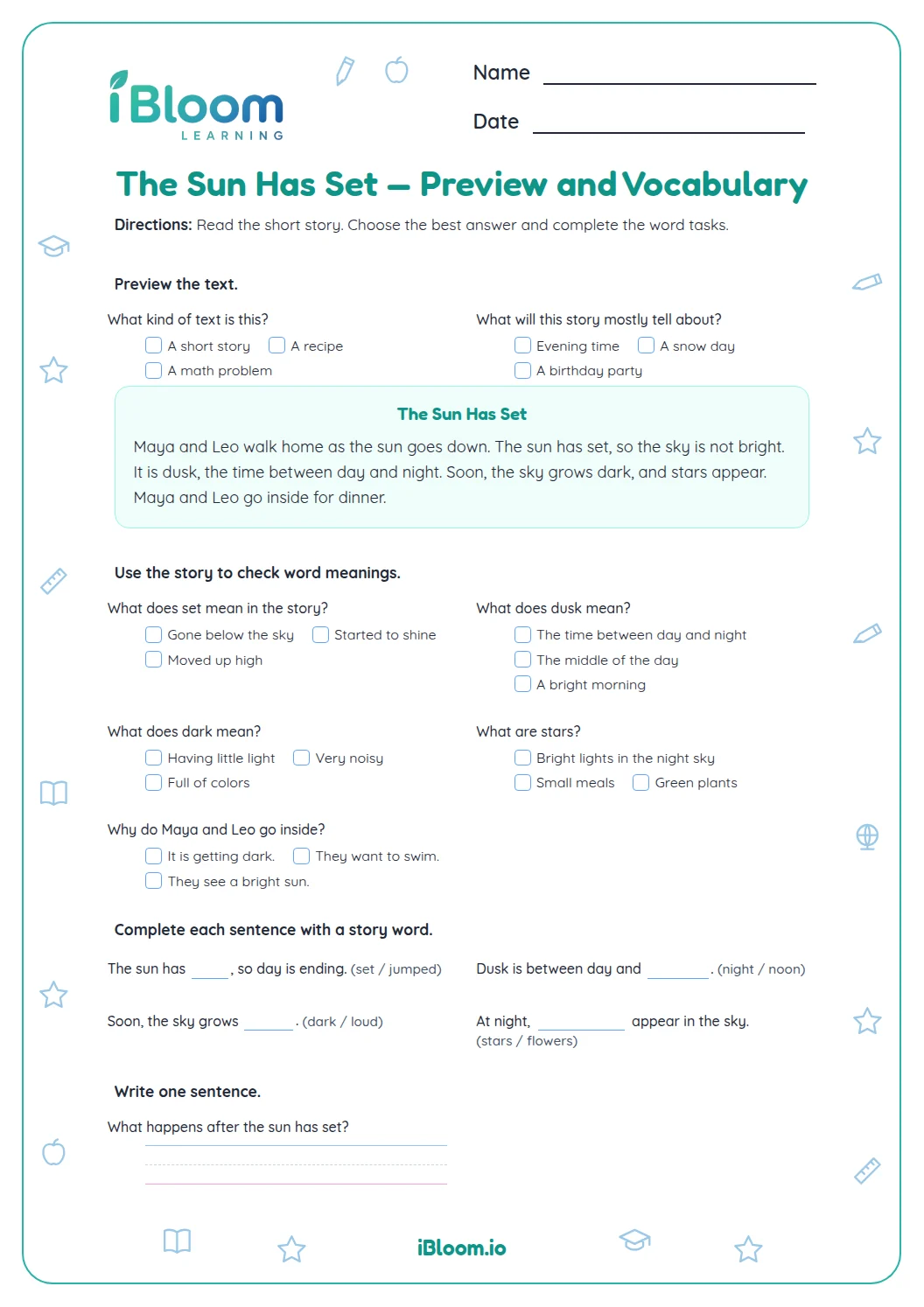
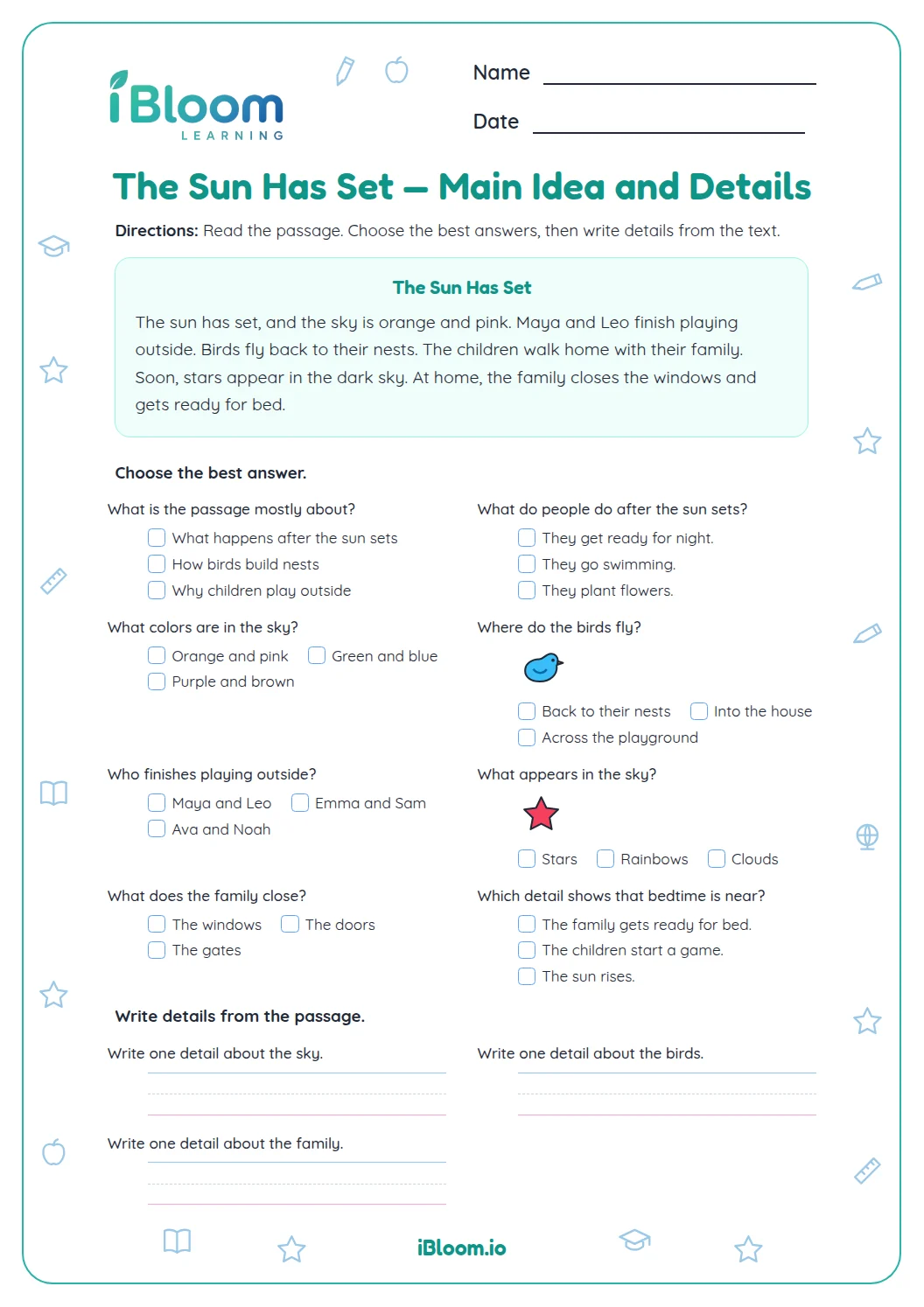
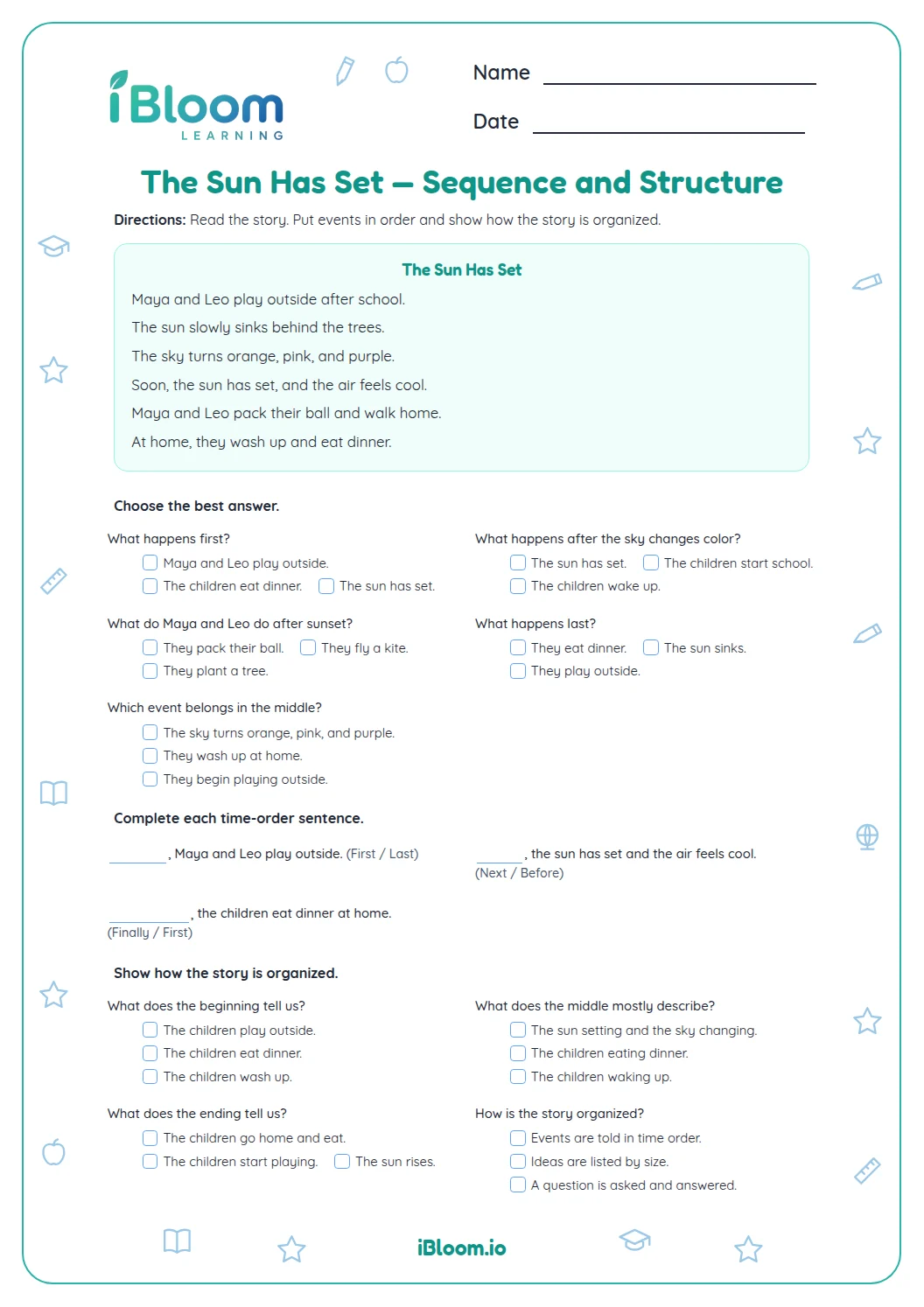
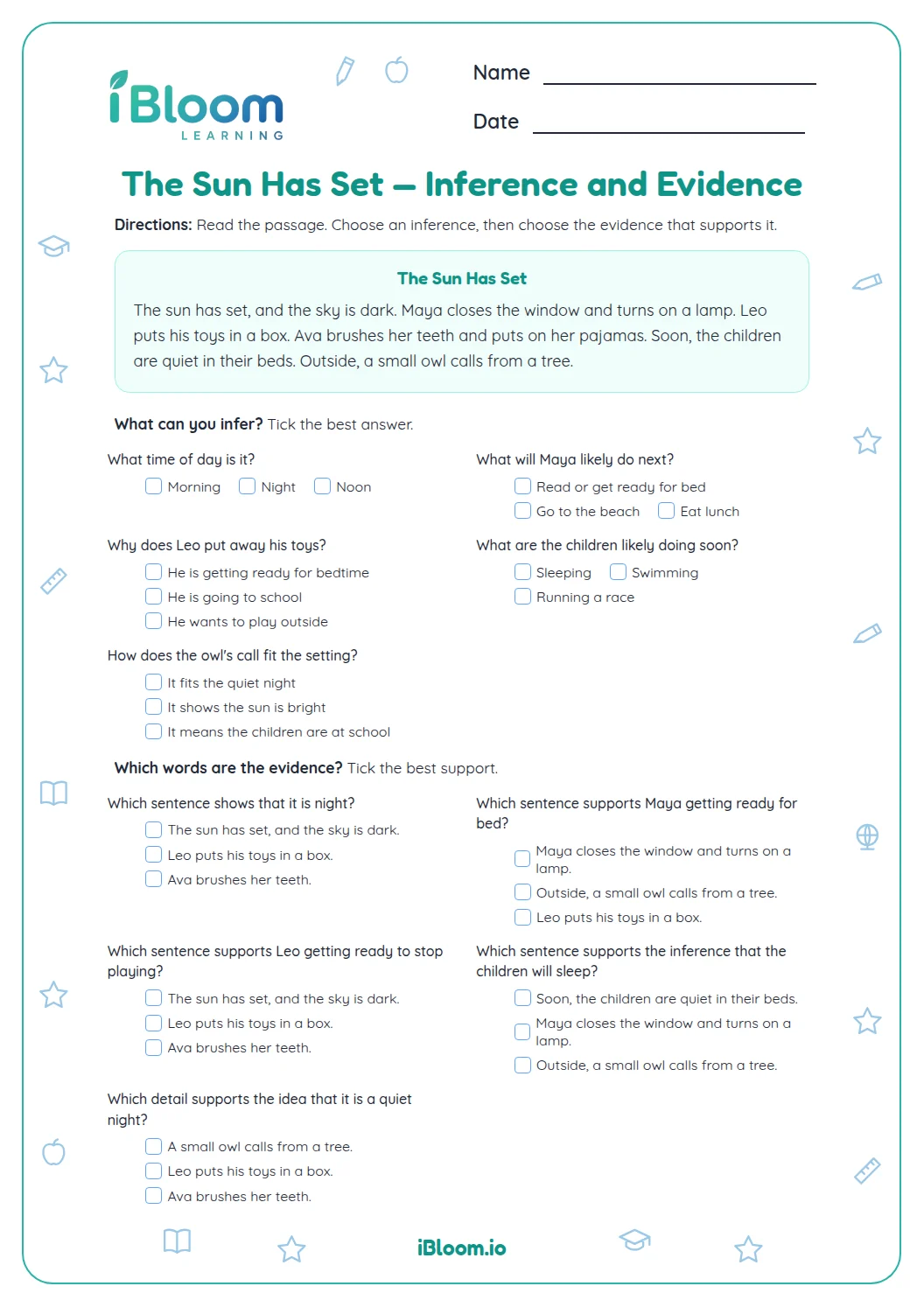
This Grade 1 printable pairs the original “The Sun Has Set” passage with 14 comprehension questions. Children find details about Maya and Leo, follow what changes as the sun sets, and write three short responses supported by the text. A separate answer key includes sample answers. The questions practice CCSS RL.1.1 by asking and answering about key details in a text.
Aligned to RL.1.1
How can children find a story detail?
Look back at the sentence that tells about the person, place, or event in the question. For example, the passage says Maya and Leo played outside after dinner.
Question 2 asks where the sun went. The answer is below the hills, taken directly from that sentence.
- 1Where did the sun go?
- 2Find the sentence that names the place.
- 3Answer: Below the hills.
How does the story move from day to evening?
Maya and Leo play outside after dinner. The sky changes color, the sun slips below the hills, and the air grows cool. Part C asks children to connect these details to the characters going inside.
Question 9 asks what Maya and Leo were getting ready for. The passage says they knew it was time to get ready for bed.
How should a written answer use evidence?
Answer the question, then include a detail that supports it. For “Why did Maya and Leo go inside?” a clear answer is “They knew it was time to get ready for bed.” The reason appears in the passage.
How to use this worksheet
- 1Read the story aloud or silently once.
- 2Reread the part named by each question.
- 3Answer who, what, where, and when questions with a story detail.
- 4For a why question, find the sentence that gives a reason.
- 5Use a complete thought for written responses.
- 6Compare answers with the sample key.
Common mistakes and quick fixes
The mistake
Guessing from the illustration or title
The fix
Point to the sentence that gives the answer.
The mistake
Giving a detail that does not answer the question
The fix
Repeat a key word from the question in the response.
The mistake
Writing a long retelling instead of a response
The fix
Answer the question in one clear sentence and add one supporting detail.
Common Core alignment
This worksheet gives focused practice with the standard below.
Look back in the text for the detail that answers each question.
On this sheet: The questions directly practice this skill.
Show the official wordingHide the official wording
Ask and answer questions about key details in a text.
What to practice next
Make more practice
Further reading
Questions parents and teachers ask
What story does this worksheet use?
It uses “The Sun Has Set,” in which Maya and Leo play outside after dinner, notice the changing sky, and go inside when the air grows cool. Questions ask children to recall key details, follow events, and explain an answer with evidence from the passage.
How can a first grader answer a written-response question?
A short phrase or sentence is enough when it answers the question clearly. For example, “They knew it was time to get ready for bed” explains why Maya and Leo went inside. The answer key accepts equivalent responses that accurately use a detail from the passage.
How many questions are included?
There are 14 questions about the passage. Ten ask for short answers, three invite a written response using a complete thought, and one asks children to identify an evening clue. The worksheet uses three pages because it includes the passage and room to write.
Should a child read the story more than once?
Yes. A first read helps a child follow the events, and a second look makes it easier to find exact details such as where the birds flew. Encourage the child to point to the sentence that supports each answer, then say the answer in their own words.
What does the answer key provide?
The key provides concise sample answers to all 14 questions. Some responses may use different words while giving the same detail from the story. Use it to check that each answer responds to the question and matches the passage, including the final details about stars and night sounds.