





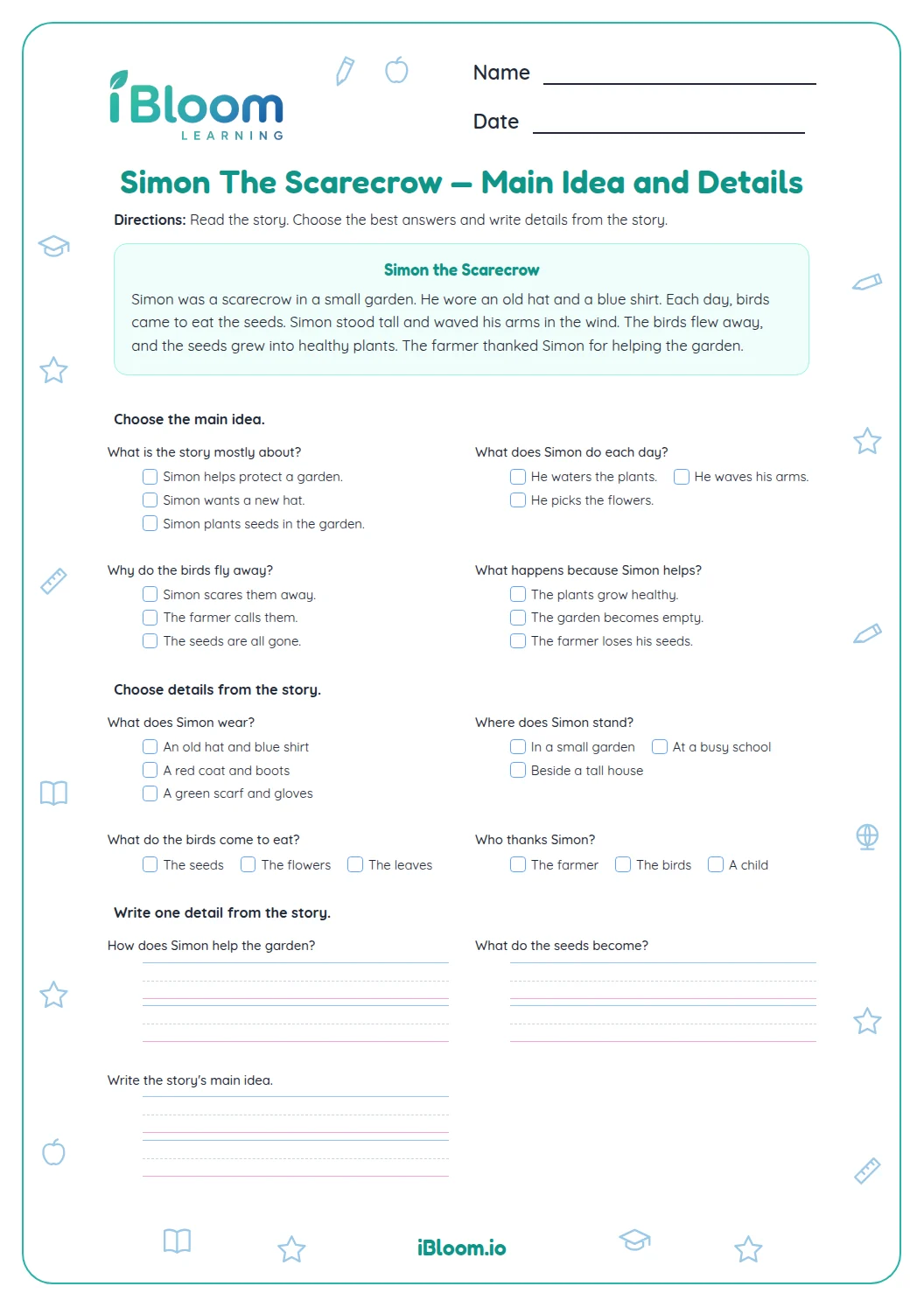
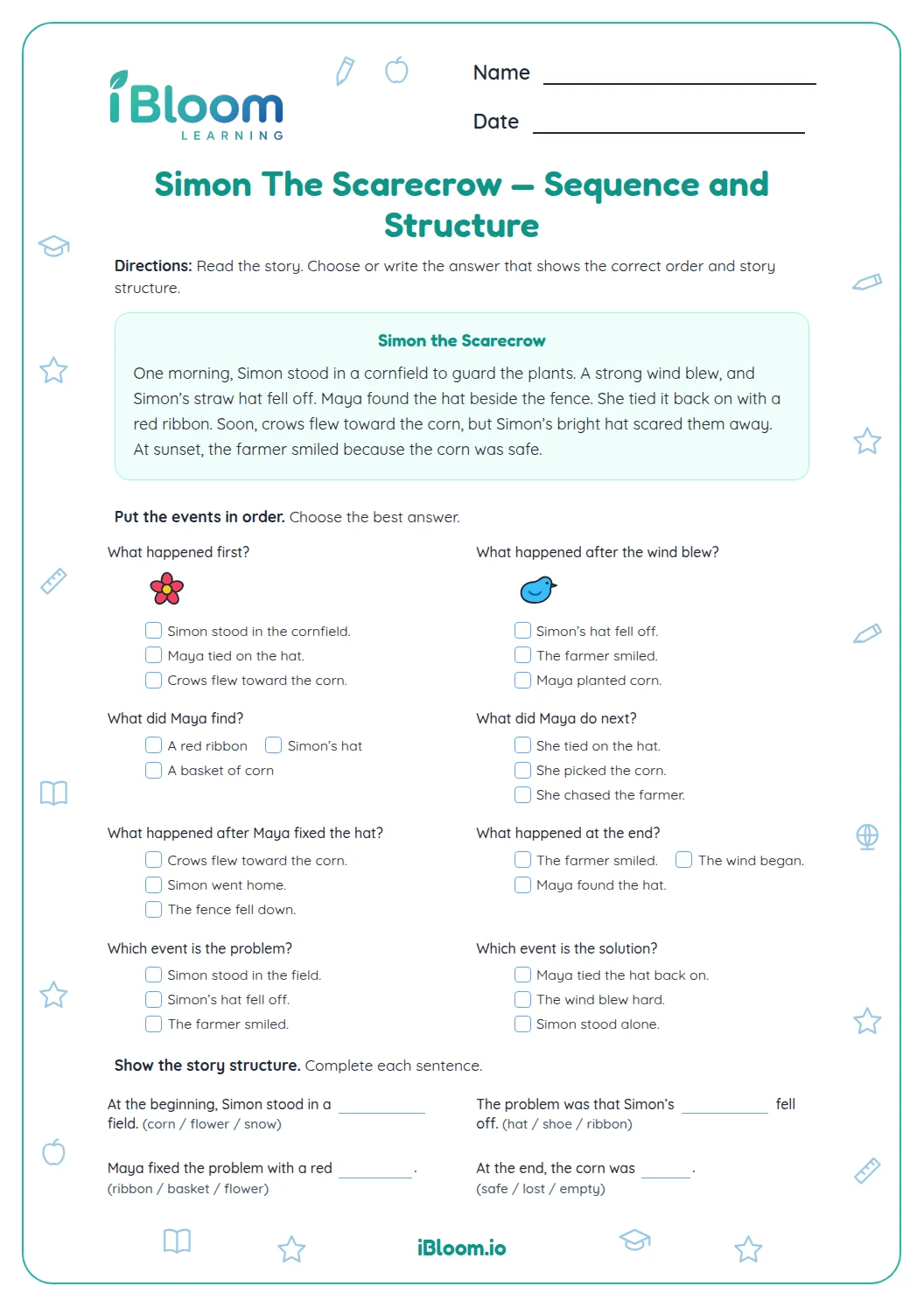
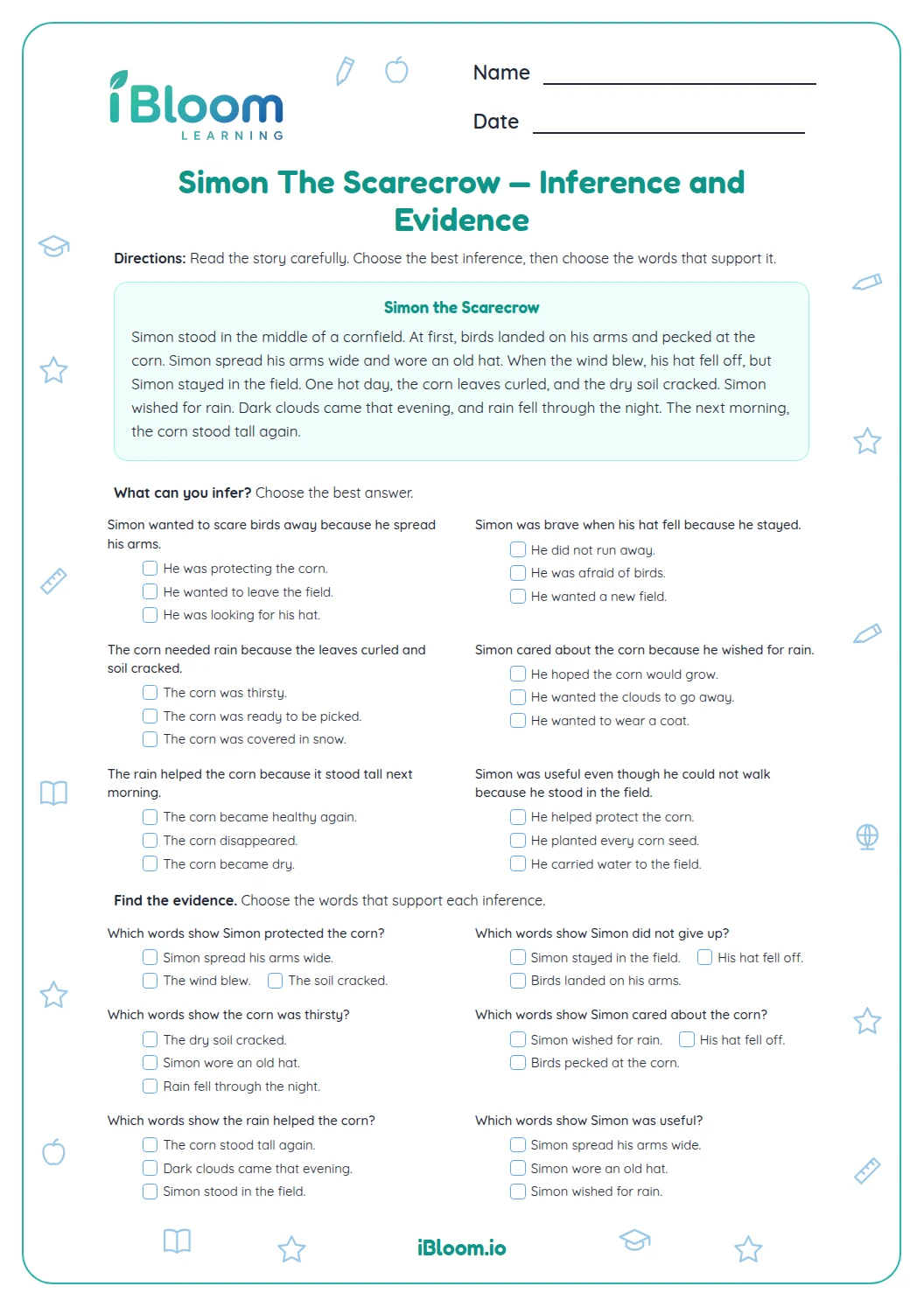
About this worksheet
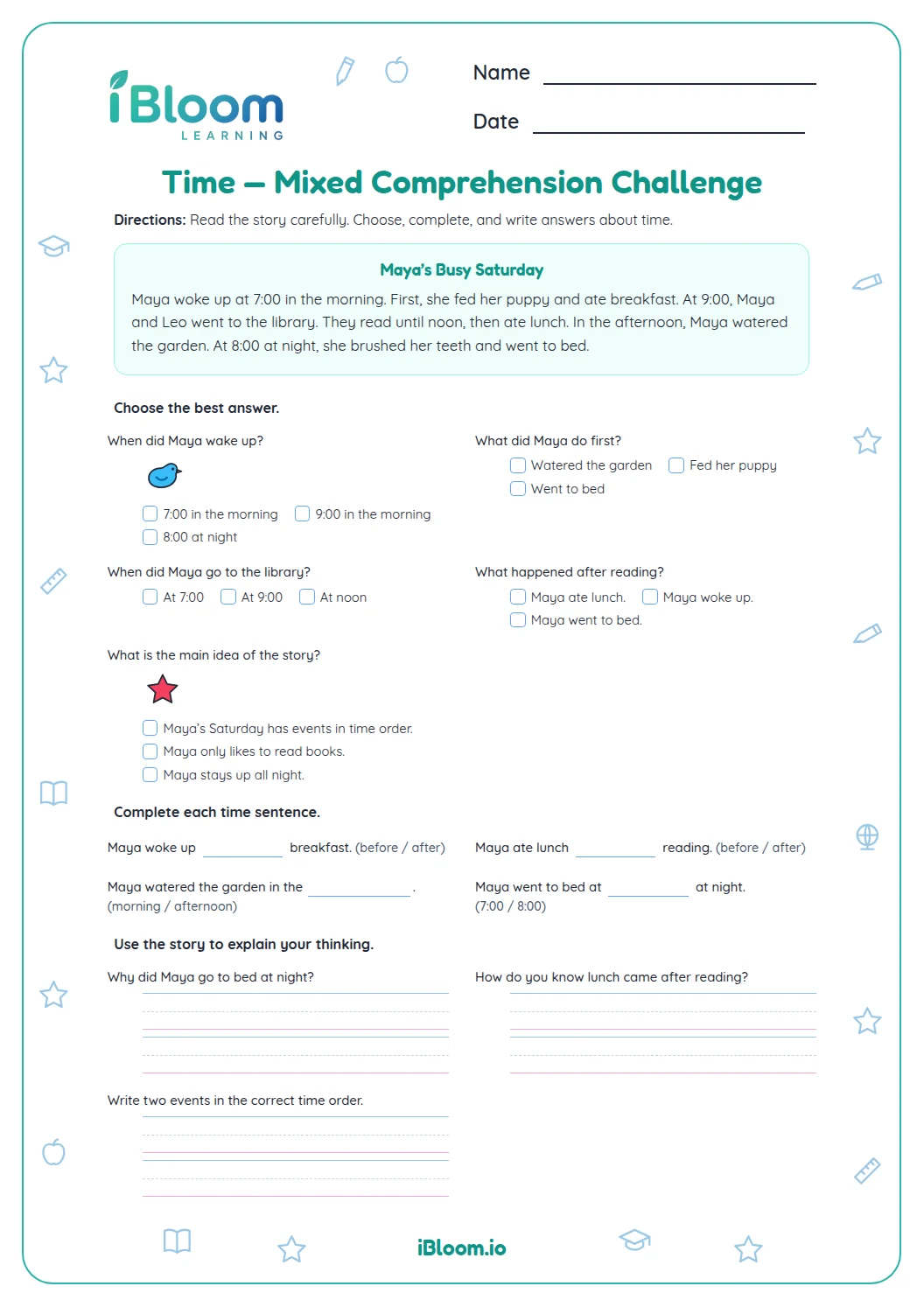
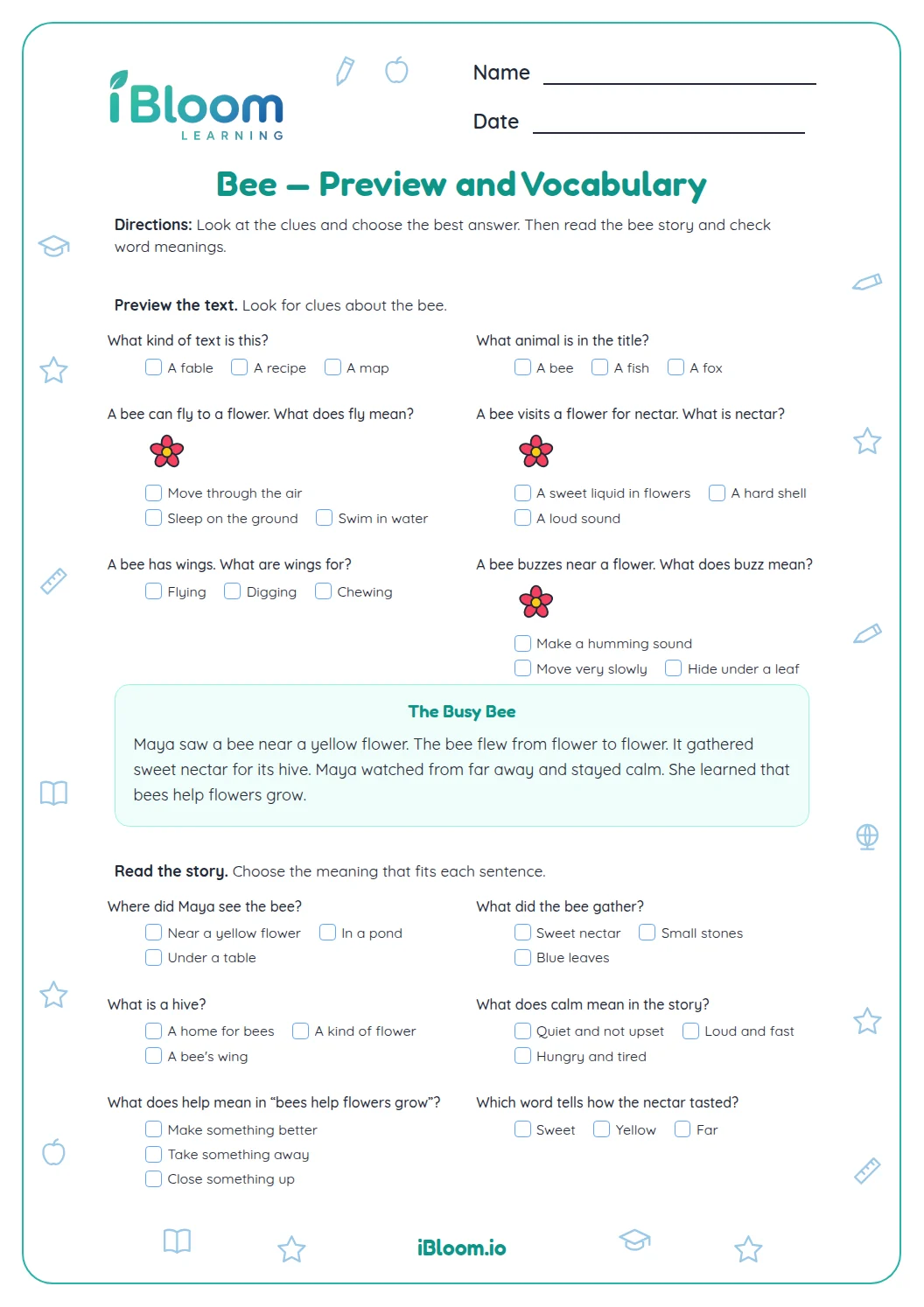
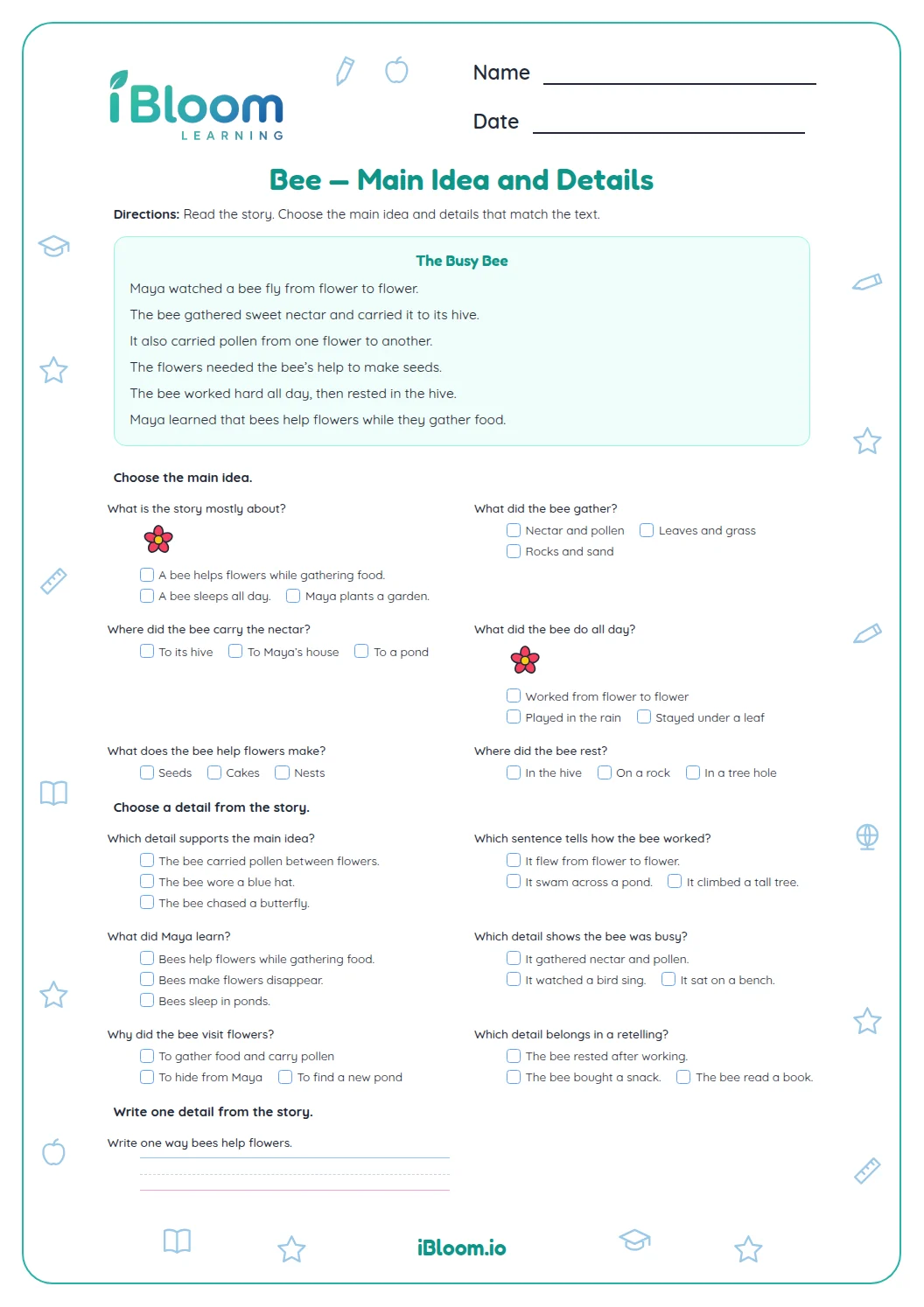
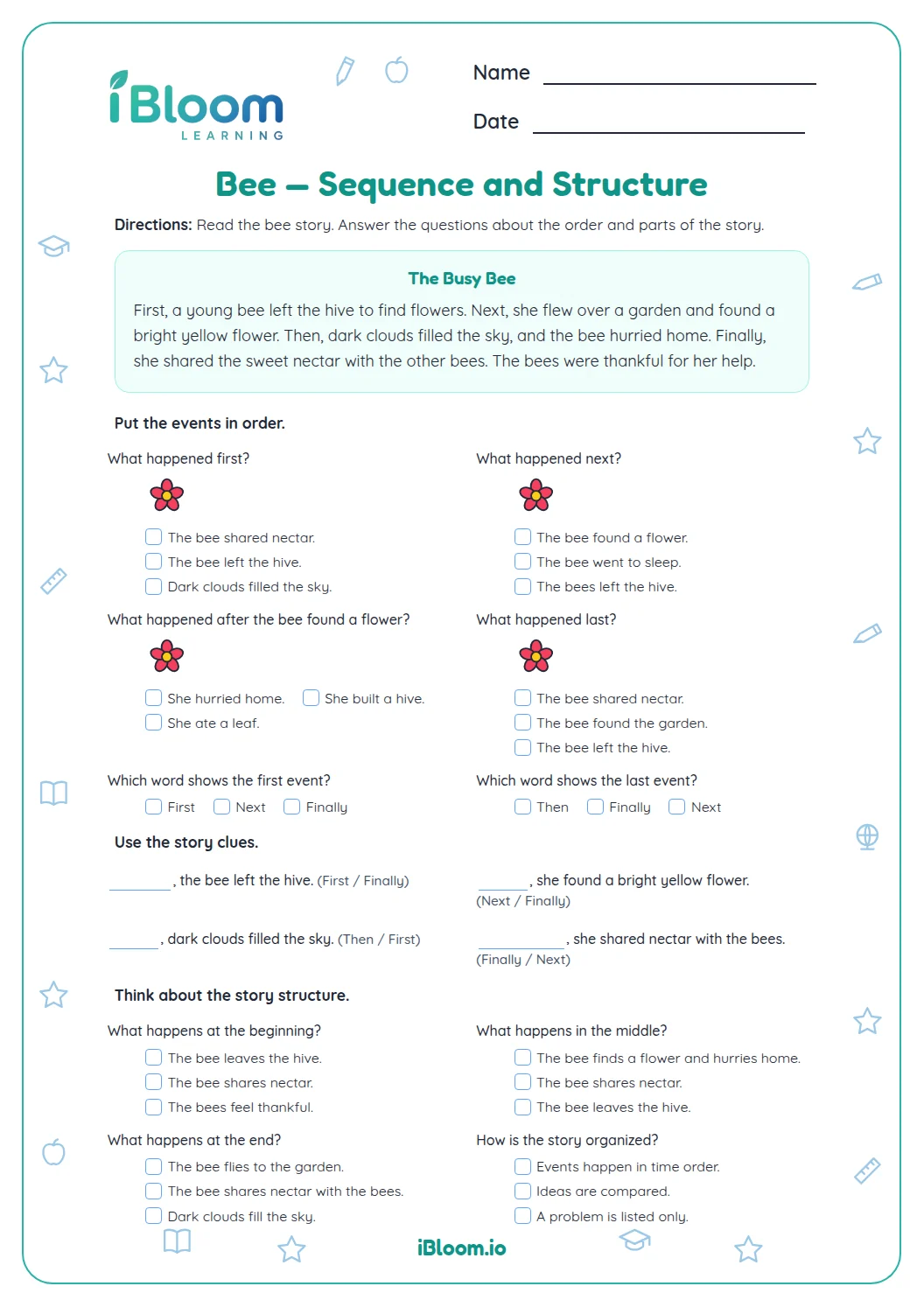
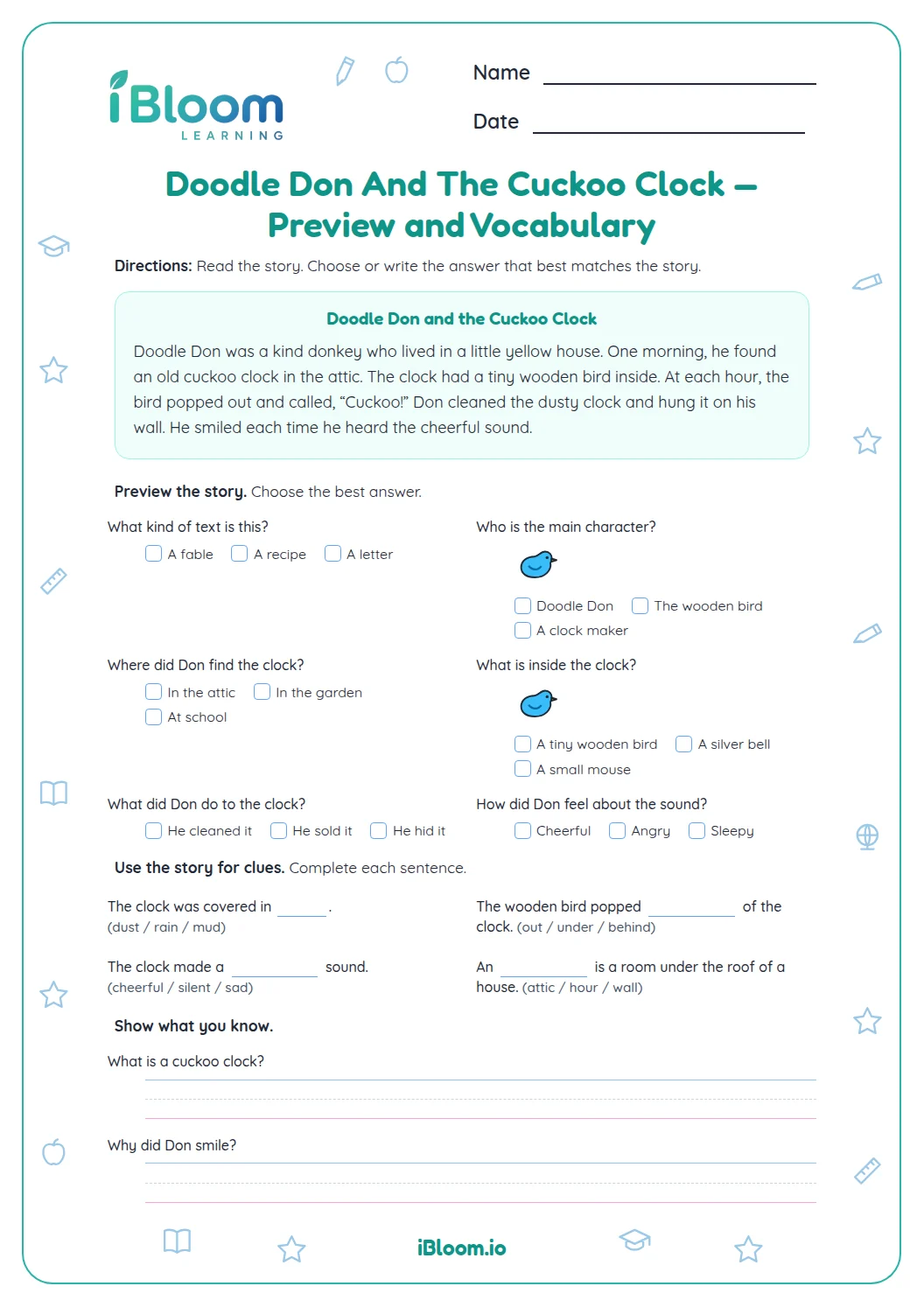
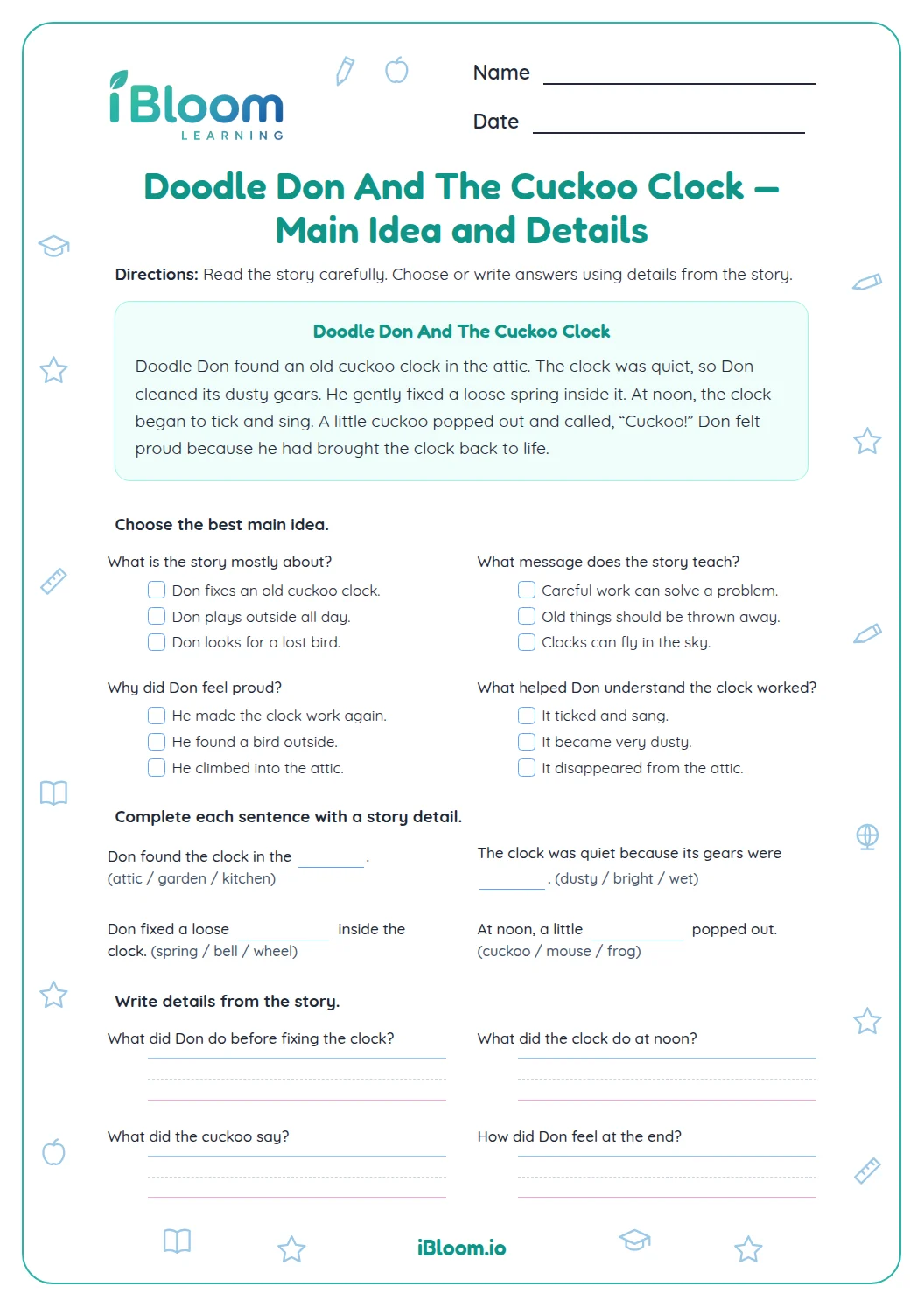
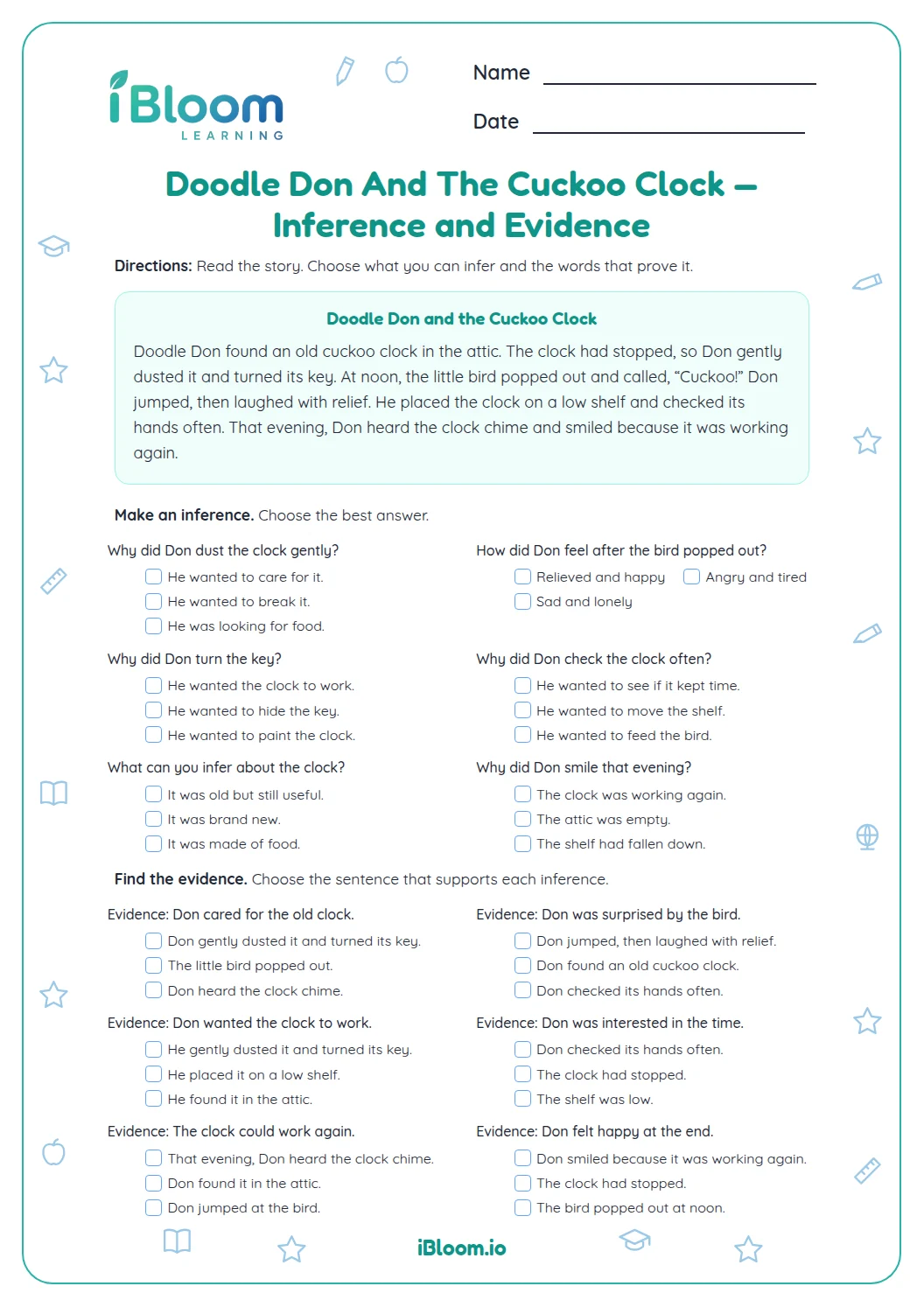
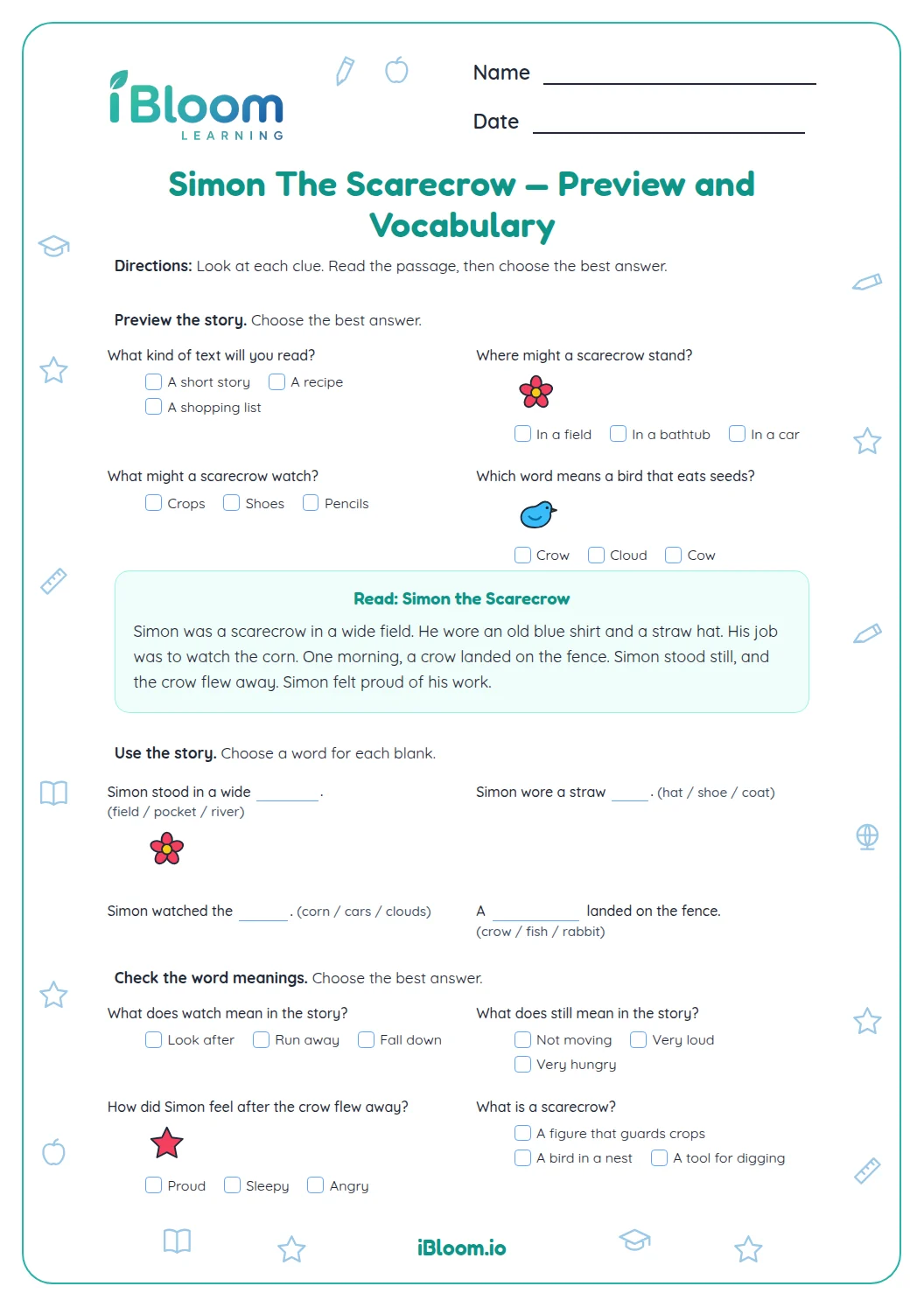
This Grade 1 printable pairs a short original story with 15 questions about time, details, sequence, vocabulary, and written response. In “Mia’s Busy Morning,” Mia wakes, eats breakfast, cares for a seed, and notices a sprout. Children use clock times and time words to follow events, then write about them. A separate answer key includes sample responses. The questions practice Common Core RL.1.1.
Aligned to RL.1.1
Which details help explain Mia’s choices?
Part B asks when Mia wakes, eats, waters the seed, and notices a sprout. Match each time clue to the event in the story.
- 1At seven o’clock, Mia woke up.
- 2The answer is 7:00.
How does the story move from seed to leaves?
Part C asks what happened first and last, and what “half past seven” means. Follow the time clues to put the events in order.
How can a written answer use evidence?
Part D asks children to describe an event at a given time and put two events in order. The key’s sample is one possible response.
How can I use this worksheet?
- 1Read the passage once to understand what happens.
- 2Return to the text when a question asks for a detail.
- 3Use time clues to order events.
- 4Write a complete sentence for each response question.
- 5Check that your answer matches something in the story.
What should I check as I work?
The mistake
Answering from memory only
The fix
A small detail can be easy to mix up. Find the sentence in the passage that supports the answer.
The mistake
Giving a one-word response
The fix
A written response should make sense on its own. Turn the key detail into a complete sentence.
The mistake
Adding an unsupported guess
The fix
An inference should connect to a story clue. Name the clue that helped you think of the answer.
Common Core alignment
Readers answer questions about key details and the order of events in a short story.
Ask and answer questions about key details in a story.
On this sheet: Readers answer literal and inferential questions using details from the passage.
Show the official wordingHide the official wording
Ask and answer questions about key details in a text.
What to practice next
Make more practice
Further reading
Questions parents and teachers ask
How long is the story?
The same story details answer questions about what happened and when. For example, Mia waters the seed at eight o’clock, after breakfast and before she sees the green curl at nine. The worksheet asks children to connect time clues with those events.
What does the worksheet ask children to do?
The story has 15 questions in four parts, plus the passage. Children answer multiple-choice questions about clock times and details, follow event order, explore a word’s meaning, and write two responses. The separate key includes the selected answers and sample sentences.
Why did Mia wait to water the seed?
Yes. Questions connect seven o’clock, half past seven, eight o’clock, and nine o’clock with events in Mia’s morning. Children also use sequence clues, including “then” and “tomorrow,” to track when the seed is watered and when the sprout appears.
What is the lesson of the story?
The worksheet has 15 questions in two question parts, plus the passage. Children answer multiple-choice questions about clock times and details, follow event order, explore a word’s meaning, and write two responses. The separate key includes selected answers and sample sentences.
How should children answer the last questions?
The story says Mia wakes at seven, eats at half past seven, waters the seed at eight, and sees a green curl at nine. Children use those clues to identify event order and describe what Mia does at a particular time.
Is there an answer key?
Yes. The answer key lists answers for all 15 questions and gives sample responses for both written items. Another sentence is acceptable when it uses accurate story details and follows the requested order or time clue. A child may write a different sentence from the sample.