
About this worksheet
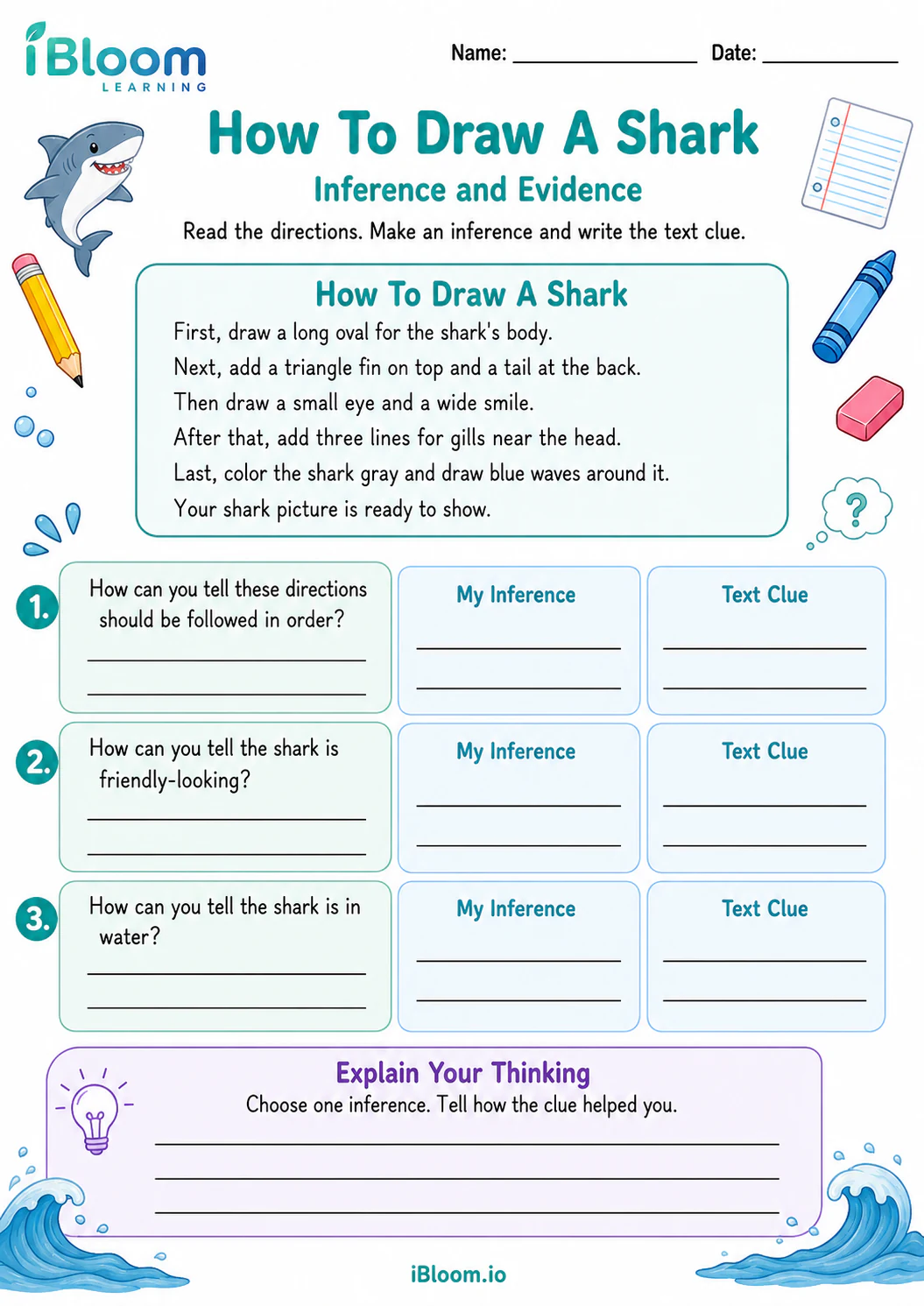
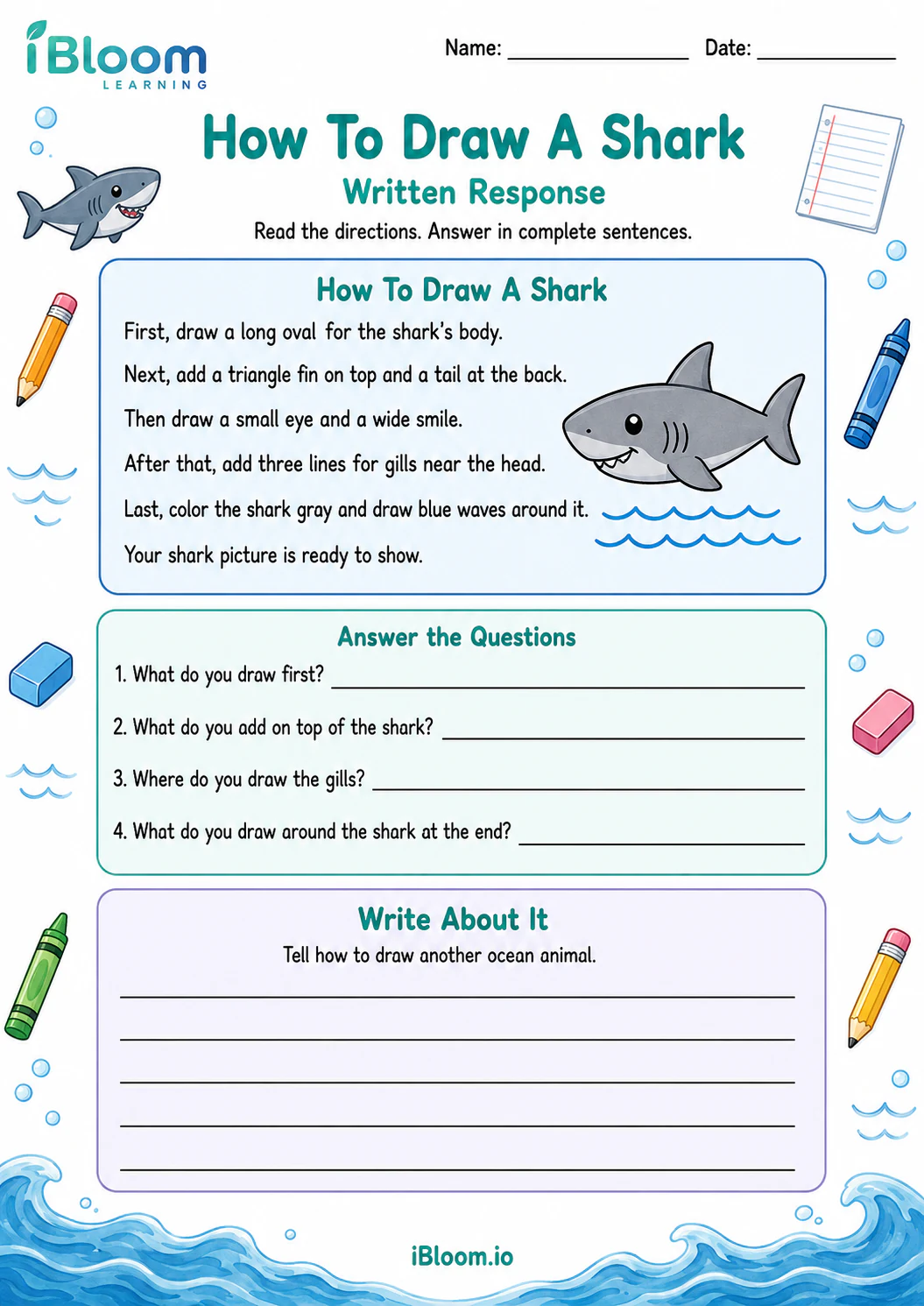
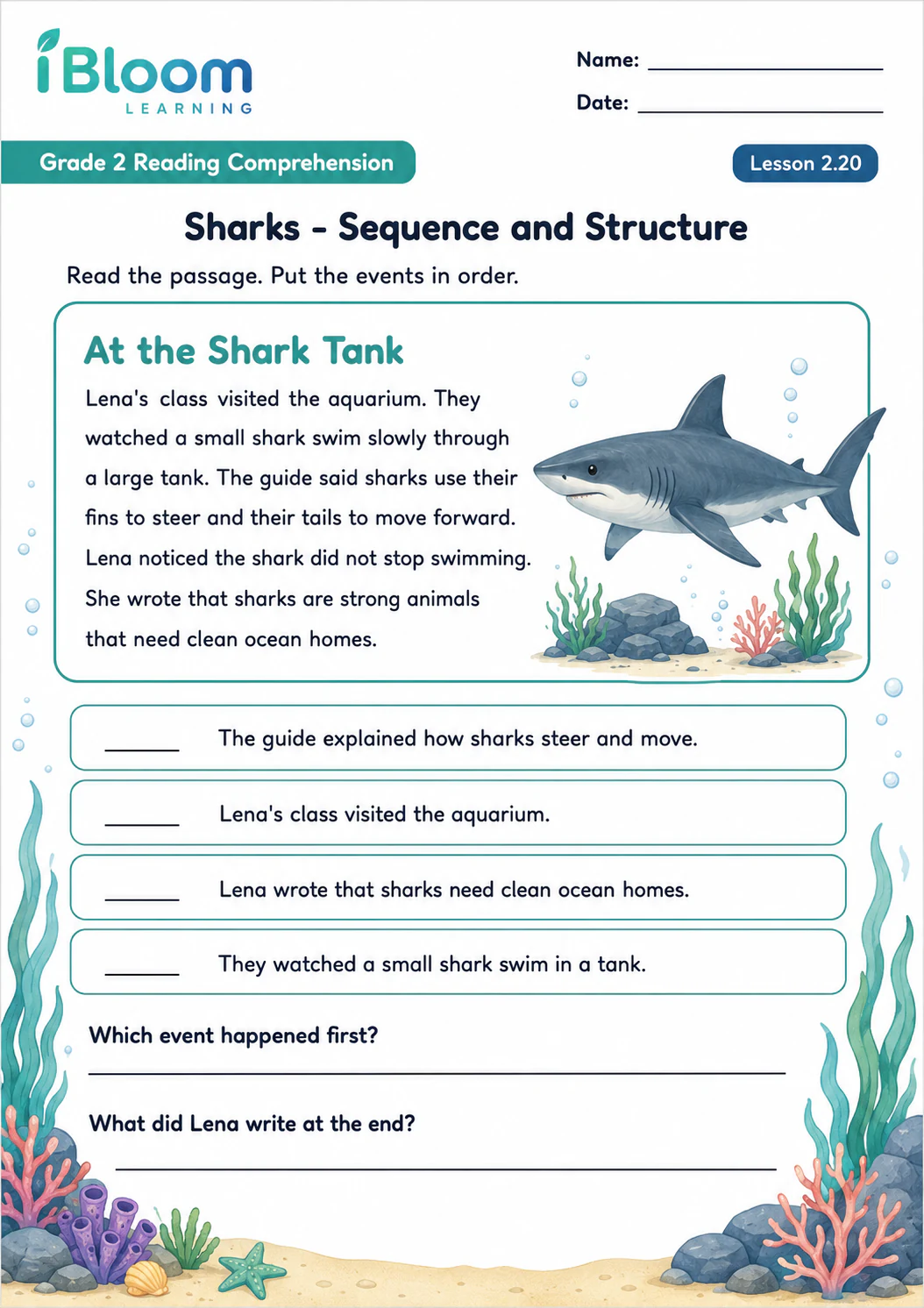
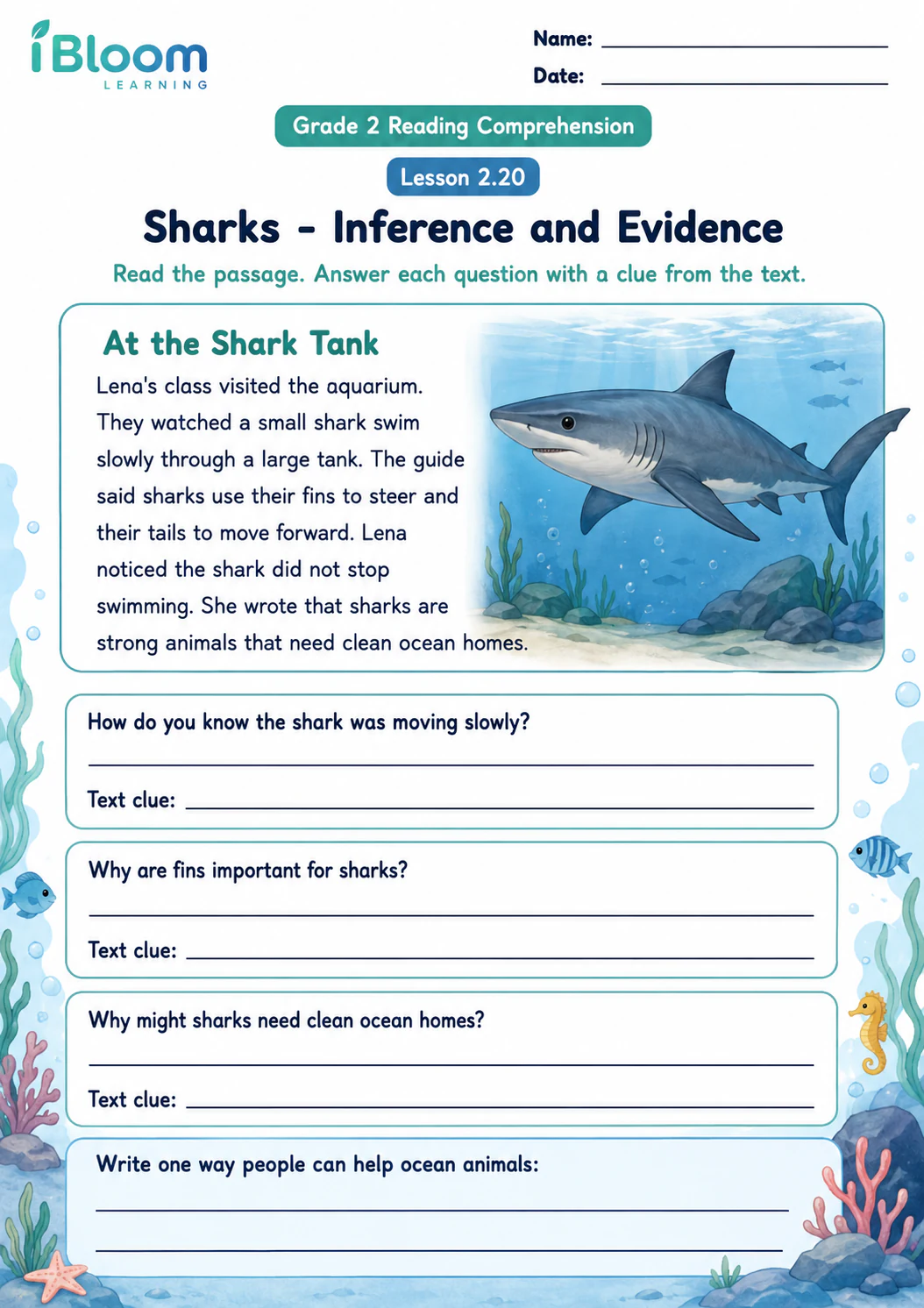
This Grade 2 reading worksheet pairs a short how-to passage with 14 questions about sequence and text structure. Children follow directions for drawing a shark, notice words such as “First,” “Next,” and “Finally,” and explain how the steps are organized. The questions practice CCSS RI.2.5 by asking readers to describe how the text is structured. A separate answer key lists the correct choices.
Aligned to RI.2.3
What happens first in the directions?
The reader draws a long oval for the shark’s body, then adds a triangle tail. Part B checks whether children can locate details and put steps in order.
- 1What should you draw first?
- 2The first sentence says to draw a long oval for the shark’s body.
How do sequence words help?
Words such as “First,” “Next,” and “Finally” signal the order of actions. Use them to work out what happens before the eye or gills are added.
How is the passage organized?
It is a set of directions grouped in time order: sketch the main shape, add fins and features, then finish the lines. The final questions ask children to describe that structure.
How to use this worksheet
- 1Read the entire passage once.
- 2Underline sequence words that show order.
- 3For a step question, return to the exact sentence.
- 4Put actions in order before writing your response.
- 5Use a passage detail to support explanations.
Common mistakes and quick fixes
The mistake
Choosing an action that appears in the passage but is out of order.
The fix
Check the sequence word before and after that action.
The mistake
Answering “why” with a guess.
The fix
Use a detail from the directions to explain.
The mistake
Treating “Next” and “Finally” as interchangeable.
The fix
Notice that “Finally” introduces the last step.
Common Core alignment
This worksheet practices the standard below.
Describe connections between steps in a procedure.
On this sheet: Children describe how the steps in the shark-drawing procedure connect in time order.
Show the official wordingHide the official wording
Describe the connection between a series of historical events, scientific ideas or concepts, or steps in technical procedures in a text.
What to practice next
Make more practice
Further reading
Questions parents and teachers ask
What does the passage teach?
The passage gives steps for drawing a simple shark. It begins with a light oval for the body, adds a triangle tail and fins, then describes the eye, mouth, gills, and final pencil marks. Questions ask children to follow the order and locate details in those directions.
Which sequence words appear?
The passage uses “First,” “Next,” and “Finally” to mark when actions happen. Readers can use those words to track the order, but they should also reread the sentences for the exact details. For example, the oval comes first, while the gill lines appear near the end.
What reading skills do the questions practice?
Children identify details, put actions in order, and explain how the passage is organized through multiple-choice questions. The passage is a set of directions arranged in time order. Readers return to the text and use sequence words as evidence for their choices.
Does the printable include an answer key?
Yes. The answer key lists the correct choice for all 14 questions. The questions check details and sequence, then ask readers to identify the passage structure and use the directions to decide what to do after a missed step.