
About this worksheet
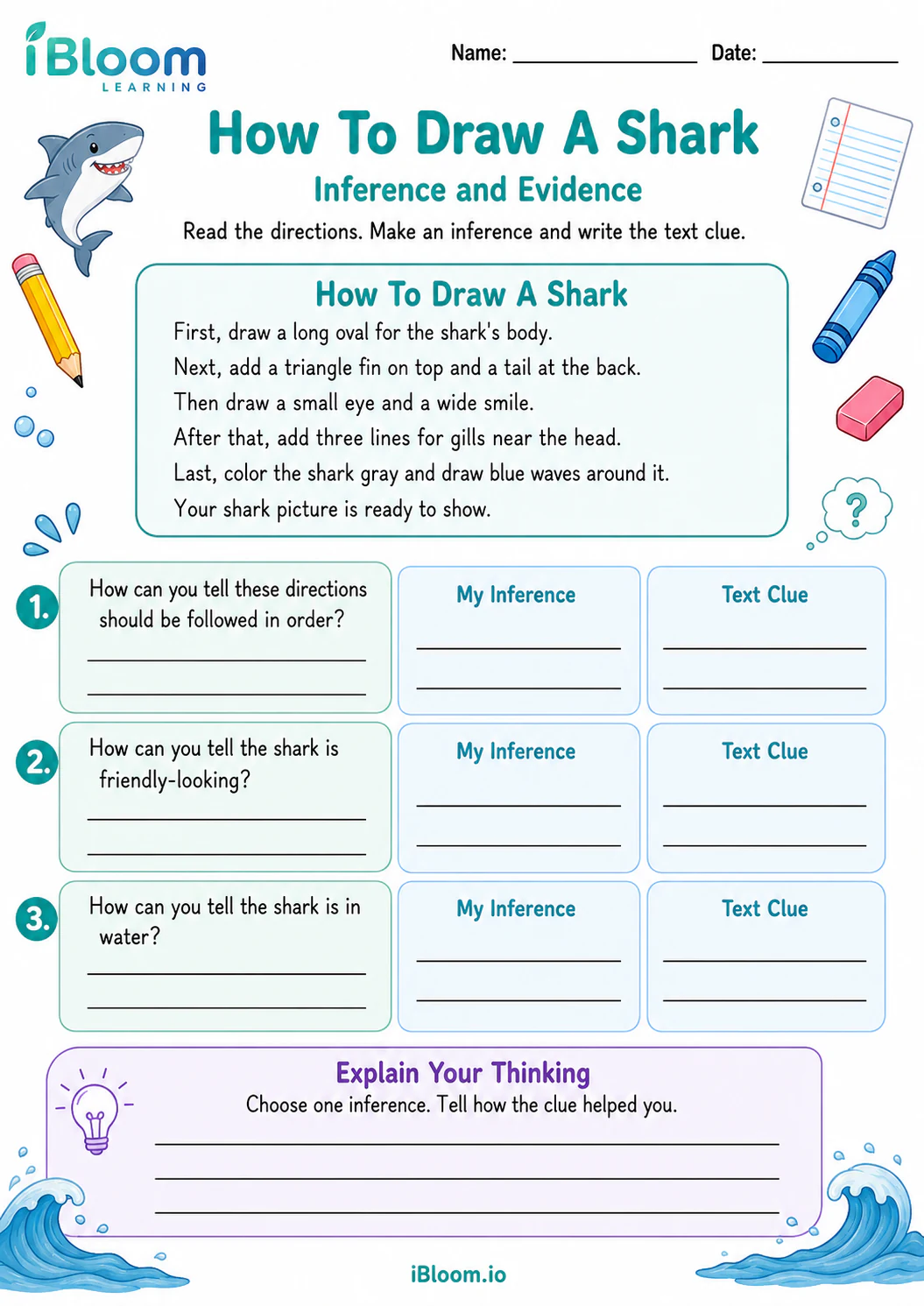
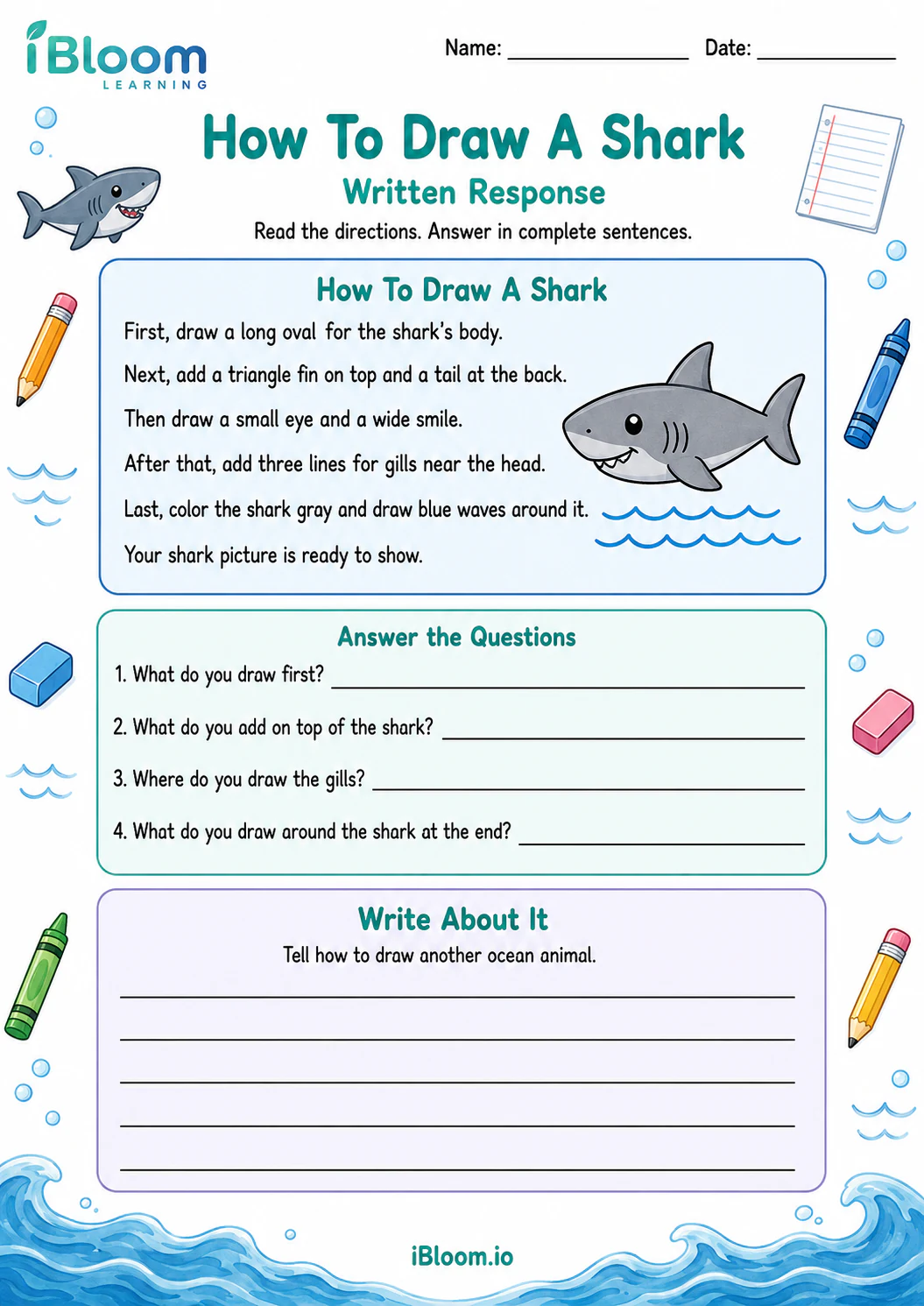
This free Grade 2 reading worksheet uses original step-by-step directions for drawing a shark. Students preview the steps, use nearby words to interpret vocabulary such as narrow and pointed, and answer questions about sequence and purpose. The final question checks a detail about the tail so students can confirm they followed the directions. It practices CCSS RI.2.3: describing how steps in a technical procedure connect. The worksheet takes three pages because the passage and drawing activity need room; a separate key is included.
Aligned to RI.2.3
How do context clues help with “narrow”?
The directions say to make one end of the oval narrow for the nose. That contrast with the body shape suggests the end becomes thinner. Question 5 asks students to choose that meaning from the context.
- 1The passage says, “Make one end narrow for the nose.”
- 2A narrow end is thinner than the rest of the oval.
- 3Choose “It gets thinner.”
Which details tell how to draw the shark?
The passage gives a sequence: begin with an oval body, add fins, then a mouth, eye, gills, and two-part tail. At the end, color the shark gray and the water blue, then add bubbles. Use those details for question 14’s drawing.
What is on the worksheet?
There are 14 multiple-choice questions in two reading parts. The questions cover explicit details, sequence, purpose, and word meaning. They follow the passage from the first oval through the tail and finishing details. The worksheet uses three pages, with a separate answer key.
How to use this worksheet
- 1Read the directions once to learn the order of the drawing steps.
- 2Use the sentence around a bold or unfamiliar word as a clue.
- 3For a sequence question, return to first, next, and last details.
- 4Choose the answer that the passage supports, not a fact you know from elsewhere.
- 5Return to the sentence that states each detail before choosing an answer.
- 6Use the answer key to review the reading questions.
Common mistakes and how to check
The mistake
Thinking “narrow” means brighter or longer.
The fix
Look at the body shape: the word describes its width, so the nose end gets thinner.
The mistake
Adding a shark detail that the passage never mentions as a required step.
The fix
Check the listed parts: body, fins, mouth, eye, gills, tail, color, and bubbles.
The mistake
Treating the last drawing direction as the first step.
The fix
Follow the signal words first, next, and last to keep the sequence in order.
Common Core alignment
This worksheet practices RI.2.3 by asking readers to follow the steps in a drawing procedure.
Describe how the drawing steps connect and follow one another.
On this sheet: Use nearby words and sentences to determine the meaning of words such as narrow and pointed.
Show the official wordingHide the official wording
Describe the connection between a series of historical events, scientific ideas or concepts, or steps in technical procedures in a text.
What to practice next
Make more practice
Further reading
Questions parents and teachers ask
What shape does the passage say to draw first?
The first shape is a large oval for the shark’s body. The directions then say to make one end narrow for the nose and the other a little thinner for the tail. Question 1 checks whether the reader noticed that first step. It is the first drawing step in the passage, before the fins or face details.
What does “narrow” mean in the directions?
In this passage, narrow means thinner from side to side. The sentence says to make one end narrow for the nose, describing the oval’s shape. Students can use that context clue to answer question 5 without needing a dictionary. This meaning is supported by how the directions describe the two ends of the oval.
What should the finished shark include?
The passage names an oval body, a top fin, two smaller fins underneath, a curved mouth, a circle eye, three short gill lines, and a tail with two pointed parts. It also asks the child to color the shark gray and water blue and add bubbles. Follow the passage in order so no key part is missed.
Does the worksheet ask children to draw?
No. It asks students to read and interpret the directions instead. The final question checks how many pointed tail parts the passage names. This keeps the answer key tied to a detail that readers can locate in the printed text.
Is there an answer key for the reading questions?
Yes. The separate answer key lists answers to all 14 multiple-choice questions. Students can compare each response with the matching step in the passage, especially for sequence words, vocabulary clues, and the number of pointed tail parts. Adults can invite a child to point to the sentence that supports a response.