
About this worksheet
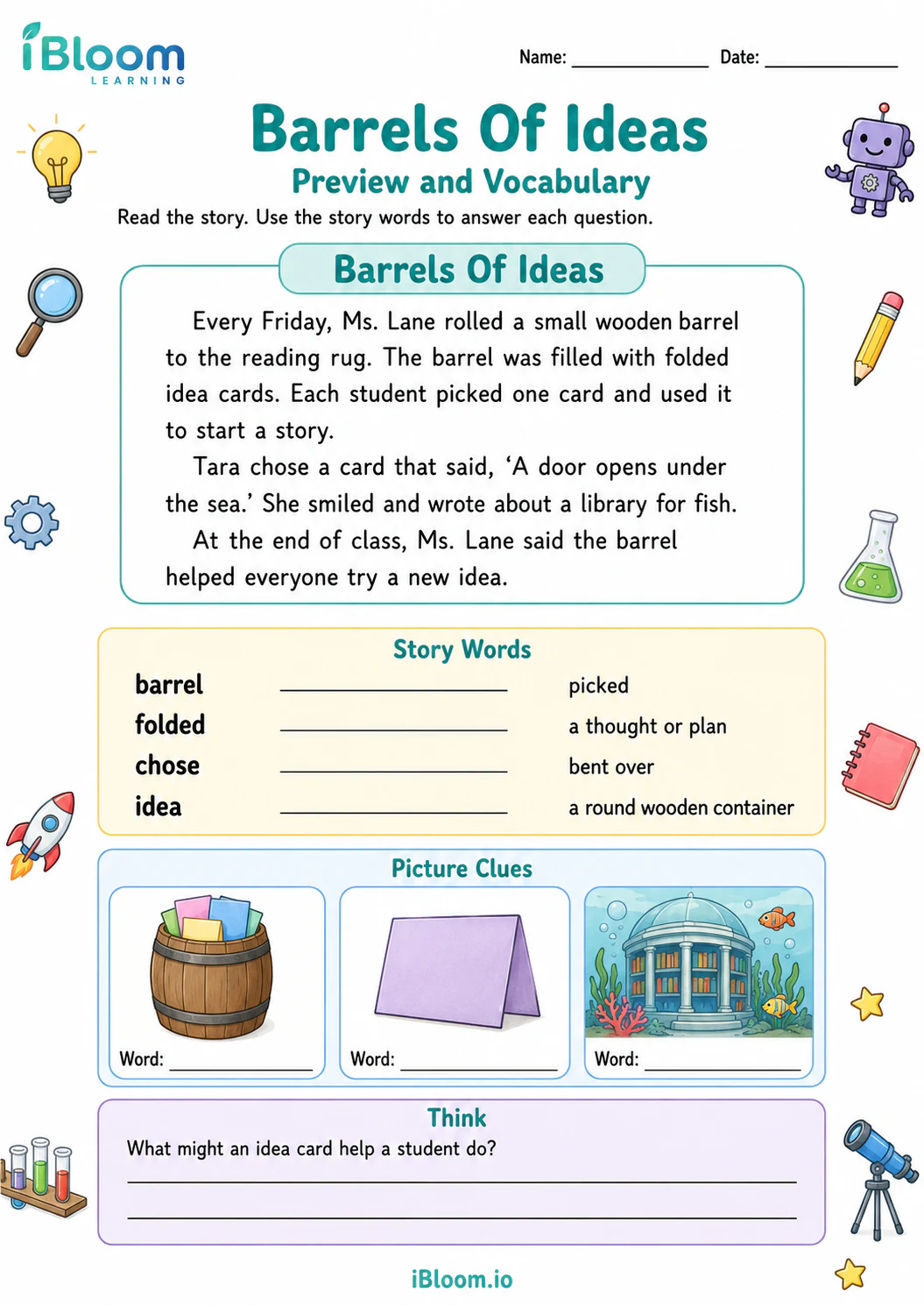
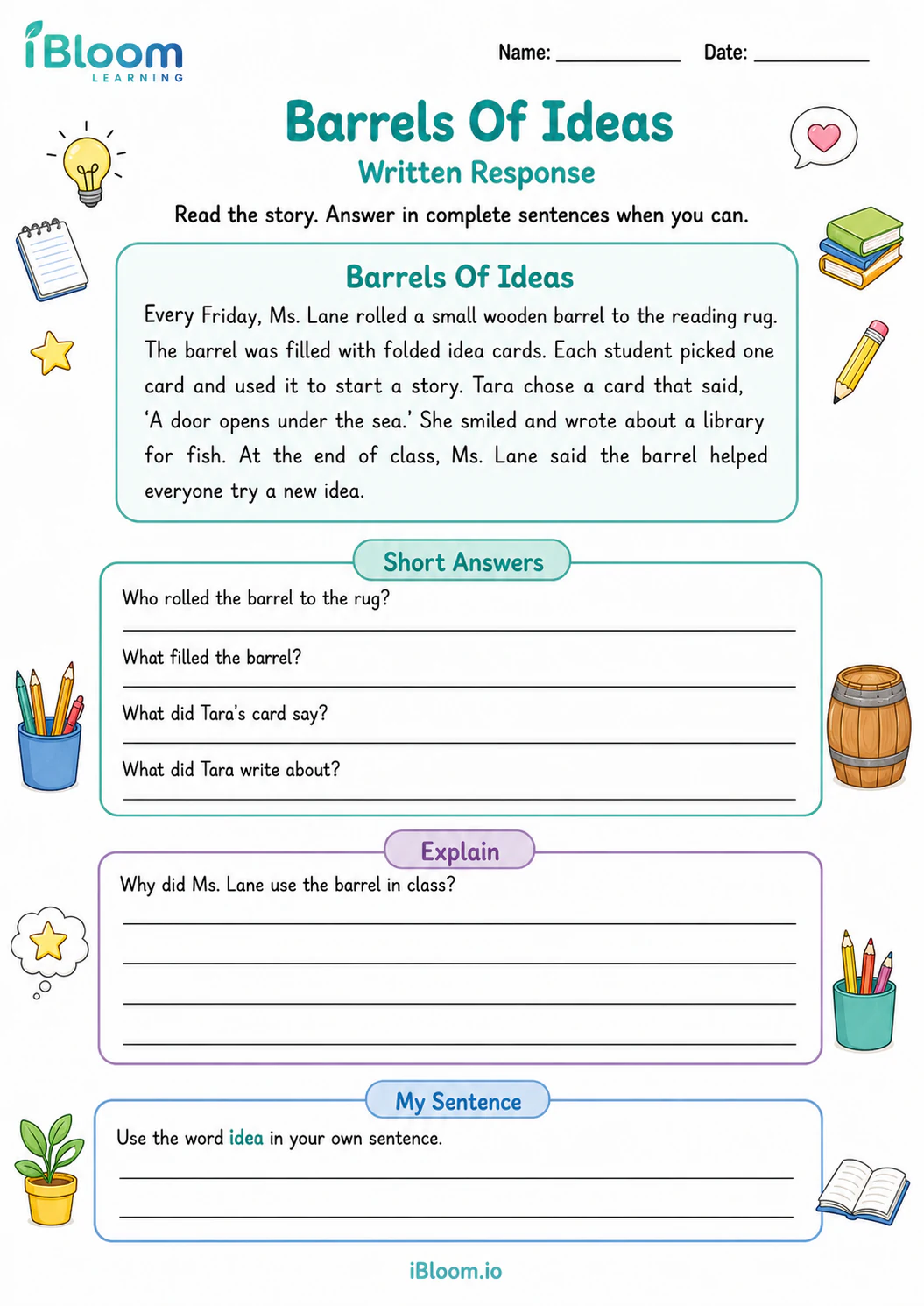
This Grade 2 reading worksheet uses the “Barrels of Ideas” story about Ms. Lane, Tara, and a class idea barrel. Children identify the main idea, recall story details, follow event order, and explain how classmates help Tara develop her story. The questions practice Common Core RL.2.2 and RL.2.1. A separate answer key includes sample responses for open-ended questions.
Aligned to RL.2.2 and RL.2.1
What is the main idea of a story?
The main idea tells what the whole story is mostly about. It is broader than one event or object. In this passage, the class uses an idea barrel and shares details to help create stories.
Which details support the main idea?
Details are events and facts that help a reader understand the story. Students picking idea cards and classmates offering details for Tara’s story show how the class builds stories together.
- 1What is the story mostly about?
- 2Think across the passage, not just one event.
- 3A class uses an idea barrel to create stories.
How can a reader retell the important events?
A retelling keeps important events in order and leaves out details that do not change what happened. Start with students choosing idea cards, then explain how Tara wrote and shared her story with help from classmates.
How to use this worksheet
- 1Read the whole story once before answering.
- 2Ask what the entire passage is mostly about.
- 3Reread to find details that support that idea.
- 4For order questions, look for what happened first and next.
- 5Use complete thoughts for written answers and check them against the story.
Common mistakes and fixes
The mistake
Choosing one detail as the main idea.
The fix
Ask whether the answer describes the whole passage or only one moment.
The mistake
Answering from memory without checking the text.
The fix
Find the sentence that provides evidence.
The mistake
Retelling events out of order.
The fix
Use the sequence in the passage: plan, plant, then see shoots.
Common Core alignment
Retell a story and identify its central message or lesson.
On this sheet: Students identify what the story is mostly about and support it with story events.
Show the official wordingHide the official wording
Recount stories, including fables and folktales from diverse cultures, and determine their central message, lesson, or moral.
Answer questions about a story using details from the text.
On this sheet: Questions ask children to recall and connect details in the passage.
Show the official wordingHide the official wording
Ask and answer such questions as who, what, where, when, why, and how to demonstrate understanding of key details in a text.
What to practice next
Make more practice
Further reading
Questions parents and teachers ask
What is the main idea of “Barrels of Ideas”?
The main idea is that a class uses an idea barrel to create stories together. Tara chooses a card about a door under the sea, and her classmates share details for her story. Children can support a main-idea answer with these events from the passage.
How long is the story?
The passage tells how Ms. Lane brings an idea barrel to the reading rug, Tara chooses a card, and classmates help with story details. Children can reread the short passage once for the events and again to locate a supporting detail.
What kinds of questions are included?
There are six multiple-choice questions and eight short or written responses. They ask about the main idea, story details, event order, a pronoun reference, and retelling. The separate key includes sample answers where more than one accurate response can work.
Can children look back at the passage?
Yes. Looking back is part of careful reading. Encourage children to reread the sentence or paragraph that contains a clue, then put the answer in their own words when a question asks for a response. The passage stays on the worksheet pages.
What is a supporting detail?
A supporting detail is a story fact that helps explain the bigger idea. In this passage, students picking story cards and classmates offering ideas for Tara’s story show how the class creates stories together. Readers can point to those events as textual support for their answer.
Does the key allow different written answers?
Yes. For questions that ask children to retell or name a detail, the key gives a sample answer. Another accurate answer from the passage can also show understanding, such as a different event Tara or her classmates take part in.