
About this worksheet
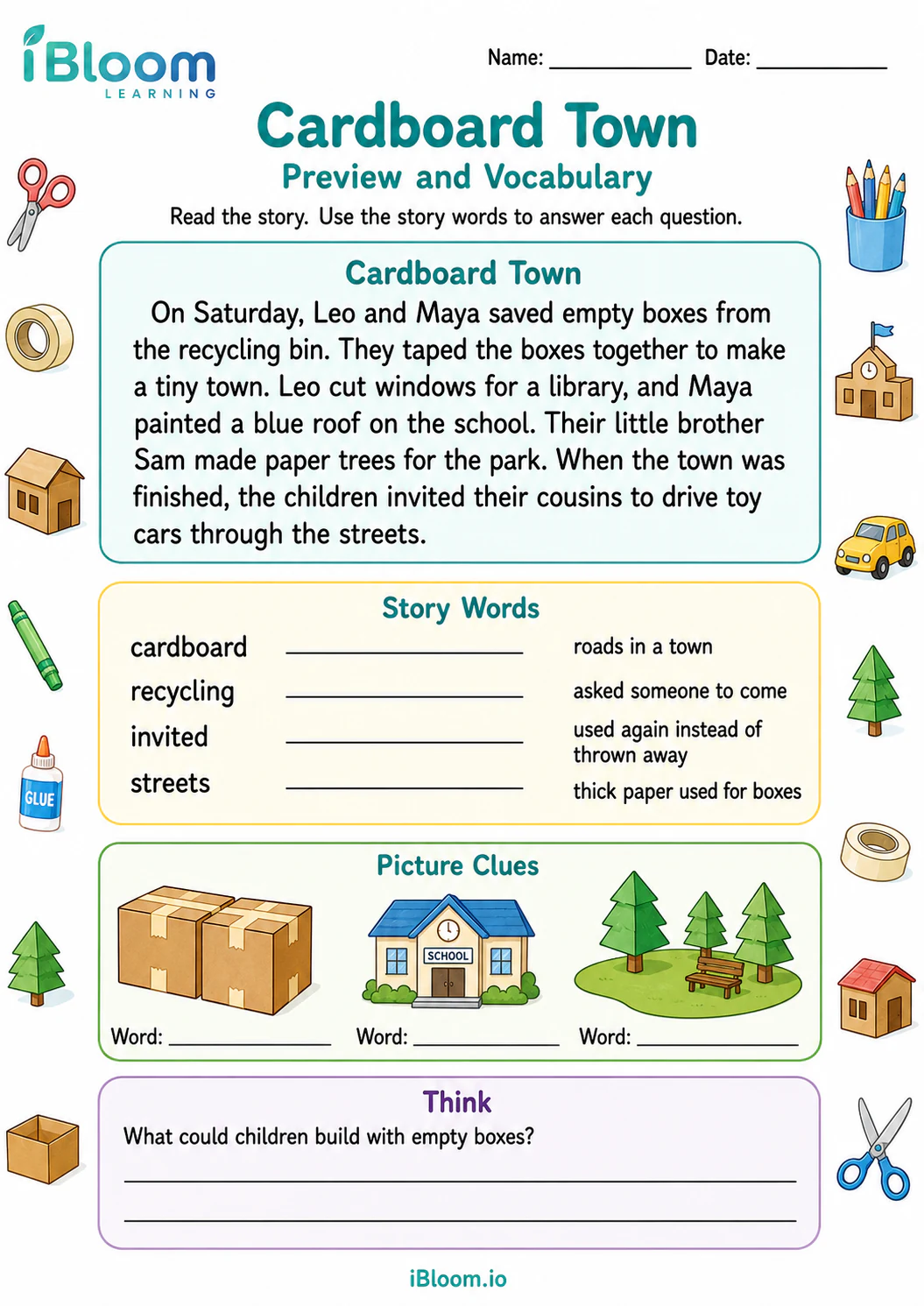
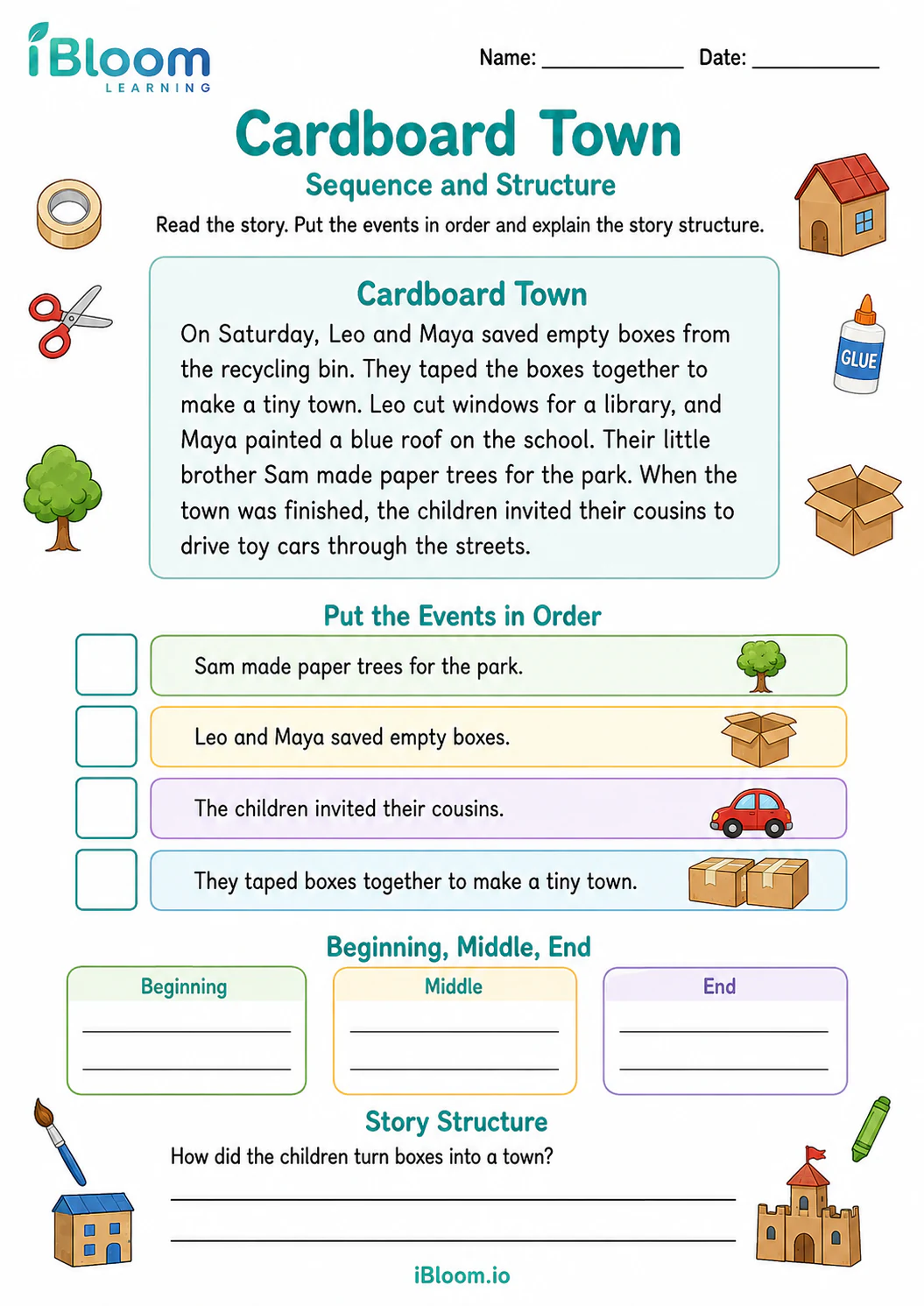
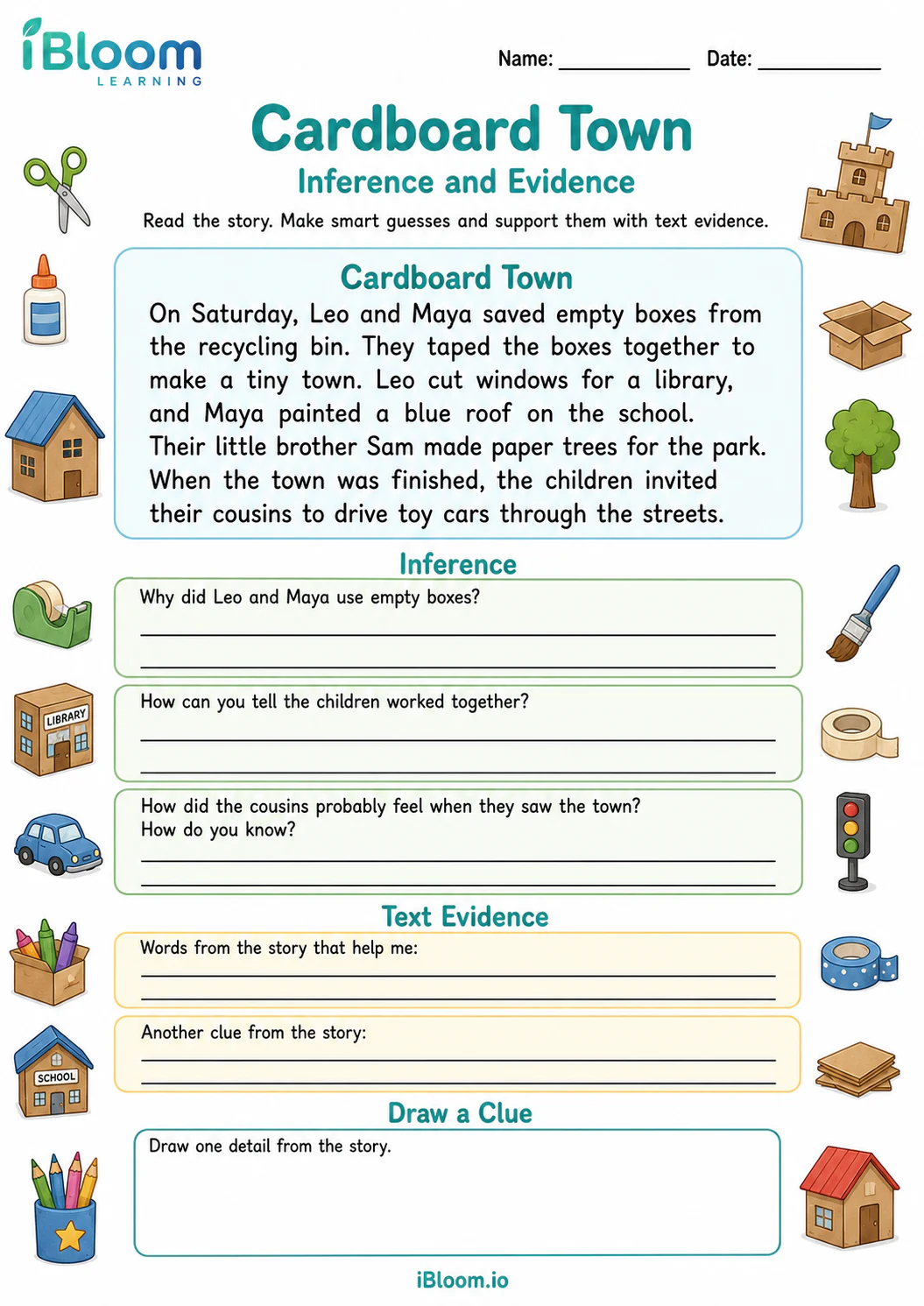
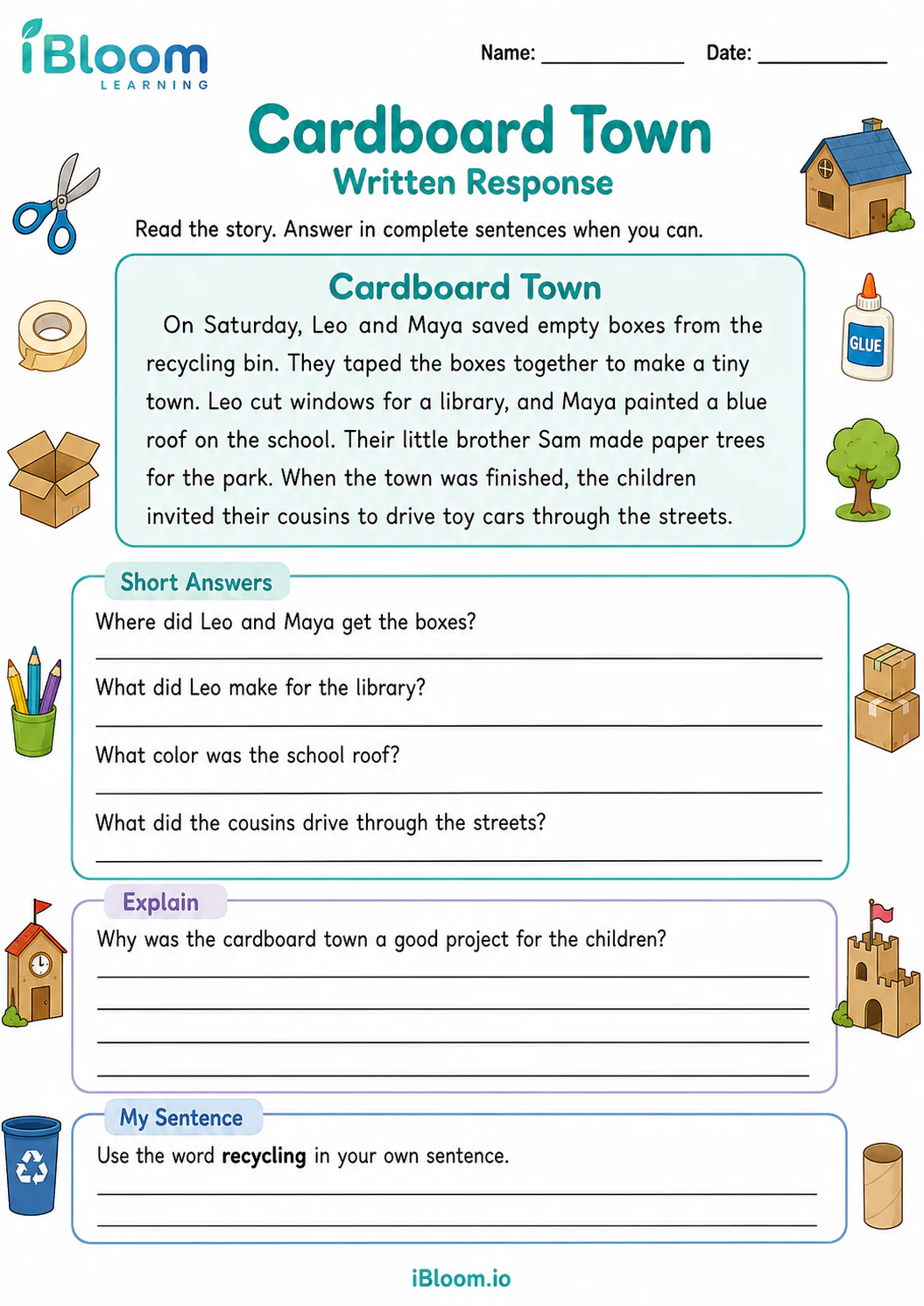
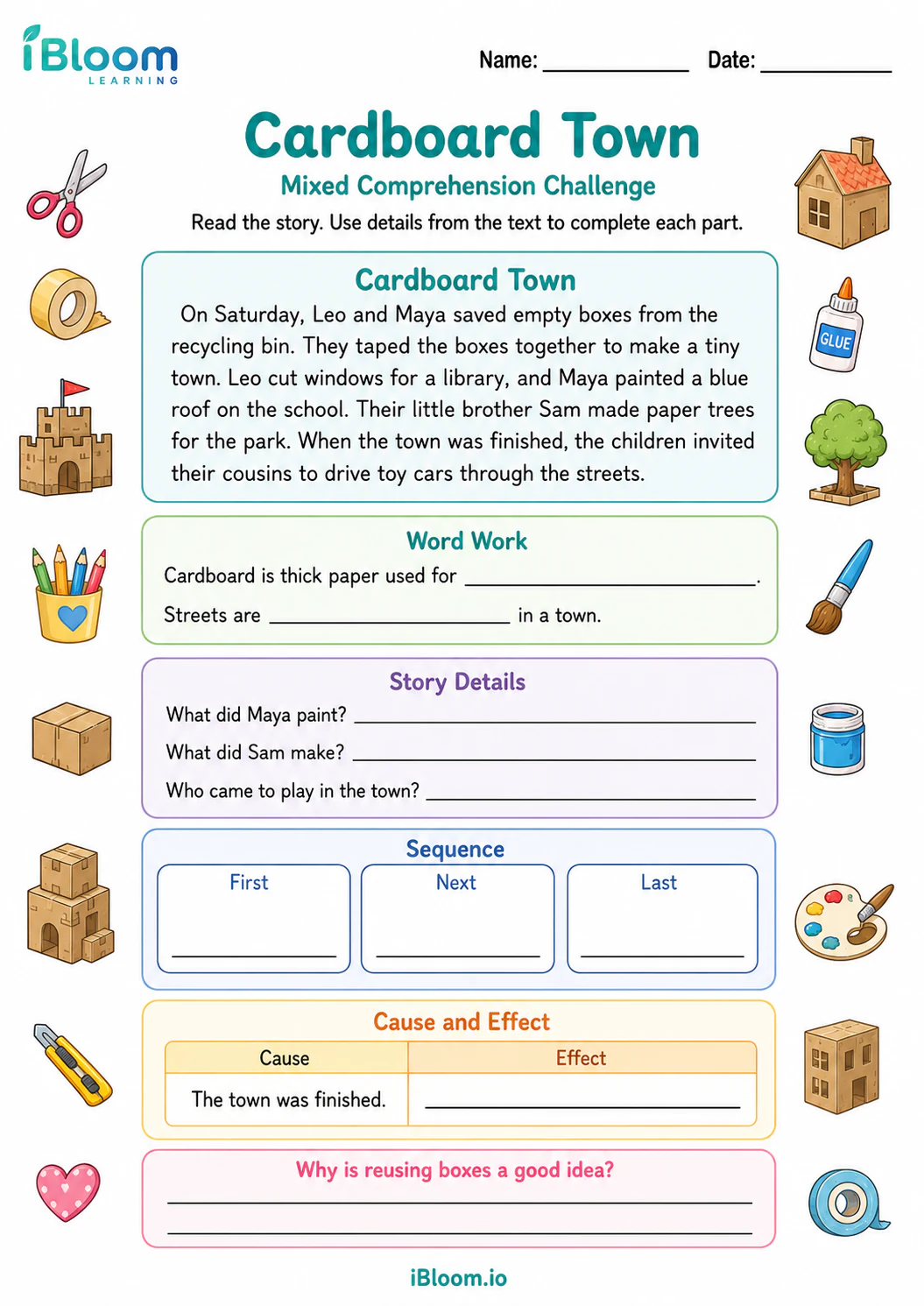
This free Grade 2 worksheet pairs “Cardboard Town” with 14 questions about its main idea and details. In Part A, Leo and Maya save boxes to make a tiny town, and their brother Sam adds paper trees. Part B asks children to choose key details and the main idea. Part C asks for the main idea with three supporting details and a response about how the finished town is used. The sheet practices Common Core RL.2.1. A separate answer key includes sample written responses.
Aligned to RL.2.1
What is the main idea of Cardboard Town?
Leo, Maya and Sam work together to make a tiny town. This idea includes the boxes, the buildings and the paper trees. “It happens on Saturday” is a true detail, but it does not tell what most of the story is about.
Question 5 asks for the main idea. Question 6 asks for a detail that supports making a town, linking a broad idea to something a character does.
Which details support the main idea?
Leo cuts windows for a library, Maya paints a blue roof on the school and Sam makes paper trees for the park. Each detail tells about a contribution to the town.
- 1Which detail supports making a town?
- 2Best choice: Sam makes park trees.
- 3The trees are something Sam makes for the town.
- 4This detail supports the idea that the children build together.
What belongs in the written responses?
question 13 asks for a main idea and three details about what the children make. A child may use two sentences: one for the main idea and one listing the library windows, school roof and park trees.
question 14 asks how the finished town is used. The final sentence says the children invite their cousins to drive toy cars through its streets. Accept different wording that preserves these details.
How to use this worksheet
- 1Read the title and passage, keeping track of Leo, Maya and Sam.
- 2Let the child look back at Part A while answering the choices in Part B.
- 3After question 5, ask which answer includes most of the building actions.
- 4Use question 6 to connect the main idea to Sam’s contribution.
- 5For question 13, find one building detail for each of the three children.
- 6Check the final response against the sentence about the cousins and toy cars.
Mistakes to check
The mistake
Naming Saturday as the main idea.
The fix
Saturday tells when. Ask what the children spend most of the story doing.
The mistake
Mixing up the children’s jobs.
The fix
Find each name in the passage: Leo cuts windows, Maya paints the roof and Sam makes trees.
The mistake
Giving three details unrelated to making the town.
The fix
Choose things the children make or change, such as the library windows, school roof and park trees.
Common Core alignment
Use story details to explain how Leo, Maya and Sam make and use their town.
On this sheet: Children answer questions about the characters, materials and actions, then support the main idea with three details.
Show the official wordingHide the official wording
Ask and answer such questions as who, what, where, when, why, and how to demonstrate understanding of key details in a text.
What to practice next
Make more practice
Further reading
Questions parents and teachers ask
Is the story included on the worksheet?
Yes, the full story appears as Part A, followed by 14 questions in Parts B and C. Children can look back at the text while answering. Leo and Maya save boxes for a town, Sam adds paper trees, and the cousins are invited to play with toy cars.
What counts as a supporting detail here?
A supporting detail helps explain the main idea that the children make a town together. Leo cutting library windows, Maya painting the school roof and Sam making park trees all support that idea. Saturday tells when the story happens, but it does not describe the building work.
Does my child need to copy the sample answer?
No. Accept different wording when it gives an accurate main idea and three building details. A child might write that the children create a little town, then name the windows, roof and trees. The key supplies one model; the passage supplies the evidence for checking other answers.
Should I read the passage aloud first?
You may read it aloud if your child needs help getting through the words. Keep the printed passage available and ask your child to point to the sentence used for an answer. Children who can read the story independently can start alone and reread tricky sections during review.
How should I check the two written responses?
Check question 13 for the main idea plus three accurate details about the town. Check question 14 for inviting the cousins to drive toy cars through its streets. Different sentences are fine when the meaning matches the passage. Review evidence before focusing on minor spelling or punctuation errors.