
About this worksheet
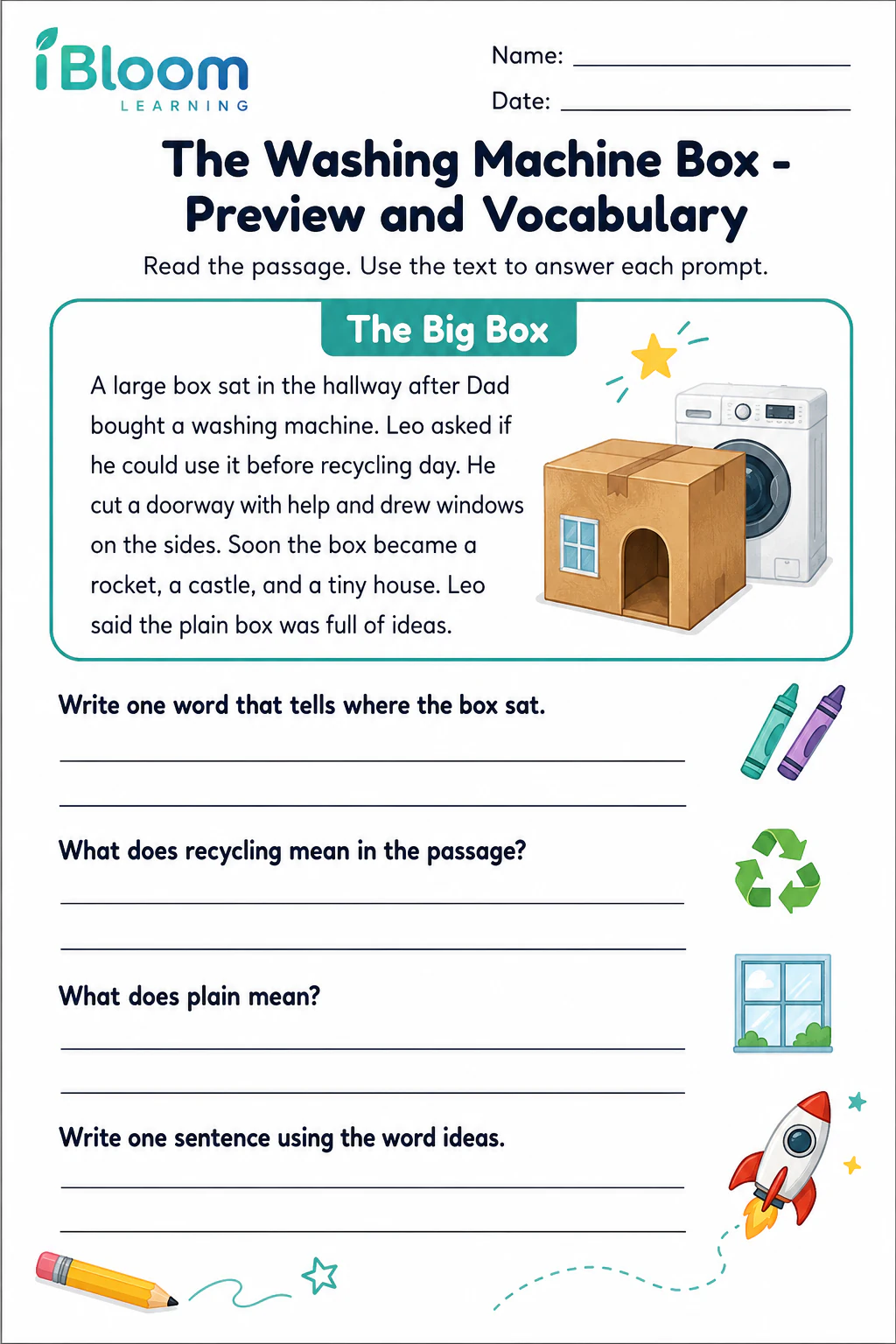
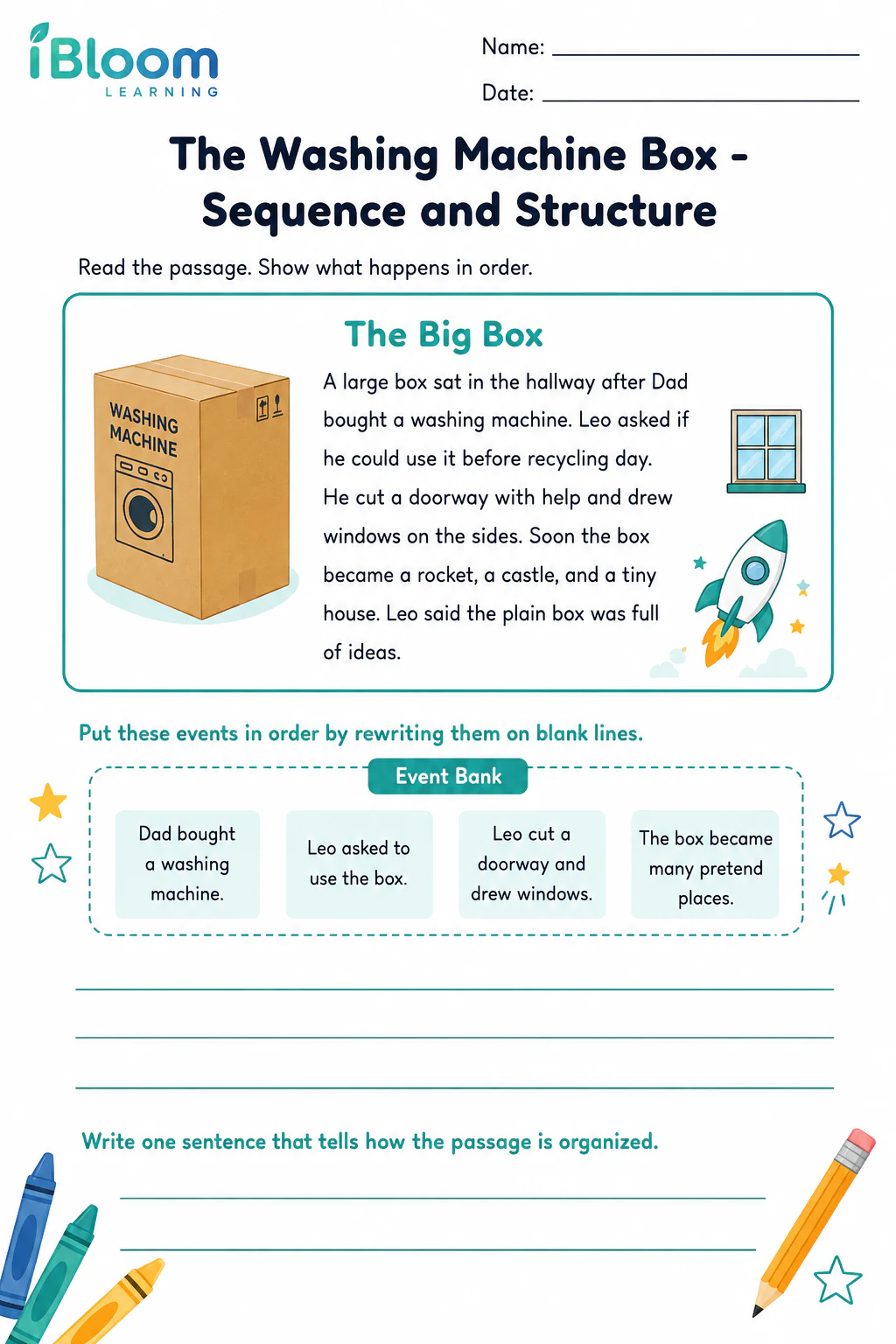
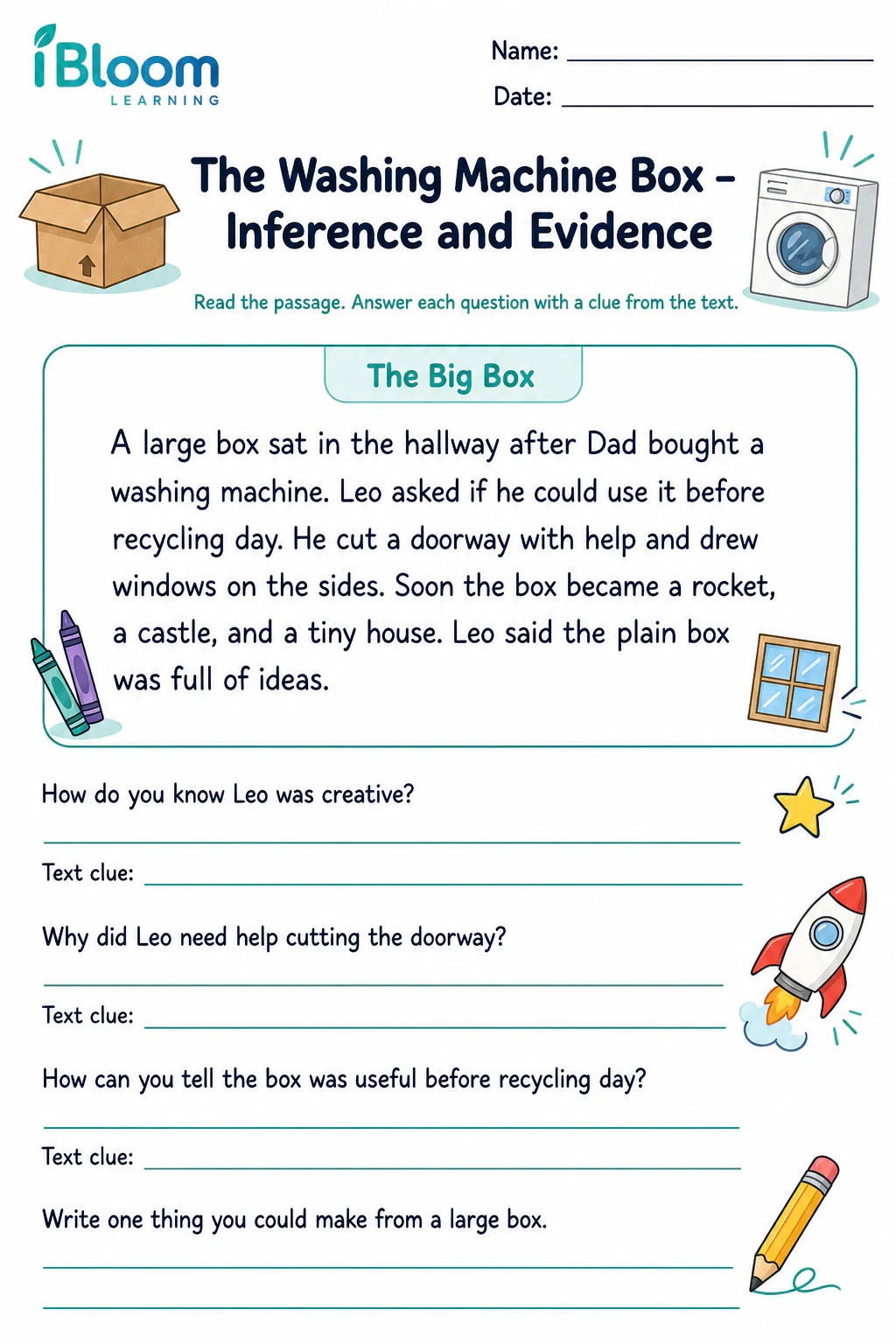
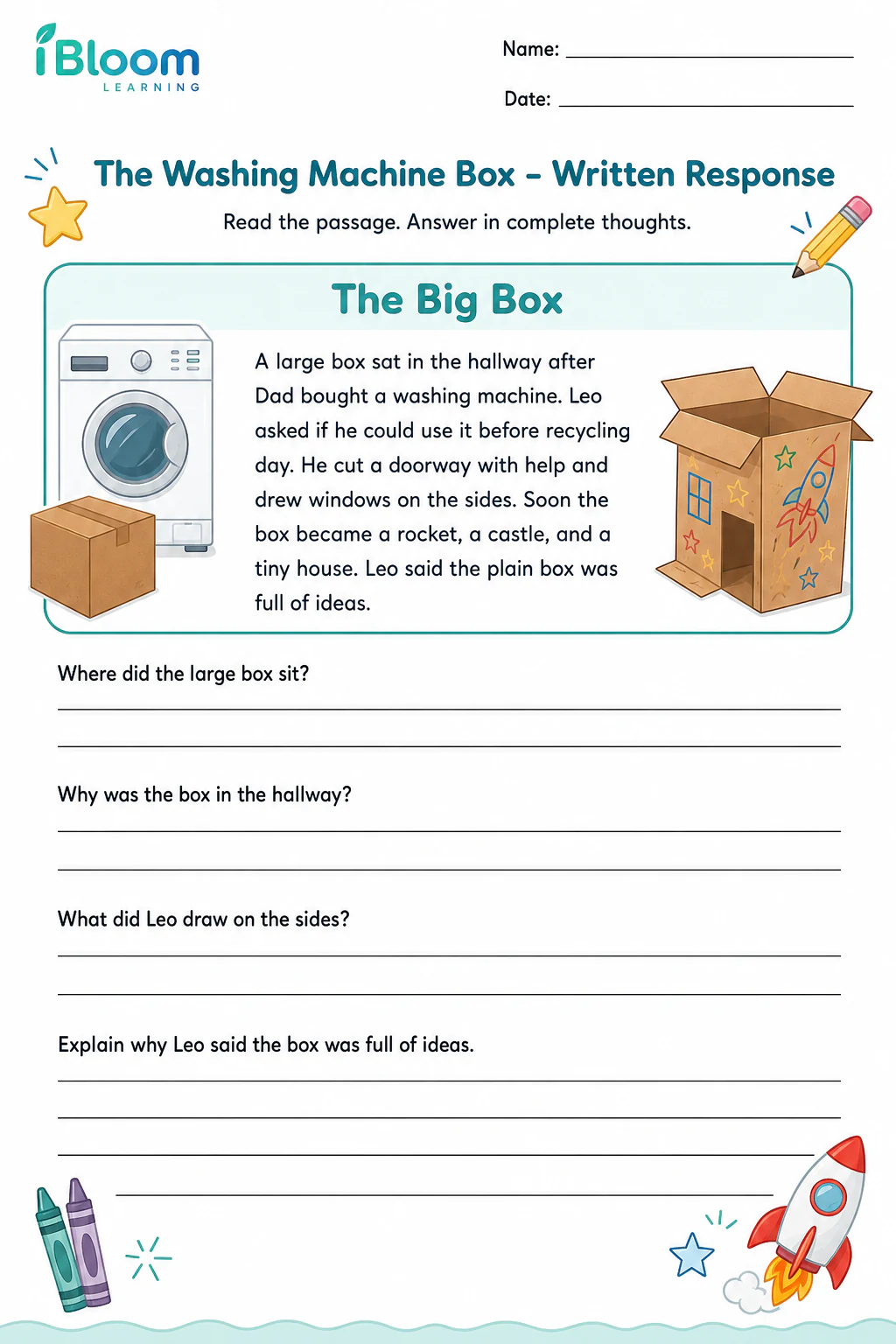
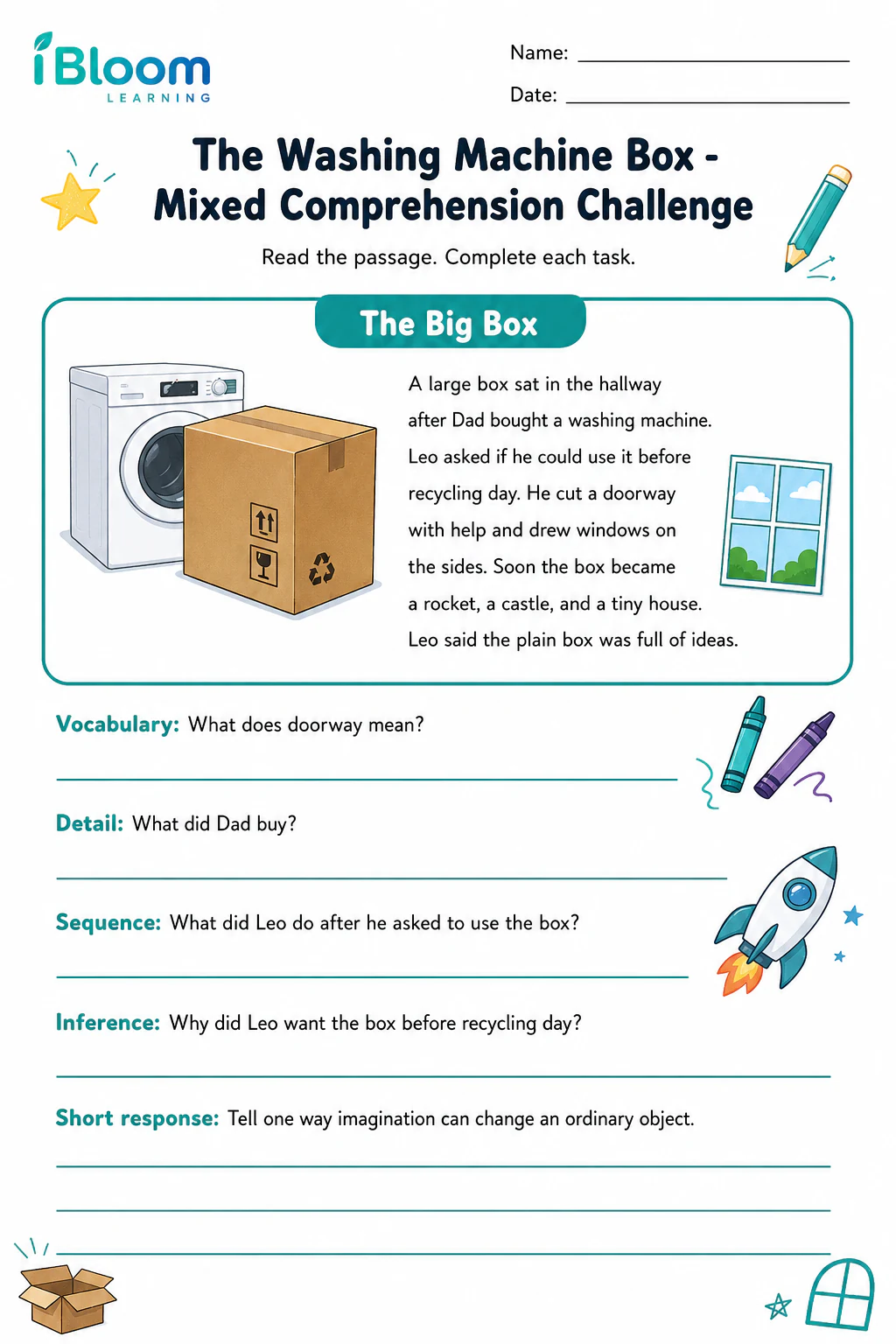
This Grade 2 reading worksheet tells how Leo uses a washing machine box for imaginative play. The passage keeps one simple sequence: Leo gets permission, adds a doorway and windows, and imagines a rocket, castle, and tiny house. Part A is the story. Part B has eight questions about key details; Part C has three choices about the main idea, message, and sequence; Part D has three short written responses linking events to the whole story. The ten questions practice Common Core RL.2.1 and RL.2.2. The answer key gives selected answers and sample written responses.
Aligned to RL.2.1 and RL.2.2
What is the difference between a main idea and a detail?
A main idea tells what the whole story is mostly about. A detail tells one specific thing that happens. Leo guarding the doorway is a detail; Leo using a box for creative play brings the rocket, castle, and house together.
The story’s message goes one step further: imagination can make an ordinary object fun. Question 10 asks children to connect the events to that broader message.
Which details support the idea of creative play?
Leo gives the same cardboard box three pretend uses. When it is a rocket, he counts backward. When it is a castle, he guards the doorway. When it is a house, his toy bear rests inside. Each detail helps explain the main idea.
- 1Idea: Leo uses his imagination.
- 2Detail 1: He pretends the box is a rocket.
- 3Detail 2: He guards the box’s door as if it were a castle.
How do the four parts build understanding?
Part A presents the passage. Part B asks eight concrete detail questions, giving children a reason to reread specific sentences. Part C asks three questions about the whole story rather than one event.
Part D has three written responses. One retells the three games in order; the others connect specific details to imagination. Accept clear paraphrases that stay faithful to the passage.
Use the worksheet step by step
- 1Read the story once for enjoyment, then ask what Leo does with the box.
- 2Reread and point to the sentence that supports each Part B answer.
- 3For Part C, test each choice against all three pretend games and their sequence.
- 4Say the three games aloud in order before writing the retelling.
- 5Check that each written response includes the requested sequence or a story detail.
Mistakes to check and how to fix them
The mistake
Choosing Dad’s new machine as the main idea because it appears first.
The fix
Ask which idea includes most of Leo’s actions across the whole story.
The mistake
Giving only one detail when question 10 asks for two.
The fix
Count the examples and connect each one to a different pretend use of the box.
The mistake
Adding a spaceship trip that really happens.
The fix
Use the word pretends; Leo’s rocket game is make-believe, and the box stays cardboard.
Common Core alignment
Answer who, what, where, and when questions using details about Leo and the box.
On this sheet: Students identify who helps Leo, where the box stands, when he wants to use it, and what he does.
Show the official wordingHide the official wording
Ask and answer such questions as who, what, where, when, why, and how to demonstrate understanding of key details in a text.
Recount Leo’s pretend games and identify the story’s message about imagination.
On this sheet: Students select the central message and retell the three pretend games in order.
Show the official wordingHide the official wording
Recount stories, including fables and folktales from diverse cultures, and determine their central message, lesson, or moral.
What to practice next
Make more practice
Further reading
Questions parents and teachers ask
Is the passage included with the questions?
Yes. Part A contains the story about Leo and the washing machine box, so children can reread it while answering. The 14 questions follow in Parts B, C, and D, with detail, main-idea, sequence, and evidence practice. Keep the passage available during the activity because finding supporting details is part of the reading task.
What is the main idea of The Big Box?
The main idea is that Leo uses his imagination to find different ways to play with a plain box. The rocket, castle, and tiny house all support that idea. Dad buying a washing machine explains where the box came from, but it does not summarize Leo’s games.
What should the retelling in question 9 include?
The retelling should name the rocket first, the castle next, and the tiny house last. Children may add what Leo does during each game. A short answer in their own words is enough as long as it keeps the three pretend uses in the correct order.
How should I check the final written response?
Look for two accurate details that show imagination, such as pretending the box is a rocket and guarding it as a castle. Accept other supported pairs, including the tiny house for the bear. The answer key gives one sample, so children’s wording can differ while the evidence stays accurate.
Can I read the story aloud to my child?
Yes. Reading the passage aloud can help a child focus on understanding the main idea and details. Leave the text visible and ask the child to point to evidence for each answer. For independent reading practice, let the child try a paragraph before you help with unfamiliar words.
What should the last written response include?
It should connect Leo’s three pretend uses of the box to his imagination and name at least one accurate detail. For example, the box becomes a rocket, and Leo counts backward before pretending to blast off. Other story details can support the same idea.