
About this worksheet
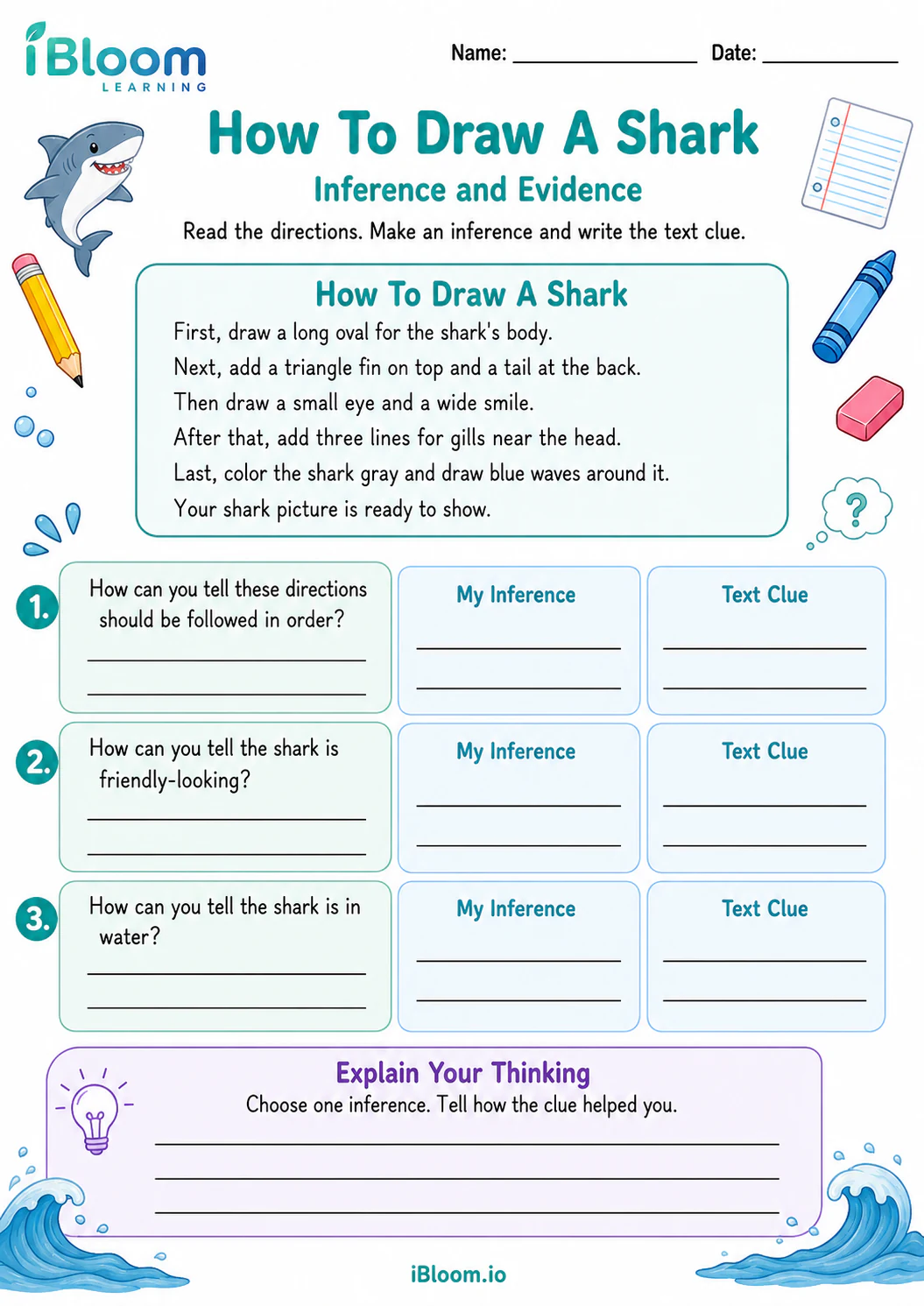
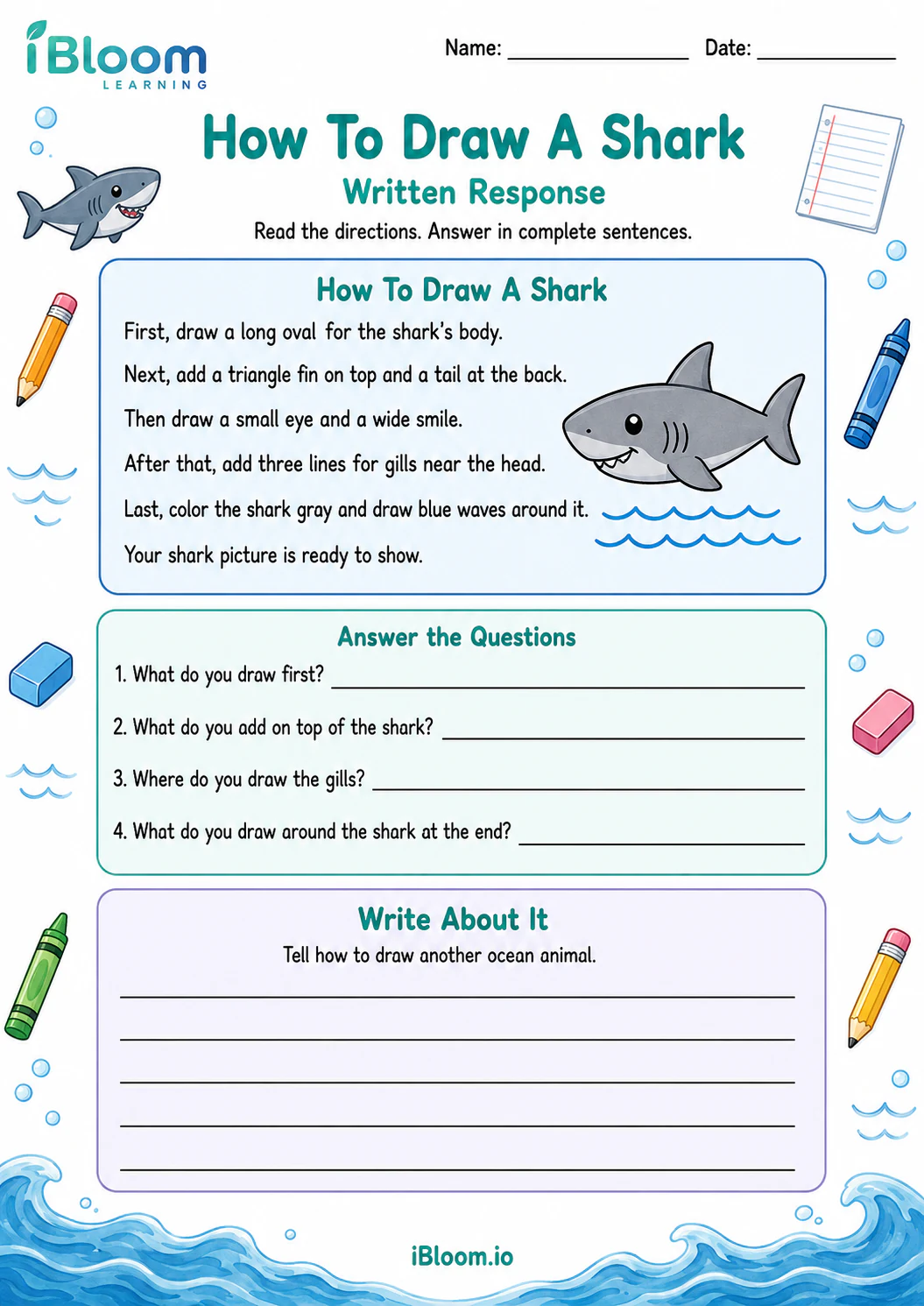
This Grade 2 worksheet uses a short set of original shark-drawing directions to practice reading informational text. Learners answer questions about key details, sequence words, vocabulary, purpose, and evidence. The passage and 16 questions fit a practice sheet, with a separate answer key. It supports CCSS.ELA-LITERACY.RI.2.1 by asking readers to answer questions about a text and refer to its details.
Aligned to CCSS.ELA-LITERACY.RI.2.1
How can readers find a detail?
Look for the sentence that directly answers the question. For example, the passage says to add three short lines for gills near the head.
How do sequence words help?
Words such as “First” and “Last” show the order of the drawing steps. Question 6 asks which step comes just before the final coloring step.
How can a reader explain the purpose?
Think about what the whole passage helps a reader do. Its steps explain how to draw and finish a shark.
How to use this worksheet
- 1Read the directions from beginning to end.
- 2Notice words that show order, such as “First” and “Last.”
- 3Return to the passage to check a detail.
- 4Use the nearby sentence to think about a word’s meaning.
- 5Write a complete sentence for questions that ask for an explanation.
Common mistakes and quick fixes
The mistake
Choosing a detail from memory instead of checking the text.
The fix
Find the sentence that gives the detail and reread it.
The mistake
Mixing up the order of two drawing steps.
The fix
Use the sequence words to put the steps in order.
The mistake
Giving a topic instead of the passage’s purpose.
The fix
Ask what the directions help the reader do.
This worksheet practices reading informational text closely.
Answer questions about the directions and use details from the text.
On this sheet:
Show the official wordingHide the official wording
Ask and answer such questions as who, what, where, when, why, and how to demonstrate understanding of key details in a text.
What to practice next
Make more practice
Further reading
Questions parents and teachers ask
What does the passage teach?
The passage gives a short sequence for drawing a shark. It names the body, fin, tail, face, gills, and finishing colors so learners can answer by returning to the directions. Ask the learner to reread the passage and point to the exact step before answering; this keeps each response tied to the text.
How many questions are on the worksheet?
There are 16 questions about details, sequence, vocabulary, purpose, and evidence. The key gives direct answers for objective items and sample responses where more than one sentence can be supported. Ask the learner to reread the passage and point to the exact step before answering; this keeps each response tied to the text.
Is this worksheet for fiction or informational reading?
It uses informational directions. Learners read steps that explain how to draw a shark and answer questions about what those steps say, including the order and purpose of the instructions. Ask the learner to reread the passage and point to the exact step before answering; this keeps each response tied to the text.
Does the worksheet include an answer key?
Yes. The separate key gives answers for the detail and vocabulary questions, plus sample responses for open-ended prompts. A learner can use it after completing the passage and questions. Ask the learner to reread the passage and point to the exact step before answering; this keeps each response tied to the text.
How can an adult help without giving answers?
Ask the learner to point to the sentence that supports an answer. For sequence questions, have them notice order words and compare the steps they mark before checking the key. Ask the learner to reread the passage and point to the exact step before answering; this keeps each response tied to the text.