




About this worksheet
This Grade 2 reading worksheet pairs an original story, “The Seedling by the Window,” with 14 questions. Students find stated details, explain a character’s actions, sequence events, and make an inference supported by evidence. The three-page worksheet includes the passage and a separate answer key with a sample written response.
Aligned to 2.RL.1
Which details can a reader find directly?
Part A is the story. Questions 1–6 ask about details the passage states directly, such as what Mia planted, where she put the cup, and what appeared on Monday. Return to the sentence that gives each detail.
Question 3 asks when the green curl appeared. The passage says it happened on Monday.
- 1Clue: “On Monday, a green curl poked through the soil.”
- 2Answer: Monday
How do story clues support an inference?
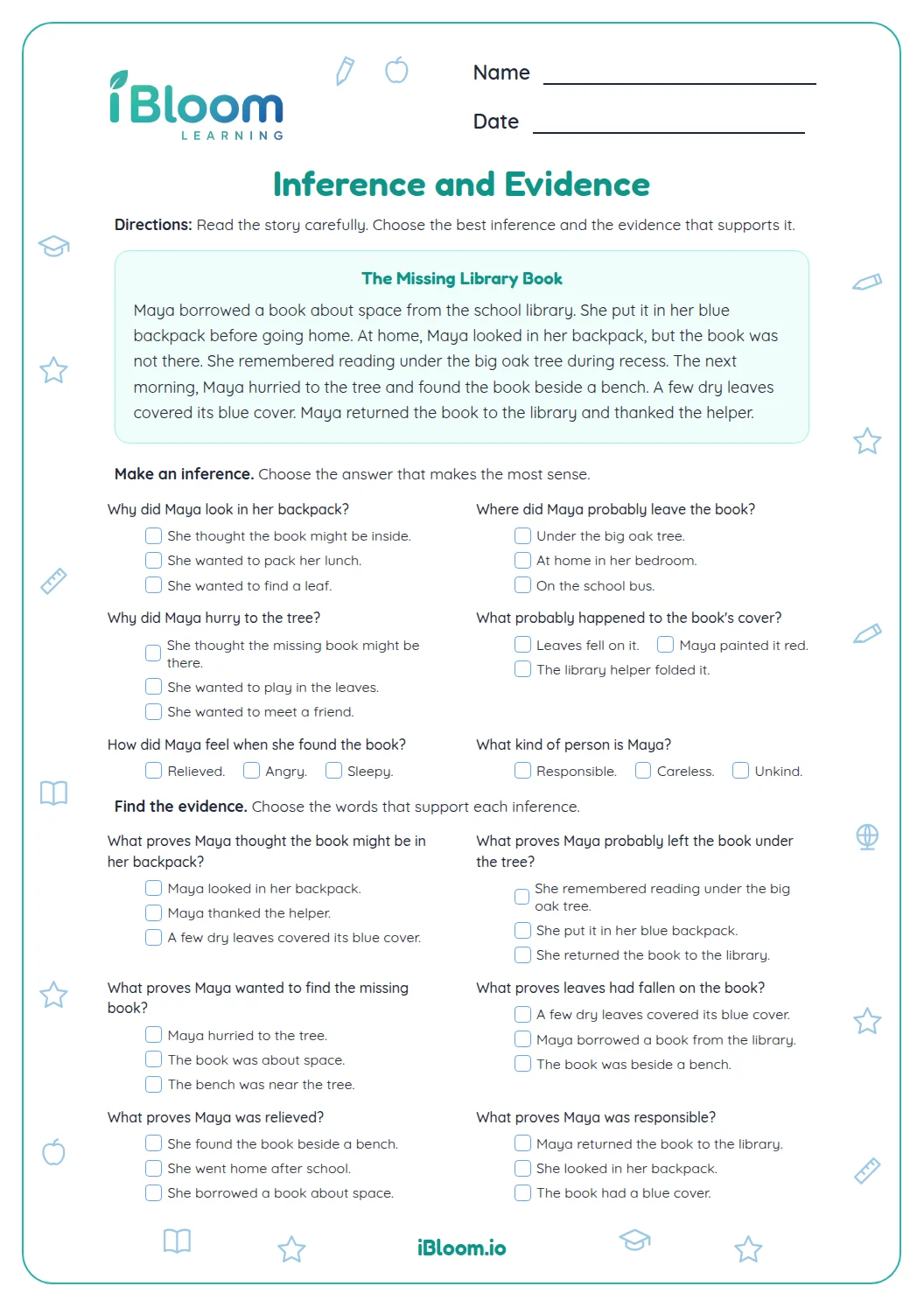
An inference is a reasonable idea supported by story details. Question 14 asks what Mia’s actions suggest about her. Checking the soil and keeping the cup safely away from the edge support the idea that she is careful. Include one of those clues in the response.
How can readers use evidence to predict what comes next?
Question 9 asks what Mia noticed about the plant, and question 10 asks why she turned the cup. For the final prediction question, Mia says they can plant the seedling outside soon. That line supports the prediction that they will plant it outside.
How to use this worksheet
- 1Read the story once to follow Mia’s actions.
- 2Reread the sentence that matches each question.
- 3For a why question, connect the answer to a character’s action.
- 4For an inference, name a clue and the idea it supports.
- 5Use a complete sentence for the written inference.
- 6Check the event order against the story.
Common mistakes and quick fixes
The mistake
Guessing without a story clue
The fix
Point to a sentence that supports the idea before writing.
The mistake
Choosing a detail from the wrong day
The fix
Reread the time words such as Monday and Friday.
The mistake
Giving an inference without evidence
The fix
Name the story action and explain what it suggests.
Common Core alignment
This worksheet practices the listed Common Core skill through its questions.
Ask and answer questions using key details and story clues.
On this sheet: Students answer who, what, where, when, why and how questions about the story.
Show the official wordingHide the official wording
Ask and answer such questions as who, what, where, when, why, and how to demonstrate understanding of key details in a text.
What to practice next
Make more practice
Further reading
Questions parents and teachers ask
What does inference and evidence mean here?
An inference is a reasonable conclusion drawn from story clues. Evidence is the detail that supports it. Question 14 asks readers to infer a trait about Mia and support it with an action, such as checking the soil or moving the cup away from the table edge.
Is the story written for this worksheet?
Yes. “The Seedling by the Window” is an original passage about Mia caring for a bean seed. Its events provide the details for all 14 questions, including the inference, sequence and prediction items. Students can look back at the passage as they work.
How should students answer question 14?
A good answer names a trait and a supporting action. For example: “Mia is careful because she checks the soil and moves the cup safely.” The key gives a sample; another response works if it connects a reasonable trait to a story detail.
Can readers look back at the passage?
Yes. Rereading is a useful way to find names, times and actions. For a direct question, locate the sentence that states the answer. For an inference question, use one or more details to explain a reasonable conclusion in your own words.
What is the answer to the prediction question?
Mia and Ben will probably plant the seedling outside. Mia says they can do this soon, which supports the prediction. Students can select the option connected to that dialogue and point to the passage as evidence for their choice.
Does the worksheet include an answer key?
Yes. The separate key gives answers to all 14 questions and a sample response to the open-ended inference. Readers can compare both the conclusion and the evidence they used to support their own answer after reading the story and checking relevant details.