




About this worksheet
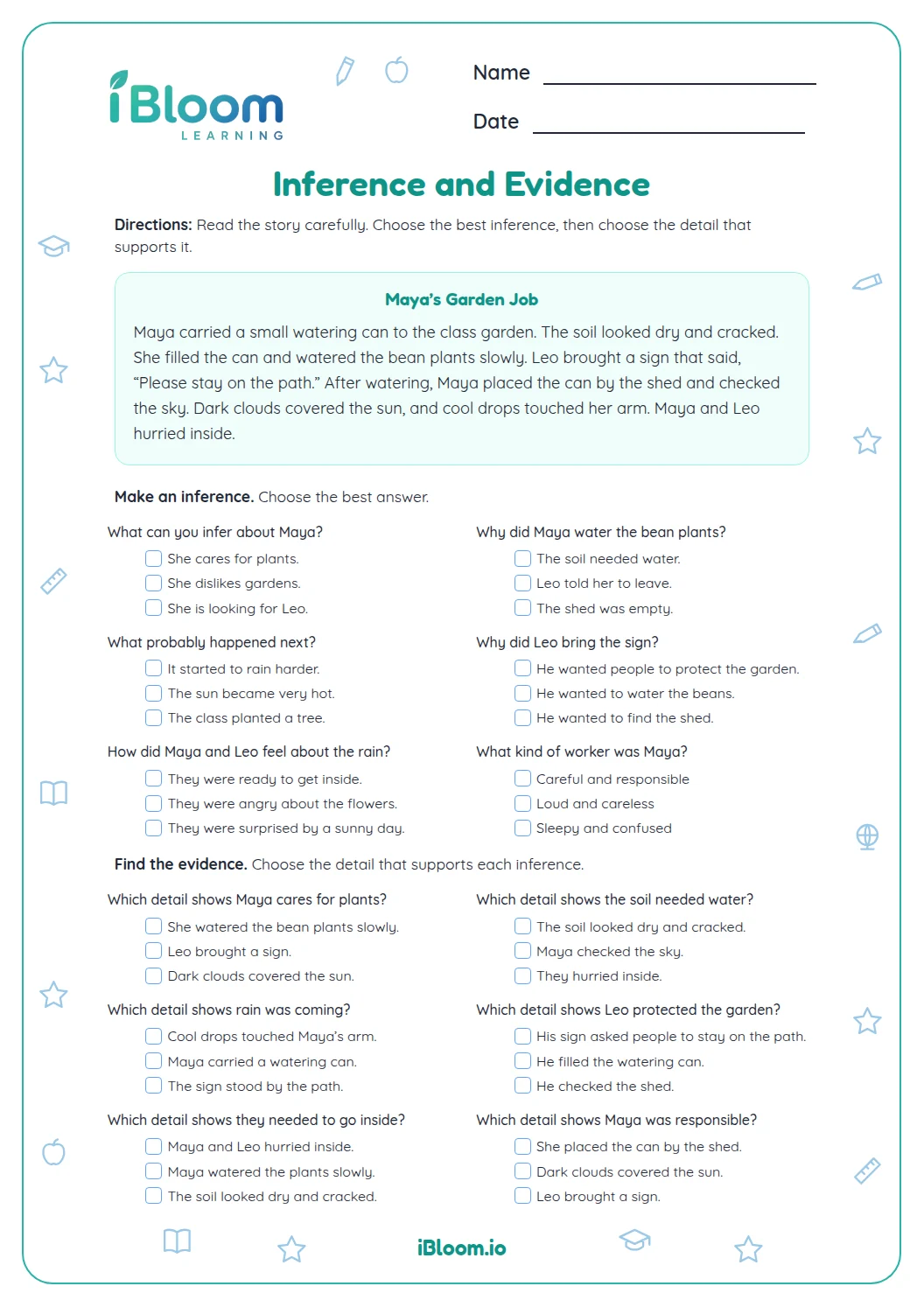
This Level J2 worksheet pairs a short original story with 14 multiple-choice questions about inference and evidence. Children infer why Mia protects a young seedling and choose the details that support those ideas. A separate answer key gives the correct choices.
Aligned to CCSS.ELA-LITERACY.RL.2.1 and CCSS.ELA-LITERACY.RL.2.3
How do readers connect a clue to an inference?
An inference is an idea a reader works out from story clues. Evidence is the specific action or detail that supports the idea. Mia carries the cup with both hands, which suggests she wants to keep the seedling safe.
Part B asks readers first to make inferences about Mia and her choices, then to identify details from the passage that support an idea.
- 1Clue: Mia carries the cup with both hands.
- 2Inference: She wants to keep the seedling safe.
- 3The action in the story supports the inference.
What do readers practice?
Part B asks readers to infer from a character’s choices. Part C asks them to locate a detail that supports an idea. Part D brings the two skills together in a written response.
- Part B: infer feelings, reasons, likely actions and choose supporting evidence
How can a child check the evidence?
Ask which exact words or action in the story supports the selected idea. A detail should explain the answer, not merely mention Mia, the cup, or the classroom.
The story and questions print on the worksheet pages, followed by a separate answer key. The key identifies the best choice for each question.
Read and answer with evidence
- 1Read the story once to learn what happens.
- 2Reread the sentence around the action in the question.
- 3Choose an inference that fits the clues instead of guessing.
- 4For evidence questions, choose words or actions that directly support the idea.
- 5Choose evidence that clearly supports the inference, rather than a detail that merely names the same character.
Common reading slips
The mistake
Choosing an answer that could happen but is not supported by the story.
The fix
Point to a sentence that makes the idea reasonable.
The mistake
Repeating an event instead of explaining what it suggests.
The fix
Connect the event to a thought or reason using “This shows…”
The mistake
Picking a detail about the right character that does not prove the idea.
The fix
Ask whether the detail gives a reason or example for the claim.
Common Core alignment
The story questions ask readers to answer comprehension questions and describe a character’s responses.
Ask and answer questions about key details and demonstrate understanding of the text.
On this sheet: Readers answer why and how questions by using details from Mia’s story.
Show the official wordingHide the official wording
Ask and answer such questions as who, what, where, when, why, and how to demonstrate understanding of key details in a text.
Describe how characters respond to major events and challenges.
On this sheet: Questions ask children to infer Mia’s reasons and describe her actions around the seedling.
Show the official wordingHide the official wording
Describe how characters in a story respond to major events and challenges.
What to practice next
Make more practice
Further reading
Questions parents and teachers ask
What is the difference between an inference and evidence?
An inference is an idea readers work out by combining clues with what they know. Evidence is the specific word, action or event in the text that supports the idea. In this story, Mia carries the cup with both hands; that action is evidence for an inference that she is careful.
How can a child prove an inference?
Ask the child to name a story detail that points to the idea. For example, Mia carries the cup with both hands, which supports that she wants to keep it safe. The detail should connect clearly to the idea, rather than simply mention the same character.
Should every written answer use a quote?
A detail from the story is enough. A child can quote a few words or describe an action in their own words. The important part is making the connection between the clue and the inference clear to a reader. clearly.
Is there an answer key for the story questions?
Yes. The separate key lists the correct choice for each question. When reviewing an answer, ask the child to point to the sentence or action that supports the inference. That keeps the focus on evidence, even though the response is selected from choices.
What happens in “Mia’s Seedling”?
Mia plants a bean seed, waters it, and watches a green tip appear. When the classroom turns chilly, she moves and wraps the cup. Later, she lets classmates take turns looking at the leaves and returns the plant to its sunny place.
How many pages should I print?
The story and 14 questions print across three worksheet pages, and the answer key is also three pages. Print the worksheet pages for the reader and keep the key separate for checking. The questions ask readers to infer from Mia’s actions and select supporting story details.