







About this worksheet
This Grade 2 printable helps children blend consonant sounds at the start of words and read the whole word in context. A short pond passage features Brad, a frog, and a bird, followed by 17 questions on beginning blends, sentence clues, and putting sounds together. The answer key supports quick review. The work aligns with Common Core RF.2.3, applying grade-level phonics and word analysis to decode words.
Aligned to RF.2.3
What is a consonant blend?
A blend has two or three consonants heard together, with each sound still audible. In “frog,” readers hear /f/ and /r/ before the vowel. This sheet asks children to notice that order and join the sounds smoothly.
How does the passage help with blending?
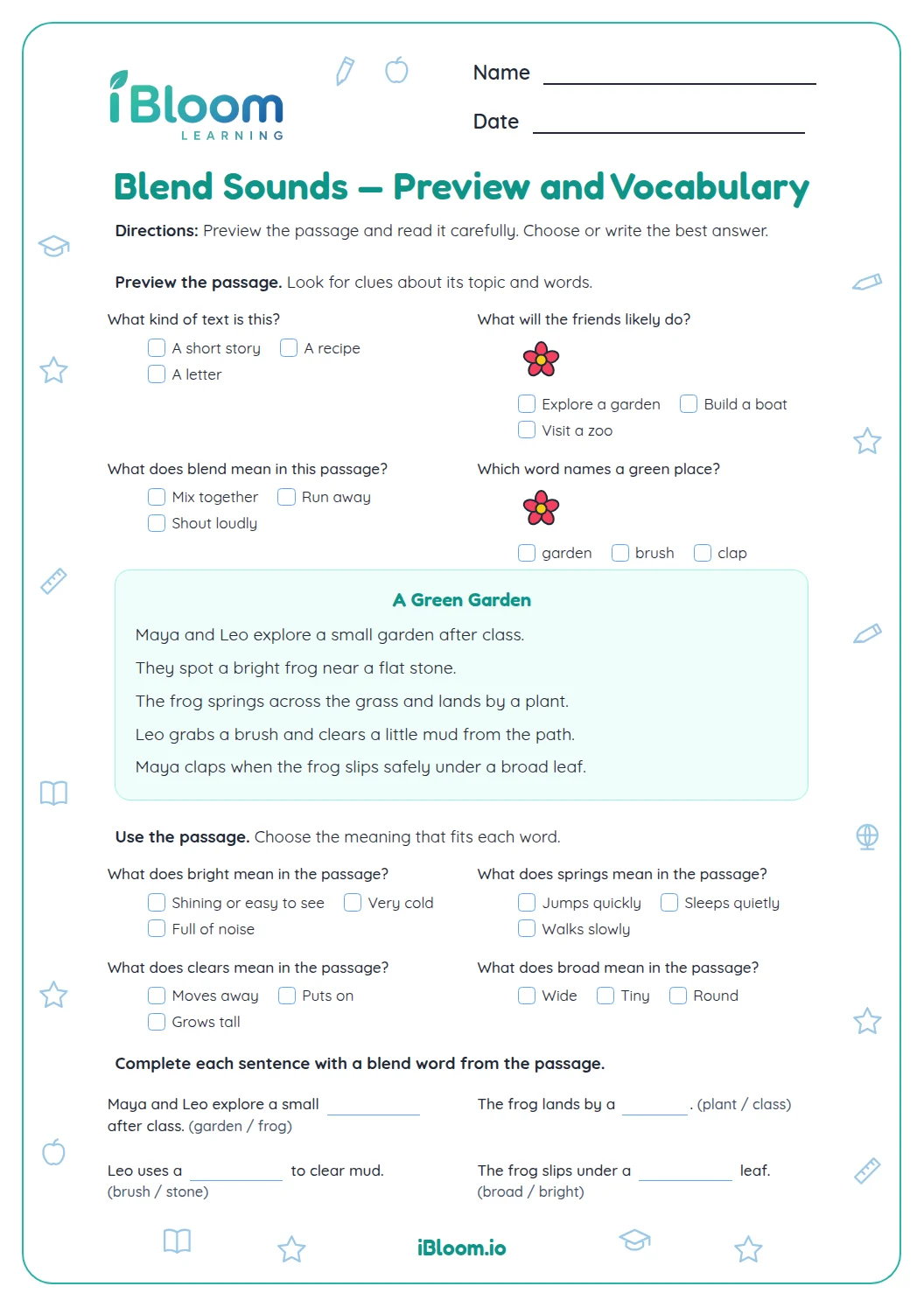
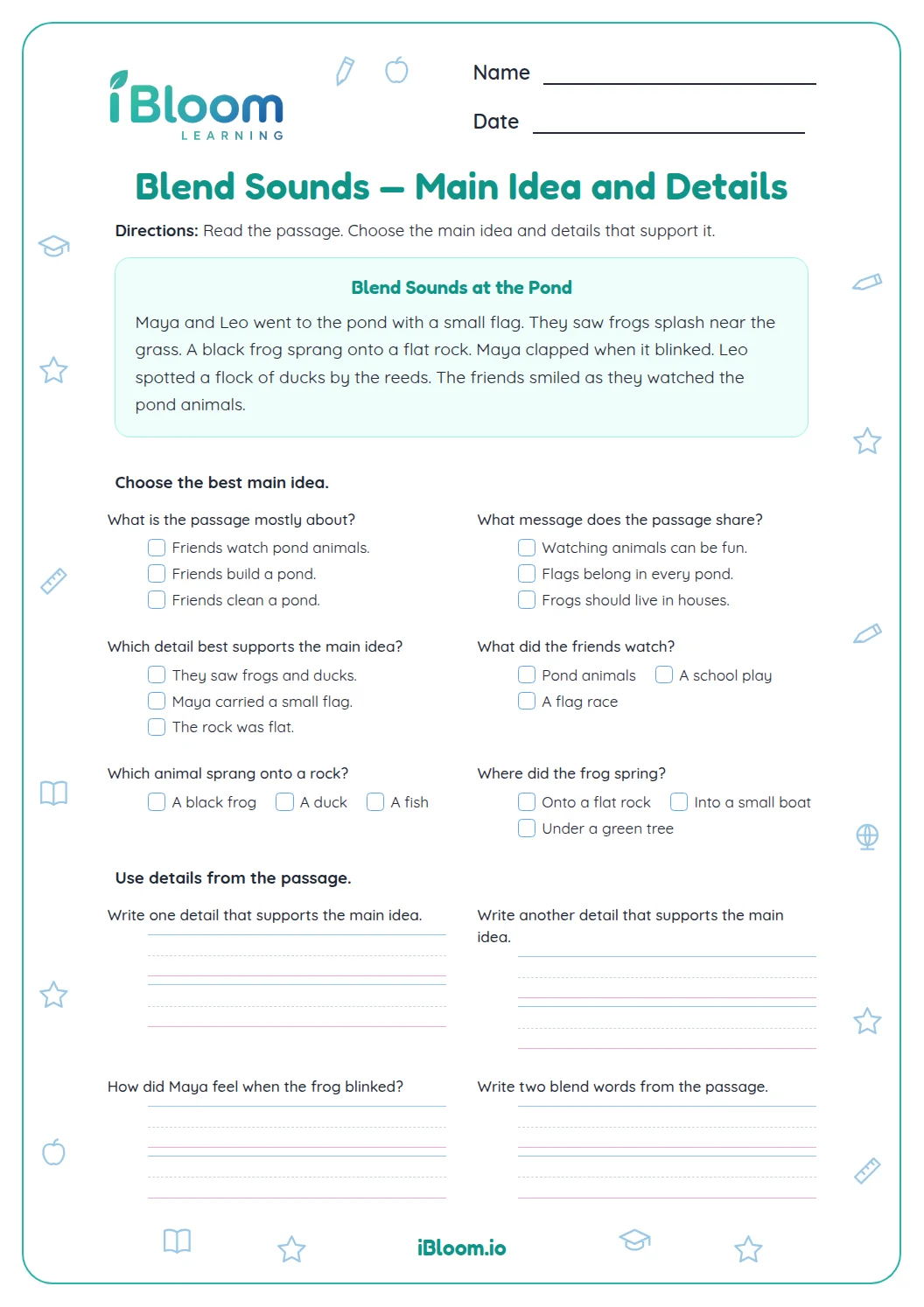
The pond passage puts words such as Brad, step, flat, grass, and plant into a connected scene. Part A identifies starting blends; Part B checks meaning in sentences; Part C asks children to write and combine sounds.
- 1Which word begins with /br/?
- 2Answer: Brad
How to use this worksheet
- 1Read the directions and look over the first example together.
- 2Work through Part A slowly, pointing to each clue or model.
- 3Ask the learner to explain one answer in their own words.
- 4Continue to the next parts, taking a short pause if needed.
- 5Use the separate key to check answers and revisit one tricky item.
Common mistakes and quick fixes
The mistake
Rushing past a clue in the prompt or model.
The fix
Pause and name the clue before selecting an answer.
The mistake
Mixing up two related words or steps.
The fix
Say both choices aloud and check which one matches the task.
The mistake
Leaving an answer unchecked.
The fix
Return to the passage, picture, or count and verify it once.
Curriculum alignment
Grade 2 readers blend consonant clusters to decode words in context.
On this sheet: Grade 2 readers blend consonant clusters to decode words in context.
Show the official wordingHide the official wording
Know and apply grade-level phonics and word analysis skills in decoding words.
What to practice next
Make more practice
Further reading
Questions parents and teachers ask
What blend examples appear on the sheet?
The passage includes blends such as br in Brad, st in step, fl in flat and flaps, gr in grass and grins, and pl in plant. Children also practice fr, bl, and tr. The answer key lists each response so an adult can review the sound pattern with the child.
How many questions are included?
There are 17 questions in four question parts after the passage. Children identify beginning blends, use sentence context, put sounds together, and follow events in time order. The answer key gives the correct choice or word for each item.
Should children say each sound separately?
At first, yes. Say each consonant sound without adding an extra vowel, then slide the sounds together into the word. For “step,” blend /s/ and /t/, then continue into /e/ and /p/. Rereading the full word helps connect decoding with meaning.
Can an adult read the passage aloud?
An adult can read directions or model a word, then invite the child to blend the target sounds. Grade 2 readers can also try the passage independently. The goal is to notice each consonant in the cluster and preserve its order while reading.
What is the answer key for?
The separate key gives the answers to all 17 questions. For a missed blend, return to the word and say its first consonant sounds slowly. For an event-order question, reread the transition words and locate the event in the passage.
How long does it take?
Plan for about 15 minutes, with extra time if the passage is read aloud or children repeat the blend practice. The worksheet has a short passage and 17 questions across four question parts after the passage. The passage and key make it easy to revisit the sequence and blend examples.