



About this worksheet
This free Grade 2 printable pairs a short informational passage about consonant sounds with questions that ask children to identify its main topic and find supporting details. Children also notice examples such as sh in ship and the sound change from fan to pan, tying phonics to the text. It practices CCSS RI.2.2 and grade-level phonics work in RF.2.3. Fourteen selected-answer questions check the main idea, supporting details, and consonant examples; a separate key supports checking.
Aligned to RI.2.2 and RF.2.3
What is the main idea of the consonants passage?
The passage explains what consonants are and how their sounds help readers build, read, and spell words. The examples—sun, ship, chin, fan, and pan—give children specific details to find.
- 1Question: Which detail supports the idea that consonants can use two letters?
- 2Look for the sentence that names two-letter consonant spellings.
- 3The passage says sh in ship and ch in chin.
- 4That detail directly supports the main idea.
How can children find a supporting detail?
Return to the sentence named in the question. For example, the last sound in nest is /t/. A detail response should match the passage rather than a guess.
What is on the worksheet?
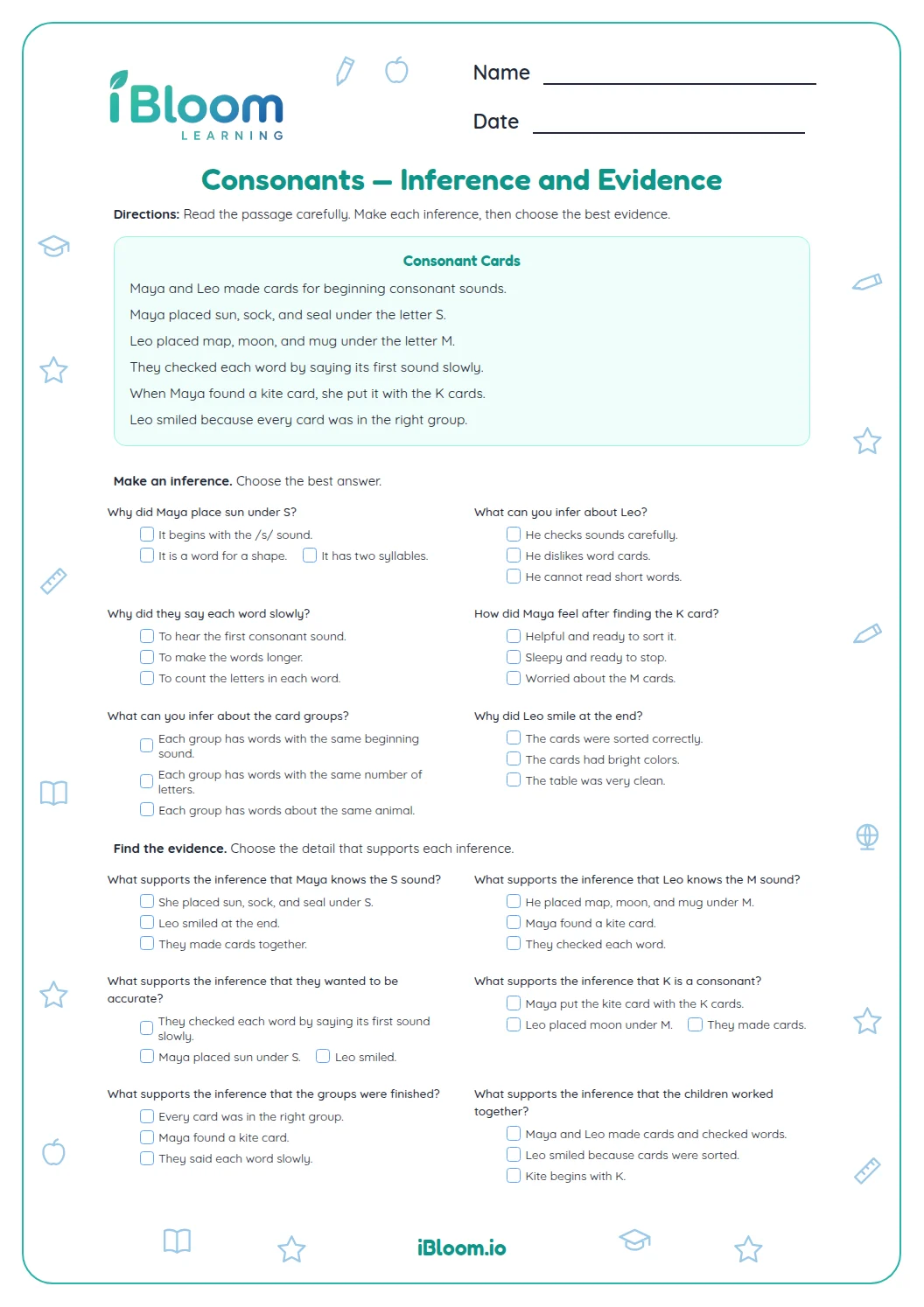
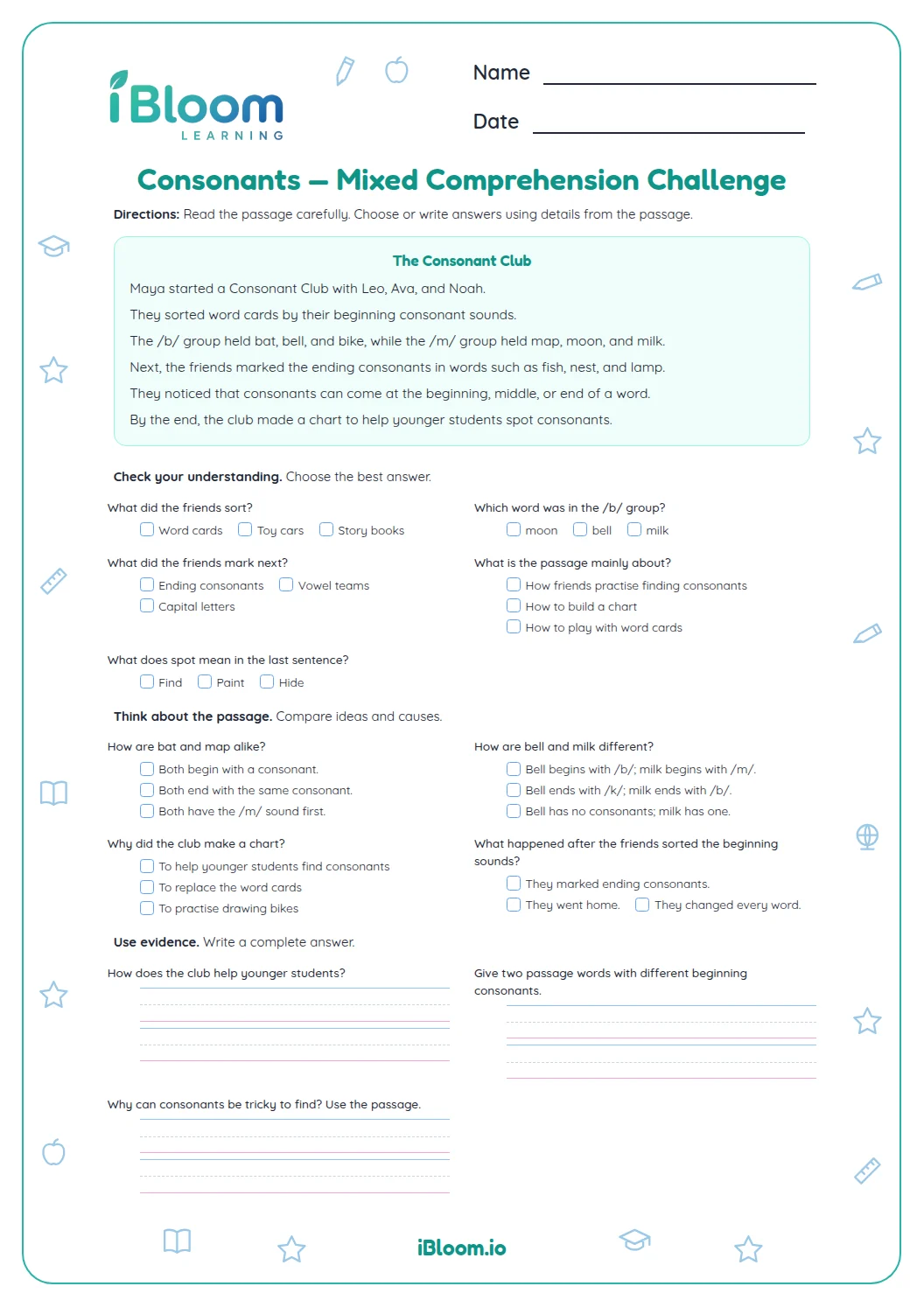
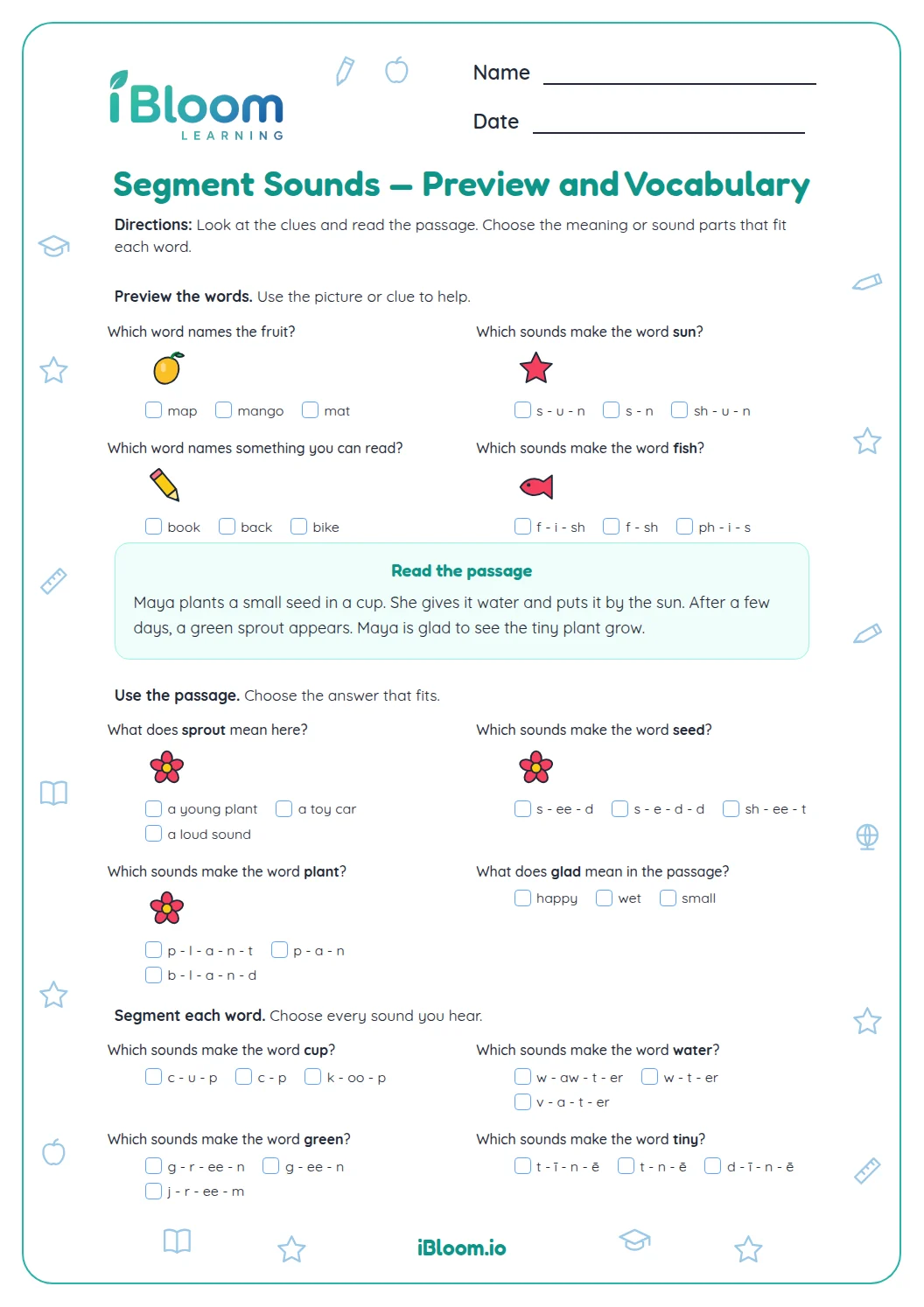
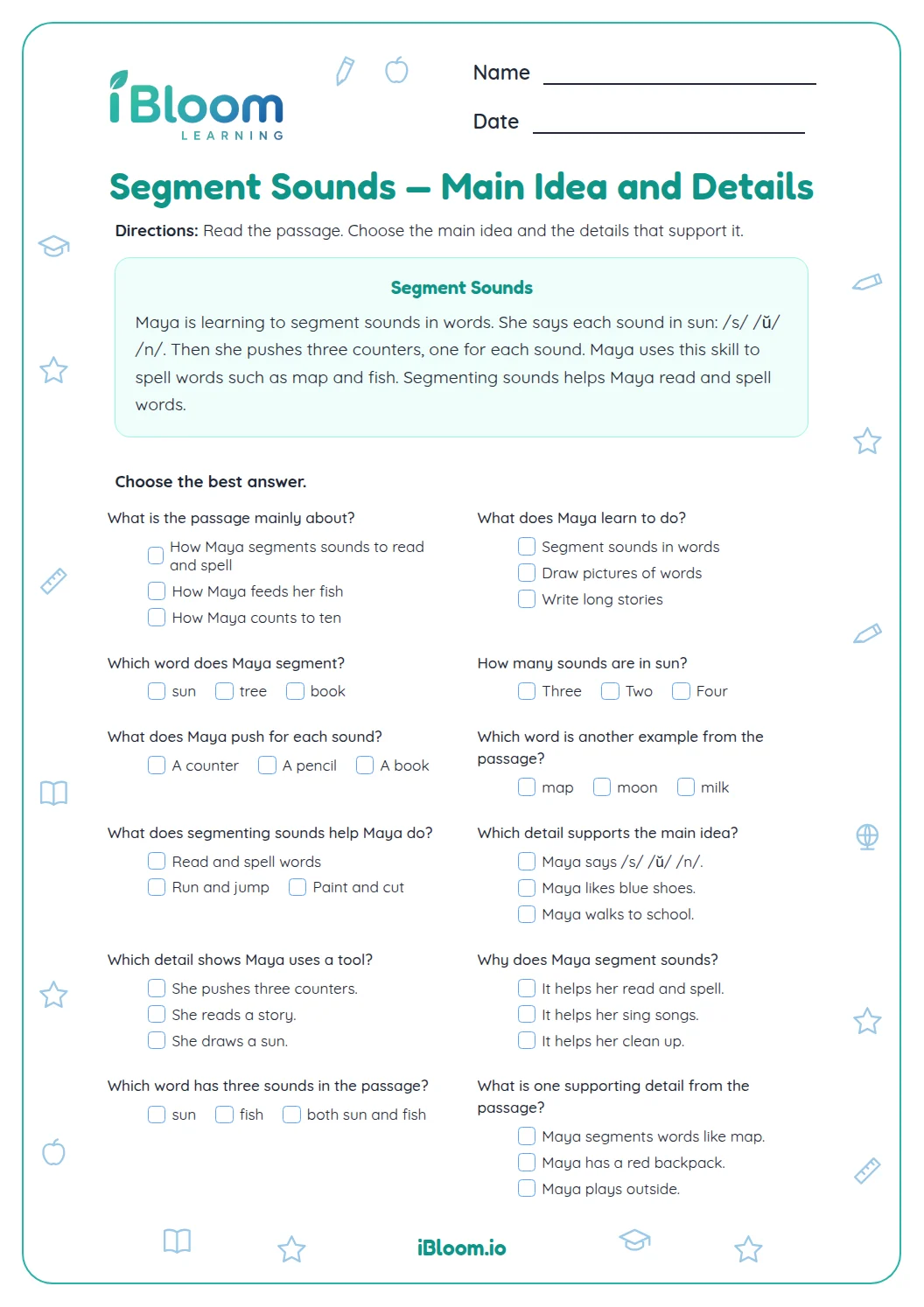
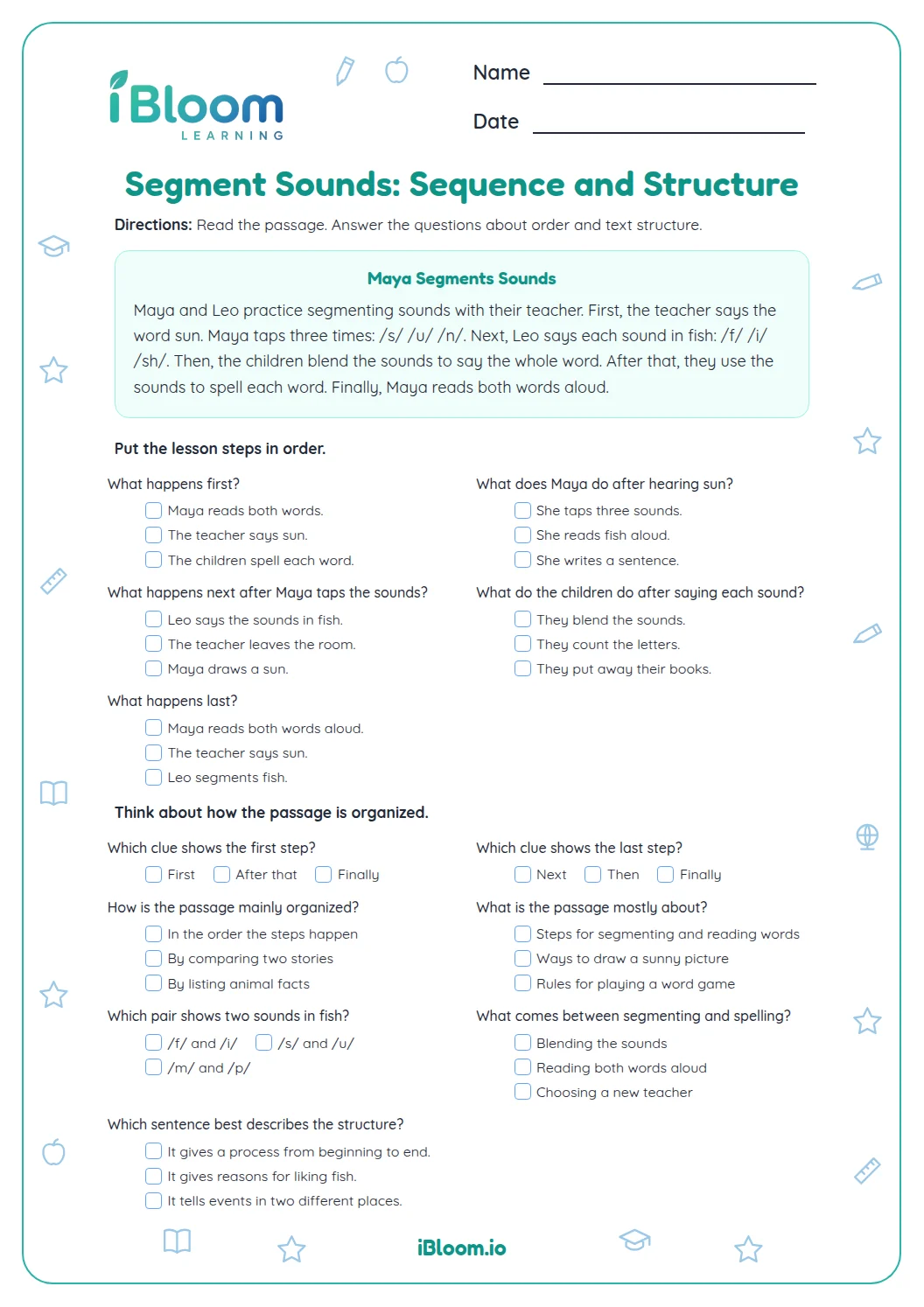
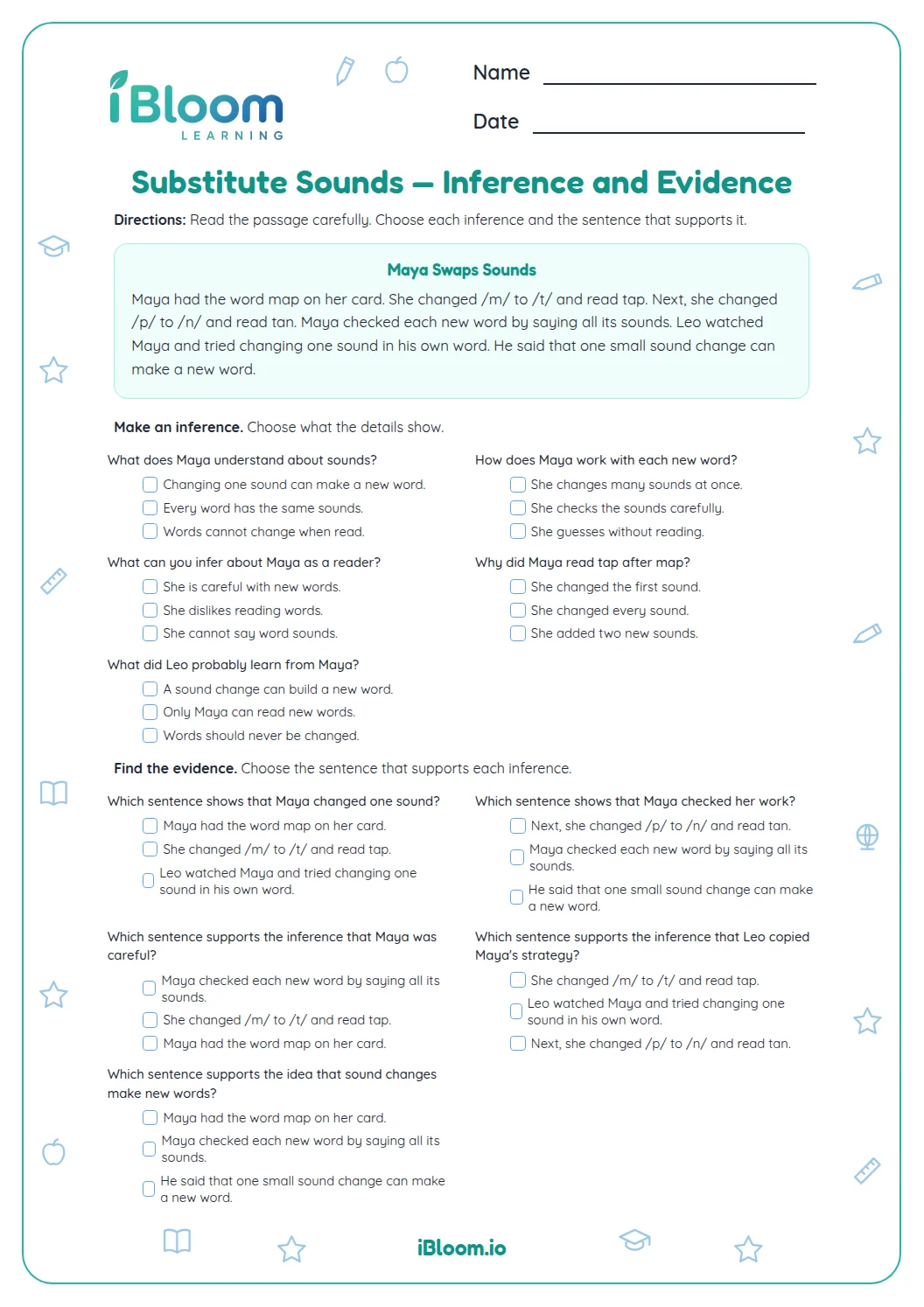
The 14 questions are grouped into four question parts after the passage. Questions 1–4 identify the main idea and basic facts, questions 5–12 connect examples to consonant sounds, and questions 13–14 select evidence from the text.
- Part A: read the passage about consonant sounds
- Part B: choose the main idea and a key detail
- Part C: identify consonant spellings and sounds
- Part D: connect more consonant examples to the passage
- Part E: select evidence that supports an answer
How to use this worksheet at home or in class
- 1Read the two paragraphs aloud once, then let the child reread independently.
- 2Answer question 1 by asking, “What idea connects both paragraphs?”
- 3For a detail question, point back to the exact sentence before answering.
- 4For the final questions, ask the child to explain why the selected evidence fits the passage.
- 5Check the response against the key; accept another wording if it uses a correct passage detail.
Common mistakes and quick fixes
The mistake
Choosing one example, such as “u is a vowel,” as the main idea.
The fix
Ask which idea covers both paragraphs and all the examples: consonant sounds help readers build and read words.
The mistake
Calling every letter in sun a consonant.
The fix
Reread the passage: s and n are consonants, while u is a vowel.
The mistake
Treating sh as two separate consonant sounds in ship.
The fix
In ship, the two letters sh work together to spell one sound: /sh/.
Common Core alignment
This page practices the listed Common Core skill with examples drawn from the worksheet.
Identify the main topic of a multiparagraph text and the focus of specific paragraphs.
On this sheet: Questions 1 and 13–14 identify and support the central topic with details.
Show the official wordingHide the official wording
Identify the main topic of a multiparagraph text as well as the focus of specific paragraphs within the text.
Apply grade-level phonics and word-analysis skills.
On this sheet: The passage and questions attend to consonant spellings and sounds in familiar words.
Show the official wordingHide the official wording
Know and apply grade-level phonics and word analysis skills in decoding words.
What to practice next
Make more practice
Further reading
Questions parents and teachers ask
What is the main idea of the consonants passage?
The passage explains that consonant sounds help readers build, read, and spell words. Its examples include the consonants in sun, the two-letter spellings in ship and chin, and the change from fan to pan when the first sound changes. That connects the details to the passage’s main idea.
Which details should support an answer?
A detail should come directly from the passage. For example, it names sh in ship and ch in chin as two-letter consonant spellings, and it says that the final sound in nest is /t/. Children can point back to those sentences.
How does this worksheet connect phonics and comprehension?
Children read a short text about consonant sounds, find its main idea, and answer questions about the text’s examples. The phonics terms are part of the passage, so responses depend on both reading for meaning and attending to sounds. This keeps each response tied to the actual text.
Does the printable include an answer key?
Yes. The separate key marks the correct choices for all 14 questions. It helps children check the main idea, details, and sound examples. Ask them to point back to the matching sentence when they review an answer. Children can review each answer aloud.
What is a consonant digraph?
A consonant digraph is two consonant letters that work together to spell one sound. In the passage, sh in ship and ch in chin are examples. The worksheet asks children to notice the letters and the sound they represent in each word.