


About this worksheet
This free Grade 2 printable pairs a short story about Maya’s kite with 16 multiple-choice questions on event order, rhyme, and story structure. Students follow what Maya does first and last, identify words such as light and flight, and use beginning, middle, and ending details. The work practices CCSS RL.2.5 for story structure and RF.K.2.a for recognizing rhyming words. A separate key marks each correct choice.
Aligned to RL.2.5 and RF.K.2.a
How can readers follow the events in Maya’s story?
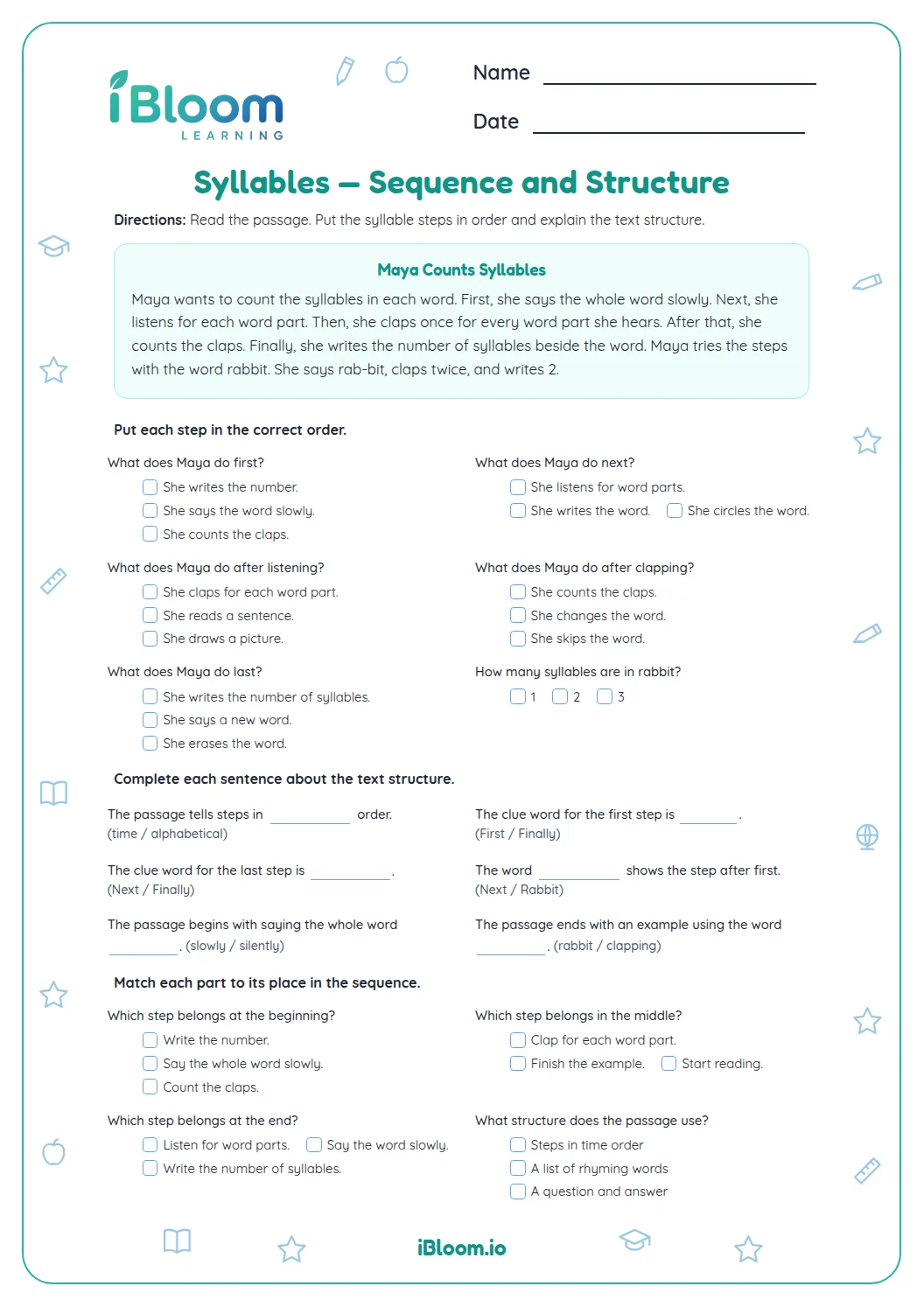
Look for order words and actions. Maya checks the string, runs, watches the kite rise, responds when the breeze pulls it toward a tree, and brings it down after the wind slows. Question 1 asks about her first action before the kite lifts.
The middle and ending actions matter too: the kite dances in the sky, Maya pulls it down, and she winds the string before walking home.
- 1Question 1 asks what Maya does before the kite rises.
- 2The passage says, “First, she checked the string and ran across the grass.”
- 3Maya checked the string first.
Which words rhyme in the passage?
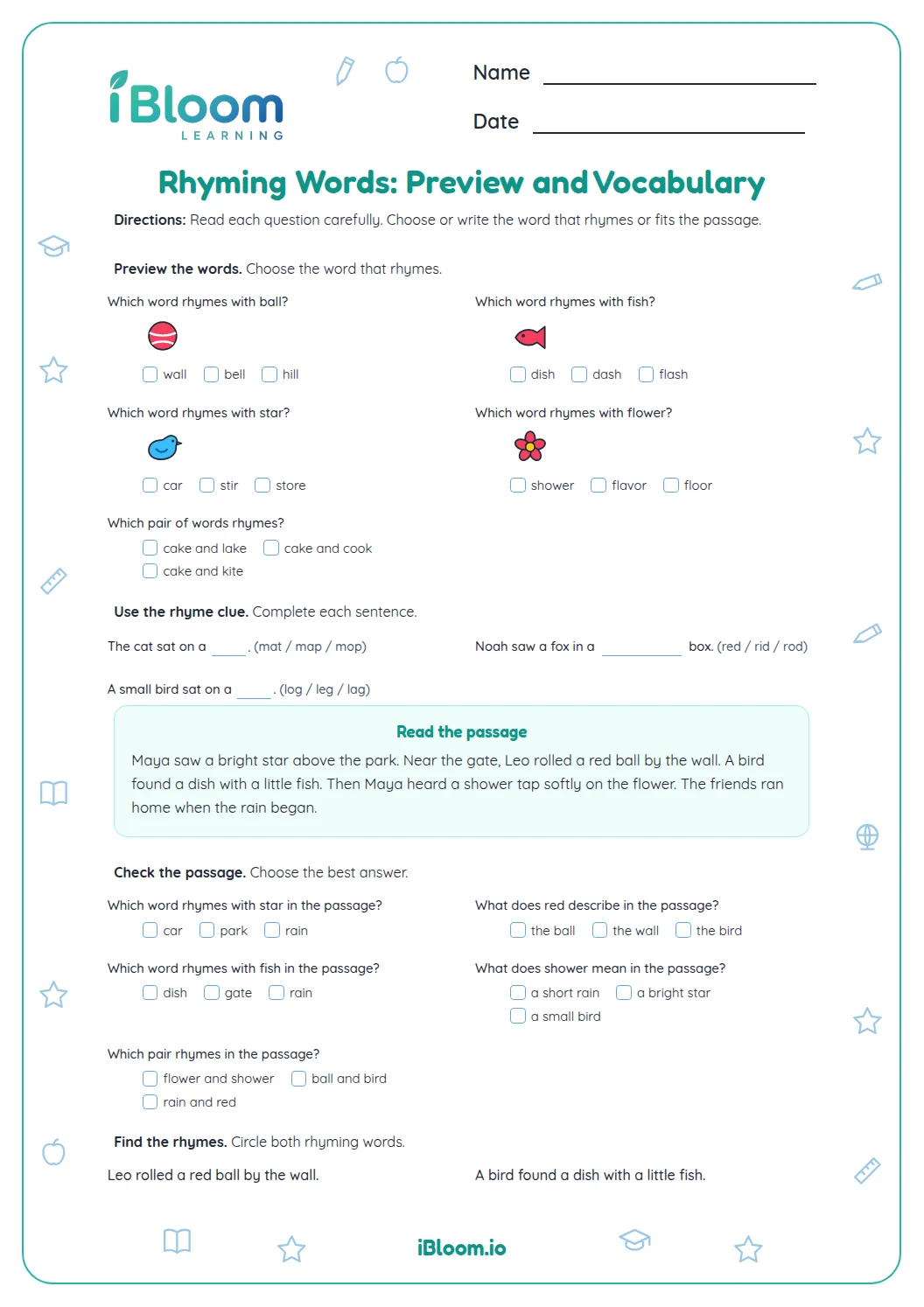
Rhyming words have the same ending sound. “Kite” and “light” rhyme, as do “light” and “flight” and “down” and “town.” The spelling does not have to be identical; listen to the final sound when checking a pair.
Question 7 asks students to choose one pair from the passage. Reading the words aloud can make the shared ending easier to hear.
What does each part ask students to do?
Part A is the passage. Part B has six questions about Maya’s actions and their order. Part C gives five rhyme questions, and Part D asks five questions about the story’s beginning, middle, and ending.
The key marks the correct choice for each item. Students can return to the story to find the sentence that supports an answer.
How to read for rhyme and order
- 1Read the story once to understand what Maya is doing.
- 2Mark order words such as first, then, when, and after.
- 3For sequence questions, return to the sentence that names the action.
- 4Say candidate rhyme words aloud and compare their ending sounds.
- 5Use a passage detail to check each choice.
Common rhyme and sequence mistakes
The mistake
Choosing words that begin alike but end with different sounds.
The fix
Listen to the whole ending sound, as in sun and run.
The mistake
Mixing up an action from the middle with the first event.
The fix
Follow the order words from Maya checking the string to the kite lifting.
The mistake
Answering a story question from memory without checking the passage.
The fix
Find the sentence that tells what happened and use its detail.
Common Core alignment
The questions connect story events with the sound patterns of rhyming words.
Use the beginning, middle, and ending events to describe a story’s structure.
On this sheet: Questions ask students to follow the story from Maya preparing the kite to bringing it home.
Show the official wordingHide the official wording
Describe the overall structure of a story, including describing how the beginning introduces the story and the ending concludes the action.
Recognize and produce rhyming words by matching the words’ ending sounds.
On this sheet: Students identify rhyming words that appear in the passage and select matching sound pairs.
Show the official wordingHide the official wording
Recognize and produce rhyming words.
What to practice next
Make more practice
Further reading
Questions parents and teachers ask
How many questions follow the story?
There are 16 multiple-choice questions in three parts after the passage. Six ask about event order, five focus on rhyme, and five ask about the story’s beginning, middle, or ending. The answer key marks each correct choice and helps readers return to the relevant story detail.
Which words rhyme in the passage?
The passage includes sun and run, light and flight, and down and town. Each pair has matching ending sounds. Students can say the words aloud and listen to the final sound; the rhyme questions also provide choices so they can compare a matching pair with non-rhyming words.
What does Maya do before the kite rises?
Maya checks the string and runs across the grass before the kite lifts into the sky. The first question asks about her action before the lift. Later questions follow the breeze, the kite’s return to the ground, and Maya winding the string before walking home.
How does the worksheet connect rhyme with story structure?
Students first follow Maya’s actions in order, then identify word pairs whose ending sounds match. The final questions ask what the beginning introduces, what causes Maya to step aside, and which action concludes the story. The answer choices keep each question tied to a detail in the passage.
What standards are listed for this worksheet?
The page lists CCSS RL.2.5 for describing a story’s structure and RF.K.2.a for recognizing rhyming words. Students use the passage to follow its beginning, middle, and ending, then identify word pairs whose ending sounds match. The key gives sample responses.