





About this worksheet
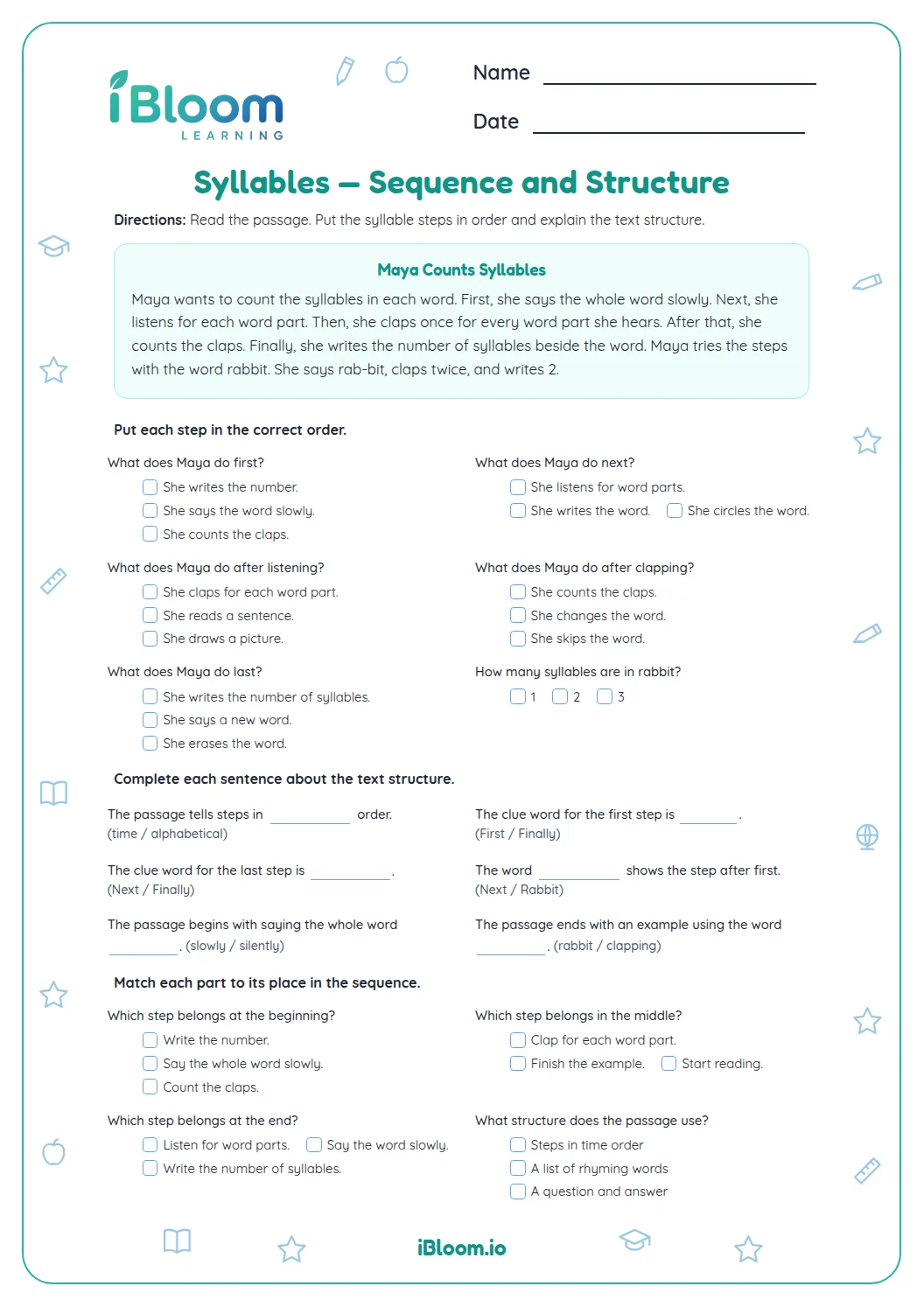
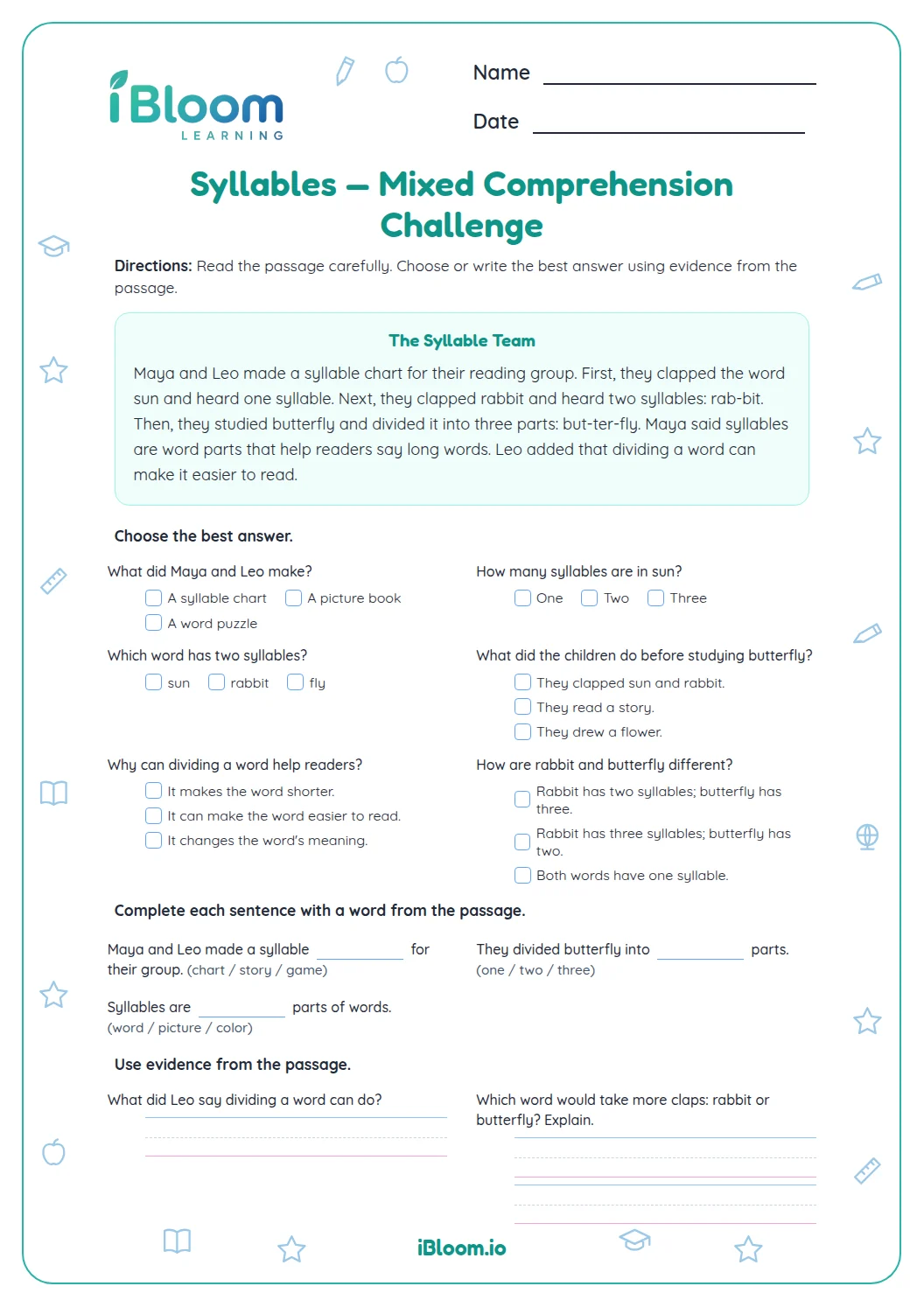
This free Grade 2 reading printable pairs an original picnic story with phonics and comprehension questions. Students count syllables in words such as napkin and rainbow, recall details from Maya’s picnic with Pip, and write short inferences supported by story clues. The passage and 12 questions occupy three worksheet pages, followed by a three-page answer key. The practice aligns with RF.2.3 and RL.2.1.
Aligned to RL.2.1 and RF.2.3
What happens in “A Picnic for Pip”?
Maya, Leo, and Ava sort words by syllable count. Emma checks by saying words aloud, and Sam notices a pattern in longer words. The passage gives clues for both phonics answers and the inference questions.
How does the sheet practice syllables?
Part B asks students to count the syllables in sunset, banana, picnic, and sun. Say each word naturally and count the spoken parts, rather than the letters.
How do readers make an inference from the sort?
Part C uses multiple-choice questions about why students sort and check words in particular ways. Match an idea to a clue in the passage; for example, Maya writes 2 because sunset has two syllables.
How can students find evidence in a sentence?
Part D asks students to circle the clue word or words in a short passage sentence. In question 10, “three” supports the inference that Leo heard three syllables in banana.
- 1Leo clapped three times for banana.
- 2Circle “three” as the syllable-count clue.
How to use this worksheet
- 1Read the short passage and notice how each student sorts words.
- 2Say each target word and count syllables, not letters.
- 3For each inference, connect an idea to a passage clue.
- 4Circle the clue word or words in each evidence sentence.
- 5Use the key to check the count, inference, and evidence.
Common mistakes and quick fixes
The mistake
Choosing an inference that is not supported.
The fix
Point to a detail in the passage before deciding.
The mistake
Guessing a word’s syllables from spelling alone.
The fix
Say the word slowly and listen for vowel beats.
The mistake
Giving a detail instead of an inference.
The fix
Combine a passage clue with what it suggests.
Common Core alignment
These Common Core standards describe the central skills practiced on this page.
Answer questions about key details and support inferences with text clues.
On this sheet: Students answer passage questions and use details as evidence for an inference.
Show the official wordingHide the official wording
Ask and answer such questions as who, what, where, when, why, and how to demonstrate understanding of key details in a text.
Apply phonics and word analysis while examining syllables in printed words.
On this sheet: Students analyze the syllables in printed words as part of phonics and word study.
Show the official wordingHide the official wording
Know and apply grade-level phonics and word analysis skills in decoding words.
What to practice next
Make more practice
Further reading
Questions parents and teachers ask
How many syllable questions are included?
There are four syllable-count questions: sunset, banana, picnic, and sun. Students say each word and count its spoken parts. The passage explains that banana has three syllables and sun has one. A strong response points to a word or sentence in the passage, not a guess.
Why did Maya write 2 beside sunset?
Sunset has two syllables, which Maya hears by clapping twice. Question 5 asks students to infer why she wrote 2. The answer comes from connecting her number to the syllable count. A strong response points to a word or sentence in the passage, not a guess.
What does question 10 ask students to circle?
It asks students to circle the word that supports the inference about how many syllables Leo heard in banana. The word “three” is the clue because Leo clapped three times. A strong response points to a word or sentence in the passage, not a guess.
How long is the printable?
The passage and 12 questions fill three worksheet pages. The separate answer key also takes three pages. Questions move from syllable counting to inferences and then locating evidence in short sentences. A strong response points to a word or sentence in the passage, not a guess.
Can two words be circled as evidence?
Yes. Question 12 asks students to find the clue in “Longer words often had more word parts to clap.” The key accepts “longer” and “more word parts,” which together express the observation Sam noticed. A strong response points to a word or sentence in the passage, not a guess.
What phonics work comes next?
The linked Grade 2 phonics pages offer practice with blending sounds, rhyming, and vowel patterns. Choose the next activity based on the word-reading feature your student is working on. A strong response points to a word or sentence in the passage, not a guess.