







About this worksheet
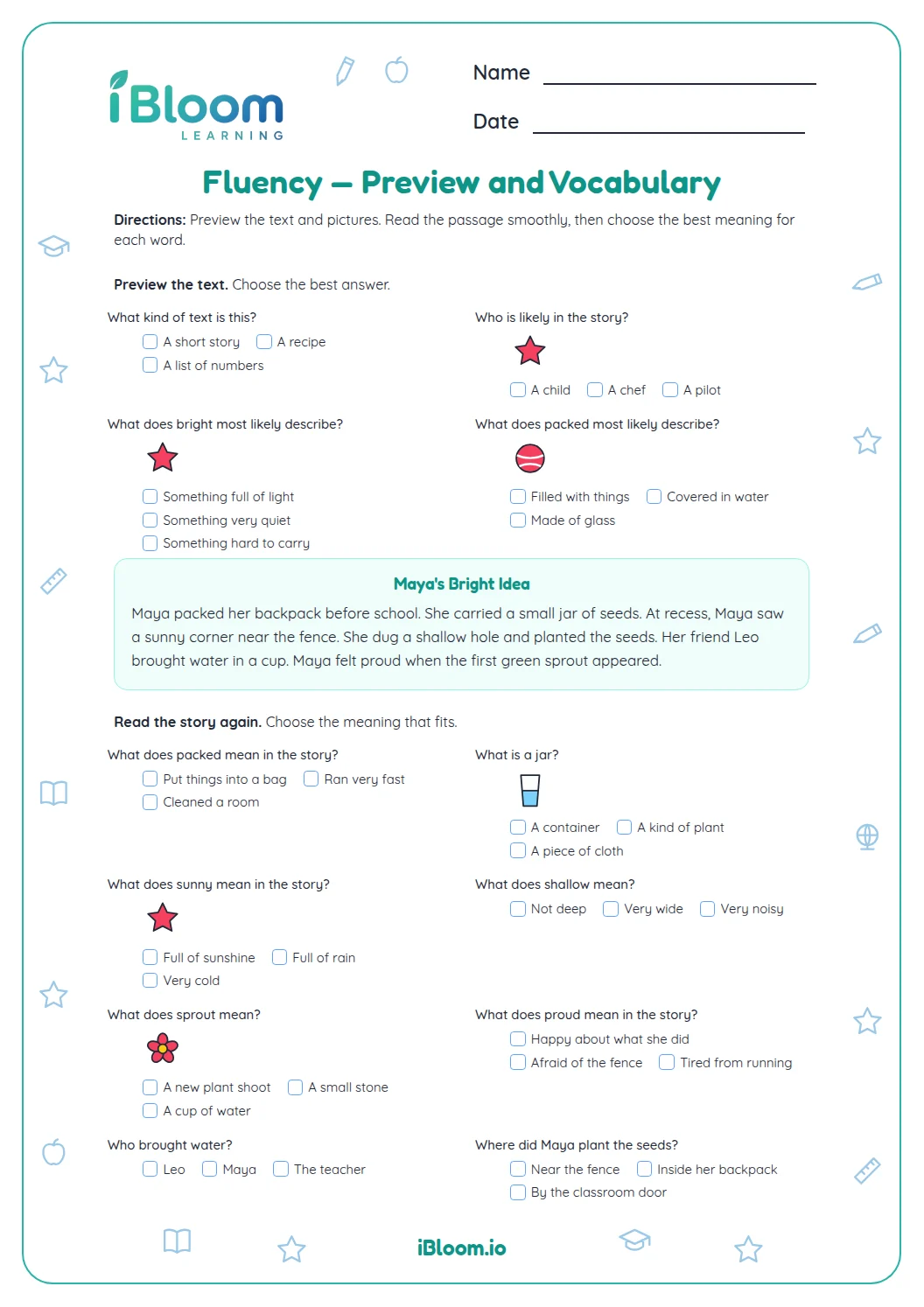
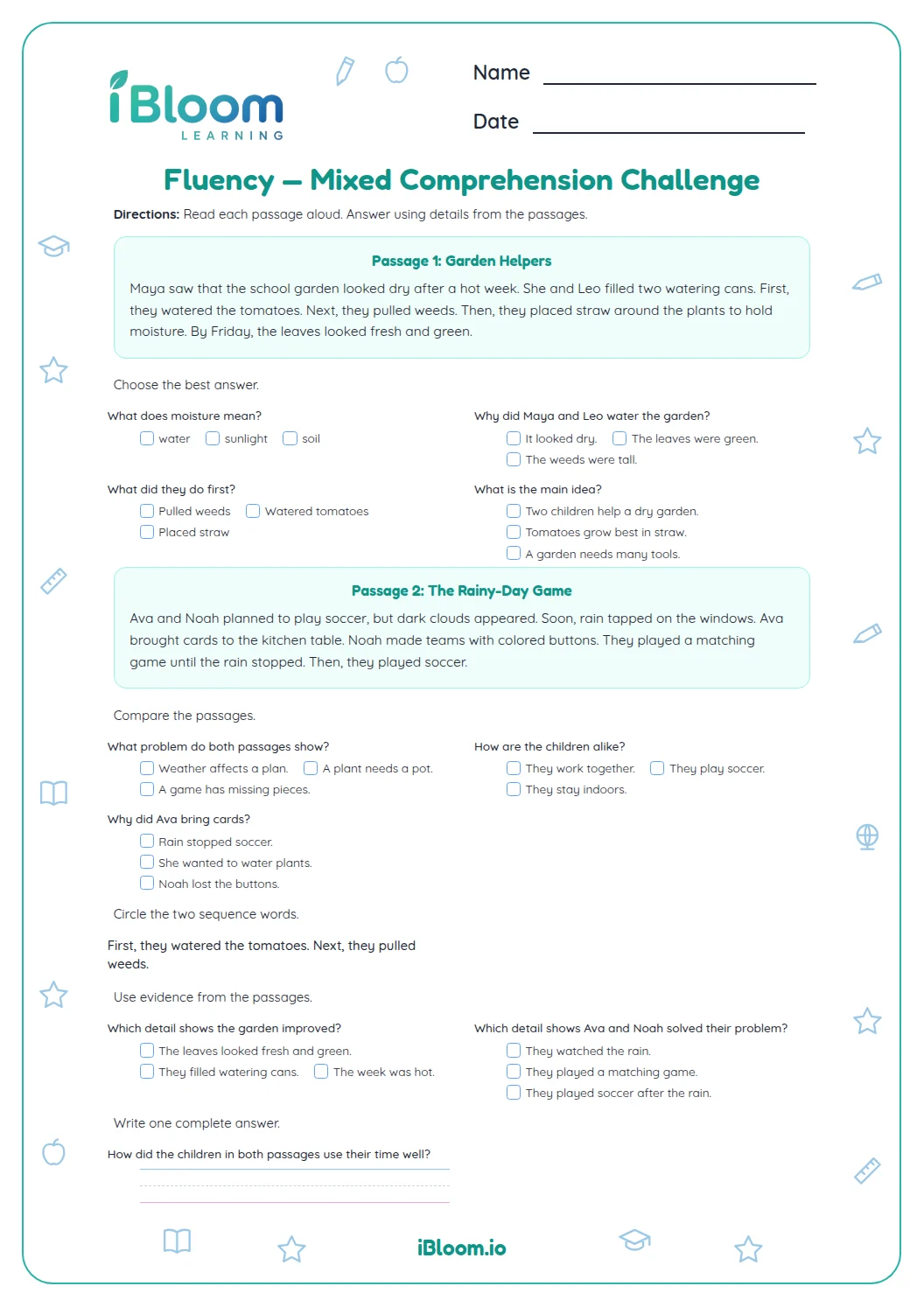
This free Grade 2 reading worksheet pairs a short original passage with 14 questions for rereading, comprehension, and written response. Children read about Eli planting seeds, return to details about his actions, put events in order, and write answers using details from the passage. The answer key includes sample wording for open responses. The questions practice answering who, what, why, and how questions about key details, aligned with CCSS RL.2.1.
Aligned to RL.2.1
How can a child find evidence for an answer?
Look back at the sentence that tells what Eli does or notices. For question 8, the passage says the soil looks dry, which explains why Eli waters the seeds. A short written answer can use the same detail in the child’s own words.
- 1Question: How does Eli know the seeds need water?
- 2Find the clue: “The soil ... looked dry.”
- 3Connect the detail to the question.
- 4Answer: The soil looks dry.
How does rereading support fluency practice?
Reread the short passage to notice Eli’s actions and phrases, then return to it to find details needed for the questions. Reading it more than once supports careful reading and comprehension.
What makes a written response complete?
A complete response answers the question and includes a relevant detail. For example, “Eli is preparing for the seeds to grow because he labels the row” gives both an idea and evidence. For open questions, accept other clear answers supported by the passage.
How to use this worksheet
- 1Read the passage once without stopping to get the main event.
- 2Read it again and notice the order of Eli’s actions.
- 3Answer detail questions by returning to the relevant sentence.
- 4For written responses, answer first and add one passage detail.
- 5Use the key to check the idea, not only the exact wording.
Common mistakes and quick fixes
The mistake
Answering from what usually happens in a garden instead of the passage.
The fix
Find the sentence that gives the information and use its detail.
The mistake
Listing events in the order they appear in the question.
The fix
Reread the passage and put the actions in the order Eli does them.
The mistake
Writing an opinion without a text clue.
The fix
Add a relevant detail from the passage to support the idea.
Common Core alignment
This reading page asks children to answer questions about key details in a short passage.
Answer questions about key details in the passage.
On this sheet: Questions ask readers to answer and write about who, what, why, and how details in Eli’s passage.
Show the official wordingHide the official wording
Ask and answer such questions as who, what, where, when, why , and how to demonstrate understanding of key details in a text.
What to practice next
Make more practice
Further reading
Questions parents and teachers ask
What does this worksheet help children practice?
This printable focuses on rereading, finding details, following sequence, and writing about a passage. It includes 14 passage-based questions and a matching answer key. Children can work through the questions in order, pause to explain an answer, and then use the key to review each response. The examples are written for this particular sheet.
Is an answer key included?
Yes. The key includes an answer for all 14 questions, with sample wording where different clear responses can be correct. For an open response, compare the child’s idea with the passage or math relationship and accept an accurate explanation even when the wording differs from the model.
Can children complete this in one sitting?
Yes. The printable is designed for one practice session, and adults can also divide it by part. Begin with the directions, let the child try the first few items, and pause to discuss the strategy. The time estimate is a guide; careful reading or conversation may take longer.
How should I use the answer key?
Use the key after the child has attempted each part. For a missed item, ask which detail, clue, or calculation supports the answer, then revisit the question together. Open responses may have multiple correct versions, so check the idea and its support rather than requiring an exact match to the sample sentence.
What if a child needs help with a question?
Read the directions aloud and return to the specific clue the question asks about. For reading, point back to the sentence with the evidence. For math, name the known numbers and operation before solving. A small hint can help the child continue while still doing the thinking and recording the response.