







About this worksheet
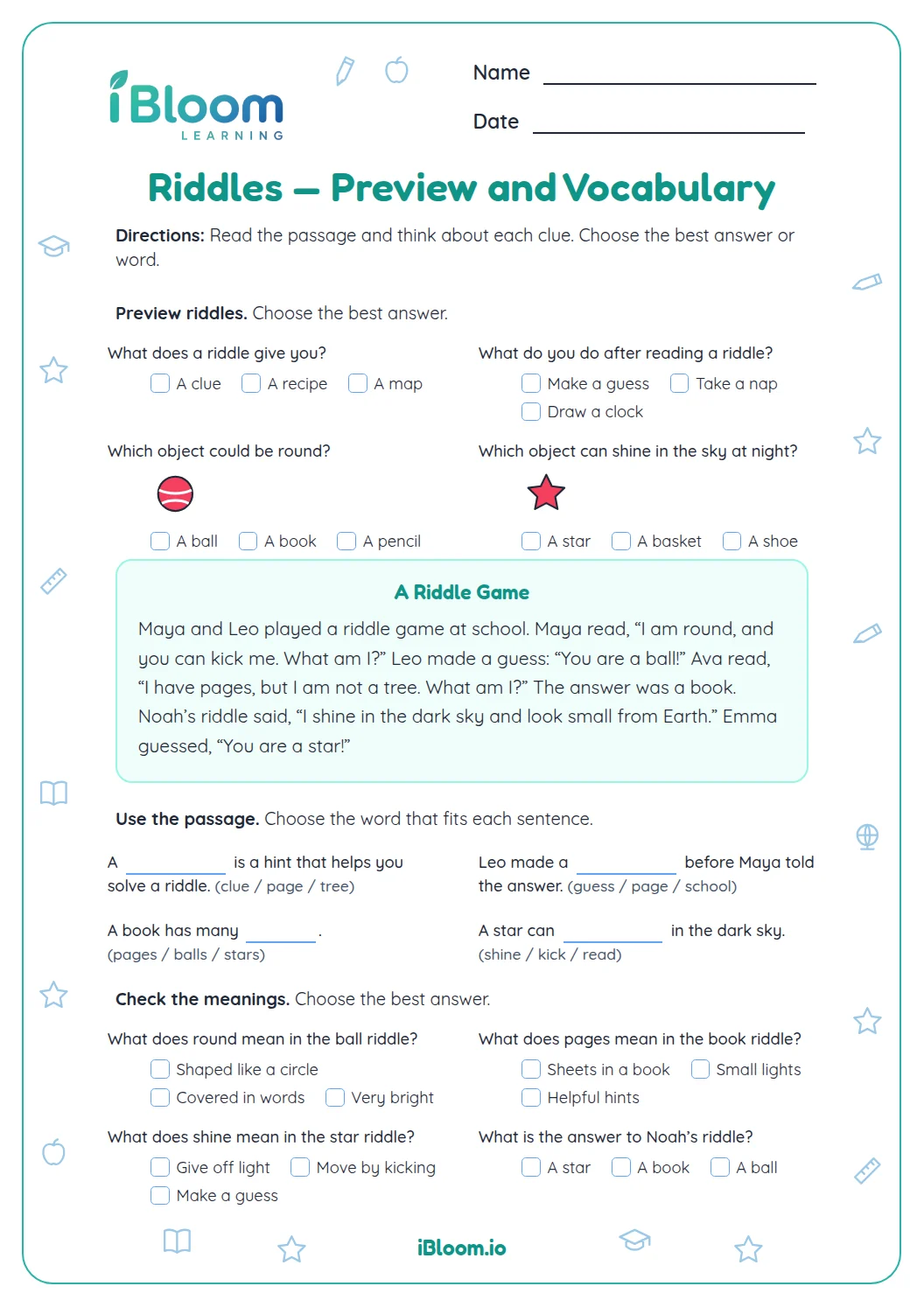
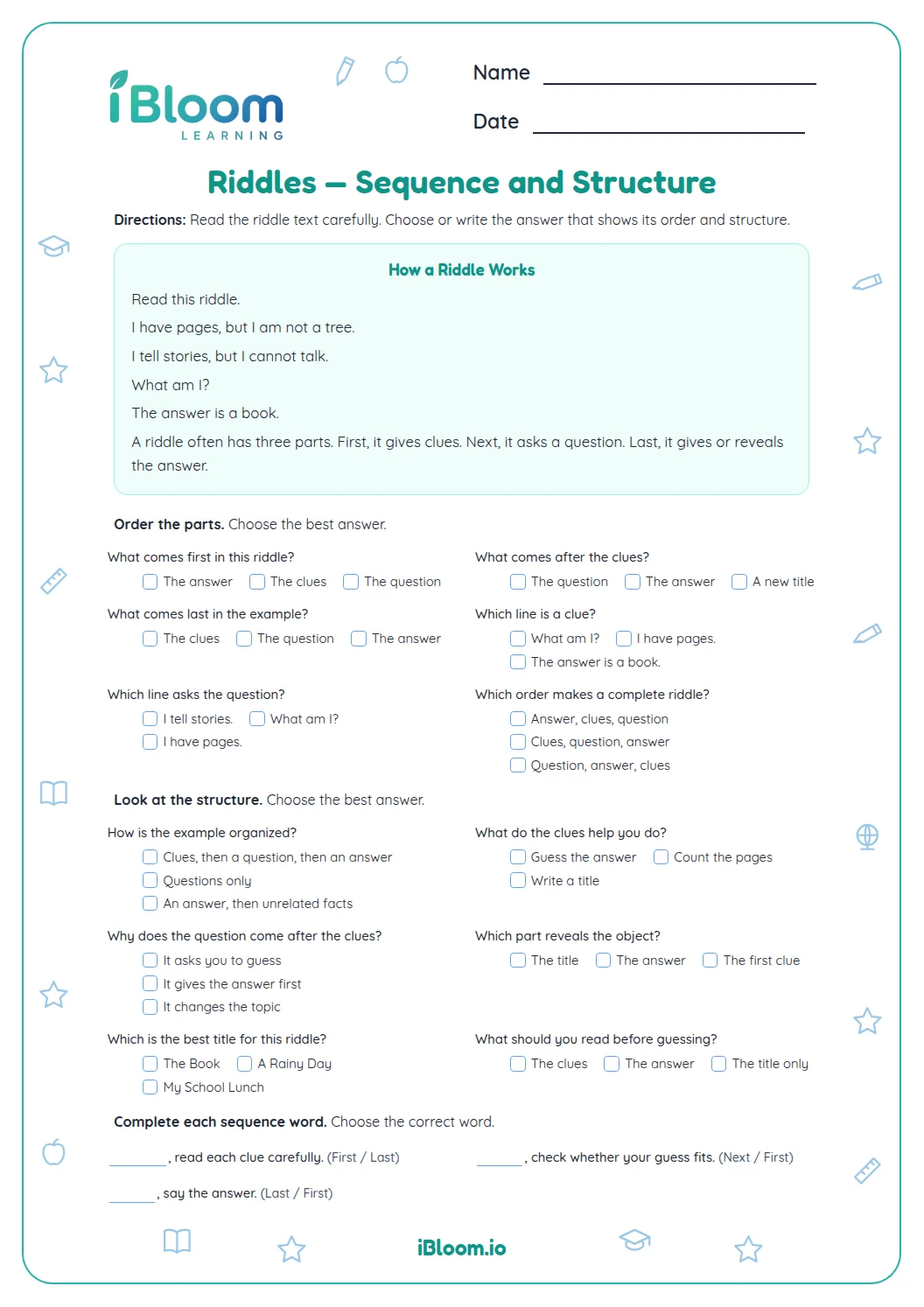
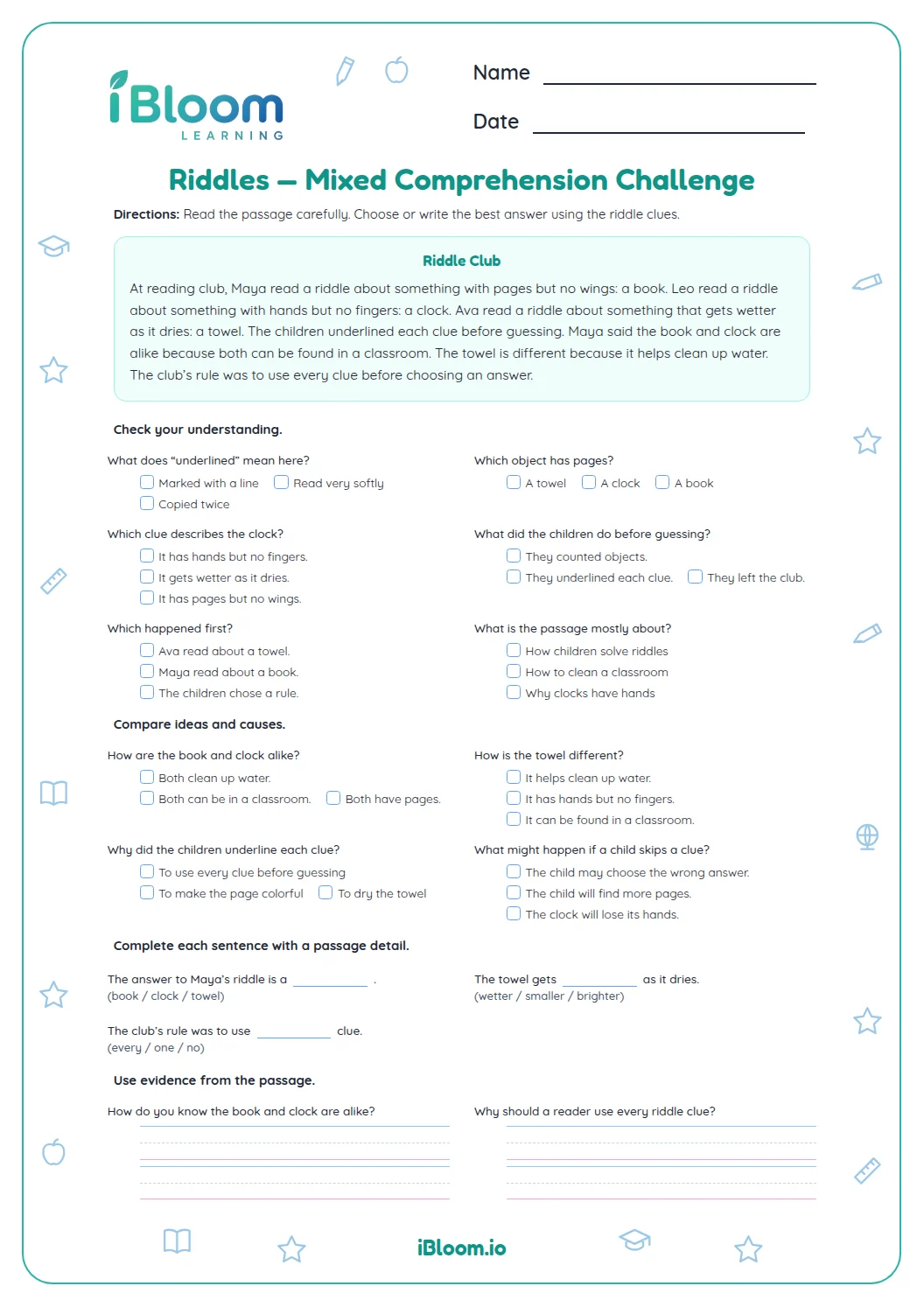
This Grade 2 worksheet uses three short riddles about a book, clock, and cloud. Children select each answer, connect details to the object, and explain how a clue supports their thinking. Later prompts ask them to compare clues and write a one-sentence riddle of their own. A separate answer key includes sample responses for open-ended questions.
Aligned to RL.2.1 and W.2.8
How do clues narrow the answer?
A useful answer fits every detail, not just one word. For question 1, pages and reading point to a book. Reread the full riddle to check that the answer matches both clues.
- 1Clues: pages; opens for reading
- 2Answer: A book has pages and opens for reading.
What makes a strong written response?
Name the answer clearly, then include a clue from the riddle. A brief sentence is enough. The goal is to show how the clue supports the answer, not to write a long story.
How is the practice organized?
The 16 riddles appear in two parts. Early questions use direct clues; later questions use a little more inference. Each response space is sized for a short written answer.
How to use this worksheet
- 1Read the whole riddle before guessing.
- 2Underline or remember two details that describe the answer.
- 3Think of an object that matches every detail.
- 4Write its name in a sentence.
- 5Add one clue as evidence.
- 6Reread the riddle to check that your answer fits.
Common slips and quick fixes
The mistake
Using only one clue
The fix
Check the answer against every sentence in the riddle.
The mistake
Writing a guess without evidence
The fix
Add a phrase from the riddle that helped you decide.
The mistake
Giving an answer that fits only part of the riddle
The fix
Read the clue again and revise until every detail makes sense.
Common Core alignment
This worksheet gives children a chance to apply the standard to a focused set of printable questions.
Answer questions about a text and point to clues.
On this sheet: Each riddle asks the learner to infer an answer from details in its sentences.
Show the official wordingHide the official wording
Ask and answer such questions as who, what, where, when, why, and how to demonstrate understanding of key details in a text.
Recall information and gather details to answer.
On this sheet: Learners use the clues supplied in each riddle to form a written answer.
Show the official wordingHide the official wording
Recall information from experiences or gather information from provided sources to answer a question.
What to practice next
Further reading
Questions parents and teachers ask
What answers do the three riddles describe?
The riddles describe a book, a clock, and a cloud. Each answer fits several details in its riddle, such as pages in the book riddle and rain in the cloud riddle. Children choose an answer and then point to the clue that supports it.
Do written responses need to match the key word for word?
No. The answer key gives sample responses for questions with more than one reasonable sentence. A child’s answer should name the right object or clue and make sense with the riddle text. A different sentence is fine when it uses an accurate clue from the passage.
How can a child explain a riddle clue?
Have the child name the object and connect one detail to it. For example, a clock has hands that show time. The worksheet asks children to use complete sentences so the connection is clear. Point back to the exact words in the passage before writing the explanation.
What does the final riddle task ask for?
The child writes a one-sentence riddle about a pencil using clues, then names the answer. A clue such as “I have a point and help you write” points to a pencil without saying its name in the riddle.
How many riddles are in the passage?
There are three riddles in the passage: one about a book, one about a clock, and one about a cloud. The questions revisit their clues and ask children to explain how those details lead to each answer. Readers can return to the passage whenever they need to confirm a detail.