


About this worksheet
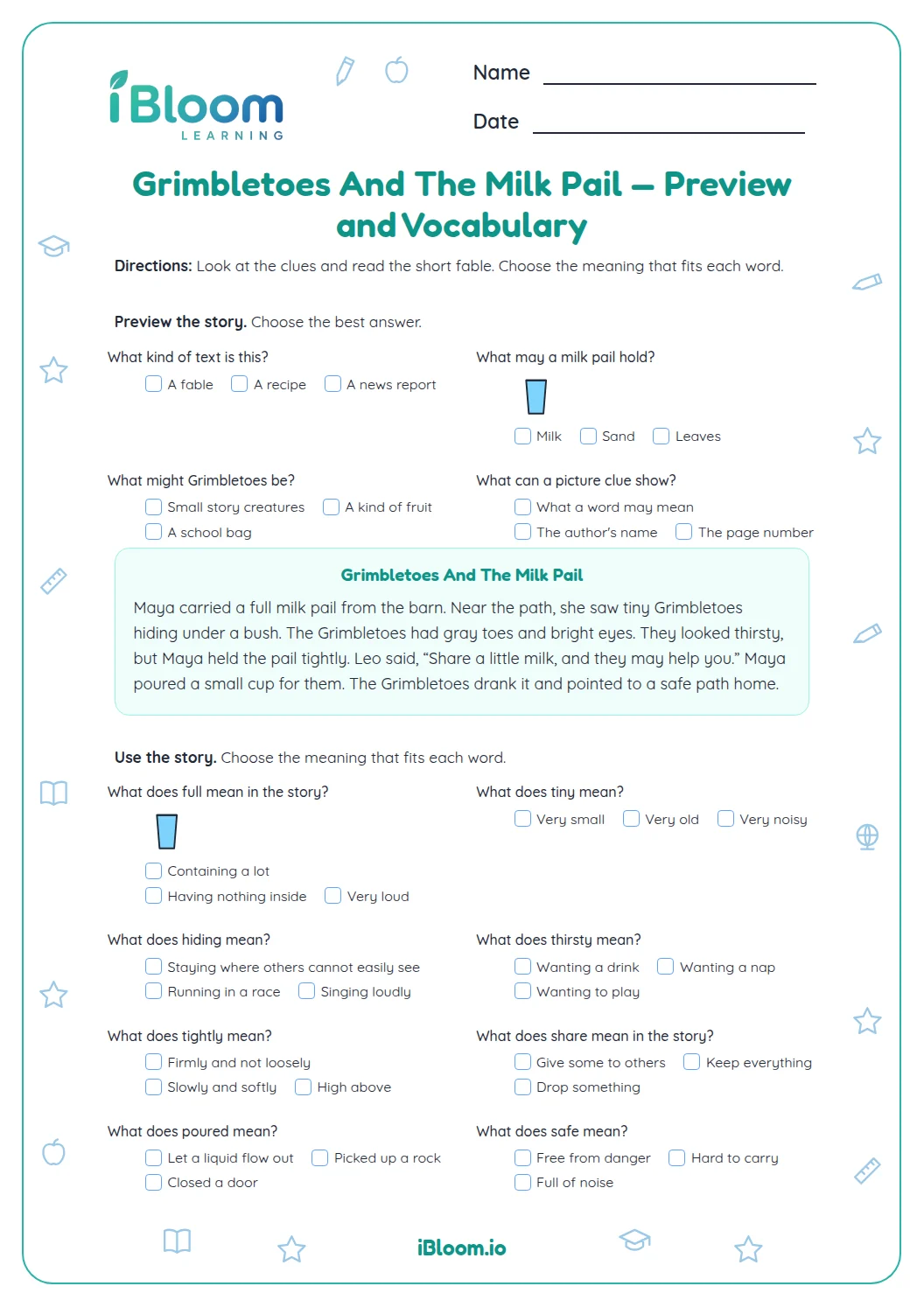
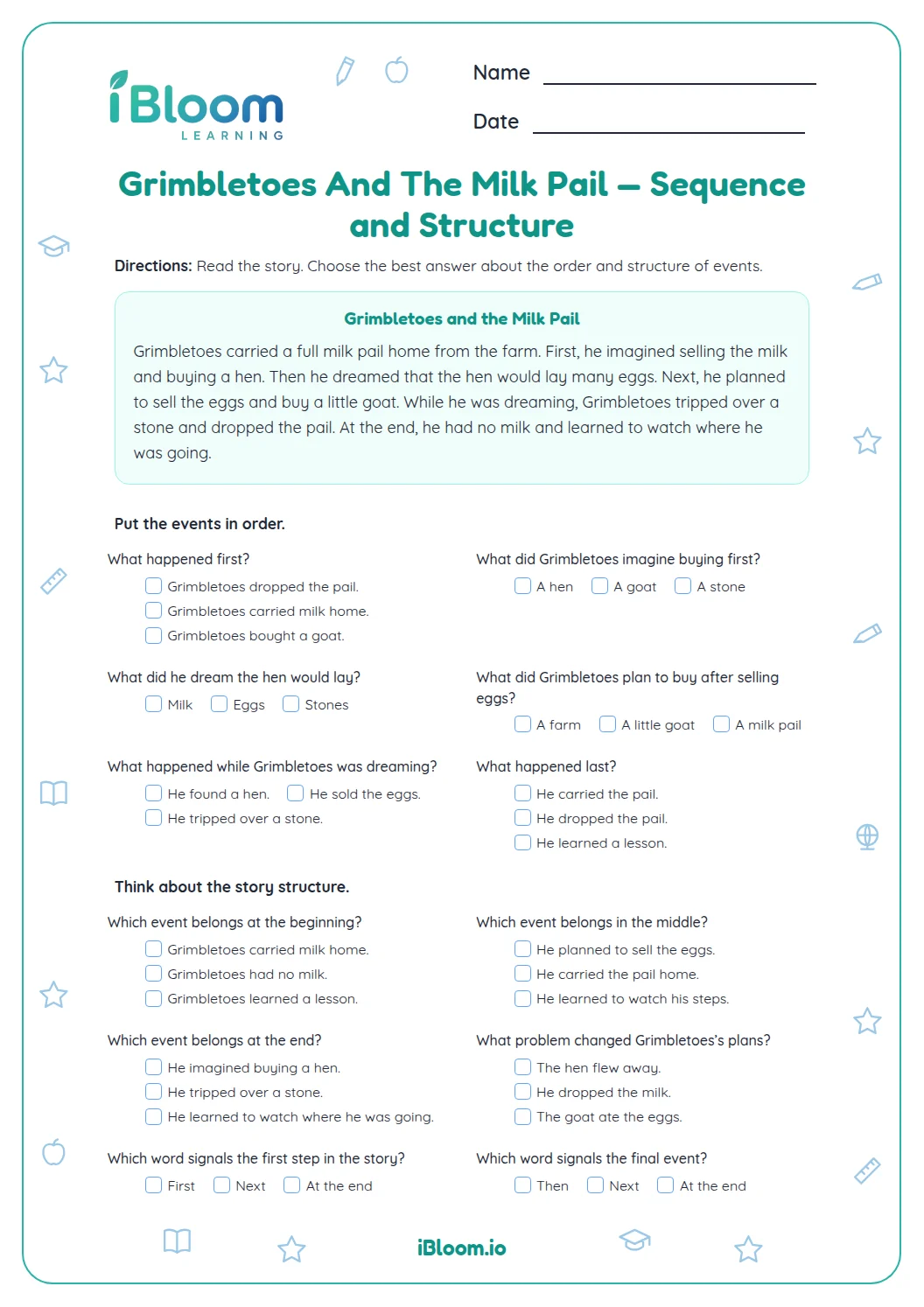
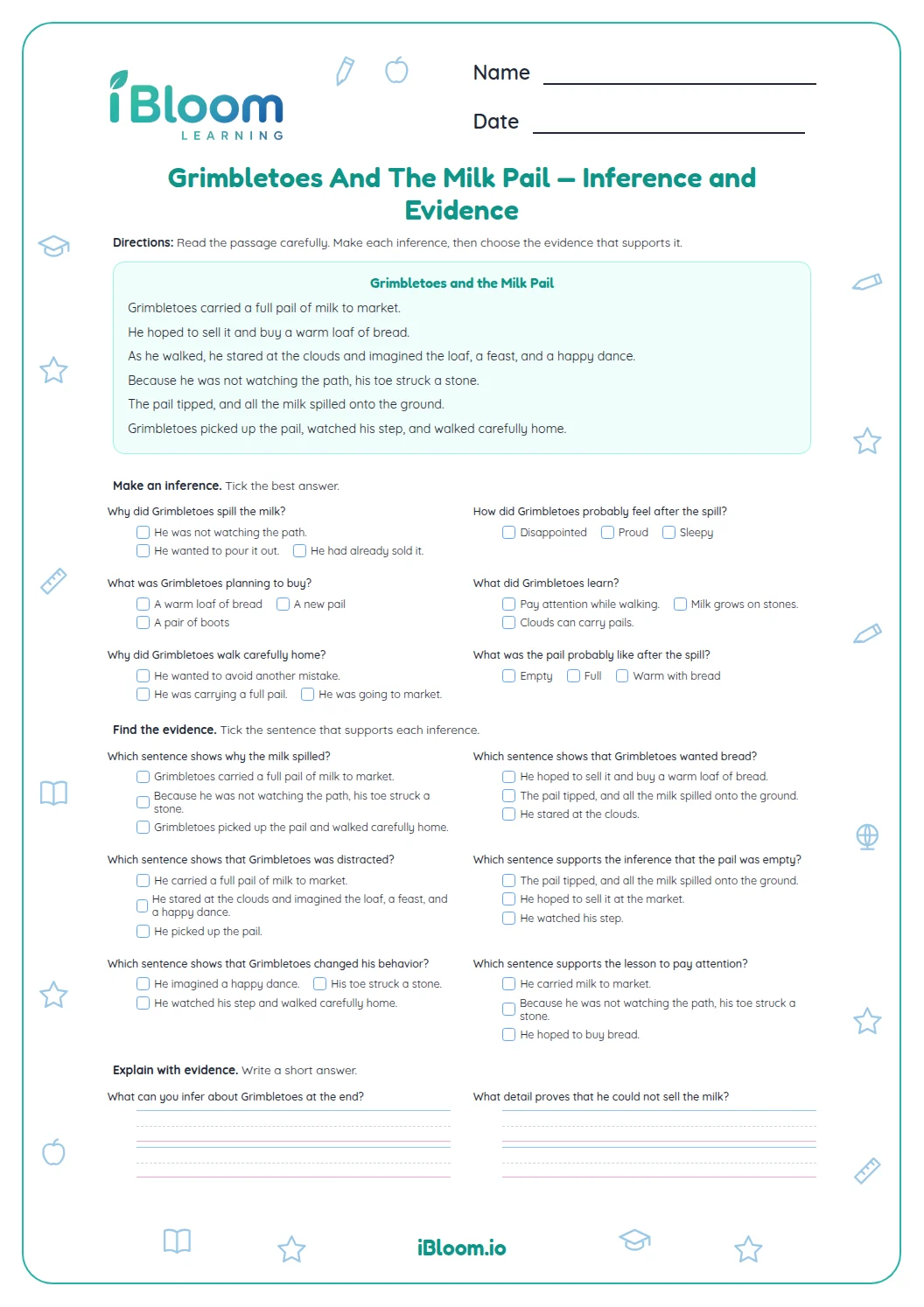
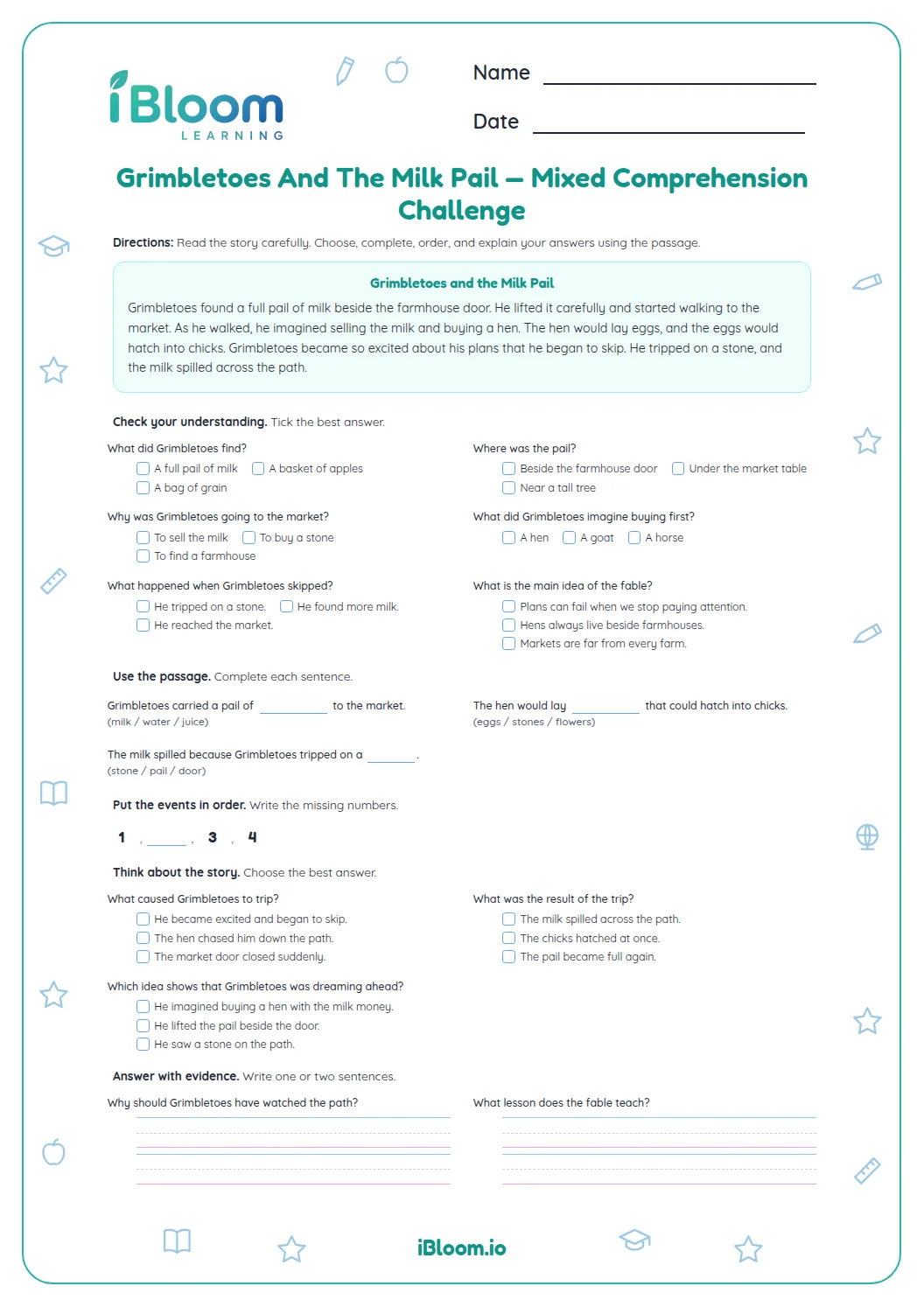
This free Grade 2 worksheet pairs Grimbletoes and the Milk Pail with 12 questions about its main idea, details, and lesson. Part A tells how Grimbletoes notices a tipped milk pail and helps a farmer. Part B has four choices about the main idea, a supporting detail, the problem, and the lesson. Part C has six detail questions; Part D has two written responses. Children practice Common Core RL.2.1 and RL.2.2 by returning to the story for evidence and explaining its message. The separate key includes correct choices and sample written answers.
Aligned to RL.2.1 and RL.2.2
How is the main idea different from a detail?
The main idea tells what the whole story is mostly about. A detail names a smaller action, object, or fact. “Grimbletoes helps out” brings the important events together; “He carries empty pails” is one action that supports it.
- 1Main idea: Grimbletoes helps out.
- 2Supporting detail: He carries empty pails.
- 3Carrying pails helps the farmer fill them with fresh milk.
Which details best support the main idea?
In question 2, all three choices describe something in the story. The child must choose the action that shows Grimbletoes helping. His home and the time of day tell us the setting; carrying pails directly supports the main idea.
Part C checks six specific details. Ask the child to find the words that answer each question, including who fills the pails and when all the pails are safe and full.
What should the written answers explain?
Question 11 asks how Grimbletoes helps. A good written answer names an action from the story, such as gathering clean pails or carrying them to the farmer. Question 10 prepares for this response by asking why the farmer thanks him.
Question 12 asks for the main idea in one sentence. Accept a child’s own wording when it captures Grimbletoes noticing a problem and helping. The lesson choice in question 4 connects those events to advice: notice trouble and help.
How to use this worksheet
- 1Read the two story paragraphs together or independently.
- 2Choose the Part B main idea and the detail that supports it.
- 3Discuss the problem and lesson in questions 3 and 4.
- 4Find the story words that answer the six Part C questions.
- 5Say each Part D answer aloud, then write a sentence.
- 6Check choices with the key and accept accurate written answers in the child’s own words.
Mistakes to notice and fix
The mistake
Choosing a setting detail as the best support for “Grimbletoes helps out.”
The fix
Ask which choice shows him doing something helpful. Carrying pails supports the idea directly.
The mistake
Saying Grimbletoes fills the pails.
The fix
Reread the second paragraph: Grimbletoes carries them, and the farmer fills them.
The mistake
Writing only “It is about milk” as the main idea.
The fix
Name the character and the important action: Grimbletoes notices a problem and helps the farmer.
Common Core alignment
Answer questions about Grimbletoes, the farmer, and the story’s important details.
On this sheet: Children use details from the passage to explain what happened and why.
Show the official wordingHide the official wording
Ask and answer such questions as who, what, where, when, why, and how to demonstrate understanding of key details in a text.
Identify the main events and the lesson of Grimbletoes and the Milk Pail.
On this sheet: Children identify the story’s main idea and lesson, then describe its main action in their own words.
Show the official wordingHide the official wording
Recount stories, including fables and folktales from diverse cultures, and determine their central message, lesson, or moral.
What to practice next
Make more practice
Further reading
Questions parents and teachers ask
Should my child read the passage more than once?
Yes, rereading helps children check each answer against the story. Read the two paragraphs first to understand what happens. Then return to the relevant sentence for each question. Keep the passage available during all three question parts so the child can point to evidence when explaining a choice.
Why are all three choices in question 2 story details?
Question 2 asks which detail best supports the main idea, so being true is only the first test. Living near a farm and the morning setting are true details. Carrying empty pails shows Grimbletoes helping the farmer, which connects directly to the main idea in question 1.
Must written answers match the key exactly?
No, children may use their own words for the two written answers. Check that each response answers its question and agrees with the story. For example, gathering clean pails and carrying empty pails both describe helpful actions. The sample answers guide checking without requiring children to copy the same wording.
How are the main idea and lesson different here?
The main idea tells what this story is mostly about: Grimbletoes notices a problem and helps the farmer. The lesson gives advice a reader can use elsewhere: notice trouble and help. Question 1 asks for the main idea, while question 4 asks for that broader lesson.
Can I read the story aloud to my child?
Yes, you can read the story aloud while your child follows the printed words. Read every answer choice without emphasizing one, then ask the child to explain the choice using a detail. Before the two written responses, let the child rehearse each sentence aloud and then write it independently.