


About this worksheet
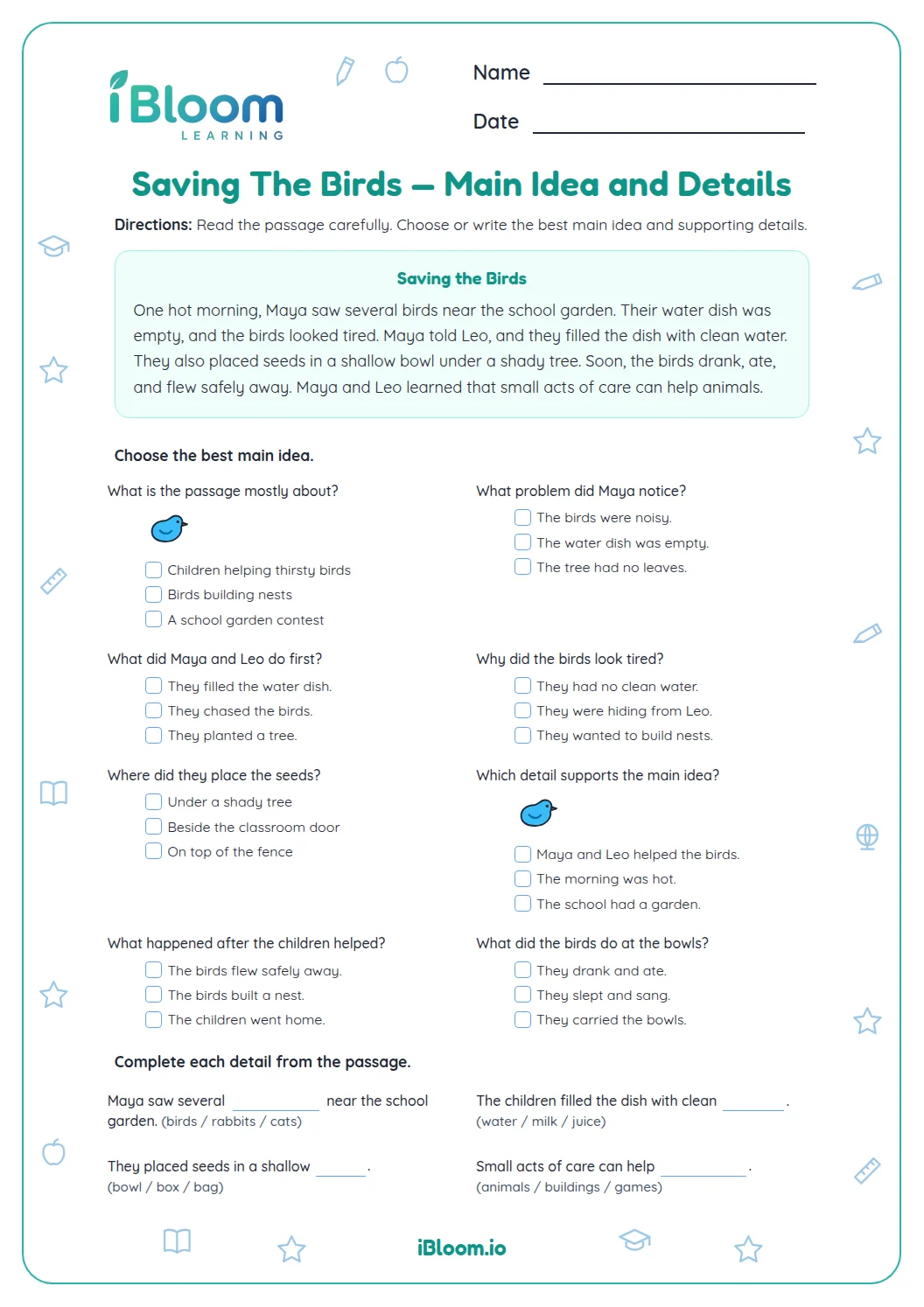
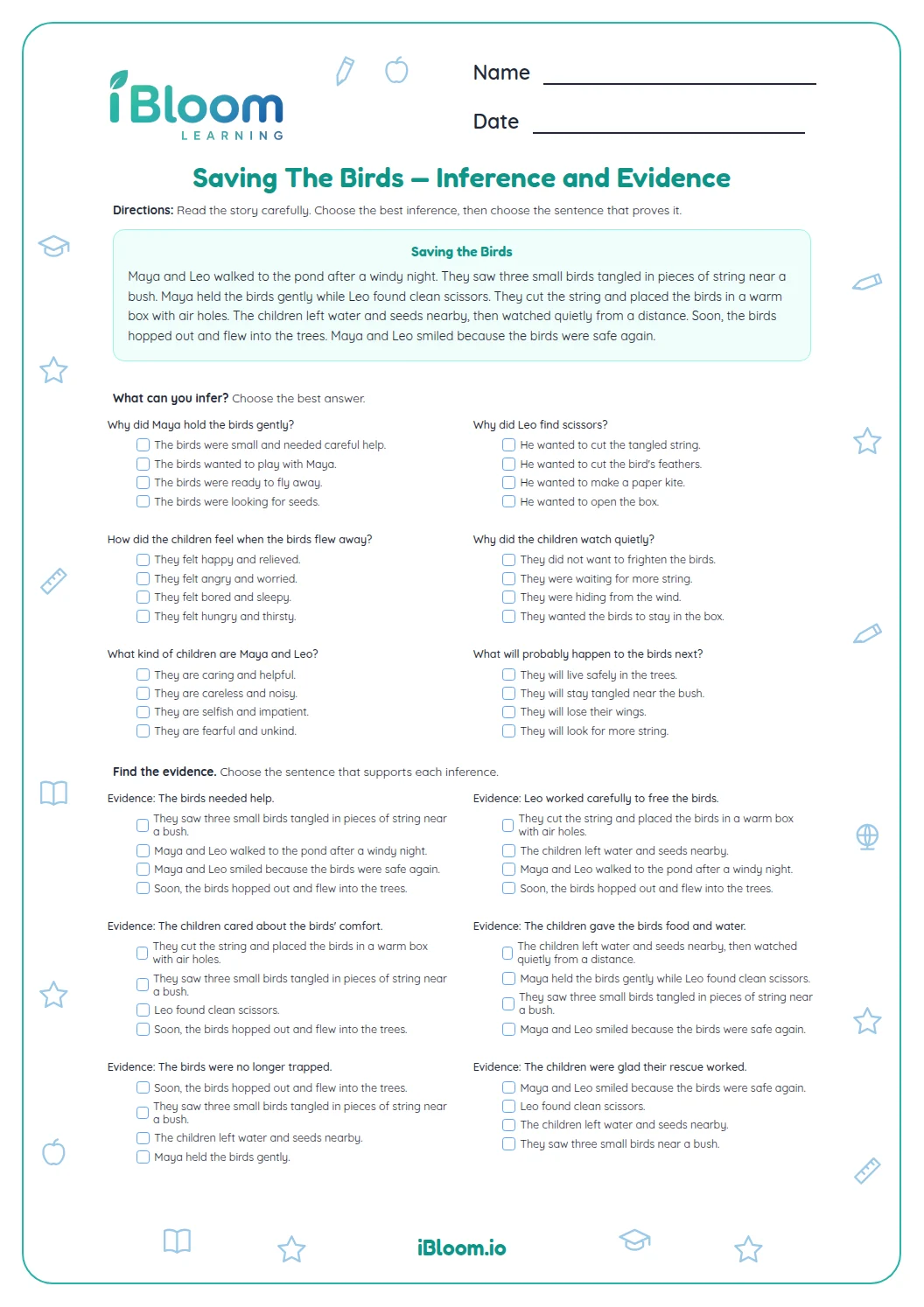
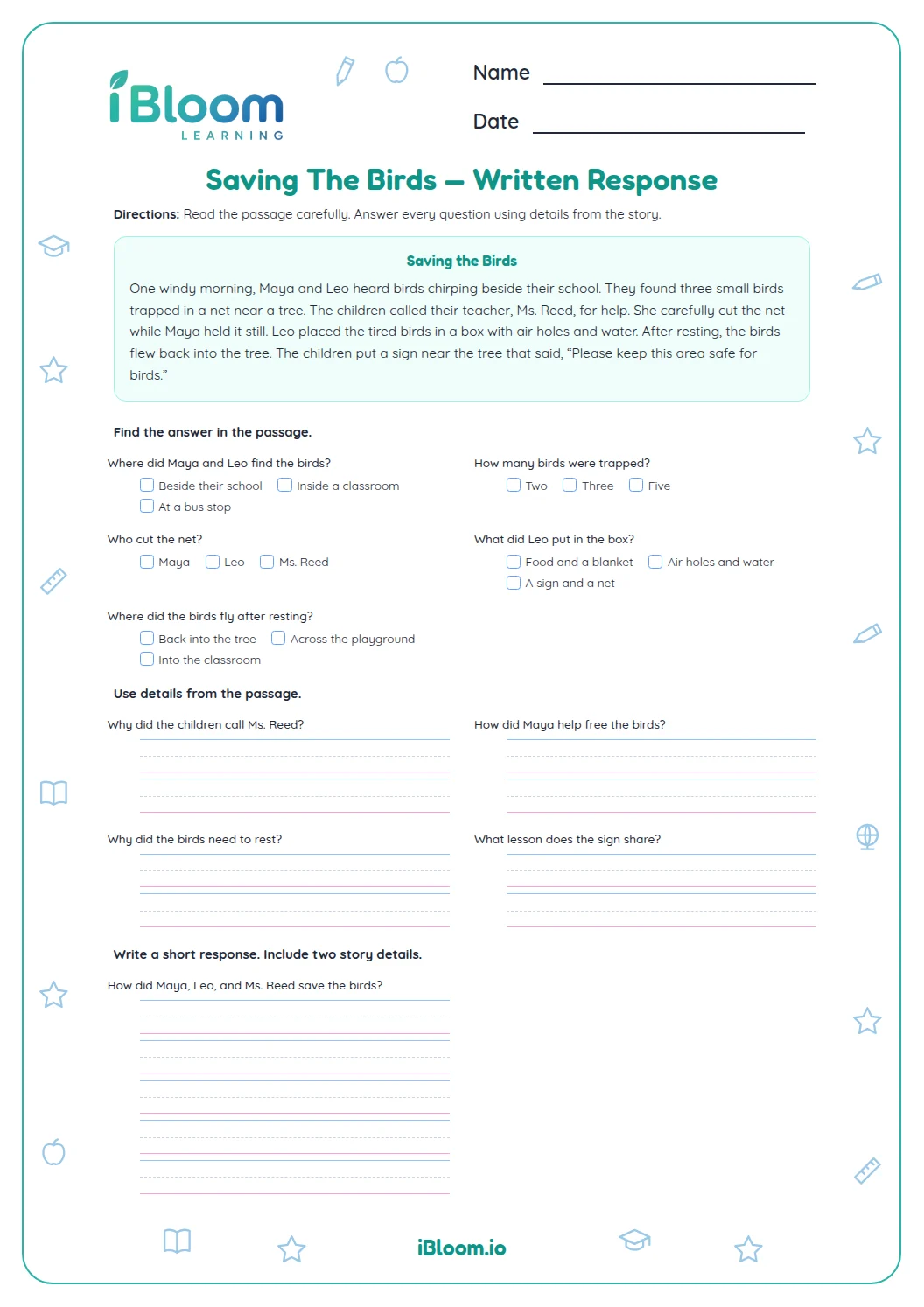
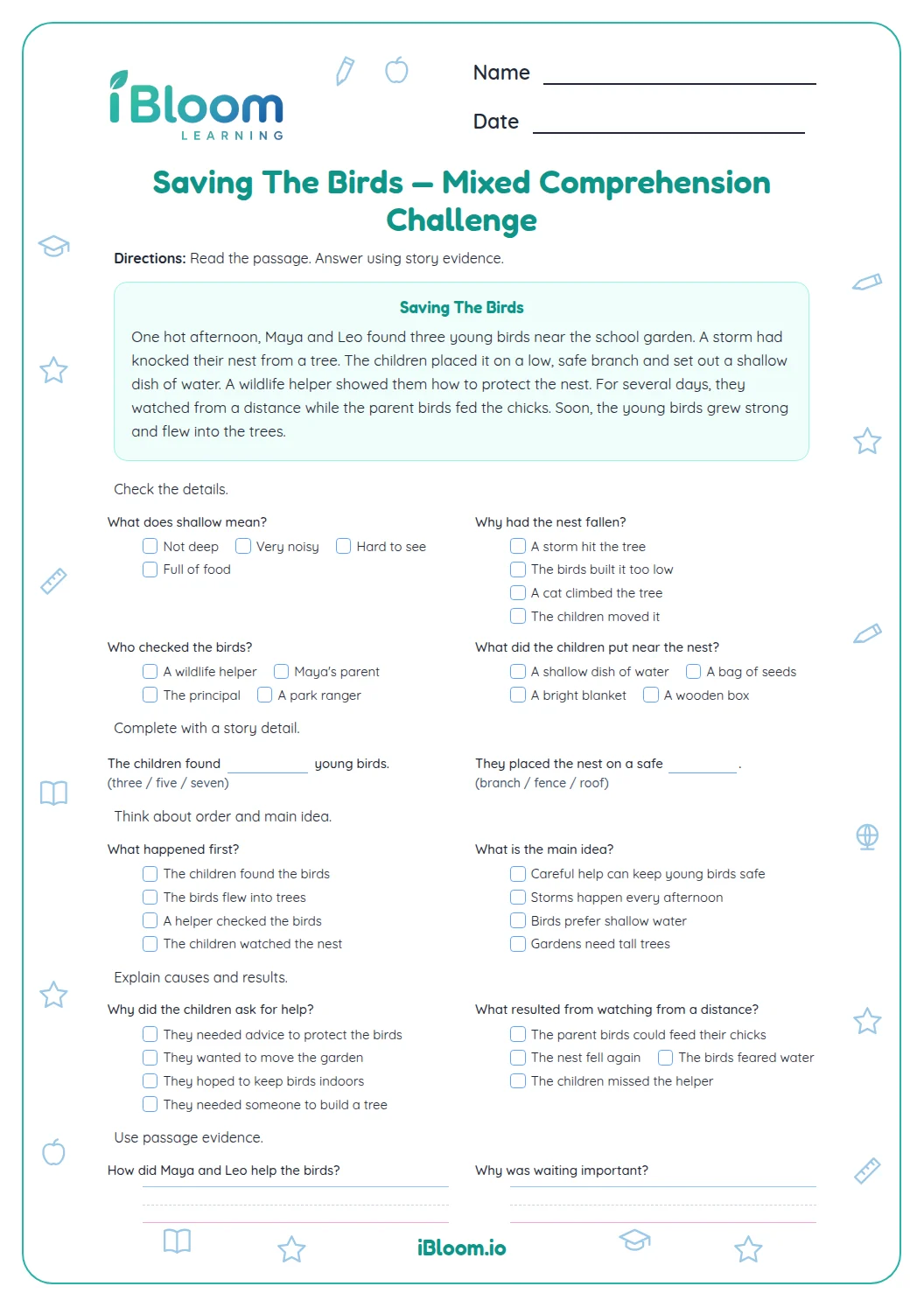
This free Grade 3 worksheet includes Saving the Birds, a story about Maya and her friends helping three chicks after their nest falls near the school garden. Part A is the passage. Part B has four short questions about the rescue. Part C asks children to number three events, and Part D connects the opening problem, the actions in the middle, and the successful ending. The sheet practices Common Core RL.3.3 by linking the characters’ goal and actions to the sequence of events. A separate answer key includes sample explanations.
Aligned to RL.3.3
How do readers follow the rescue in order?
Track what the children do with the chicks and the nest. First they put the chicks in a box; next they secure the nest to a low branch; then they return the chicks. The mother’s return comes at the end.
- 1The children place the birds back in the nest.
- 2Next, they watch quietly from far away.
- 3By sunset, the mother bird returns and feeds her chicks.
How do the beginning, middle, and ending fit together?
The beginning introduces a problem: three chicks are beside their fallen nest. The middle shows the children working together, with their teacher’s help, to restore a place for the chicks. The ending shows the mother returning to feed them.
Part D asks children to explain these connections. For question 9, a useful answer tells why securing the nest matters, rather than merely repeating that the children use string.
How should children number the three selected events?
Part C includes three events from the larger story. Maya finds the birds first, the children tie up the nest next, and the mother returns last. Write 2, 3, and 1 beside the events as printed.
Other actions happen between these events. Children are ordering the three selected moments relative to one another, not numbering every action in the passage.
How to use this worksheet
- 1Read the passage once to understand the fallen-nest problem.
- 2Reread and find first, next, then, and by sunset.
- 3Answer Part B with a short detail from the story.
- 4Number Part C’s three events in the order they happen.
- 5Explain how the middle and ending connect to the opening problem, then check the key.
Mistakes to notice and fix
The mistake
Putting the chicks back before the nest is secured.
The fix
Find the sentence beginning Next; the nest must be in place before the chicks return.
The mistake
Numbering events in their printed order.
The fix
Locate each event in the passage before writing 1, 2, or 3.
The mistake
Saying only that it is sunset when asked how the plan worked.
The fix
Name the result: the mother returns and feeds the chicks in their nest.
Common Core alignment
Connect the children’s wish to help with their rescue steps and the successful ending.
On this sheet: Students identify Maya’s motivation, order the rescue steps, and explain how the actions solve the problem.
Show the official wordingHide the official wording
Describe characters in a story (e.g., their traits, motivations, or feelings) and explain how their actions contribute to the sequence of events
What to practice next
Make more practice
Further reading
Questions parents and teachers ask
What is the correct order for Part C?
The answers down the page are 2, 3, and 1. Maya finds the birds first, the children tie the nest to a branch next, and the mother returns last. These are three selected events, so children should order them relative to one another.
Who helps Maya save the birds?
Leo, Ava, and Noah join Maya, and their teacher comes outside to help. The children work together to move the chicks, secure the nest, and return the birds. Ask your child to point out how these actions help solve the problem Maya notices.
How does the worksheet practice story structure?
Part D connects the opening problem, the rescue actions in the middle, and the result at the end. Children explain why tying up the nest helps and how the mother’s return shows success. These questions ask how events fit together rather than just what happens next.
Do written answers have to match the key exactly?
No, accurate short answers can use different words from the key. For question 9, “It makes a safe home for the chicks again” explains why securing the nest matters. Check that each response answers the question and agrees with the details in the passage.
Can children look back at the passage while answering?
Yes, keep the passage available throughout the questions. Ask children to find the sentence that proves an event happened before or after another one. Looking back also helps them separate what the story actually says from a guess about what the children might have done.