

About this worksheet
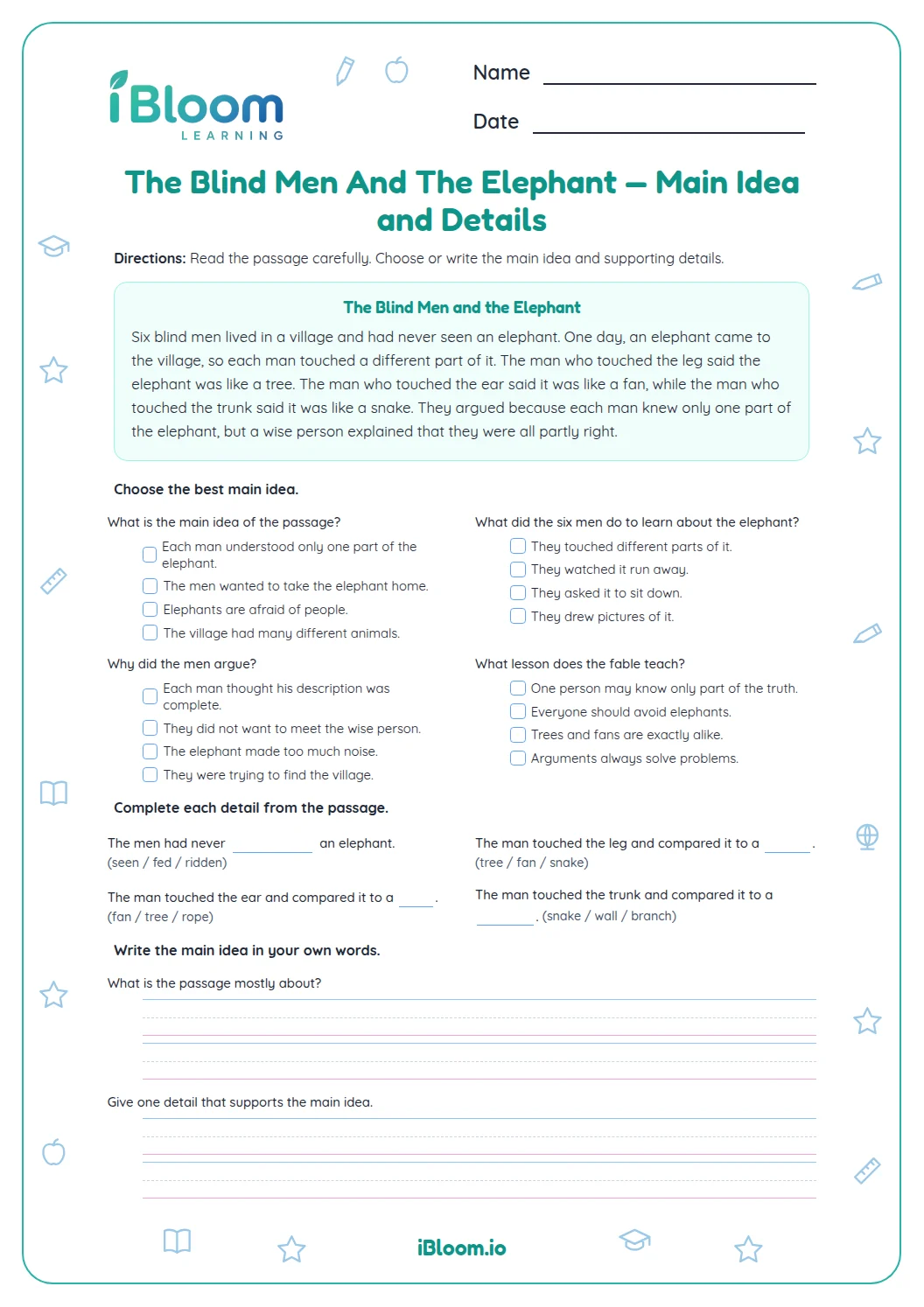
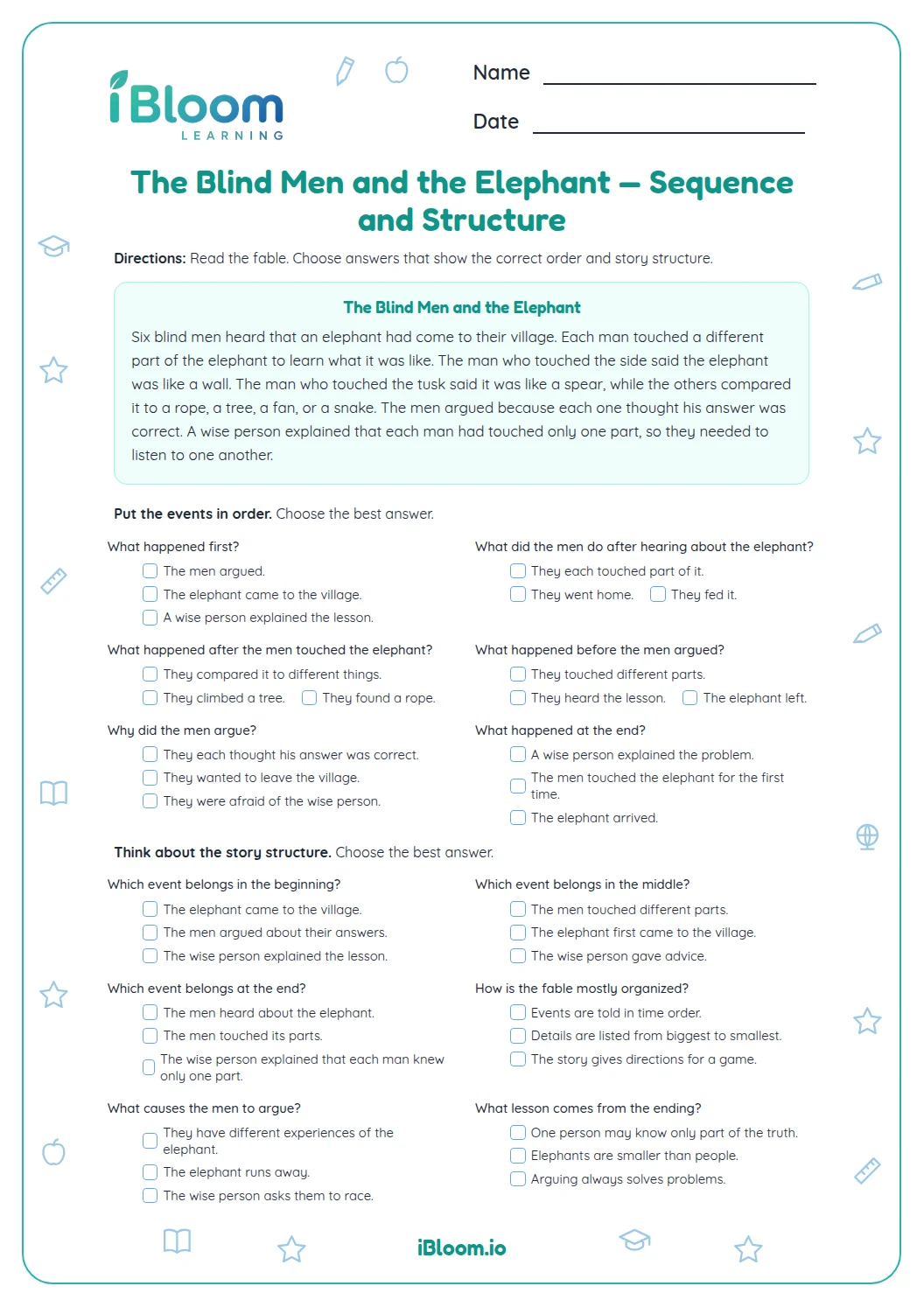
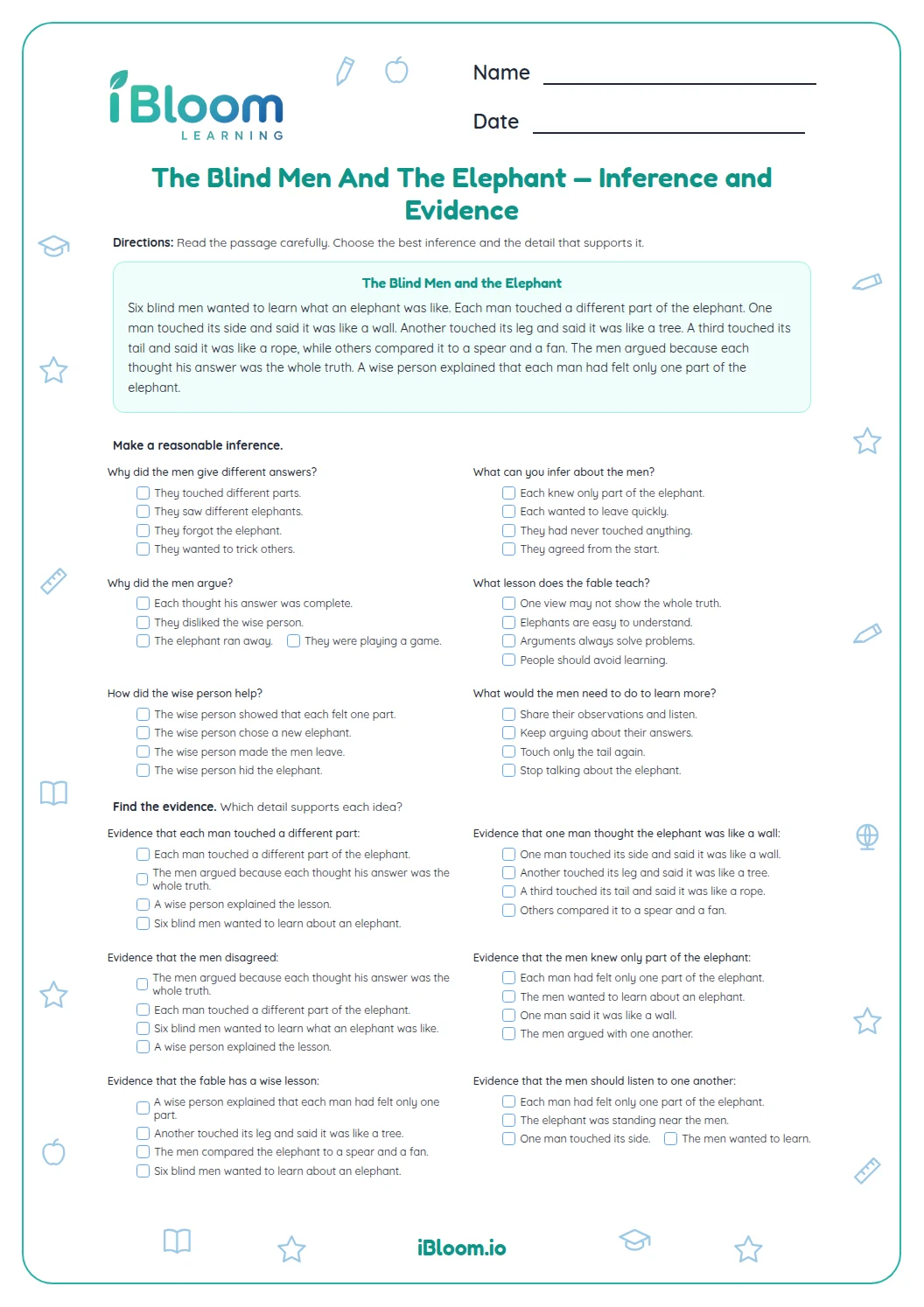
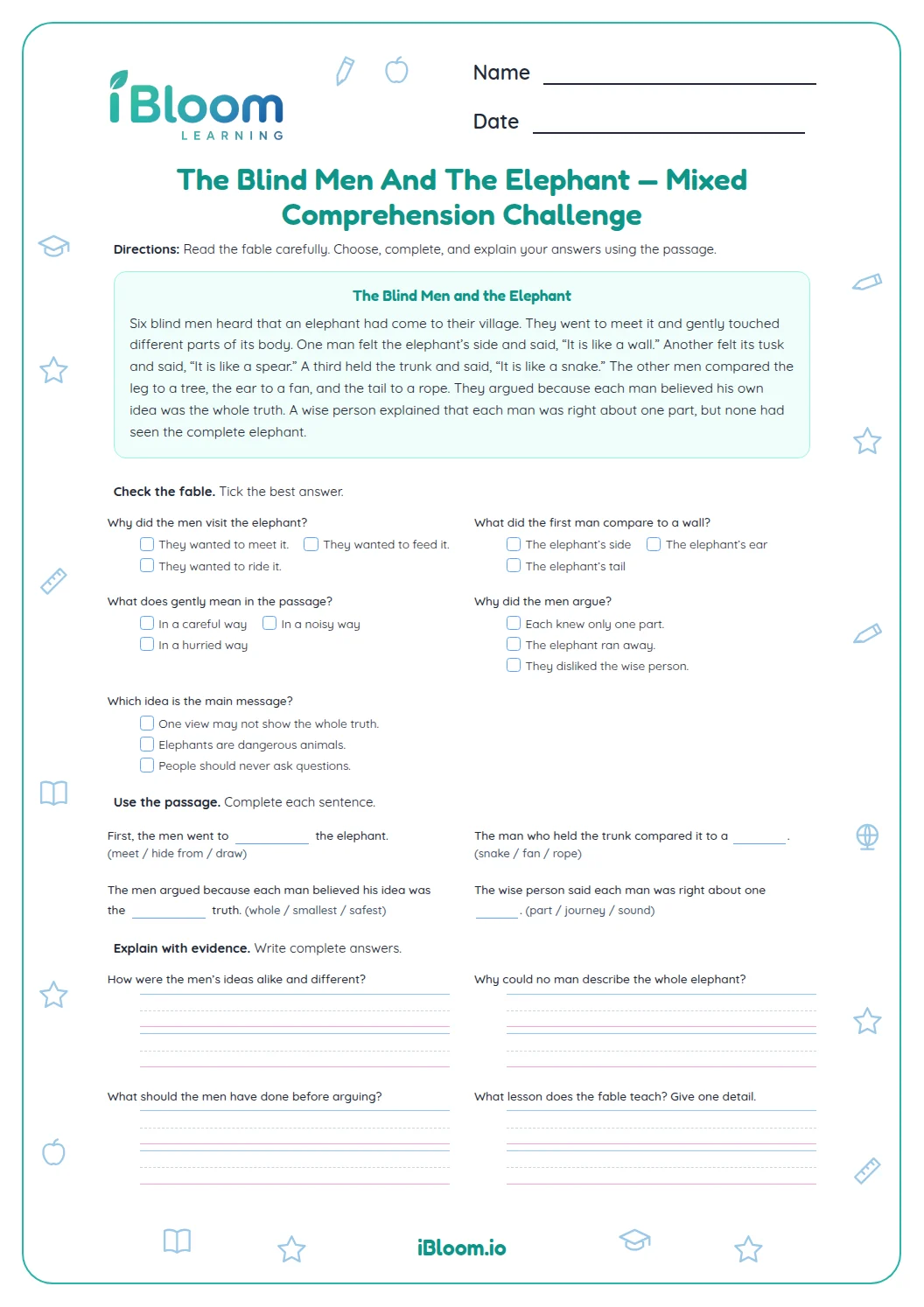
This free Grade 3 reading worksheet pairs an original retelling of The Blind Men and the Elephant with ten questions about its title and vocabulary. Children begin with the title questions in Part B, then read the passage in Part A and complete Parts C and D. Six men learn about different parts of an elephant and discover why they need to listen to one another. Six multiple-choice vocabulary questions and two written responses use details from the retelling. The vocabulary work supports Common Core L.3.4a: using sentence-level context to determine a word or phrase’s meaning. A separate key supplies answers and models.
Aligned to L.3.4a
What should children do before reading?
Begin with the title questions in Part B. The title names the men and the elephant, giving children a clear starting point for thinking about the encounter. The second question asks which question the title could help a reader investigate.
Then read Part A. Its passage appears first on the printable page, while the directions tell children to start with Part B. Covering the passage briefly is a simple way to keep the title study focused.
How do the comparisons explain new words?
The men use familiar objects to describe what they feel. A wall helps explain broad, and a tree helps explain sturdy. Read the comparison and the describing word together, then try a possible meaning in the sentence.
- 1Another wrapped his hands around a sturdy leg.
- 2“No, it is like a tree!”
- 3A tree comparison supports “strong and firm,” the meaning of sturdy here.
What should a written vocabulary answer include?
Part D asks children to explain why broad fits the wall comparison and what partly right means at the end. Each answer should connect the meaning to an event or description in the passage.
Accept different wording that preserves the idea. For partly right, a child might explain that each man accurately described one piece of the animal but needed the other descriptions to understand the whole.
How to use this worksheet
- 1Read the title and answer the two questions in Part B before reading the passage.
- 2Read Part A aloud or independently, pausing at the six comparisons.
- 3For each Part C word, reread the sentence that contains it.
- 4Try each meaning in that sentence and choose the one that fits.
- 5Write the two Part D explanations and compare their ideas with the sample key.
Mistakes to check and how to fix them
The mistake
Choosing a familiar meaning of trunk, such as a storage box.
The fix
Reread what the third man touches: the animal and snake comparison point to the elephant’s nose.
The mistake
Taking partly right to mean that every description was wrong.
The fix
Name one accurate detail each man learned about a single part.
The mistake
Defining a word without connecting it to the fable.
The fix
Add the comparison or action that helped explain the meaning.
Common Core alignment
Use the fable’s comparisons and actions to work out word meanings.
On this sheet: Parts C and D ask readers to infer and explain meanings using sentences from the retelling.
Show the official wordingHide the official wording
Use sentence-level context as a clue to the meaning of a word or phrase.
What to practice next
Make more practice
Further reading
Questions parents and teachers ask
Which part should my child complete first?
Complete Part B first by studying the title and answering its two questions. Then read the fable in Part A and finish the vocabulary work in Parts C and D. The directions name this order so children can think about the title before learning what happens in the retelling.
Which words does the vocabulary section practice?
The six multiple-choice questions practice broad, sturdy, trunk, argued, insisted, and partly. Children use the animal descriptions and the men’s actions to choose meanings. The final two written questions return to broad and partly right, asking children to explain those meanings with a connection to the fable.
Does this worksheet include the story?
Yes, the passage is printed as Part A, so children can return to the exact sentences while answering. This original retelling keeps six blind men, their different impressions of an elephant, and a wise traveler who encourages them to share what they learned. The ending emphasizes listening to other people.
Can I read the fable aloud to my child?
Yes, reading aloud can help the child attend to the vocabulary and comparisons. Pause after each man’s description and ask what the comparison tells us about that part of the elephant. Let the child choose answers and point back to words that support a meaning before you check the key.
How should I score the two written responses?
Accept an explanation that gives the intended meaning and connects it to the retelling. For broad, the child should connect width with the wall comparison. For partly right, the child should explain that each man understood one part. The sample answers on the key demonstrate these ideas in concise sentences.