

About this worksheet
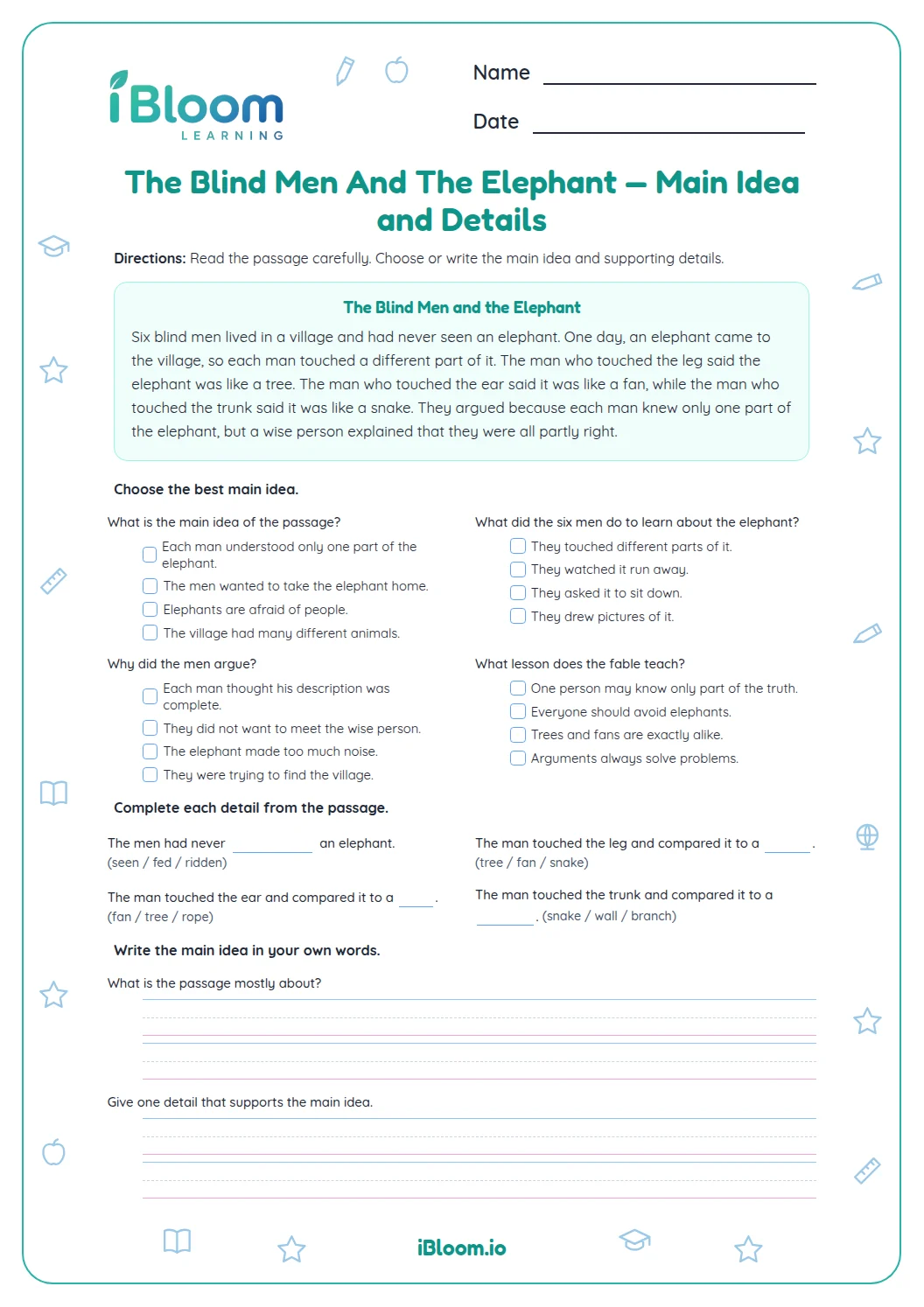
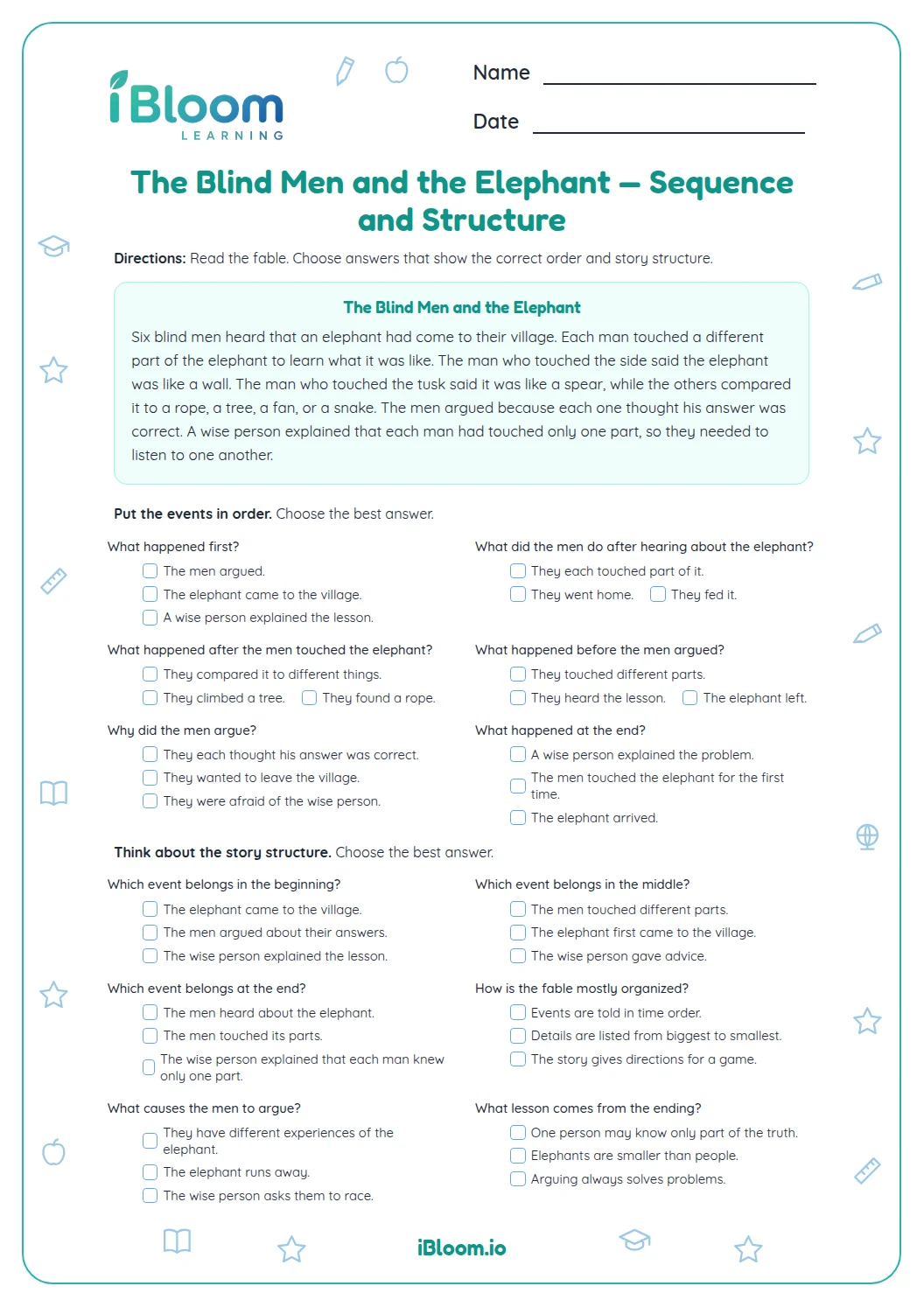
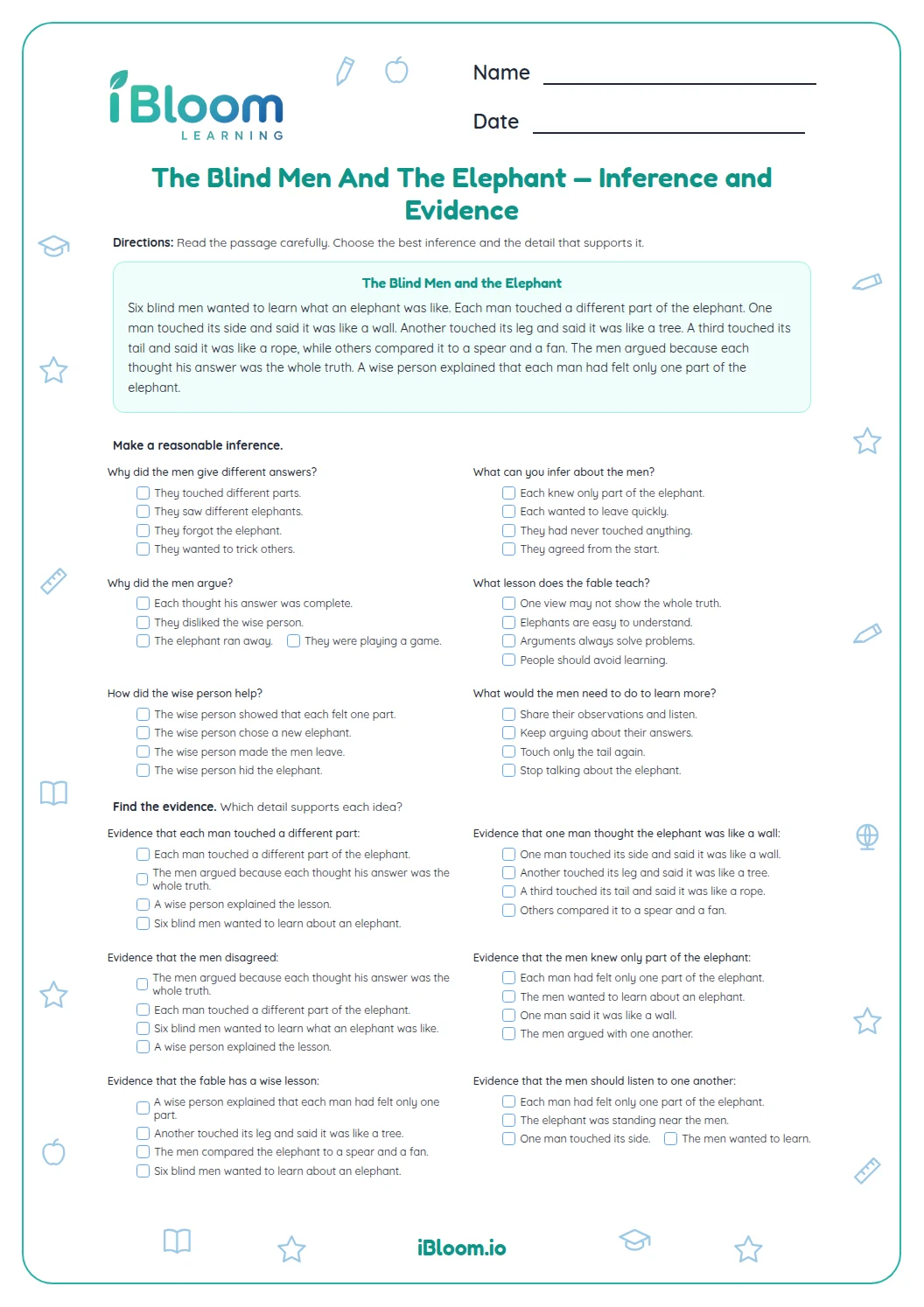
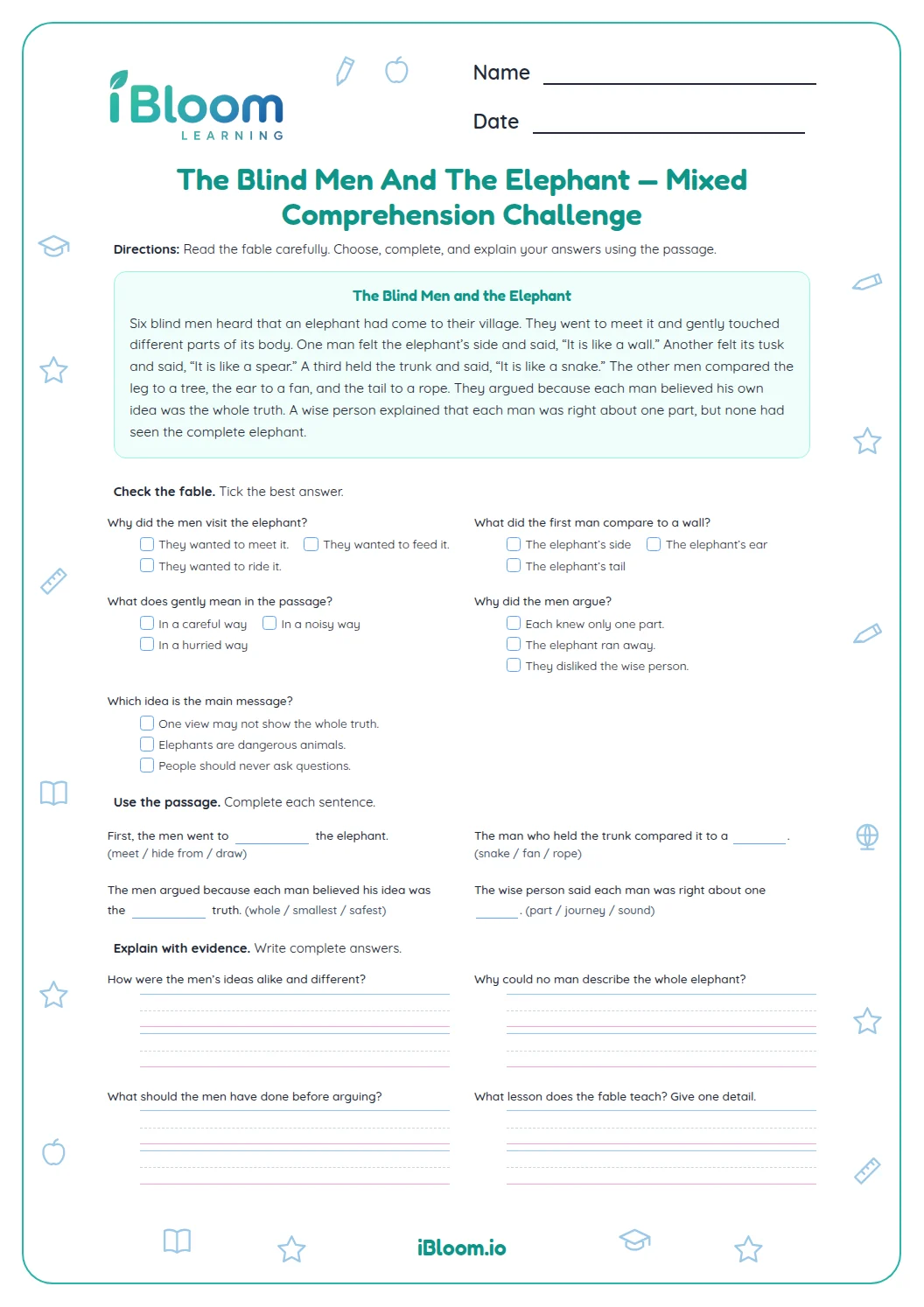
This Grade 3 reading worksheet pairs an original, concise retelling of The Blind Men and the Elephant with 14 comprehension questions. Students recall details, connect each man’s touch to his comparison, put events in order, and explain the fable’s lesson in their own words. The practice supports CCSS RL.3.1 and RL.3.2 by asking readers to answer with text details and explain a story’s central message. A separate answer key offers sample responses for open questions.
Aligned to RL.3.1 and RL.3.2
What happens in the fable?
Six men touch different parts of an elephant and make different comparisons: wall, spear, snake, tree, fan, and rope. Their individual observations are partial, so none describes the entire animal.
- 1Question 3 checks a precise detail: the second man touches a tusk and calls it a spear.
How do details support the lesson?
The men’s comparisons show why their views differ. The traveler asks them to share what each felt; the men then stop arguing and listen. Those events support the lesson about hearing more than one point of view.
How should students answer the written responses?
A strong response answers the question and names a story detail. For question 11, a student can say yes and point to the man who felt the broad side and compared it to a wall.
How to use this worksheet
- 1Read the fable once for the events.
- 2Reread the part named in a question.
- 3Answer recall questions with a story detail.
- 4For the lesson, explain what the men learn.
- 5Use a complete sentence for written responses.
Common mistakes and quick fixes
The mistake
Naming only one comparison as the whole elephant.
The fix
Recall that each man touched a different part; use several details to explain the disagreement.
The mistake
Giving a lesson that the story does not show.
The fix
Connect the lesson to the men sharing discoveries and then listening.
The mistake
Writing an opinion without evidence.
The fix
Add a concrete detail, such as the side feeling like a wall or the ear like a fan.
Common Core alignment
This page gives focused practice with the skills named in these standards.
Answer questions with details stated in the fable.
On this sheet: Parts B and C ask readers to locate and explain details from the fable.
Show the official wordingHide the official wording
Ask and answer questions to demonstrate understanding of a text, referring explicitly to the text as the basis for the answers.
Retell the fable and explain its lesson using key details.
On this sheet: Part C asks for the fable’s lesson and the details that teach it.
Show the official wordingHide the official wording
Recount stories, including fables, folktales, and myths from diverse cultures; determine the central message, lesson, or moral and explain how it is conveyed through key details in the text.
What to practice next
Make more practice
Further reading
Questions parents and teachers ask
What lesson does this version of the fable teach?
The men learn that each person may know only part of a larger truth. Each man touches a different part of the elephant; when they share what they discovered, they can listen and understand more.
What should a written answer include?
Use a complete thought and a detail from the fable. For example, to support the lesson, a student can explain that each man touched one part and that sharing helped them understand the whole elephant.
How many questions follow the passage?
There are 14 questions in three parts. They check details and comparisons, ask what the men do after arguing, and finish with the fable’s lesson and a written response supported by a detail.
What does the answer key provide for the written response?
It gives a sample response: each man touched one part, so the men shared discoveries to understand the elephant. Other answers can work if they use an accurate story detail that supports the lesson.
Why do the men describe the elephant differently?
Each man touches a different part and uses that limited experience to describe the animal. The side feels like a wall, while the tail feels like a rope. Once they share what they noticed, they see how their descriptions fit together.