

About this worksheet
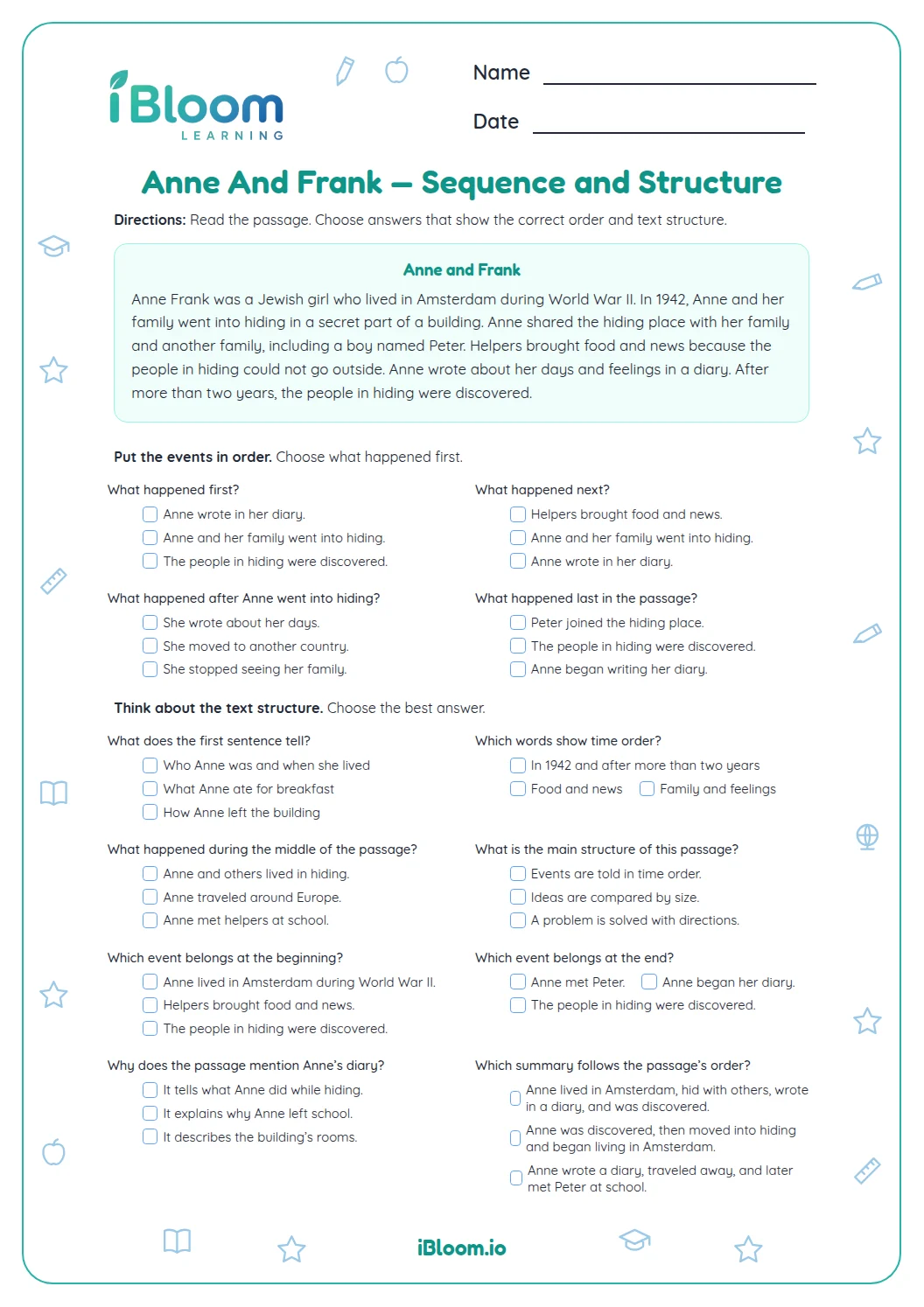
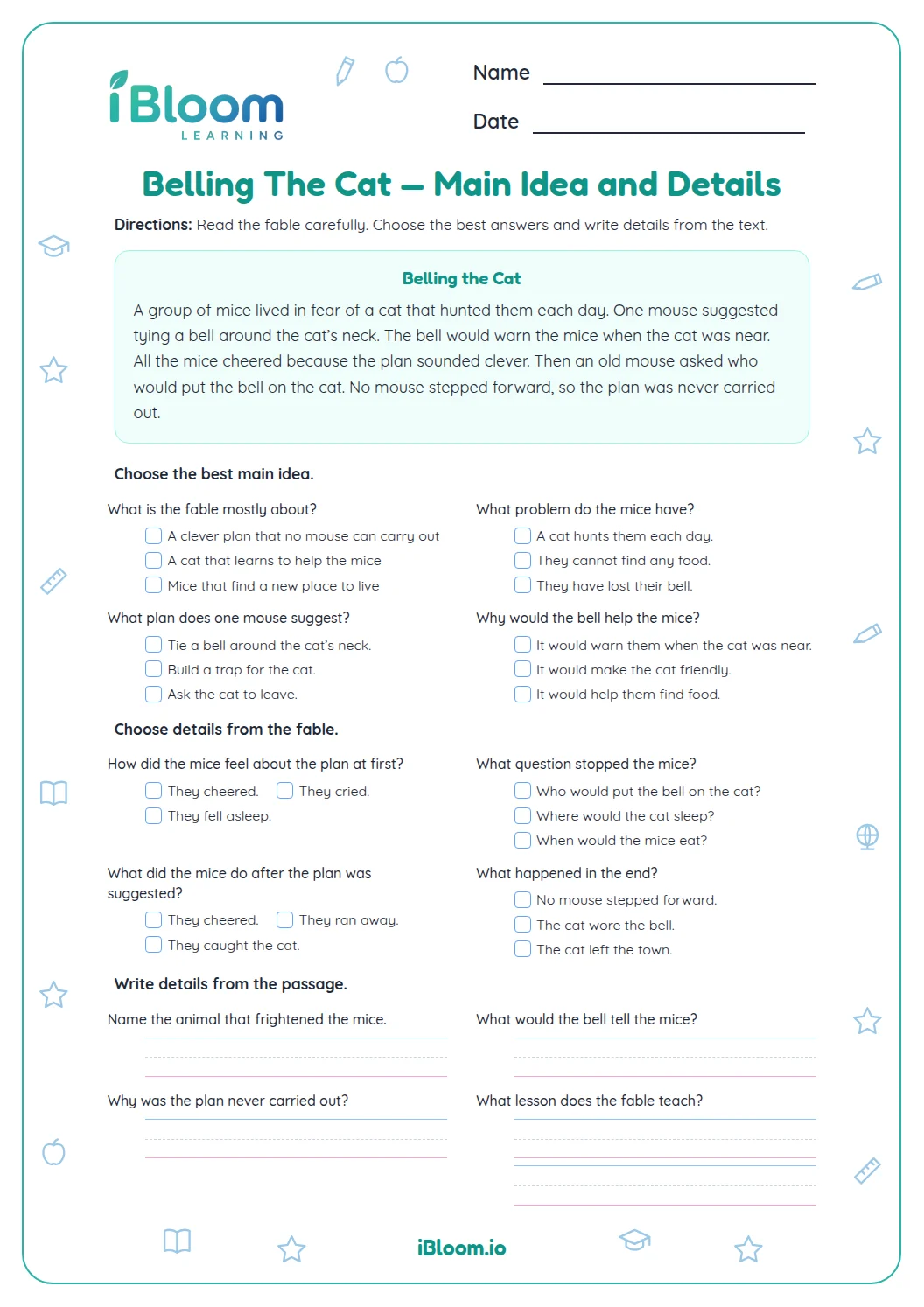
This free Grade 3 worksheet pairs a passage about Anne Frank and her diary with 15 questions on main idea and supporting details. Children identify what the whole passage explains, locate facts about Anne’s life and writing, and connect details to the main idea. It aligns with CCSS RI.3.1 and RI.3.2. The passage and questions fit three worksheet pages, with an answer key.
Aligned to RI.3.1 and RI.3.2
What is a main idea?
A main idea tells what a whole passage is mostly about. It is broader than one fact. In this passage, a strong main idea includes Anne’s diary and the way it helps readers understand her experience, rather than only the diary’s name.
How do details support the main idea?
Details give specific information that builds the larger idea. Readers can test a possible main idea by asking whether several important facts connect to it.
- 1Possible idea: Anne wrote about her life while hiding.
- 2She wrote about thoughts, hopes, and daily experiences.
- 3She called the diary Kitty and hoped to be a writer.
- 4Those details fit the main idea about her writing.
What will students practice on this sheet?
The questions begin with the whole-passage idea, then return to facts and details. Students revisit one passage to connect specific information with what it is mostly about.
- 6 multiple-choice questions
- 9 short answers that locate passage information
- Questions about Anne, her diary, and its importance
How to use this worksheet
- 1Read the passage to learn who Anne is and why the family hid.
- 2Ask what the whole passage is mostly about.
- 3Check whether that idea fits the beginning, middle, and ending.
- 4Find exact details about Anne’s diary and hopes.
- 5Answer each short question with a passage detail.
- 6Check that each answer matches the text and key.
Common mistakes and quick fixes
The mistake
Choosing one fact as the main idea.
The fix
Ask whether it describes the whole passage or only one part.
The mistake
Picking an idea that fits one paragraph but not the whole text.
The fix
Test it against details from the beginning and ending.
The mistake
Listing a detail without connecting it to the main idea.
The fix
Explain how that fact helps show what the passage is mostly about.
Common Core alignment
This worksheet gives children focused practice with the stated grade-level skill.
Answer from the passage and point to details that support each answer.
On this sheet: Questions ask readers to refer to passage details in their answers.
Show the official wordingHide the official wording
Ask and answer questions to demonstrate understanding of a text, referring explicitly to the text as the basis for the answers.
Identify the passage’s main idea and explain how key facts support it.
On this sheet: Readers identify the passage’s main idea and connect details to it.
Show the official wordingHide the official wording
Determine the main idea of a text; recount the key details and explain how they support the main idea.
What to practice next
Questions parents and teachers ask
What is the main idea of the Anne Frank passage?
The passage is mainly about Anne writing in her diary while her family was in hiding and how her words later helped readers learn about her experience. Details about Kitty, her hopes, and daily writing support that idea. It applies to the whole selection rather than only one fact.
How many details should a child use in a written answer?
Follow the wording of the question. If it asks for one detail, give one clear fact from the passage; if it asks for two, name two separate facts. The short-answer items on this sheet each ask for a specific fact or idea.
What was Anne’s diary called?
Anne called her diary Kitty. The passage also explains that she wrote about her thoughts, hopes, and daily experiences while her family was in hiding. The passage also names the diary Kitty. The name Kitty is a detail readers can locate and check in the text.
Why is Anne’s diary important in the passage?
The passage says her words helped readers learn about the experience of a Jewish girl living through World War II. Her diary includes both the fear of hiding and hopes for the future. Readers can cite the final paragraph as evidence.
Is an answer key included?
Yes. The separate key lists the main idea and details for all 15 questions. Short responses may use different wording when they name the same fact or express the same idea supported by the passage. Each response should match a printed passage detail.