

About this worksheet
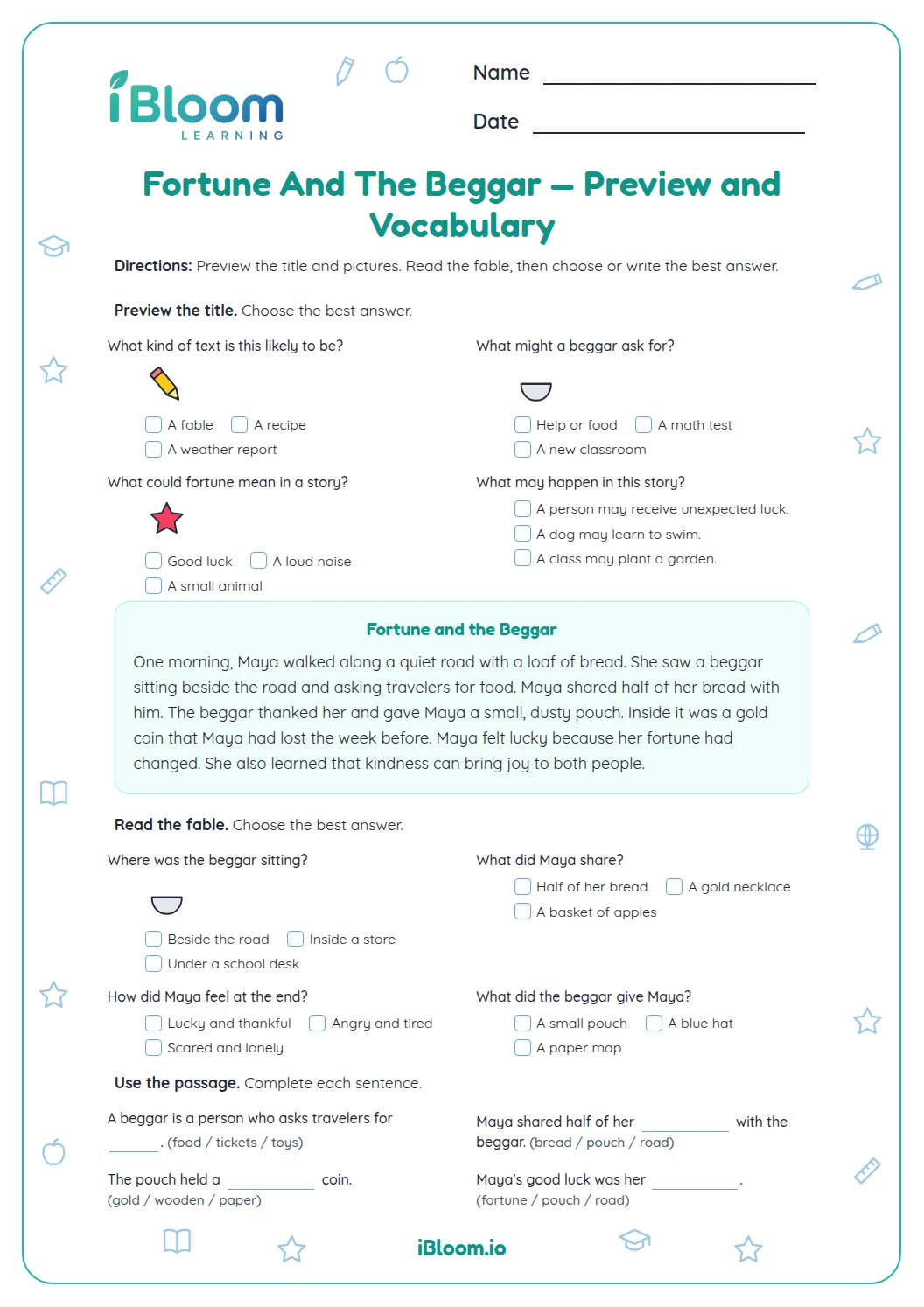
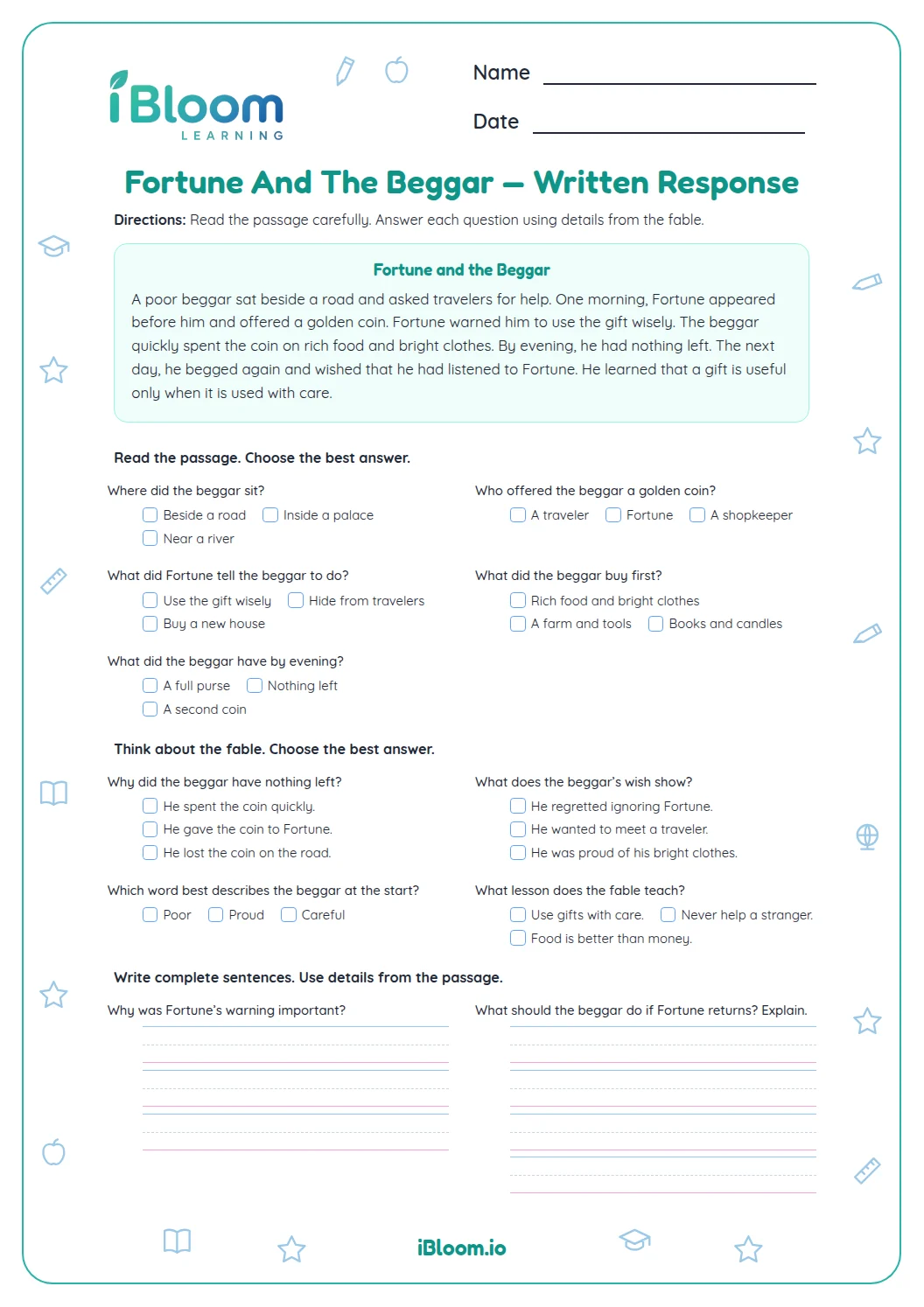
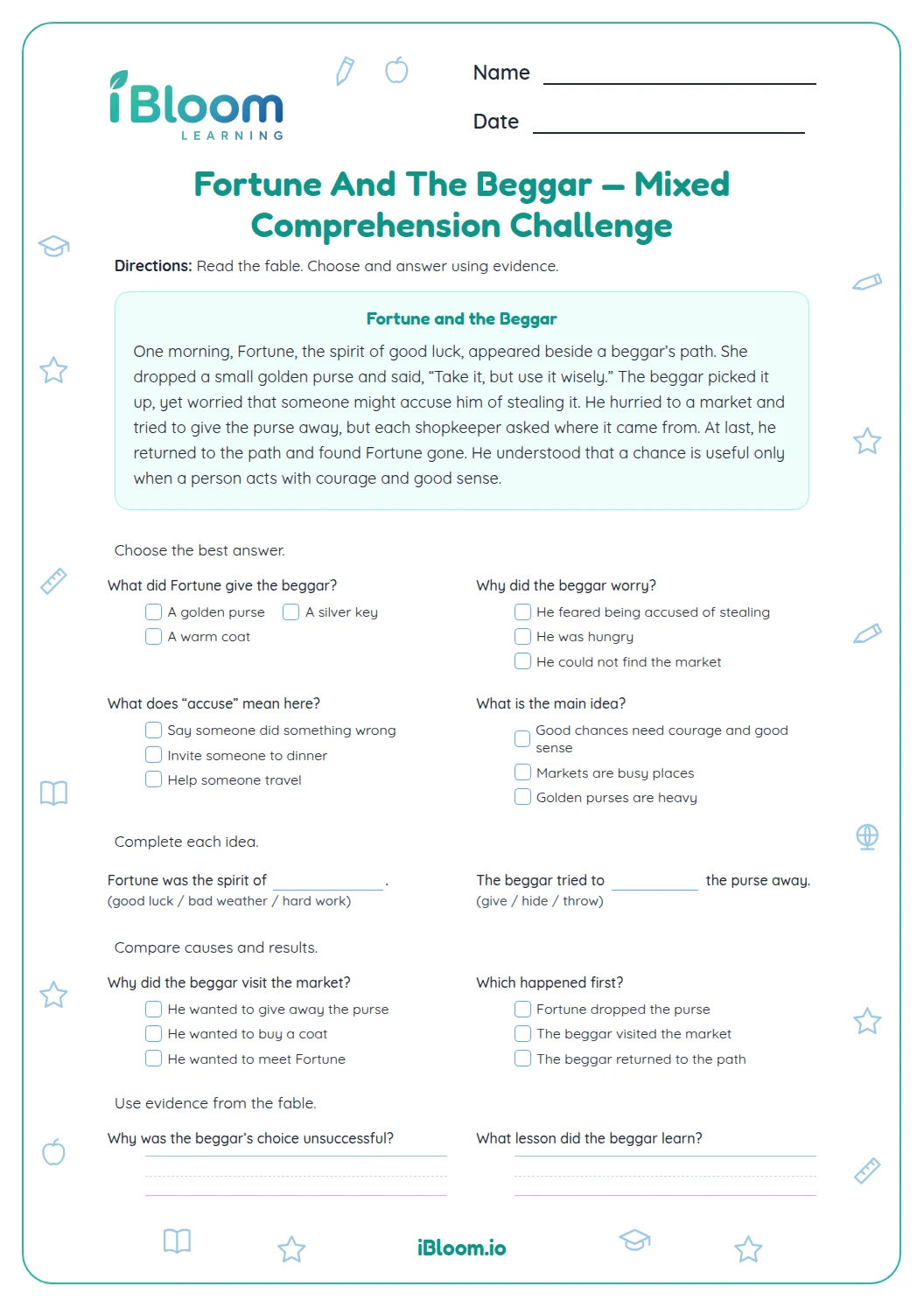
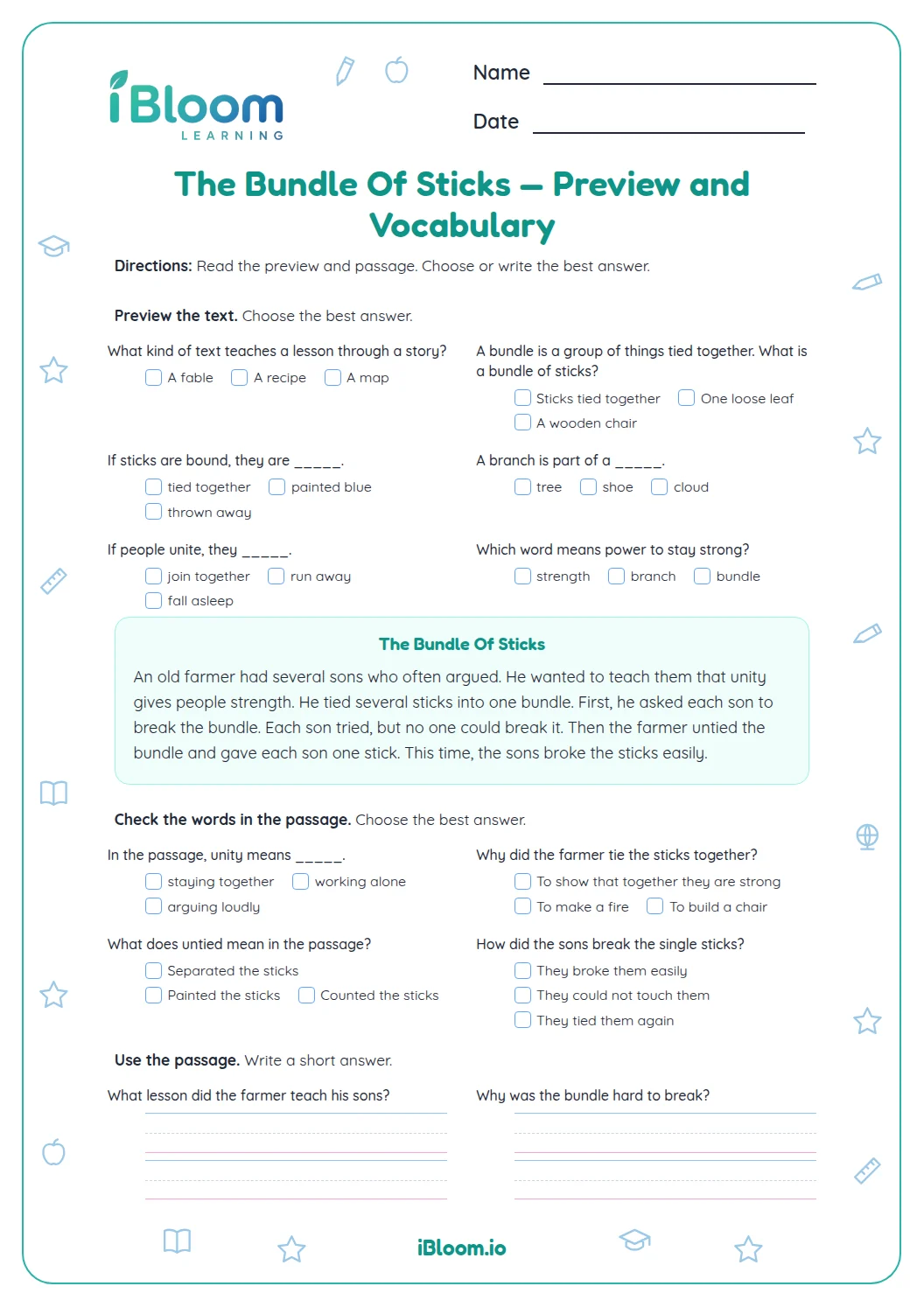
This free Grade 3 reading worksheet pairs an original retelling of Fortune and the Beggar with fourteen comprehension questions. Fortune gives the beggar a coin to share. He helps a hungry child, whose grateful family later sends him food. Children identify the main idea and explain the lesson through those connected acts of kindness. Part A contains the passage, Part B has thirteen choices, and Part C has one written evidence response, and Part D connects an ending detail to the lesson. The work practices Common Core RL.3.2 and RL.3.1. A separate key includes sample written answers.
Aligned to RL.3.2 and RL.3.1
What is the difference between the main idea and the lesson?
The main idea connects the important events: the beggar helps a hungry child, and the child’s family later helps him. The lesson applies beyond this story: one kind act can encourage another.
Ask children to connect the gift of the coin with the return of the food. The road tells where the story happens, but those two gifts explain its message.
Which details support the lesson?
Question 13 asks for two details that show kindness being passed on. The beggar gives away his only coin, and the grateful family sends him food. Together, these actions show both giving and receiving help.
- 1Detail 1: The beggar gives his coin to the hungry child.
- 2Detail 2: The child’s family sends the beggar food.
- 3Connection: One act of kindness leads to another.
How can children find evidence without copying the whole passage?
Reread the beggar’s decision in the second paragraph and the family’s response in the last paragraph. Children can name each action in their own words instead of copying a whole paragraph.
Part B asks about key details, the main idea and the lesson. Part C asks for two supporting details, and Part D connects the ending to the lesson.
How to use this worksheet
- 1Read Part A once for the whole story.
- 2Reread Fortune’s request and the beggar’s decision.
- 3Answer the thirteen choices in Part B, pointing to evidence.
- 4Connect the gift of the coin with the return of the food.
- 5Write two supporting details in Part C, then choose the ending detail in Part D.
- 6Compare the written responses with the sample answers.
Mistakes to notice and fix
The mistake
Naming only “a gold coin” as the main idea.
The fix
Explain what the beggar does with it and how the family responds.
The mistake
Using the road as the best evidence of kindness.
The fix
Choose an action that helps someone, such as giving the coin or sending food.
The mistake
Saying the beggar gives the coin because he expects a reward.
The fix
Reread the last paragraph: he gives without expecting anything in return.
Common Core alignment
Explain the lesson about kindness using the beggar’s gift and the family’s response.
On this sheet: Children connect two acts of kindness to the fable’s central message.
Show the official wordingHide the official wording
Recount stories, including fables, folktales, and myths from diverse cultures; determine the central message, lesson, or moral and explain how it is conveyed through key details in the text.
Answer questions by returning to specific details in the fable.
On this sheet: Children answer questions and cite details about Fortune’s request, the gift and the food.
Show the official wordingHide the official wording
Ask and answer questions to demonstrate understanding of a text, referring explicitly to the text as the basis for the answers.
What to practice next
Make more practice
Further reading
Questions parents and teachers ask
Which version of Fortune and the Beggar is on this sheet?
This version follows Fortune’s gift of a coin, the beggar’s help for a hungry child and the grateful family’s return gift of food. The complete passage is printed in Part A. Children use this version’s events to answer all fourteen questions about the main idea, details and lesson.
What should the main-idea choice include?
It should connect the beggar’s kindness with the kindness he receives. “Kindness is returned” summarizes the two gifts that shape the story. Ask your child to explain who gives each gift and how the second action follows from the first, using details from the passage.
Which two details support the lesson about kindness?
The beggar gives his only coin to the hungry child, and the child’s family sends him food. These details show help passing from one person to another. In question 13, children should name both actions; their sentences can differ from the model in the key.
Does the story say that every kind act earns a reward?
No. The beggar helps without expecting anything back, and the family chooses to thank him. The lesson is that kindness can encourage more kindness. Keep the explanation tied to those choices rather than promising children that helping someone will always bring them a gift.
How can I help with the written questions?
Ask your child to explain the answer aloud before writing. For question 13, ask who helps whom and what each person gives. For question 14, ask how the family’s response connects to the lesson. Accept wording that differs from the key when the details and explanation agree with the passage.