

About this worksheet
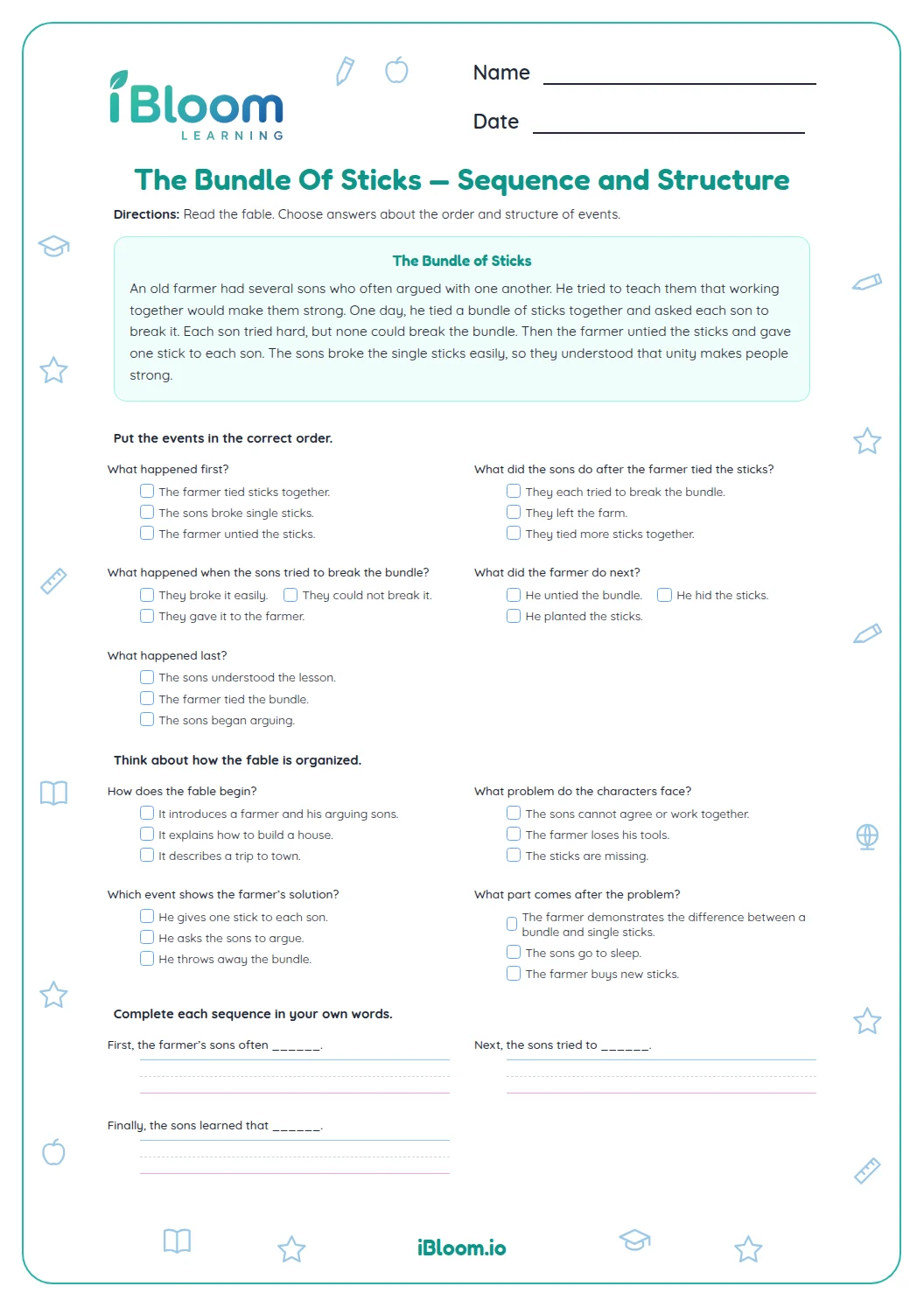
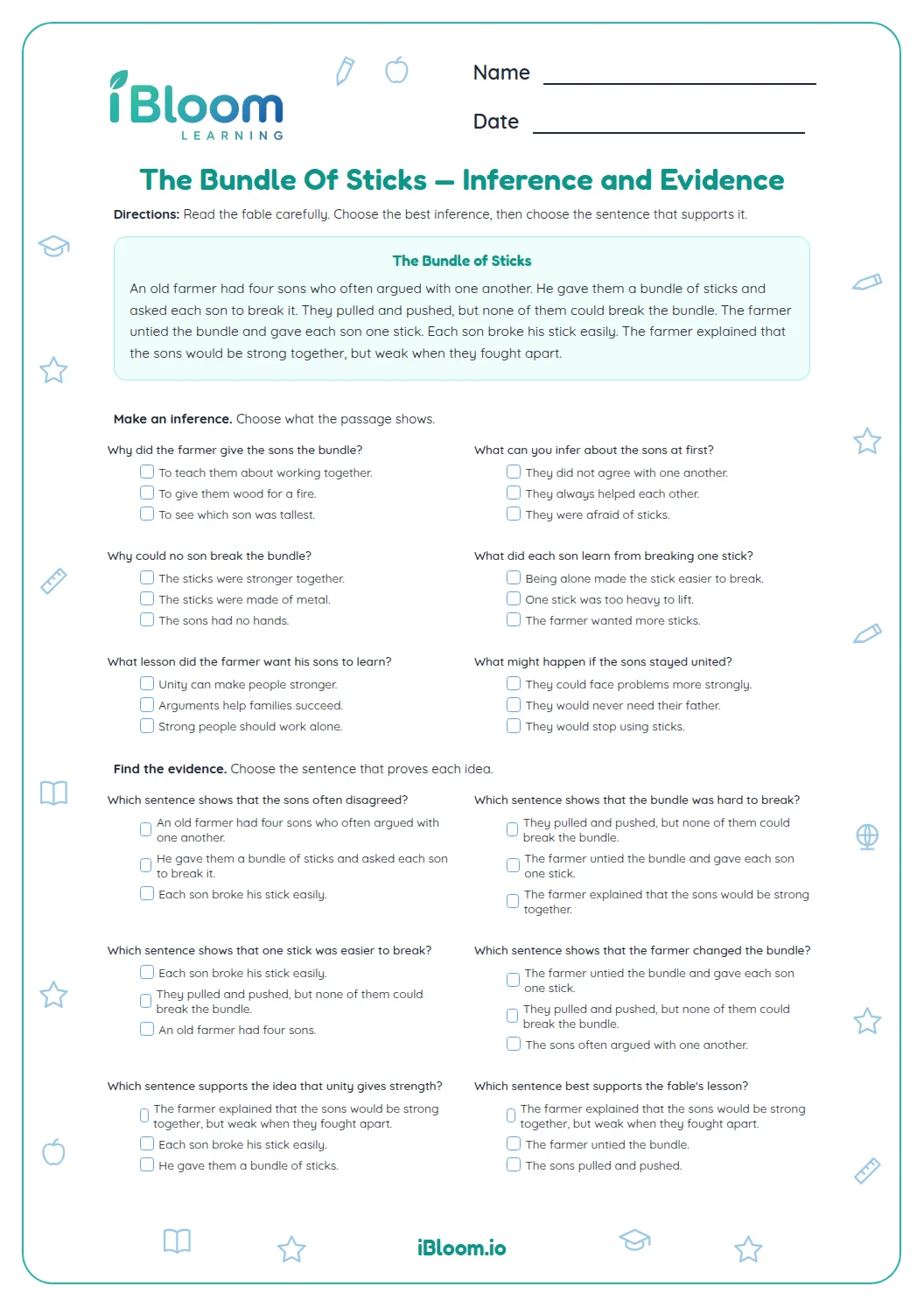
This free Grade 3 worksheet follows a beggar who carries too much gold after Fortune warns him to take only what he can safely carry. Part A is a three-paragraph fable. Part B has six time-word choices for retelling the events. Part C has eight multiple-choice questions about story parts, order, feelings, and how the beggar’s decision leads to the ending. The fourteen questions practice Common Core RL.3.3, linking a character’s actions to later events. A separate key gives every time word and marks the correct choices.
Aligned to RL.3.3
How do the three paragraphs organize the fable?
The first paragraph introduces the beggar’s need, Fortune’s offer, and her warning. The second shows his choice to take the heavy bag and the loss at the bridge. The third shows the result: he returns empty-handed and regrets his decision.
How do the time words help retell the events?
Read the six Part B sentences as one retelling. First introduces the opening event; next, then, after that, and later carry the events forward; finally introduces the last event. Choose from the pair supplied for each event.
- 1He asks for help. (First / Finally)
- 2Asking travelers for help is the opening event.
- 3Answer: First.
How can children explain the ending?
Connect the beggar’s decision to its result. He wants all the gold, so he carries a heavy bag. It slips into the river, leaving him with nothing. The final paragraph shows him reflecting on that choice and the lesson he learned.
How to use this worksheet
- 1Read the fable once, then name the main event in each paragraph.
- 2Read the six Part B events in order and write their time words.
- 3Answer the eight Part C questions using the passage to check the beginning, middle, and ending.
- 4Use details about the bridge and the final paragraph to explain the loss and the beggar’s reflection.
- 5Check with the key and explain why each selected answer fits the fable.
Mistakes to notice and fix
The mistake
Choosing Finally for Fortune’s offer.
The fix
The offer comes near the beginning; the return with empty hands comes last.
The mistake
Saying Fortune takes the gold back.
The fix
Reread the bridge scene: the heavy bag slips from the beggar’s grip.
The mistake
Choosing “Hurry even faster” as a way to avoid the loss.
The fix
Fortune warns him about how much he can carry safely. Taking a lighter load follows her advice.
Common Core alignment
Explain how a character’s choices lead to later events.
On this sheet: Children order events and explain how the main character’s actions shape the middle and ending.
Show the official wordingHide the official wording
Describe characters in a story (e.g., their traits, motivations, or feelings) and explain how their actions contribute to the sequence of events.
What to practice next
Make more practice
Further reading
Questions parents and teachers ask
What does this Fortune and the Beggar: Sequence and Structure (Grade 3) worksheet practice?
It pairs focused reading comprehension practice with a short story written for this page. Children can reread the passage, point to a detail, and use that detail to support each answer in their own words. The questions move from direct details to explaining ideas.
Can a student use the passage while answering?
Yes. The passage stays available on the worksheet, so students can return to it as they work. Rereading a sentence or paragraph can help them check a detail before choosing an answer or explaining an idea. They can underline a clue before responding.
What is included in the answer key?
The key gives an answer for every question. For responses that can be phrased in different ways, it provides a sample; students may use other wording when it is accurate and supported by the passage. An adult can accept another clear answer with evidence.
How can an adult use the written responses?
Ask the student to point to the sentence or event that supports the response. A short oral explanation can help them connect the evidence to the idea before they write or select their final answer. This makes the reasoning visible without requiring a long response.
How long should the worksheet take?
Plan for about 20 minutes, with extra time if the student rereads the story or discusses an answer. The pace depends on reading fluency and how much explanation each response needs. Students can complete the questions independently or talk through selected items with an adult.