

About this worksheet
This Grade 3 reading worksheet pairs an original informational passage about Anne Frank with vocabulary and comprehension questions. Students use nearby text to interpret words such as annex, recorded, and observations, then write two responses about what readers learn from Anne’s diary. It practices CCSS RI.3.4 and RI.3.2; the separate key provides answers and sample responses.
Aligned to CCSS.ELA-LITERACY.RI.3.4 and CCSS.ELA-LITERACY.RI.3.2
How does context help explain unfamiliar words?
Use the sentence around an unfamiliar word and the passage’s topic. The word annex is explained as an extra part of a building, which helps make sense of the family’s hiding place.
Which details explain Anne’s diary?
The passage says Anne recorded daily events, worries, and hopes and called the diary Kitty. Those details support questions about what she wrote and why readers value the diary.
How can a response use evidence?
Answer the question first, then point to a detail. For example, readers can learn about Anne’s thoughts because she recorded her daily events and hopes.
Read, find, and respond
- 1Read the passage once for its main idea.
- 2Reread the sentence around each vocabulary word.
- 3Find a passage detail before choosing an answer.
- 4For each written response, answer in a complete thought.
- 5Check that the detail comes from the passage.
Reading checks
The mistake
Choosing a word meaning without using context.
The fix
Reread the full sentence and nearby detail.
The mistake
Confusing the annex with the diary.
The fix
The annex is the building space; the diary is Anne’s writing.
The mistake
Giving an opinion instead of a passage detail.
The fix
Name what Anne wrote or what the passage says readers learn.
Common Core alignment
The vocabulary and comprehension questions practice these informational reading skills.
Use context and details in this biography to understand words and ideas.
On this sheet: The questions ask learners to practice this standard.
Show the official wordingHide the official wording
Determine the meaning of general academic and domain-specific words and phrases in a text relevant to a grade 3 topic or subject area.
Identify key ideas and details in the biography.
On this sheet: The questions ask learners to practice this standard.
Show the official wordingHide the official wording
Determine the main idea of a text; recount the key details and explain how they support the main idea.
What to practice next
Make more practice
Further reading
Questions parents and teachers ask
What is the passage about?
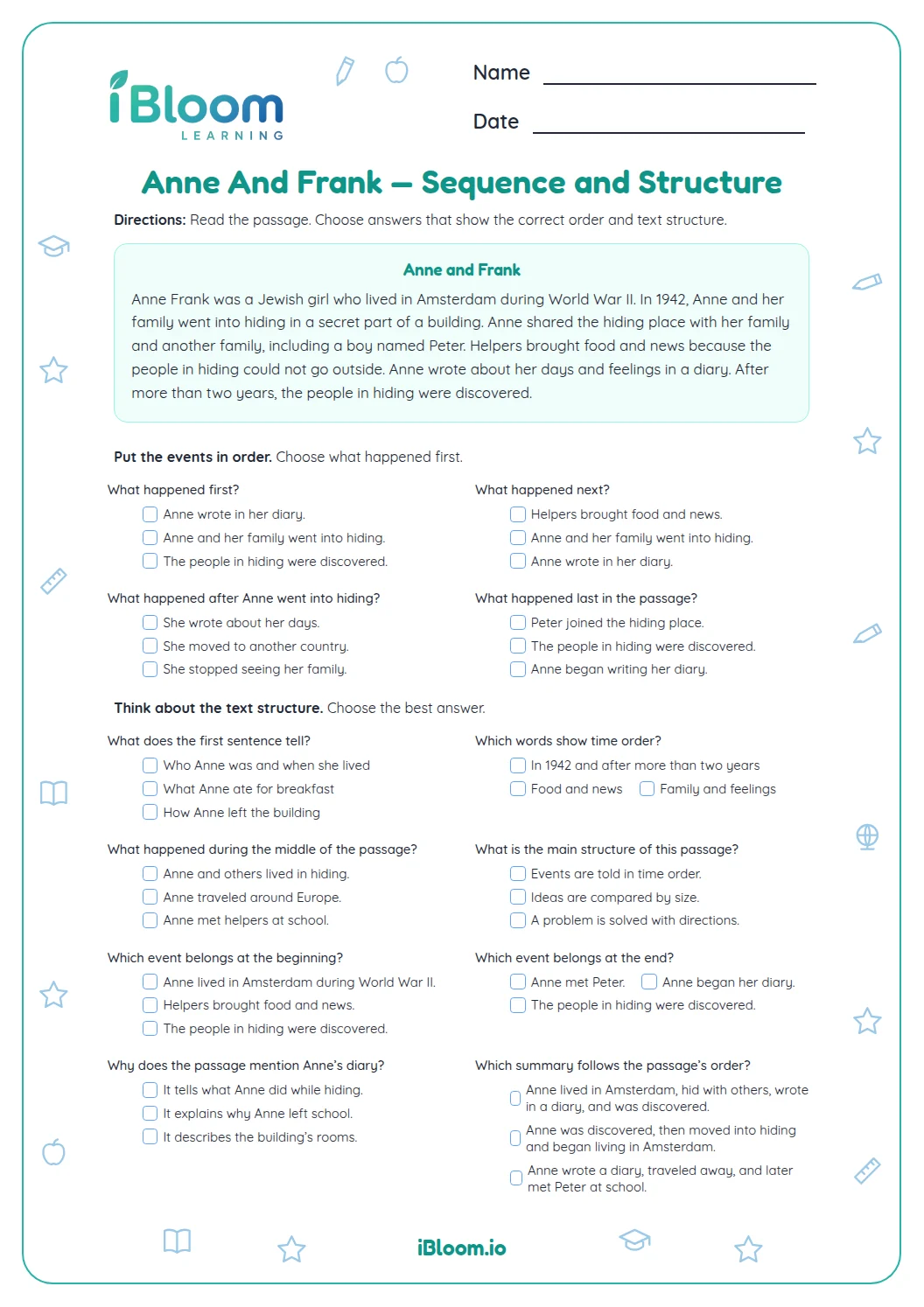
The original informational passage introduces Anne Frank, her family’s hiding place during World War II, and the diary in which Anne recorded events and thoughts. It also explains why readers can learn about her life and the time she lived through by reading her words.
How does the worksheet practice vocabulary?
Several multiple-choice questions ask children to use nearby details to understand words such as annex, recorded, and observations. Reread the sentence and connect the unfamiliar word to what the passage says. The final written questions ask students to explain what readers learn from the diary.
What does “annex” mean in this passage?
An annex is an extra part of a building. The passage says Anne and her family hid in a secret annex in Amsterdam, which helps explain that it was a space connected with a building. The worksheet asks students to use the passage context to select that meaning.
Is an answer key included?
Yes. A separate key lists the choices for the multiple-choice items and provides sample responses for the two written questions. The sample wording is a guide; another response is suitable when it answers the question and is supported by a detail from the passage.
What should students include in a written response?
A complete response should answer the question and include an accurate passage detail. For instance, a student might explain that readers learn about Anne’s thoughts because she wrote about daily events, worries, and hopes. Rereading the relevant lines helps keep the response grounded in the text.