

About this worksheet
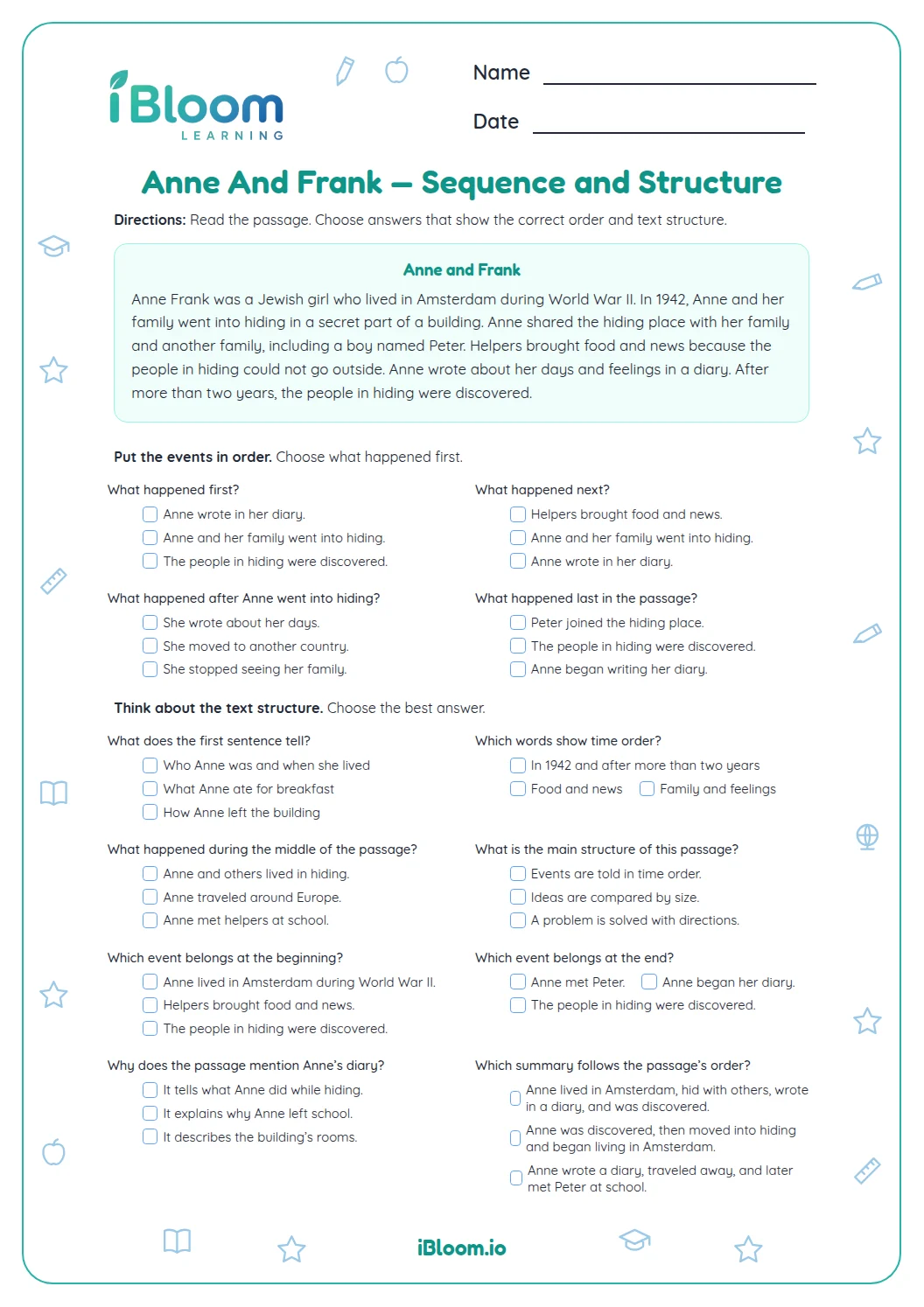
This Grade 3 reading worksheet pairs an original 159-word passage about Anne Frank with 14 questions. Students locate details about her family’s hiding place, daily life, diary, and hopes, then answer in their own words using the passage as evidence. A separate answer key includes sample responses for the open questions. The questions practice Common Core RL.3.1.
Aligned to RL.3.1
How does the passage support comprehension practice?
The passage gives students facts about Anne’s life in hiding and her diary. The first question group checks whether they can find stated details; the written-response group asks them to explain ideas using those same details.
How can a student support a written answer?
Reread the part of the passage that relates to the question. Include the answer and a detail that shows where it came from. For example, the passage says people below worked during the day, so the family stayed quiet to avoid being heard.
- 1Why did the family stay quiet during the day? → They did not want people below to hear them.
How should families use the answer key?
The key’s written responses are examples, not the only acceptable wording. Check that a student’s answer includes the passage’s important idea and does not add a detail the text never gives.
How to use this worksheet
- 1Read the passage once to understand who Anne was and where her family lived.
- 2Return to the text when a question asks for a detail.
- 3For a written response, answer the question in a complete sentence.
- 4Add a passage detail when the question asks why or how.
- 5Compare the main idea of an open response with the sample answer.
Common mistakes and quick fixes
The mistake
Answering from memory instead of the passage.
The fix
Reread the sentence that contains the needed detail.
The mistake
Giving a detail without answering the question.
The fix
Start with a direct answer, then add the supporting detail.
The mistake
Adding information that is not stated.
The fix
Use only what the passage says or what its details clearly support.
Common Core alignment
This worksheet practices the listed Common Core skill.
Answer questions about a story and point to details that support the answer.
On this sheet: Students answer questions and cite story details in Parts A and B.
Show the official wordingHide the official wording
Ask and answer questions to demonstrate understanding of a text, referring explicitly to the text as the basis for the answers.
What to practice next
Make more practice
Further reading
Questions parents and teachers ask
How many questions are on the Anne Frank worksheet?
The worksheet has 14 questions in two parts. Nine questions ask students to choose a passage detail, and five ask for a short written response. The answer key includes sample responses for open questions, so a student’s wording can differ while preserving the passage’s meaning.
What reading skill does this page practice?
Students answer questions about a text and use details from it as evidence. The first part checks literal understanding of Anne’s family, hiding place, diary, and hopes. The second part asks students to explain why details matter or what readers can infer from them.
Is the passage appropriate for Grade 3?
The passage is 159 words and uses a straightforward sequence of events with familiar sentence structures. It introduces Anne Frank through a few focused facts rather than asking students to interpret a long historical account. An adult can provide context if the class is new to this topic.
How should I check an open response?
Compare it with the passage and the sample in the key. The sample shows one accurate response, while other wording is fine if it answers the question and stays grounded in the text. Ask the student to point to the sentence that supports the response.
Does the worksheet include an answer key?
Yes. The printable includes a separate key with answers to the choice questions and sample responses for the written questions. For open responses, use the key to check the central idea rather than requiring students to copy the sample word for word.