

About this worksheet
This Grade 3 printable pairs an original Golly Grue story with 14 questions about inference and text evidence. Learners track how Golly moves from watching a game to joining it, then use story details to explain what he feels and learns. The answer key includes model responses for the written items. It practices CCSS RL.3.1 by asking learners to refer to details when answering and explaining.
Aligned to RL.3.1
How does Golly’s story give clues about his feelings?
The passage introduces Golly watching a game from behind a stump. Questions ask learners to infer why he stays back and find the detail that supports that idea.
For question 1, infer that Golly is nervous about joining; question 2 asks for the matching clue: he watches from behind the stump.
What happens when Golly joins the game?
Later questions follow Golly’s actions when the ball rolls away and when he helps gather pinecones. Learners connect those events to his apology and his wish to play again.
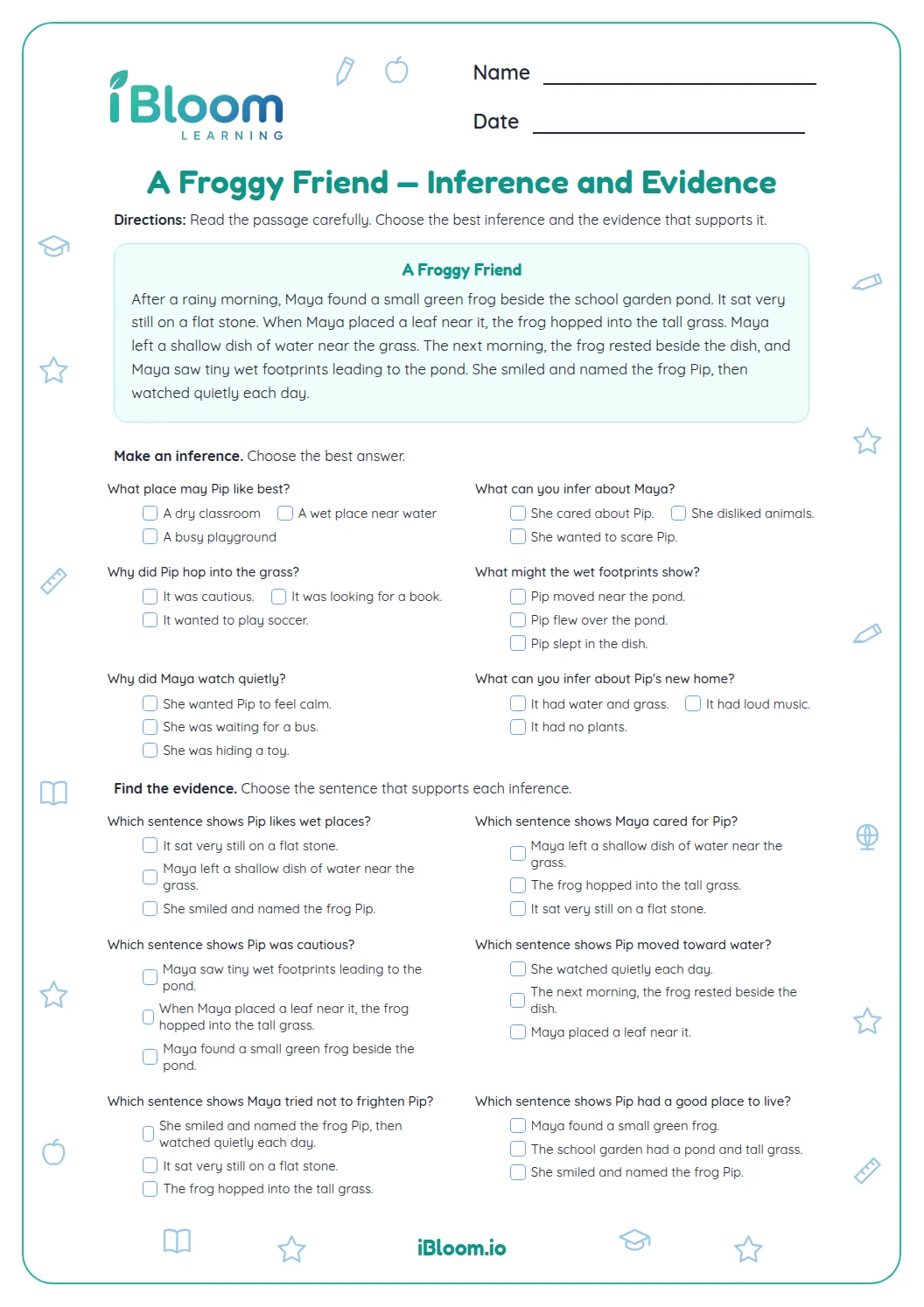
The written responses ask learners to cite a clue and explain how Nella helps Golly feel included.
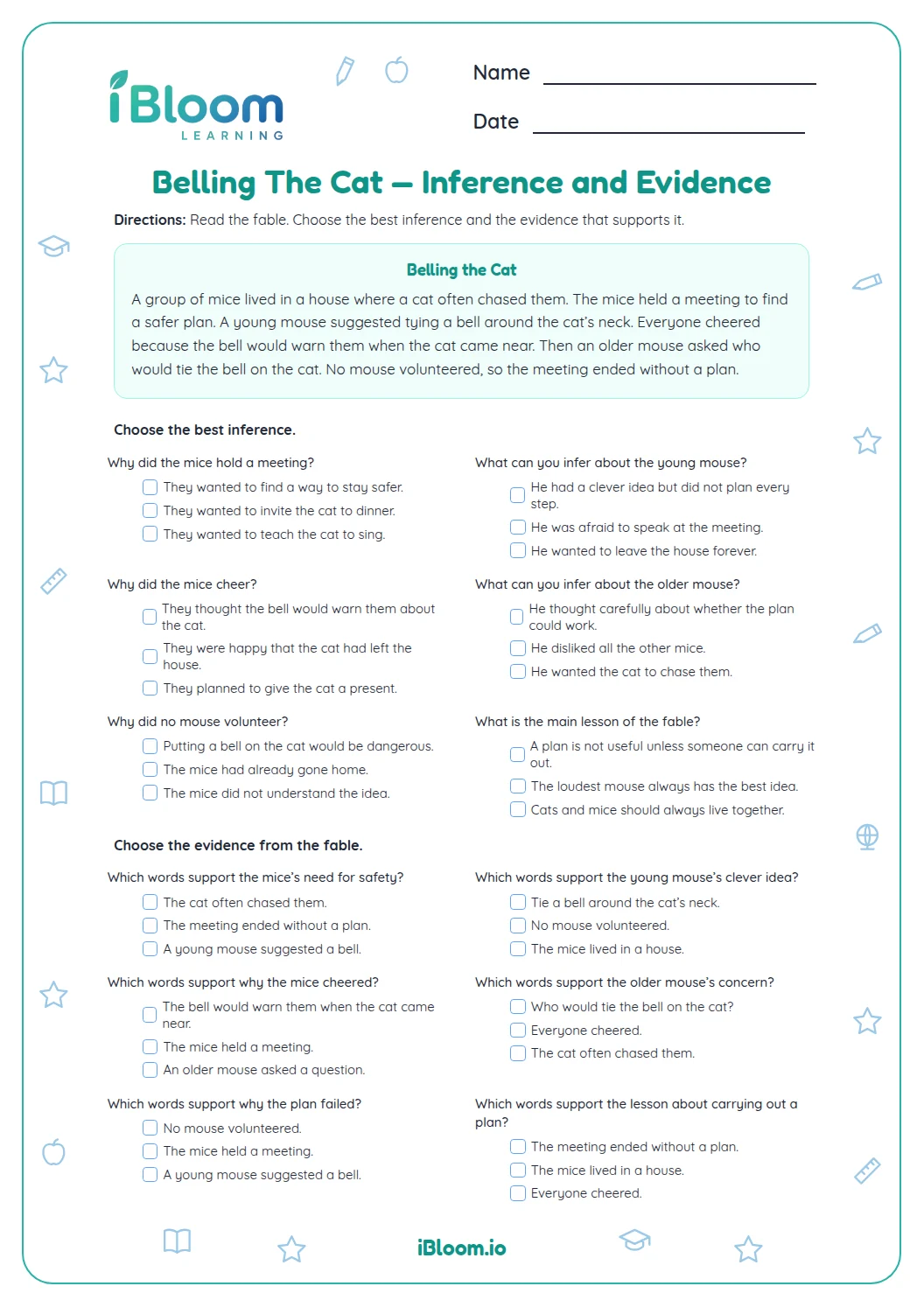
Which details support an inference about Golly?
The final items focus on a phrase, a lesson, and evidence of change. Ask the learner to point to the exact line behind an inference.
The answer key accepts clear wording that matches the passage; written examples are models, not the only possible phrasing.
How to use this worksheet
- 1Read the passage once to follow what happens.
- 2Reread the lines named in each question.
- 3Choose or write an inference that fits those clues.
- 4Point to a detail that supports the response.
- 5Check written responses against the story and key.
Common mistakes and quick fixes
The mistake
Treating a guess as an inference.
The fix
Connect the idea to one or more story details.
The mistake
Choosing a detail that does not prove the idea.
The fix
Ask how the detail supports the response.
The mistake
Retelling an event instead of explaining what it suggests.
The fix
State the idea, then name the clue behind it.
Common Core alignment
This practice connects the worksheet activities to the standard below.
Use story details to answer questions and explain inferences.
On this sheet: Use story details to answer questions and explain inferences.
Show the official wordingHide the official wording
Ask and answer questions to demonstrate understanding of a text, referring explicitly to the text as the basis for the answers.
What to practice next
Make more practice
Further reading
Questions parents and teachers ask
What story does the worksheet use?
The passage follows Golly Grue as he watches a game, accepts Nella’s invitation, and helps after the ball knocks over pinecones. Learners use what he says and does to infer how he feels. The story is printed on the worksheet, so no separate reading is needed.
How many questions are included?
There are 14 questions across four question parts, plus the passage. They ask about character feelings, actions, a phrase, evidence, and the story’s lesson. Several questions use multiple choice; three ask for a short written response. The passage and answer key are included in the printable.
What does the answer key provide?
They ask about character feelings, actions, a phrase, evidence, and the story’s lesson. Several questions use multiple choice; three ask for a short written response. The passage and key are included in the printable. Each question refers back to this story.
Can an adult read the story aloud?
Yes. An adult may read the passage or directions aloud, then invite the learner to choose and explain an answer. The evidence task still asks the learner to locate a detail in the printed story, even when listening support is used.
How can a learner tell an inference from a detail?
A detail is stated in the passage, such as Golly hiding behind the stump. An inference combines a detail with what the reader knows, such as concluding that Golly feels nervous about joining the game. The worksheet practices moving from clue to idea.