

About this worksheet
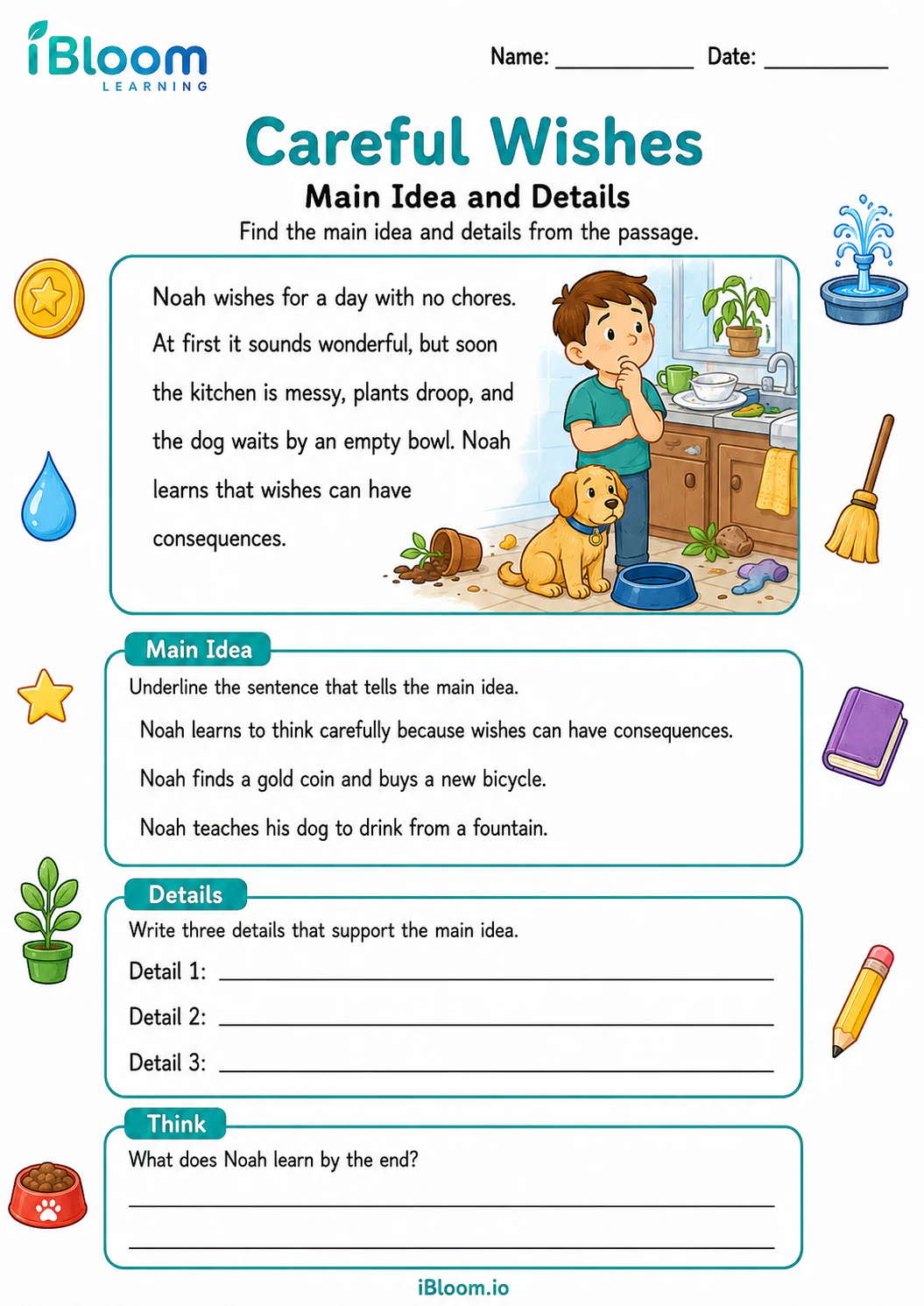
Read an original story about Liza’s first spelling bee, then identify its main idea and the details that support it. The 14 questions combine multiple choice, direct text details, and short written explanations. This worksheet supports CCSS RL.4.2 by asking readers to determine a theme or main idea and explain how details support it. A separate answer key includes sample responses.
Aligned to RL.4.2
How do details support a story’s main idea?
The main idea tells what the story is mostly about; details show how it develops. Liza’s practice with Mateo and her decision to review missed words support the idea that she learns through effort.
How should students work through the practice?
Begin with main idea, then use the later parts to practice the same skill through the task types printed on the sheet.
How can students check their work?
Reread each item, verify that the response fits the passage or sentence, and compare it with the separate answer key.
How to use this worksheet
- 1Read the direction at the start of each part.
- 2Work through the questions in order.
- 3Reread the passage or sentence when a detail matters.
- 4Check responses with the separate key and revise any answer that needs it.
Common mistakes and quick fixes
The mistake
Choosing an answer from one word alone.
The fix
Reread the complete sentence or story detail.
The mistake
Giving an idea without support.
The fix
Add a specific clue or detail from the text.
The mistake
Rushing past a direction.
The fix
Check each response against the task and passage.
This practice aligns with a Common Core English language arts standard.
State the big idea, then select details that show how it develops.
On this sheet: Use story details to identify and explain its main idea.
Show the official wordingHide the official wording
Determine a theme of a story, drama, or poem from details in the text; summarize the text.
What to practice next
Make more practice
Further reading
Questions parents and teachers ask
How do details support a story’s main idea?
The main idea tells what the story is mostly about; details show how it develops. Liza’s practice with Mateo and her decision to review missed words support the idea that she learns through effort. This page includes structured practice and a separate key.
What is included on the printable?
The sheet includes 14 questions in three parts and a separate answer key with 4 pages. The parts move from supported choices to independent responses, so students practice the target skill in more than one way. Review each direction before starting that part.
How should a student use the answer key?
Complete the questions first, then compare each response with the key. For an open response, the key is a model rather than the only acceptable wording; accept a clear equivalent idea supported by a relevant detail. Students can revise an answer after checking the passage again.
Can this worksheet be used at home?
Yes. A student can read the directions and complete the printable independently or with an adult. An adult may read instructions aloud, then invite the student to explain a choice or correction. That short discussion helps connect the answer to the skill being practiced.
How long does the worksheet take?
Plan for about 20 minutes, with extra time if the student writes full explanations. Work through one part at a time and revisit the passage or example when needed. The student can pause between parts and finish the remaining questions later.