

About this worksheet
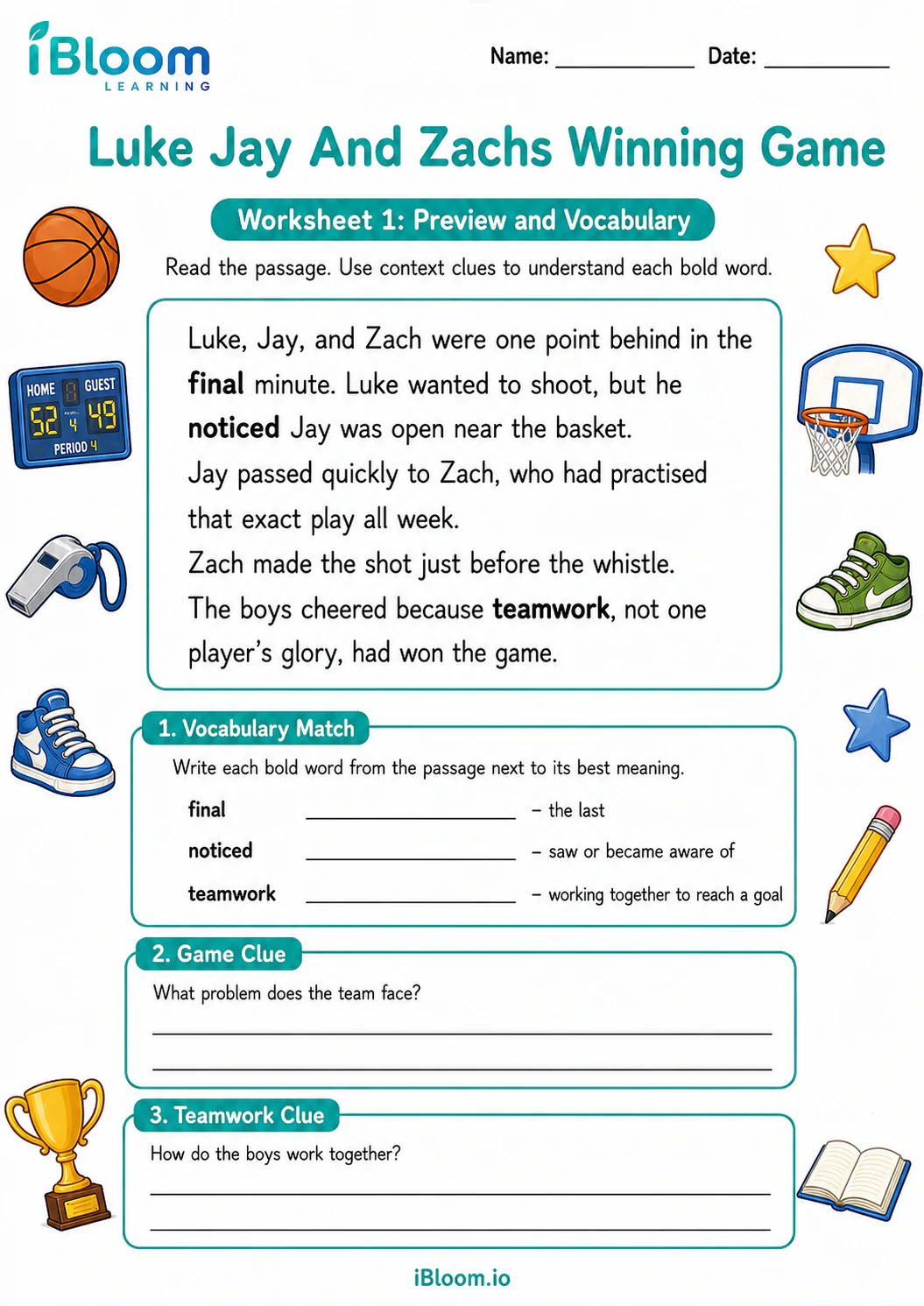
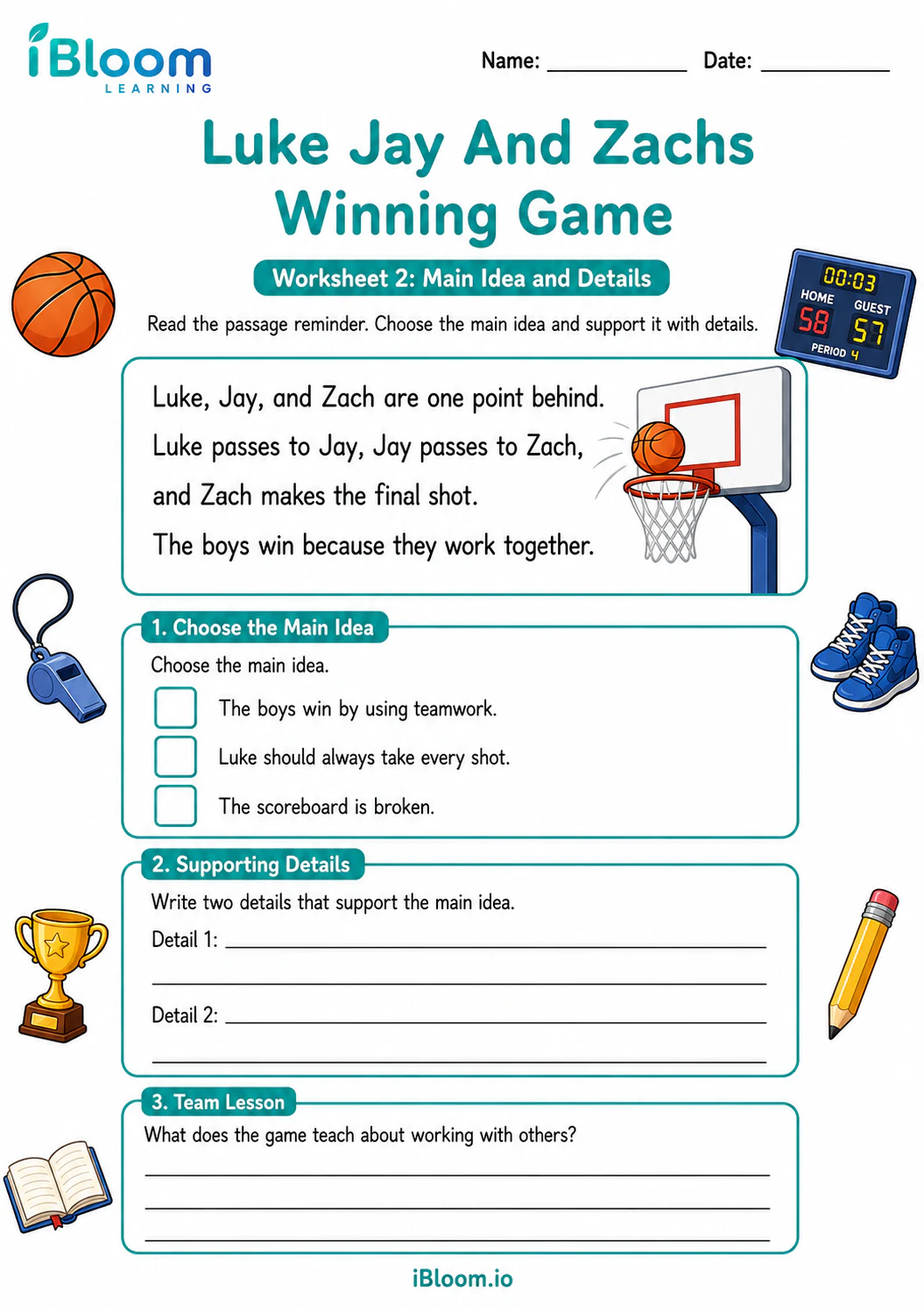
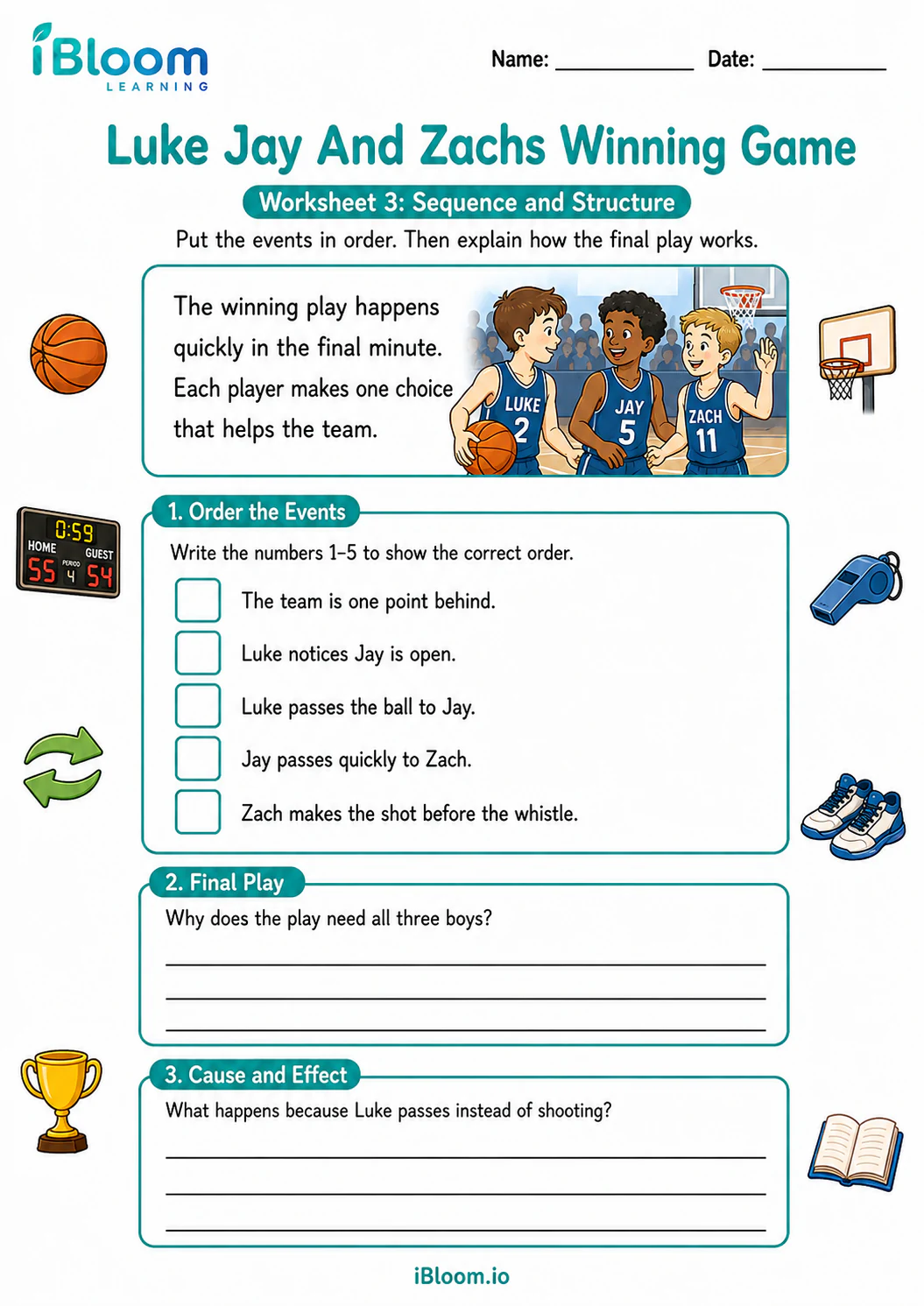
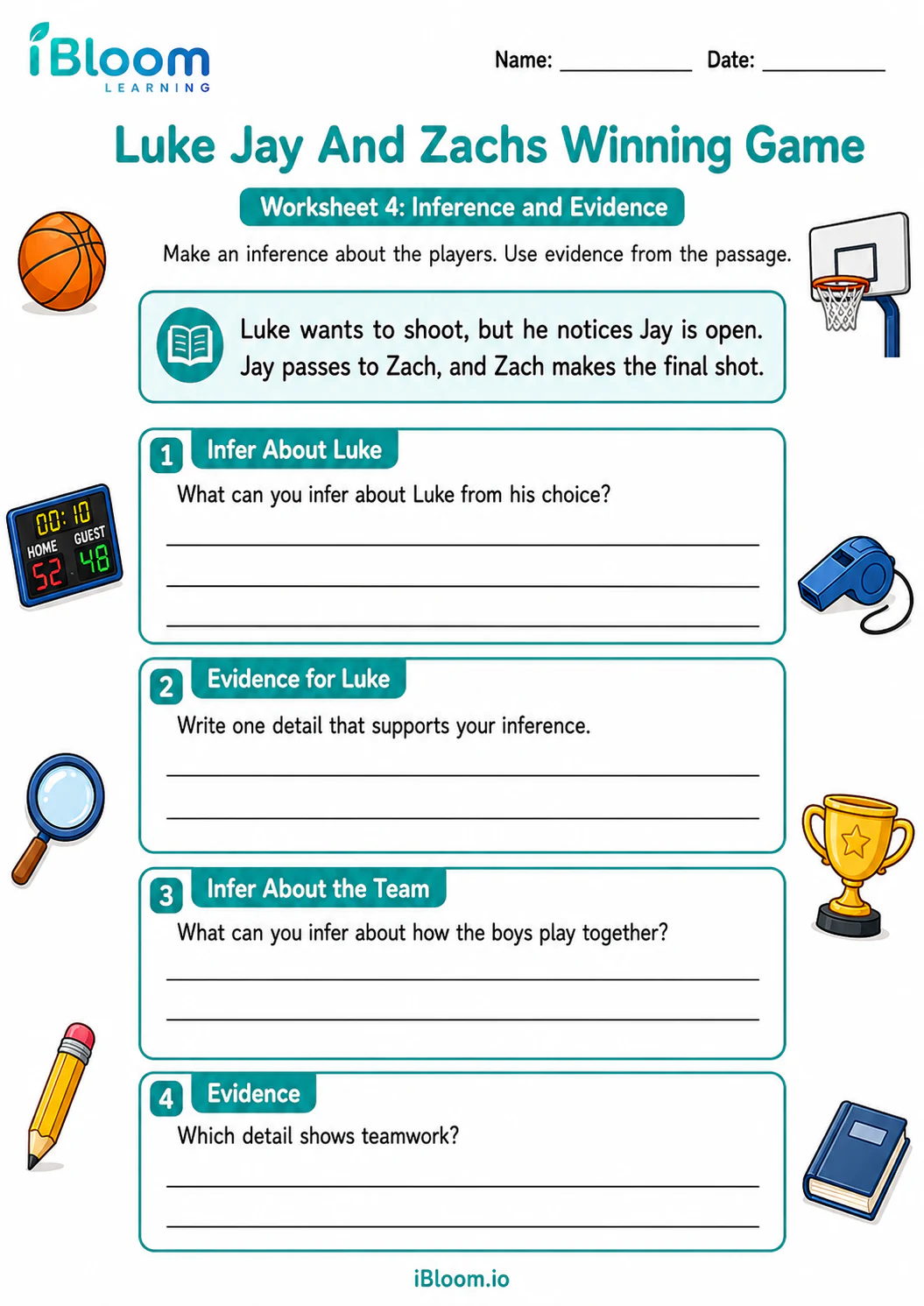
This Grade 4 printable uses an original story about Luke, Jay, and Zach winning a basketball game through teamwork. Students answer 14 questions across detail retrieval, short answers, and written responses that ask them to explain how the team won. The questions practice referring to explicit details and making inferences supported by the text, aligned with Common Core RL.4.1. A separate answer key includes model responses for open-ended items.
Aligned to RL.4.1
Which details help explain the relay?
The early questions check who passed the ball and what each player noticed. Returning to the passage helps students distinguish an exact detail from a guess.
For example, question 1 asks who made the final shot. The passage says Zach made it, so Zach is the answer.
- 1Question 1: Zach made the final shot.
- 2Look back at the passage and match the name to the action.
How can a reader support an inference?
An inference combines a clue in the text with what the reader knows. Luke passed when he saw Jay open, which supports the inference that Luke looked for a teammate in a better position.
Use a story detail in the response so the reader can see how the idea was reached.
What makes a written response complete?
A complete response answers the question directly and adds a relevant detail. The final item asks how teamwork helped; students can name Luke’s pass to Jay and Jay’s pass to Zach.
The key gives sample wording, but a different response is also correct when it answers the prompt and fits the passage.
How to use this worksheet
- 1Read the passage once to understand what happened.
- 2Return to the paragraph named by a question and find a matching clue.
- 3For short answers, state the person, action, or idea asked for.
- 4For written responses, answer first and then add a story detail.
- 5Check the key for meaning; open responses can use different wording.
Common mistakes and quick fixes
The mistake
Using a guess instead of a story clue.
The fix
Point to the sentence that names the person or action before answering.
The mistake
Retelling the whole passage instead of answering one question.
The fix
Start with a direct answer, then add only the detail that supports it.
The mistake
Giving an opinion without evidence.
The fix
Include a specific clue, such as the handoff mark or Zach’s signal.
Common Core alignment
This page asks students to answer questions about a literary text and support ideas with details.
Use details and examples from a story to explain what it says and what can be inferred.
On this sheet: Students locate story facts, explain motives and support written answers with evidence.
Show the official wordingHide the official wording
Refer to details and examples in a text when explaining what the text says explicitly and when drawing inferences from the text.
What to practice next
Make more practice
Further reading
Questions parents and teachers ask
How many questions are on this worksheet?
There are 14 questions after the passage. They include multiple-choice detail checks, short answers, and written responses that ask students to explain an idea with evidence from the story. The separate key makes it easy to review each response. The answer key also models how to point back to a sentence instead of relying on memory alone.
Does the worksheet include an answer key?
Yes. A separate key lists the answer for every question and provides sample responses for items with more than one reasonable wording. Students can compare whether their response answers the prompt and uses a fitting detail from the passage.
What reading skill does this page practice?
Students refer to details in a literary passage to explain what happened and draw supported inferences. For example, they connect Luke passing when he saw Jay open with the idea that Luke looked for a teammate in a better position.
Can students use different wording in written answers?
Yes. The key’s written answers are models, not the only acceptable sentences. A response is sound when it answers the question accurately and uses a detail that matches the passage, such as Luke passing to Jay or Jay noticing Zach moving toward the hoop.
How should a student answer the final question?
The final question asks how teamwork helped the team win and requests two details. A student might mention that Luke passed to Jay when he saw him open and that Jay passed to Zach, who made the final shot.